The global AI in spine surgery market size was estimated at USD 1.85 billion in 2025 and is predicted to increase from USD 2.25 billion in 2026 to approximately USD 13.29 billion by 2035, expanding at a CAGR of 21.8% from 2026 to 2035.The growing geriatric population and healthcare digitalization are increasing the use of AI in spine surgery. Growing demand for minimally invasive surgeries, healthcare investments, and new product launches are also enhancing the market growth.
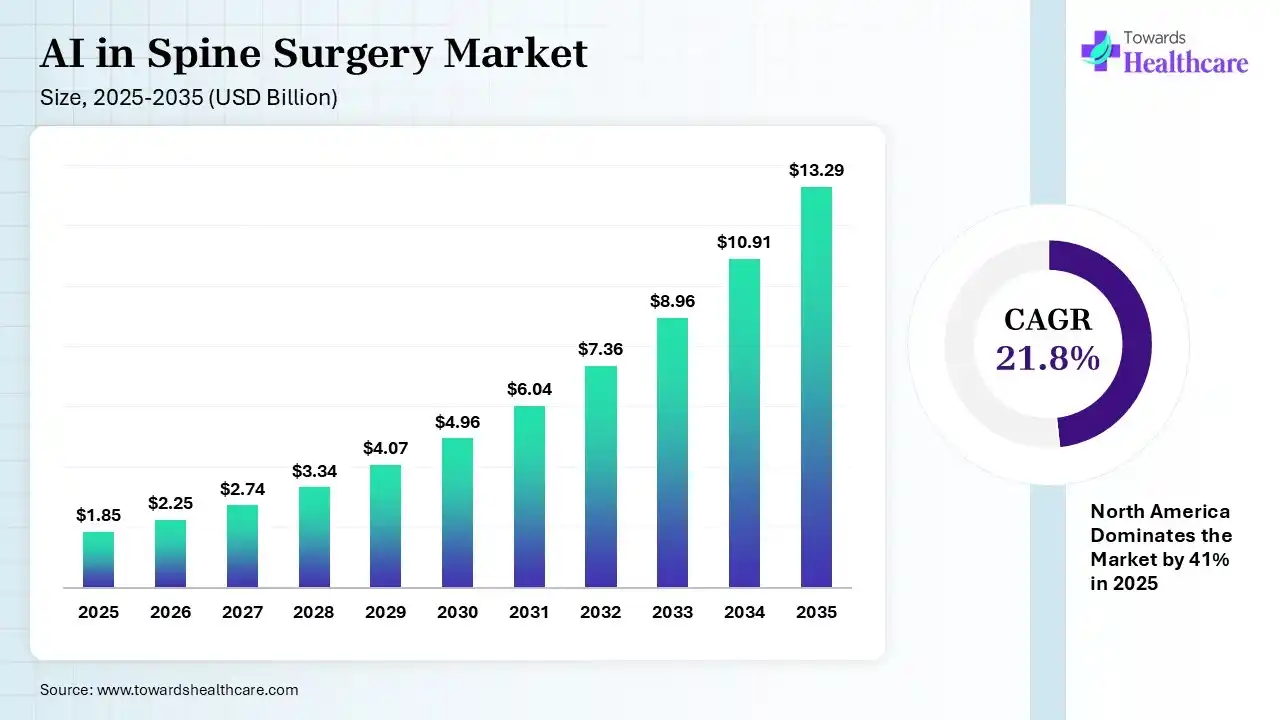
The AI in spine surgery market is driven by growing demand for precision, rapid technological integration, and the rising burden of spinal disorders. The AI in spine surgery refers to the use of artificial intelligence technologies to assist, automate, and enhance spine surgeries. It helps in preoperative planning, intraoperative assistance, postoperative monitoring, diagnostics, outcome prediction, screening, and automated documentation.
AI in spine surgery refers to the use of artificial intelligence technologies to assist surgeons in preoperative planning, real-time surgical navigation, implant positioning, risk prediction, and postoperative care, improving the precision, safety, and efficiency of spinal procedures.
The AI in spine surgery market is expanding rapidly due to the increasing demand for minimally invasive procedures, rising prevalence of spinal disorders, and growing adoption of robotic-assisted surgical systems. Advanced machine learning algorithms, computer vision, and 3D imaging are enabling highly accurate surgical planning and real-time decision support. Emerging trends include AI-powered predictive analytics, personalized treatment planning, digital twin technology, and cloud-based surgical data platforms. Future opportunities lie in autonomous surgical assistance, integration with augmented reality and robotics, and continuous AI learning from clinical data. These innovations are enhancing patient outcomes, reducing complications, shortening recovery times, and driving the next generation of intelligent spine care.
Growing Applications
The use of AI in hospitals, specialty clinics, and ambulatory surgical centres is increasing to enhance spine surgery outcomes. Its expanding application in the optimization of surgical models, interpretation of outputs, safe evidence-based decisions, and improved consistency in care are promoting its adoption.
Expanding Technological Innovations
The growing technological advancements are promoting the adoption of AI in the development of new robotic systems, as well as AR/VR systems to offer improved accuracy, real-time intraoperative support, surgical strategies, rehabilitation planning, risk assessments, etc.
Blooming Software
To offer predictive outcomes, automated documentation, streamlined reporting, seamless integration with electronic health records, and reasoning transparency, new software is being developed by the companies.
| Table | Scope |
| Market Size in 2026 | USD 2.25 Billion |
| Projected Market Size in 2035 | USD 13.29 Billion |
| CAGR (2026 - 2035) | 21.8% |
| Leading Region | North America by 41% |
| Historical Data | 2020 - 2023 |
| Base Year | 2025 |
| Forecast Period | 2026 - 2035 |
| Measurable Values | USD Millions/Units/Volume |
| Market Segmentation | By Component, By Technology, By Application, By Surgery Type, By End User, By Region |
| Top Key Players | Medtronic, Stryker, Zimmer Biomet, Johnson & Johnson (DePuy Synthes), Globus Medical, NuVasive, Alphatec (ATEC), Augmedics, xvision Spine System, Brainlab |
The Software Segment Dominated the Market With 46% in 2025
| Segment | Share 2025 (%) |
| Software | 46% |
| Hardware | 38% |
| Services | 16% |
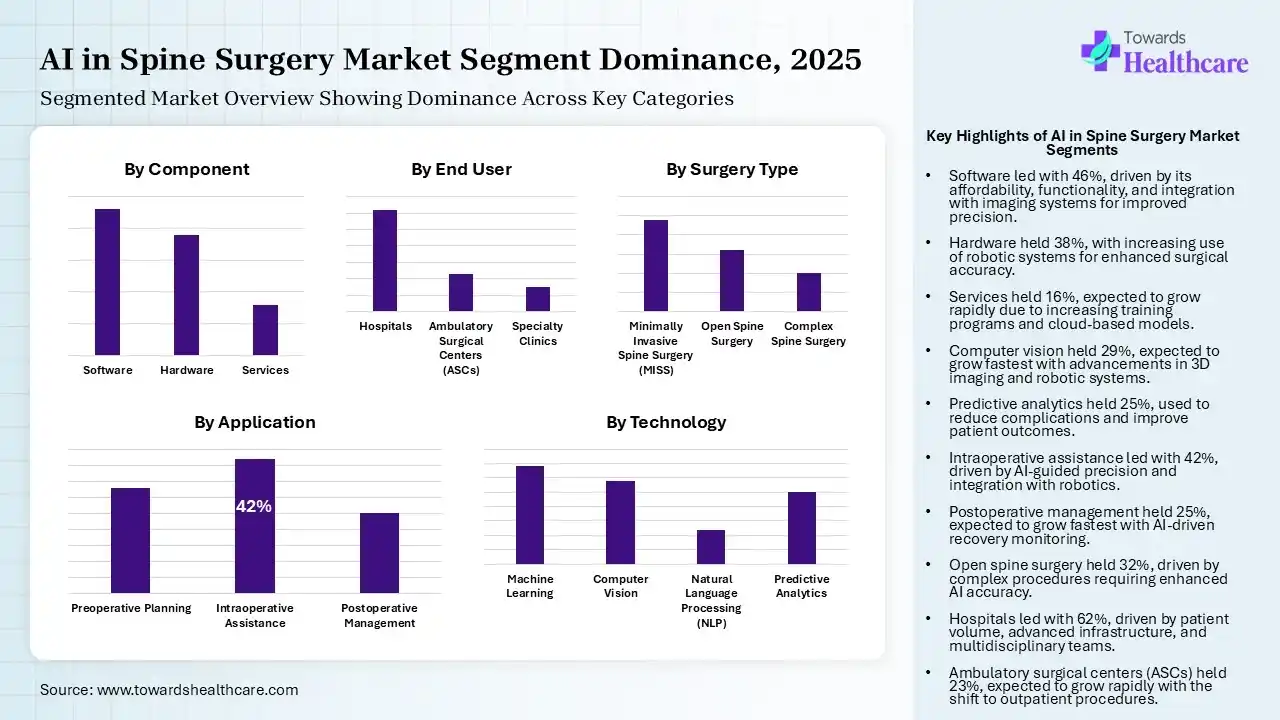
The software segment held the largest revenue share of 46% of the AI in spine surgery market in 2025, driven by its high functionality, affordability, and faster updates. This increased their adoption across the hospitals to reduce surgical errors and enhance precision. Their seamless integration with other imaging systems also increased their demand.
The hardware segment held 38% of the market share in 2025, due to a growing shift towards robotic systems to enhance their surgical accuracy and workflow efficiency. Growing healthcare investments and demand for minimally invasive surgeries are also increasing their use. The technological advancements are also driving their innovations.
The services segment held 16% of AI in spine surgery market share in 2025 and is expected to grow at the fastest CAGR during the upcoming years, due to growing training programs, which are increasing the adoption of the AI platforms. Expanding cloud-based models are also enhancing the accessibility and scalability of the services. Recurring revenue models are also attracting the providers.
The Machine Learning Segment Dominated the Market With 34% in 2025
| Segment | Share 2025 (%) |
| Machine Learning | 34% |
| Computer Vision | 29% |
| Natural Language Processing (NLP) | 12% |
| Predictive Analytics | 25% |
The machine learning segment contributed the biggest revenue share of 34% of the AI in spine surgery market in 2025, due to its enhanced predictive accuracy, improving surgical outcomes, and reducing patient risks. Improved handling of complex medical data and integration with other planning tools also increased their use. Their image analysis and predictive analytics capabilities also increased their adoption rates.
The computer vision segment held the second-largest share of 29% of the market in 2025 and is expected to grow at the fastest CAGR during the predicted time, due to its real-time imaging and navigation driven by vision-based AI. Growing use in robotic systems is also increasing their demand. Increasing advancements in 3D imaging are also increasing their use.
The predictive analytics segment held 25% of the AI in spine surgery market share in 2025, driven by its growing use across hospitals. They are being used to reduce complications and readmissions. Additionally, the growing shift towards value-based care is also increasing their adoption rates.
The natural language processing (NLP) segment held 12% of the market share in 2025, due to its automated clinical documentation and data extraction. It also improves the surgical outcomes by assisting in the surgical planning. Growing integration with HER are also increasing their use to enhance workflow efficiency.
The Intraoperative Assistance Segment Dominated the Market With 42% in 2025
| Segment | Share 2025 (%) |
| Preoperative Planning | 33% |
| Intraoperative Assistance | 42% |
| Postoperative Management | 25% |
The intraoperative assistance segment accounted for the highest revenue share of 42% of the AI in spine surgery market in 2025, due to enhanced surgical precision with the use of real-time AI guidance. Integration with robotics also enhanced efficiency and safety, which increased their use. Additionally, growth in robotic surgeries has also increased their demand.
The preoperative planning segment held 33% of the market share in 2025, due to the growing use of AI for spine surgery mapping and simulation. Reduction in the intraoperative uncertainty and complications is also increasing their use. Additionally, they are also being preferred for improving patient outcomes.
The postoperative management segment held 25% of AI in spine surgery market share in 2025 and is expected to grow at the fastest CAGR during the upcoming years, due to the growing use of AI for monitoring the surgery recovery. It also helps in predicting patient outcomes and offers remote patient care. Furthermore, expanding value-based healthcare is also increasing its use.
The Minimally Invasive Spine Surgery (MISS) Segment Dominated the Market With 48% in 2025
| Segment | Share 2025 (%) |
| Minimally Invasive Spine Surgery (MISS) | 48% |
| Open Spine Surgery | 32% |
| Complex Spine Surgery | 20% |
The minimally invasive spine surgery (MISS) segment held a majority revenue share of 48% of the AI in spine surgery market in 2025 and is expected to grow with the fastest CAGR during the predicted time, driven by growth in the demand for minimally invasive procedures. Their faster recovery period and affordable solutions also increased their use. Additionally, enhanced precision also increased the use of AI in these surgeries.
The open spine surgery segment held the second-largest share of 32% in 2025, due to its complex procedures, which increased the demand for AI. Its enhanced accuracy and better visualization are also increasing its use in severe cases. Seamless integration with other healthcare tools is also driving their demand.
The complex spine surgery segment held 20% of the market share in 2025, driven by the growing use of AI in high-risk procedures such as deformity correction. The growing geriatric population and demand for improved surgical outcomes are also increasing their use. Improvements in imaging and planning tools are also increasing their adoption rates.
The Hospitals Segment Dominated the Market With 62%in 2025
| Segment | Share 2025 (%) |
| Hospitals | 62% |
| Ambulatory Surgical Centers (ASCs) | 23% |
| Specialty Clinics | 15% |
The hospitals segment held the dominating share of 62% of the AI in spine surgery market in 2025, due to growth in the patient volume, which increased the use of AI. The presence of enhanced surgical infrastructure also increased the patient reliance on them. The availability of multidisciplinary teams has also increased their use.
The ambulatory surgical centers (ASCs) segment held the second-largest share of 23% of the market in 2025 and is expected to grow at the fastest CAGR during the upcoming years, due to the growing shift towards outpatient procedures. Their affordable services are also increasing their use. Furthermore, the presence of advanced technologies is also increasing the use of AI to improve operational efficiency and patient throughput.
The specialty clinics segment held 15% of the AI in spine surgery market share in 2025, driven by their focus on niche spine treatments. The personalized patient care and minimally invasive procedures are also increasing their use. Additionally, integration with telemedicine platforms is also increasing their demand.
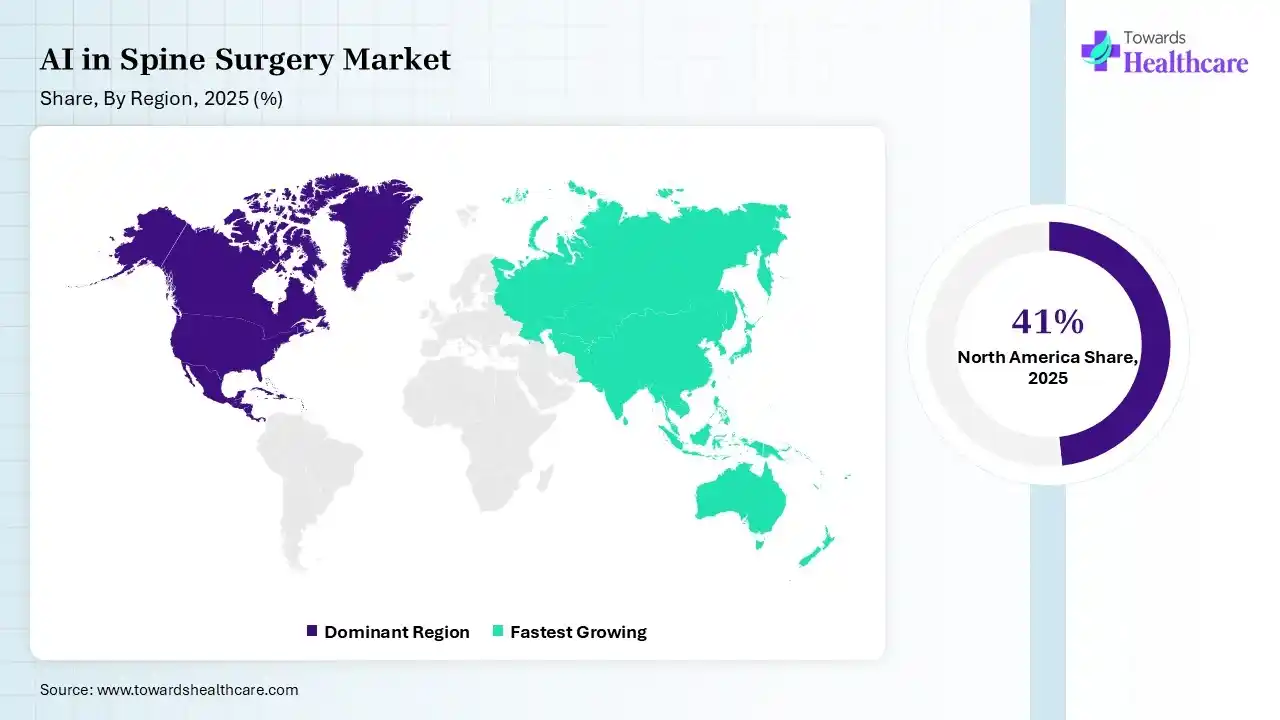
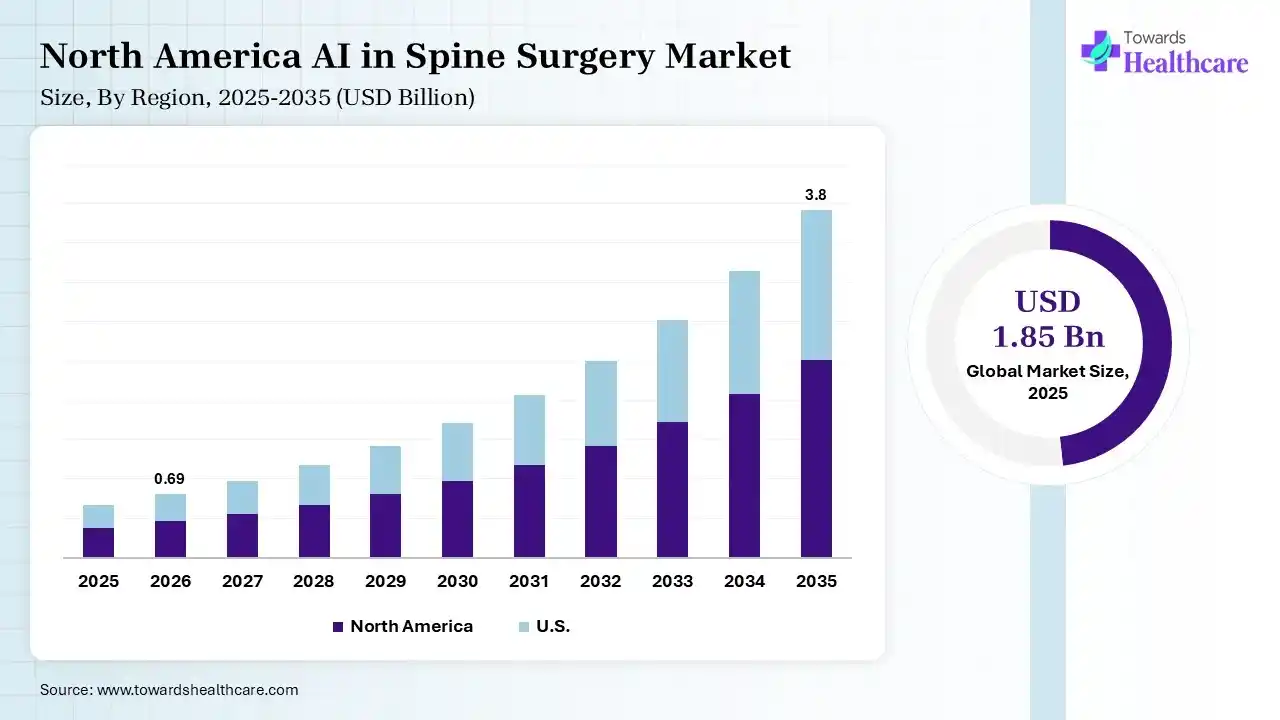
North America dominated the AI in spine surgery market with 41% in 2025, due to the presence of a strong healthcare infrastructure and early technology adoption drive growth. The presence of favourable reimbursement policies and early technology adoption also increased the use of AI in spine surgeries. High investment in AI and robotics has also increased their innovations, which contributed to the market growth.
The presence of advanced healthcare and robust industries are driving the adoption of various AI solutions, enhancing the spine surgical outcomes. The growing healthcare expenditure and geriatric populations are also increasing their use. Additionally, increasing innovations are also promoting their early adoption.
U.S. Leads the Ai in Spine Surgery Market Through Advanced Surgical Innovation
The U.S. AI in spine surgery market dominates due to its advanced healthcare infrastructure, widespread adoption of robotic-assisted surgery, and strong integration of AI-powered imaging and navigation systems. High healthcare spending, the growing prevalence of spinal disorders, and increasing investments in digital health technologies further accelerate market growth. The presence of leading medical device manufacturers, AI developers, and specialized spine centers also strengthens the country’s leadership in innovation and clinical adoption.
Canada Emerges as a Fast-Growing Hub for AI in Spine Surgery
The Canada AI in spine surgery market is growing significantly due to increasing investments in digital healthcare, expanding adoption of robotic-assisted surgical systems, and rising demand for minimally invasive spine procedures. Strong collaboration between healthcare institutions, research organizations, and AI technology developers is accelerating innovation. Government support for healthcare modernization, improved access to advanced imaging technologies, and an aging population with spinal disorders are further driving market growth.
Asia Pacific held 22% share of the AI in spine surgery market in 2025 and is expected to grow at the fastest CAGR during the forecast period, due to rapid healthcare modernization and rising investments. The growing patient population and demand for minimally invasive surgeries are also increasing their use. Expanding medical tourism is also increasing the use of AI in spine surgeries, enhancing the market growth.
China Market Trends
The growing spinal disorders in China are increasing the demand for AI in spine surgery, where the expanding healthcare infrastructure is also increasing their adoption rates. Growing government support and rising demand for minimally invasive or robotic surgeries are also increasing their use. Technological advancements are also promoting innovations.
India Accelerates AI Adoption in Advanced Spine Care
The India AI in spine surgery market is witnessing significant growth due to the increasing availability of AI-enabled surgical planning software and navigation platforms in tertiary care hospitals. Rising demand for precision-based surgeries, expansion of private healthcare networks, and greater participation of global medical technology companies are boosting adoption. Continuous surgeon training on AI-assisted procedures, increasing clinical research activities, and the integration of intelligent analytics into surgical workflows are further strengthening the country’s position in the evolving market.
| Companies | Headquarters | AI in Spine Surgery |
| Medtronic | Dublin, Ireland | AiBLE Ecosystem |
| Stryker | Kalamazoo, U.S. | Mako SmartRobotics |
| Zimmer Biomet | Warsaw, U.S. | ROSA One Spine |
| Johnson & Johnson (DePuy Synthes) | New Brunswick, U.S. | VELYS Spine |
| Globus Medical | Audubon, U.S. | ExcelsiusGPS |
| NuVasive | San Diego, U.S. | Pulse platform |
| Alphatec (ATEC) | Carlsbad, U.S. | EOS insight |
| Augmedics | Chicago, U.S. | xvision Spine System |
| Proprio | Seattle, U.S. | Paradigm |
| Brainlab | Munich, Germany | Elements Spine Planning |
Strengths
Weaknesses
Opportunities
Threats
By Component
By Technology
By Application
By Surgery Type
By End User
By Region






Principal Consultant
Payal Rabde is a Healthcare Market Research Analyst at Towards Healthcare Research & Consulting with 4+ years of experience in pharmaceuticals, biotechnology, medical devices, and life sciences.
Learn more about Payal Rabde

Reviewed By
Aditi Shivarkar is a seasoned professional with over 14 years of experience in healthcare market research. As a content reviewer, Aditi ensures the quality and accuracy of all market insights and data presented by the research team.
Learn more about Aditi Shivarkar