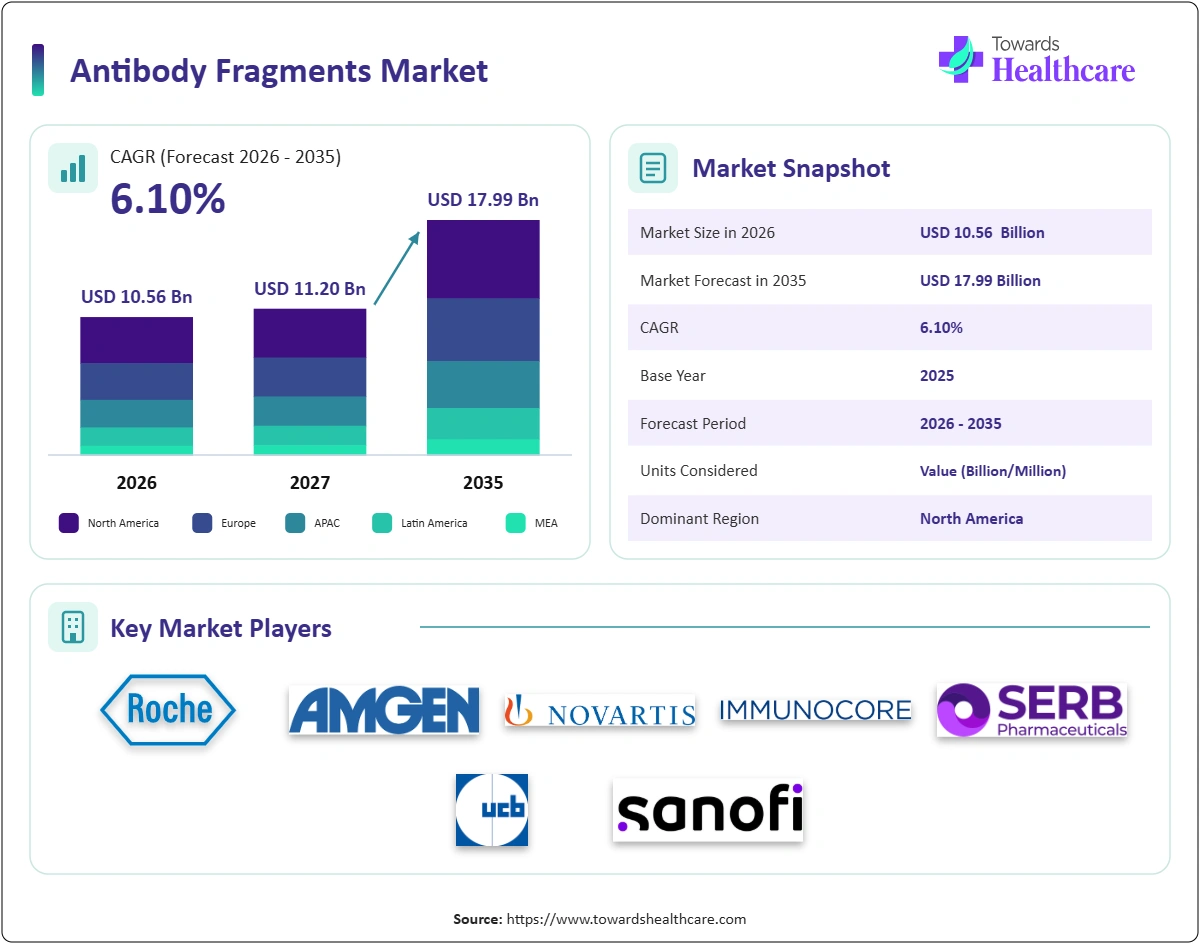
The market is projected to grow from USD 9.95 billion in 2025 to USD 17.99 billion by 2035 because fragment-based drugs have a significant presence in immunology, ophthalmology, and toxicology, and newer T-cell engagers and nanobodies are contributing to fast growth in revenue in oncology and rare diseases. Wider use of bispecific T-cell engagers, new nanobody approvals, half-life extension technologies, and growing research and diagnostic use support steady growth, lifting the market to USD 13.38 billion by 2030 and sustaining a CAGR of 6.10% from 2026 to 2035. Biosimilar erosion of older Fab drugs has a negative effect on the pace of market growth.
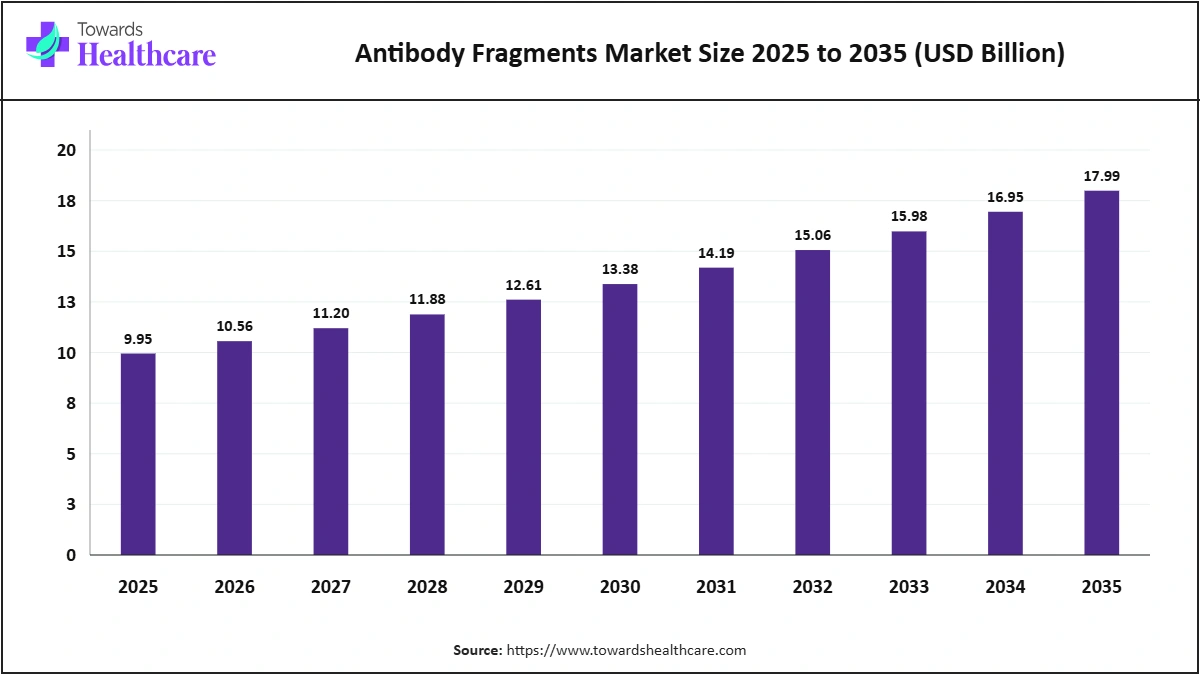
Analyst View: We built the estimate from the sales of marketed fragment-based drugs by type, specificity, application, and region, plus research and diagnostic fragment reagents and contract production. Drug sales highlight patient numbers, pricing, label expansions, and biosimilar competition, while reagent sales reflect research and diagnostic activity. The growth rate is a testament to strong adoption of T-cell engagers and new fragment formats, which supports a slightly higher rate than comparable estimates. The rate of market expansion is throttled by biosimilar competition for ranibizumab and certolizumab.
Driver: Fragments can penetrate tissues very well, and T-cell engagers are growing in oncology. Nanobodies enable new drugs, and established Fab drugs provide stable revenue. Antidotes and antivenoms continue to be important.
Restraint: Short half-lives need frequent dosing, and biosimilars erode older products. Cytokine release limits certain engagers. Manufacturing of new formats involves significant intricacies, and pricing pressure is growing.
Opportunity: Solid tumor engagers can expand application base, and Asian markets offer significant growth potential. Fragments have the ability to cross barriers such as the blood-brain barrier. Diagnostic imaging uses are growing, and contract manufacturing is expanding.
Note: 2025 is the base year; 2035 values are forecasts.
Sources: Expert interviews, secondary sources, Towards Healthcare database and Towards Healthcare analysts.
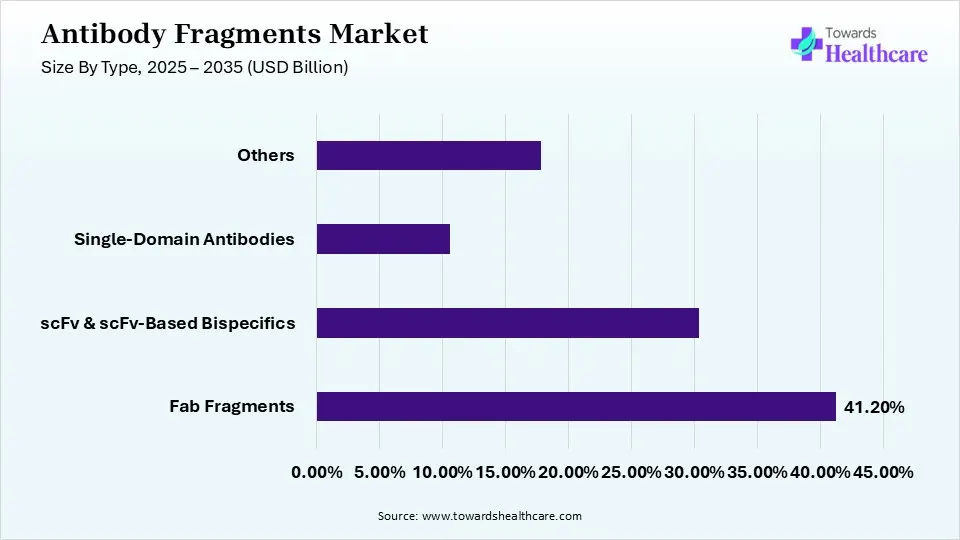
Fab fragments held 41.20% (USD 4.10 billion) of revenue in 2025 and are projected to reach USD 7.01 billion by 2035, expanding at a CAGR of 5.50% during the forecast period. Fab fragments contain one antigen-binding arm of an antibody. Some of the marketed Fab drugs include certolizumab pegol for Crohn's disease, rheumatoid arthritis and psoriasis, ranibizumab for wet age-related macular degeneration, idarucizumab for dabigatran reversal, and polyclonal Fab antivenoms and digoxin antidotes. This segment accounted for a major revenue share because these products are well established, but ranibizumab faces biosimilar competition.
Single-chain variable fragments join the variable regions of the heavy and light chains into one small protein. This category includes brolucizumab for eye disease and bispecific T-cell engagers such as blinatumomab for acute lymphoblastic leukaemia and tarlatamab for small cell lung cancer, which link T cells to cancer cells. In November 2025, tarlatamab received full FDA approval, and T-cell engagers are driving strong growth.
Single-domain antibodies, or nanobodies, are the smallest antigen-binding fragments, derived from camelid heavy-chain antibodies. Caplacizumab is used to treat acquired thrombotic thrombocytopenic purpura, and ozoralizumab, which is marketed in Japan, is used to treat rheumatoid arthritis; many multispecific nanobodies are in development. This is the fastest-growing type owing to the fact that nanobodies are stable, easy to produce, and can be combined into multispecific drugs.
Others include F(ab')2 fragments, TCR-scFv fusions such as tebentafusp for uveal melanoma, diabodies, and research and diagnostic fragments.
Note: 2025 is the base year; 2035 values are forecasts.
Sources: Expert interviews, secondary sources, Towards Healthcare database and Towards Healthcare analysts.
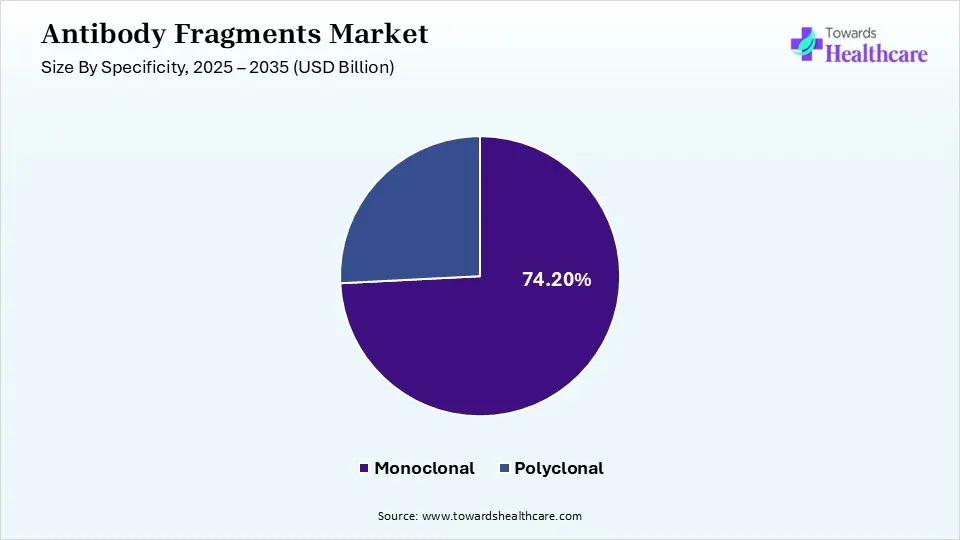
The monoclonal segment held the largest share of 74.20% (USD 7.38 billion) in 2025 and is projected to reach USD 13.54 billion by the end of the forecast period, expanding at a CAGR of 6.25% from 2026 to 2035. Monoclonal fragments are derived from a single antibody clone and include almost all modern fragment therapeutics and research fragments. This segment holds a leading position because it offers precise targeting and consistent manufacturing, and new pipeline products are all monoclonal.
Polyclonal fragments are derived from immunized animals and include ovine and equine Fab antivenoms for snakebite and digoxin immune Fab. This segment continues to be significant for toxicology and antidote uses but exhibits a relatively slow pace of growth
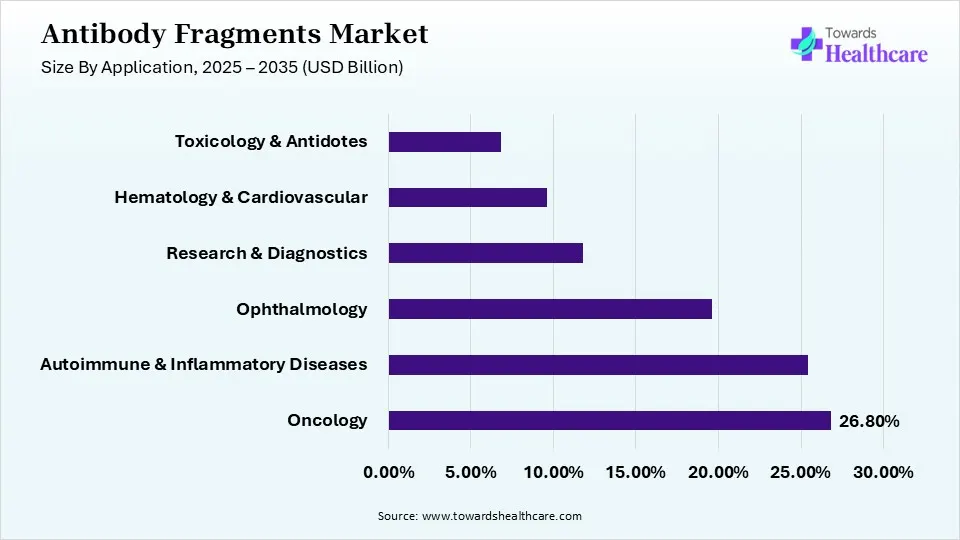
Note: 2025 is the base year; 2035 values are forecasts.
Sources: Expert interviews, secondary sources, Towards Healthcare database and Towards Healthcare analysts.
The oncology segment accounted for 26.80% (USD 2.67 billion) of revenue in 2025 and is projected to reach USD 5.70 billion by 2035, expanding at a CAGR of 7.88% during the forecast period. This segment is growing at the highest rate in the applications category, driven by T-cell engagers such as blinatumomab and tarlatamab, TCR-fusion tebentafusp, and many fragment-based immunotherapies and imaging agents that are in the development stage.
Autoimmune and inflammatory diseases hold a significant share in the application category, owing to certolizumab pegol for Crohn's disease, rheumatoid arthritis, psoriatic arthritis, ankylosing spondylitis, and psoriasis.
Ophthalmology uses small fragments such as ranibizumab and brolucizumab, which penetrate the retina well when injected into the eye, and are used to treat macular degeneration and diabetic eye disease. Biosimilars and newer long-acting drugs are putting significant pressure on this segment.
Research and diagnostics include Fab, scFv, and nanobody reagents for imaging, immunoassays, flow cytometry, and structural biology.
Hematology and cardiovascular include caplacizumab for acquired TTP, idarucizumab for anticoagulant reversal, and digoxin immune Fab.
Toxicology and antidotes include crotalidae Fab antivenoms for snakebite and other antitoxins.
Analyst View: Segment values were allocated by matching drug and reagent sales to fragment types, specificities, and applications, using company product revenues and research market data. Fab fragments, monoclonal formats, and oncology and immunology hold a leading position. We expect single-domain antibodies and oncology to gain the highest amount of share, while ophthalmology Fab revenue faces significant pressure from biosimilars.
| Region | 2025 Share | 2025 Value (USD Billion) | 2035 Value (USD Billion) | CAGR 2026–2035 |
| North America | 49.20% | 4.90 | 8.44 | 5.58% |
| Europe | 25.60% | 2.55 | 4.55 | 5.98% |
| Asia Pacific | 19.40% | 1.93 | 3.97 | 7.48% |
| Latin America | 3.40% | 0.34 | 0.60 | 5.98% |
| Middle East & Africa | 2.40% | 0.24 | 0.43 | 5.98% |
Note: 2025 is the base year; 2035 values are forecasts.
Sources: Expert interviews, secondary sources, Towards Healthcare database and Towards Healthcare analysts.
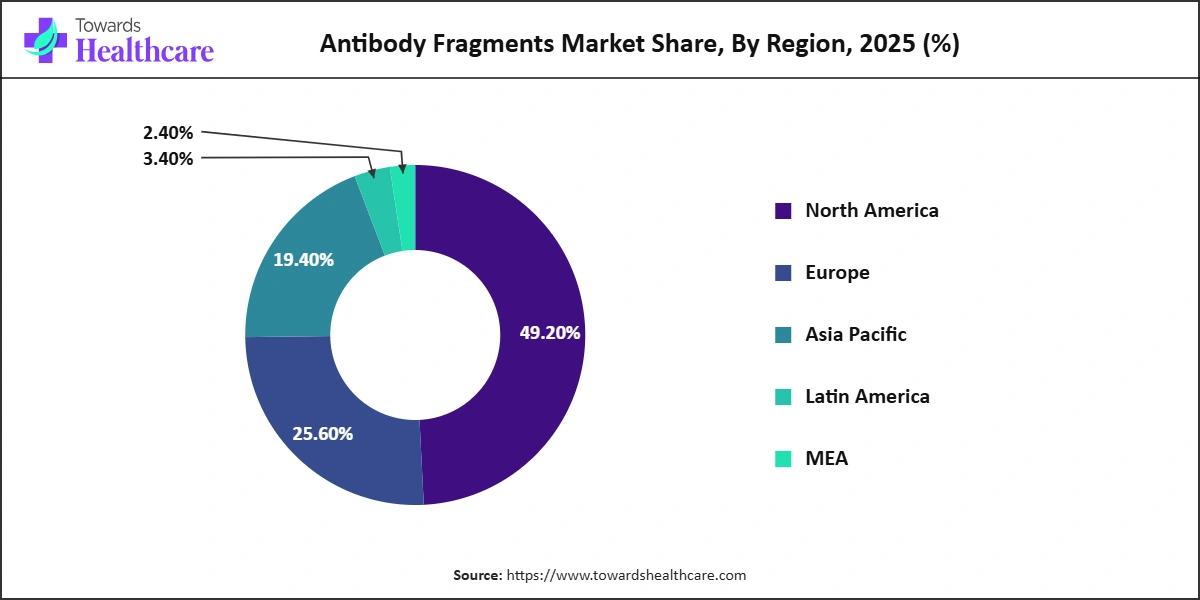
North America held 49.20% (USD 4.90 billion) of revenue in 2025 and is forecasted to expand to USD 8.44 billion by 2035, growing at a CAGR of 5.58% from 2026 to 2035. The U.S. is the largest market for certolizumab pegol, ranibizumab, blinatumomab, and tarlatamab, owing to high biologic prices and early adoption of new oncology drugs. It also has the largest research reagent market and a significant presence of fragment-focused biotechnology companies.
Europe accounted for a 25.60% (USD 2.55 billion) share in 2025 and is projected to reach USD 4.55 billion by the end of the forecast period, expanding at a CAGR of 5.98% from 2026 to 2035. This region has widely adopted fragment therapies under national health systems and benefits from the presence of key market players such as UCB, Novartis, Roche, Sanofi (Ablynx), and Immunocore. Biosimilar ranibizumab is widely used, which throttles the pace of growth in ophthalmology.
Asia Pacific held a market share of 19.40% (USD 1.93 billion) in 2025 and is projected to reach USD 3.97 billion by 2035, expanding at a CAGR of 7.48% over the forecast period. This region is growing at the highest rate, owing to expanding biologic access in China, Japan, and South Korea, approvals of local fragment drugs such as ozoralizumab in Japan and envafolimab in China, and a large nanobody and antibody engineering industry in China.
Latin America accounted for 3.40% (USD 0.34 billion) of net market revenue in 2025 and is projected to reach USD 0.60 billion by the end of the forecast period, expanding at a CAGR of 5.98% from 2026 to 2035. Some of the key regional growth drivers include significant use of antivenoms and access to biologics in Brazil and Mexico.
Middle East & Africa held a 2.40% (USD 0.24 billion) share in 2025 and is projected to reach USD 0.43 billion by 2035, expanding at a CAGR of 5.98% during the forecast period. The regional market ecosystem benefits from biologic access in Gulf countries and significant demand for antivenoms.
Analyst View: Regional shares were built from drug sales and reagent demand in each region. North America holds the largest share because of pricing and oncology adoption. We assign Asia Pacific the highest growth premium because biologic access and local fragment innovation are expanding at the fastest pace in this region.
| Rank | Company Name | Market-Specific Revenue (USD Billion) | 2025 Share | Key Products / Business | Headquarters |
| 1 | UCB | 2.30 | 23.12% | Cimzia (certolizumab pegol) | Belgium |
| 2 | Amgen | 2.10 | 21.11% | Blincyto and Imdelltra T-cell engagers | United States |
| 3 | Novartis | 1.05 | 10.55% | Lucentis (ex-U.S.) and Beovu | Switzerland |
| 4 | Roche | 0.75 | 7.54% | Lucentis (U.S.) and Susvimo | Switzerland |
| 5 | Immunocore | 0.38 | 3.82% | Kimmtrak (tebentafusp) | United Kingdom |
| 6 | SERB Pharmaceuticals | 0.30 | 3.02% | CroFab and DigiFab | France |
| 7 | Sanofi | 0.28 | 2.81% | Cablivi (caplacizumab) | France |
| 8 | Samsung Bioepis | 0.12 | 1.21% | Byooviz ranibizumab biosimilar | South Korea |
| 9 | Boehringer Ingelheim | 0.10 | 1.01% | Praxbind (idarucizumab) | Germany |
| 10 | Taisho Pharmaceutical | 0.05 | 0.50% | Nanozora (ozoralizumab) | Japan |
Note: Company revenues and shares are 2025 estimates.
Sources: Company press releases, expert interviews, secondary sources, Towards Healthcare database and Towards Healthcare analysts.
UCB led the market with 23.12% (USD 2.30 billion) of revenue in 2025, followed by Amgen at 21.11% (USD 2.10 billion) and Novartis at 10.55% (USD 1.05 billion). The dominance of UCB can be attributed to Cimzia, a PEGylated Fab used to treat various inflammatory diseases. Amgen is close behind with its BiTE T-cell engagers Blincyto and Imdelltra, which are growing rapidly, and Novartis sells Lucentis outside the United States and Beovu. Roche, Immunocore, SERB Pharmaceuticals, Sanofi, Samsung Bioepis, Boehringer Ingelheim and Taisho compete through Lucentis and Susvimo, a TCR-scFv fusion, Fab antivenoms and antidotes, the first approved nanobody, ranibizumab biosimilars, an anticoagulant reversal Fab and a trivalent nanobody.
The top 10 companies accounted for 74.67% (USD 7.43 billion) share, while the remaining 25.33% (USD 2.52 billion) was shared among biosimilar manufacturers, Asian fragment drug developers, research reagent suppliers and contract manufacturers. The market is concentrated around a few blockbuster products, and competition revolves around clinical efficacy, dosing convenience, half-life, safety, pricing, and biosimilar entry. Pipelines of nanobodies, multispecifics, and T-cell engagers are intensifying competition in oncology and immunology.
The antibody fragments ecosystem links discovery platforms and engineering technologies with drug developers, contract manufacturers, regulators, distributors and clinical and research users.
| Ecosystem Stage | Role in the Market | Key Companies |
| Discovery & Engineering | Discover and engineer fragments | Phage display and nanobody platforms, biotech developers |
| Drug Developers | Develop and market fragment drugs | UCB, Amgen, Novartis, Roche, Sanofi, Immunocore |
| Manufacturing | Produce fragments in microbial and mammalian systems | Lonza, Samsung Biologics, WuXi Biologics, in-house plants |
| Regulators & Payers | Approve and reimburse drugs | FDA, EMA, NMPA, PMDA, insurers |
| End Users | Use fragment products | Hospitals, ophthalmology clinics, oncology centres, research labs |
Sources: Company press releases, expert interviews, secondary sources, Towards Healthcare database and Towards Healthcare analysts.
The Towards Healthcare Companies Quadrant positions key participants in the market by market strength, reflecting revenue scale, market share and geographic reach, and by innovation and growth strategy, reflecting product portfolio breadth, research and development intensity and collaborations. Positions reflect each company's 2025 fragment drug revenue and our evaluation of its pipeline, launches, and technology platforms.
Sources: Company press releases, expert interviews, secondary sources, Towards Healthcare database and Towards Healthcare analysts.
Leaders: UCB, Amgen, Novartis and Roche bring together the largest fragment revenue and growing or broad portfolios.
Innovators: Immunocore, Sanofi, Samsung Bioepis and Taisho Pharmaceutical provide nanobody, TCR-fusion and biosimilar fragment products.
Niche Players: SERB Pharmaceuticals and Boehringer Ingelheim cater to the needs of antidote and reversal segments.
By Type
By Specificity
By Application
By Region
The market is defined as therapeutic, diagnostic, and research antibody fragments, including Fab, F(ab')2, scFv and scFv-based bispecifics, single-domain antibodies and other engineered fragments. The 2025 base year was built bottom-up from fragment drug sales by type, specificity, application and region, plus research and diagnostic reagent sales, and checked top-down against company product revenues for marketed fragment drugs.
Segment, regional and company values were allocated from fragment types, specificities, applications and regional drug sales. Key estimates were verified by cross-checking company disclosures, regulatory and industry data and published third-party estimates, and inputs that could not be reconciled have not been included. All segment, regional and company figures were reconciled to the same 2025 base year, and the 2026–2035 forecast, which applies a constant CAGR from the 2025 base, was recalculated and validated.
Analyst View: The market combines mature Fab drugs facing biosimilars with fast-growing T-cell engagers and nanobodies. The market is shifting towards oncology and newer formats. Our estimate links demand to product sales and reagent use, so the forecast follows approvals, uptake, and biosimilar entry. The main upside comes from T-cell engagers and nanobodies, while the main risks are biosimilar erosion and safety limits.