
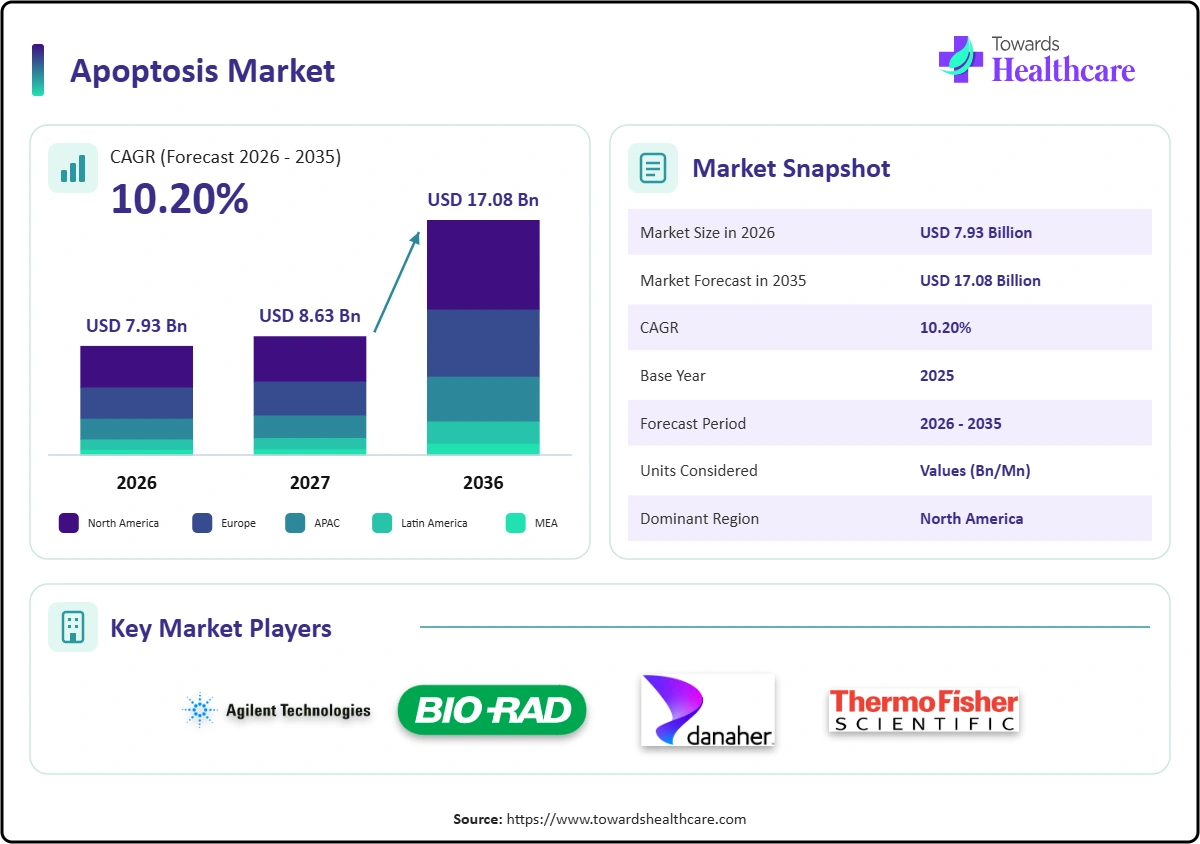
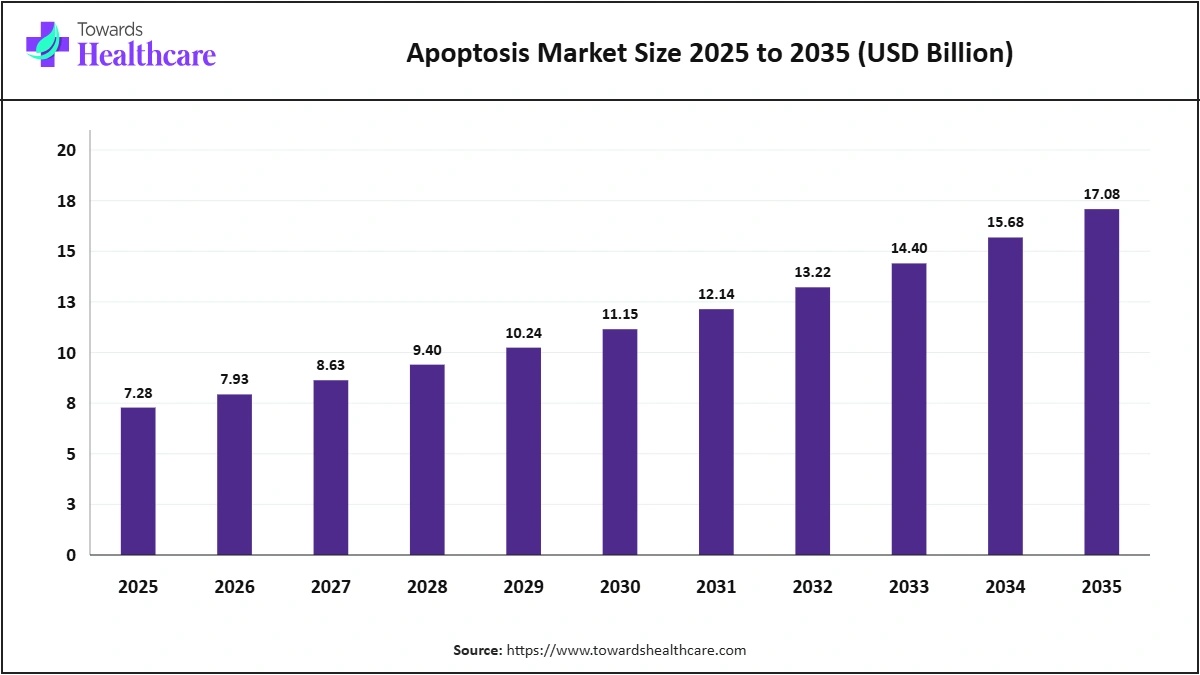
The apoptosis market is anticipated to grow from USD 7.28 billion in 2025 to USD 17.08 billion by 2035, driven by increasing use of apoptosis analysis in cancer research, toxicology, and disease studies. Growing biopharmaceutical R&D, cell-based assays, and drug screening further increase demand for assay kits and analytical instruments. Advances in high-throughput screening, live-cell imaging, 3D cell models and multiplexed assays, along with expanding research activities across Asia Pacific, further support market growth. The market is projected to reach USD 11.15 billion by 2030, registering a CAGR of 8.90% during 2026–2035.
Analyst View: The market is poised for strong growth, driven by increasing adoption of apoptosis assays in cancer research, drug development, and toxicology studies. Advancements in high-throughput screening, live-cell imaging, and 3D cell models, alongside expanding biopharmaceutical R&D and research activities in Asia Pacific, are expected to strengthen market demand. The growth rate reflects steady R&D growth and new technologies, moderated by research funding pressures and instrument budget cycles.
Driver: Growing use of cell death assays in oncology drug discovery and increasing research into neurodegeneration and inflammation drive market demand. Rising adoption of in vitro toxicology testing, cell therapy development, immune cell survival analysis, and high-throughput screening further supports the demand for apoptosis assays, reagents, and analytical instruments.
Restraint: Market growth is restrained by fluctuations in research funding and the high cost of analytical instruments. Additionally, assay variability can affect result reproducibility, while reagent price competition and the need for specialized expertise in complex data analysis create further challenges.
Opportunity: Advancements in live-cell imaging and AI-based image analysis offer opportunities to improve assay accuracy and efficiency. Growing adoption of 3D organoid models, expanding research activities in Asia, increased CRO outsourcing, and the shift toward non-animal testing methods are expected to create new growth opportunities.
| Segments | 2025 Share | 2025 Value (USD Billion) | 2035 Value (USD Billion) | CAGR 2026-2035 |
| Consumables (Kits & Reagents) | 55.40% | 4.03 | 9.70 | 9.16% |
| Instruments | 44.60% | 3.25 | 7.38 | 8.56% |
Note: 2025 is the base year; 2035 values are forecasts.
Sources: Expert interviews, secondary sources, Towards Healthcare database, and Towards Healthcare analysts.
Consumables (Kits & Reagents): This segment was valued at USD 4.03 billion in 2025 and is projected to reach USD 9.70 billion by 2035, at a CAGR of 9.16% from 2026 to 2035. Consumables include ready-to-use assay kits, fluorescent and luminescent reagents, antibodies against apoptosis markers such as cleaved caspase-3 and PARP, dyes, buffers, and microplates. They account for the largest share and are growing faster because they are used up in every experiment, and the number of cell-based assays in drug discovery and research keeps rising.
Instruments: The instruments segment accounted for 44.60% (USD 3.25 billion) in 2025 and is estimated to represent USD 7.38 billion by 2035, at a CAGR of 8.56% from 2026 to 2035. Instruments cover flow cytometers, cell imaging and high-content screening systems, live-cell analysis systems, and microplate readers used for apoptosis and other cell analyses. They are capital purchases with replacement cycles of several years, and the share attributable to apoptosis reflects their wide use in cell death studies. Demand depends on research budgets and is supported by new spectral flow cytometers and automated imaging platforms.
| Segments | 2025 Share | 2025 Value (USD Billion) | 2035 Value (USD Billion) | CAGR 2026-2035 |
| Flow Cytometry | 35.20% | 2.56 | 5.70 | 8.33% |
| Cell Imaging & Analysis | 24.60% | 1.79 | 4.62 | 9.93% |
| Spectrophotometry & Plate Readers | 22.40% | 1.63 | 3.77 | 8.73% |
| Others | 17.80% | 1.30 | 2.99 | 8.73% |
Note: 2025 is the base year; 2035 values are forecasts.
Sources: Expert interviews, secondary sources, Towards Healthcare database, and Towards Healthcare analysts.
Flow Cytometry: Flow cytometry dominated the apoptosis market in 2025, accounting for 35.20% of revenue, valued at USD 2.56 billion. The segment is projected to reach USD 5.70 billion by 2035, registering a CAGR of 8.33% during 2026-2035. Flow cytometry is the leading technology because it measures apoptosis in thousands of individual cells using Annexin V, caspase, and viability dyes, distinguishing early apoptotic, late apoptotic, and necrotic cells. It is standard in immunology, oncology, and cell therapy research. Brighter dyes and spectral cytometers allow more markers per sample.
Cell Imaging & Analysis: This segment was valued at USD 1.79 billion of the apoptosis market in 2025 and is projected to reach USD 4.62 billion by 2035, growing at a CAGR of 9.93% from 2026 to 2035. Cell imaging & analysis covers fluorescence microscopy, high-content screening, and live-cell imaging systems that track apoptosis over time in cell cultures and 3D models. It is the fastest-growing technology because drug discovery teams want kinetic, image-based data and high-throughput screening of compound effects.
Spectrophotometry & Plate Readers: The spectrophotometry and plate readers segment was valued at USD 1.63 billion in 2025 and is expected to reach USD 3.77 billion by 2035, registering a CAGR of 8.73% during 2026-2035. These technologies measure colorimetric, fluorescent, and luminescent signals associated with apoptosis in microplate-based assays. Their fast processing, cost efficiency, and easy automation make them widely used in high-throughput drug screening and cell-based research.
Others: The other segments reached USD 1.30 billion in 2025 and are estimated to represent USD 2.99 billion by 2035, expanding at a CAGR of 8.73% from 2026 to 2035. Others include Western blotting, immunohistochemistry, TUNEL staining of tissue sections, electrophoresis, and emerging single-cell and mass cytometry approaches.
| Segments | 2025 Share | 2025 Value (USD Billion) | 2035 Value (USD Billion) | CAGR 2026-2035 |
| Caspase Assays | 31.20% | 2.27 | 5.14 | 8.49% |
| Annexin V Assays | 19.60% | 1.43 | 3.34 | 8.89% |
| Mitochondrial Assays | 16.40% | 1.19 | 3.01 | 9.69% |
| DNA Fragmentation Assays | 15.20% | 1.11 | 2.59 | 8.89% |
| Cell Permeability Assays | 10.20% | 0.74 | 1.74 | 8.89% |
| Others | 7.40% | 0.54 | 1.26 | 8.89% |
Note: 2025 is the base year; 2035 values are forecasts.
Sources: Expert interviews, secondary sources, Towards Healthcare database, and Towards Healthcare analysts.
Caspase Assays: This segment generates USD 2.27 billion of the apoptosis market in 2025 and is expected to reach USD 5.14 billion by 2035, at a CAGR of 8.49% from 2026 to 2035. Caspase assays measure the activity of caspase enzymes that drive apoptosis, using colorimetric, fluorescent, or luminescent substrates. They are the most widely used assay type because they are sensitive, easy to run in microplates, and suitable for high-throughput drug screening.
Annexin V Assays: In 2025, the annexin V assays segment held a 19.60% share, valued at USD 1.43 billion, and is expected to grow to USD 3.34 billion by 2035, registering a CAGR of 8.89% during the forecast period. Annexin V assays detect phosphatidylserine exposed on the surface of early apoptotic cells, usually by flow cytometry with a viability dye. They are a standard method for distinguishing stages of cell death and are supported by new, brighter conjugates.
Mitochondrial Assays: The mitochondrial assays segment generated USD 1.19 billion in 2025 and is projected to reach USD 3.01 billion by 2035, registering the fastest CAGR of 9.69% during 2026–2035. These assays detect early apoptotic changes by measuring mitochondrial membrane potential and cytochrome c release. Growing research into mitochondrial dysfunction, particularly in neurodegenerative diseases, cardiotoxicity, and drug safety studies, drives segment growth.
DNA Fragmentation Assays: With a 15.20% market share in 2025, the segment is projected to grow from USD 1.11 billion to USD 2.59 billion by 2035, registering a CAGR of 8.89% from 2026-2035. DNA fragmentation assays, such as TUNEL, detect DNA breaks characteristic of late apoptosis in cells and tissue sections. They are important in histology, toxicology, and in vivo studies.
Cell Permeability Assays: The market value was USD 0.74 billion in 2025 and is projected to represent USD 1.74 billion by 2035, growing at a CAGR of 8.89% from 2026 to 2035. Cell permeability assays use dyes that enter cells with damaged membranes to distinguish late apoptotic and necrotic cells. They are often combined with other assays for complete cell death profiling.
Others: This segment held 7.40% market share, with a market size of USD 0.54 billion in 2025 and is projected to reach USD 1.26 billion by 2035, exhibiting a CAGR of 8.89% over the forecast period. Others include assays for PARP cleavage, Bcl-2 family proteins, and other apoptosis pathway markers.
| Segments | 2025 Share | 2025 Value (USD Billion) | 2035 Value (USD Billion) | CAGR 2026-2035 |
| Cancer | 46.00% | 3.35 | 7.59 | 8.52% |
| Neurodegenerative Disorders | 15.40% | 1.12 | 2.89 | 9.92% |
| Immunology & Inflammation | 14.20% | 1.03 | 2.43 | 8.92% |
| Cardiovascular Diseases | 9.60% | 0.70 | 1.64 | 8.92% |
| Others | 14.80% | 1.08 | 2.53 | 8.92% |
Note: 2025 is the base year; 2035 values are forecasts.
Sources: Expert interviews, secondary sources, Towards Healthcare database, and Towards Healthcare analysts.
Cancer: The cancer segment, valued at USD 3.35 billion in 2025, is forecast to reach USD 7.59 billion by 2035, growing at a CAGR of 8.52% during the forecast period. Cancer research accounts for the largest share because most cancer therapies, including chemotherapy, targeted drugs, antibody-drug conjugates, and immunotherapies, work by inducing tumor cell death, and apoptosis assays are used to evaluate efficacy throughout discovery and development.
Neurodegenerative Disorders: With 15.40% market share, the segment is growing to USD 1.12 billion in 2025 and is projected to reach USD 2.89 billion by 2035, at a CAGR of 9.92% from 2026 to 2035. Neurodegenerative disorder research studies neuronal cell death in Alzheimer's, Parkinson's, ALS, and other diseases. It is the fastest-growing application as investment in neuroscience drug development rises.
Immunology & Inflammation: The immunology and inflammation segment was valued at USD 1.03 billion in 2025 and is projected to reach USD 2.43 billion by 2035, registering a CAGR of 8.92% during 2026–2035. Apoptosis analysis in immunology and inflammation research helps evaluate immune cell death, which plays an important role in autoimmune diseases, infection responses, and cell therapy development. Growing research into CAR-T cell persistence, survival, and therapeutic potency further supports segment growth.
Cardiovascular Diseases: The cardiovascular diseases segment accounted for 9.60% of the apoptosis market in 2025, generating USD 0.70 billion in revenue. The segment is projected to reach USD 1.64 billion by 2035, registering a CAGR of 8.92% during 2026-2035. Apoptosis assays support cardiovascular research by measuring cardiomyocyte death associated with heart failure, ischemia, and drug-induced cardiotoxicity. Growing research into cardiac cell damage and treatment safety further supports segment growth.
Others: Others accounted for 14.80% (USD 1.08 billion) of the apoptosis market in 2025 and is projected to reach USD 2.53 billion by 2035, expanding at a CAGR of 8.92% from 2026 to 2035. Others include toxicology, stem cell research, infectious disease, and developmental biology.
| Segments | 2025 Share | 2025 Value (USD Billion) | 2035 Value (USD Billion) | CAGR 2026-2035 |
| Pharmaceutical & Biotechnology Companies | 51.20% | 3.73 | 8.52 | 8.62% |
| Academic & Research Institutes | 27.60% | 2.01 | 4.76 | 9.02% |
| Hospital & Diagnostic Laboratories | 15.80% | 1.15 | 2.73 | 9.02% |
| CROs | 5.40% | 0.39 | 1.07 | 10.52% |
Note: 2025 is the base year; 2035 values are forecasts.
Sources: Expert interviews, secondary sources, Towards Healthcare database, and Towards Healthcare analysts.
Pharmaceutical & Biotechnology Companies: This segment dominated the market in 2025, generating USD 3.73 billion in revenue. It is projected to reach USD 8.52 billion by 2035, registering a CAGR of 8.62% during 2026-2035. Pharmaceutical and biotechnology companies represent the largest end-user group because they routinely use apoptosis assays for target validation, compound screening, mechanism-of-action studies, and drug safety assessment. Growing drug discovery and development activities further support segment demand.
Academic & Research Institutes: The academic and research institutes segment generated USD 2.01 billion in 2025 and is projected to reach USD 4.76 billion by 2035, registering a CAGR of 9.02% over the forecast period. These institutions use apoptosis assays extensively in cancer, neuroscience, immunology, and cell biology research. Government grants, foundation funding, and expanding biomedical research activities further support segment growth.
Hospital & Diagnostic Laboratories: This segment accounted for 15.80% of the apoptosis market in 2025, generating USD 1.15 billion in revenue. It is projected to reach USD 2.73 billion by 2035, registering a CAGR of 9.02% over the study period. Hospital and diagnostic laboratories use apoptosis-related assays in specialized clinical studies and research, particularly in hematology and oncology. Growing cancer research and demand for advanced diagnostic testing further support segment growth.
CROs: The CROs segment accounted for 5.40% (USD 0.39 billion) of the market share in 2025 and is expected to reach USD 1.07 billion by 2035, at a CAGR of 10.52% from 2026 to 2035. CROs perform outsourced cell-based assays, screening, and toxicology studies for drug developers. This is the fastest-growing end user as pharmaceutical companies outsource more discovery and preclinical work.
Analyst View: The market is driven by strong demand for consumables and flow cytometry technologies, supported by their widespread use in cell death analysis and drug screening. Cancer research remains the leading application, while neurodegenerative disease research is gaining momentum. Pharmaceutical and biotechnology companies dominate end-user demand, whereas CROs are emerging as a high-growth segment due to increasing outsourcing of drug discovery and preclinical testing. Growing adoption of live-cell imaging, advanced assays, and automated screening technologies is expected to shape market expansion.
| Region | 2025 Share | 2025 Value (USD Billion) | 2035 Value (USD Billion) | CAGR 2026-2035 |
| North America | 43.20% | 3.14 | 6.98 | 8.30% |
| Europe | 26.00% | 1.89 | 4.36 | 8.70% |
| Asia Pacific | 23.40% | 1.70 | 4.50 | 10.20% |
| Latin America | 4.40% | 0.32 | 0.74 | 8.70% |
| Middle East & Africa | 3.00% | 0.22 | 0.50 | 8.70% |
Note: 2025 is the base year; 2035 values are forecasts.
Sources: Expert interviews, secondary sources, Towards Healthcare database, and Towards Healthcare analysts.
North America: The North American region contributed 43.20% of the market share, reaching a value of USD 3.14 billion in 2025 and is projected to reach USD 6.98 billion by 2035, growing at a CAGR of 8.30% from 2026 to 2035. The U.S. has the largest life science research base, with NIH funding of more than USD 40 billion a year, a large pharmaceutical and biotechnology industry, and major research universities. Leading suppliers such as Thermo Fisher Scientific, Danaher, BD, Bio-Rad, Bio-Techne, Agilent, and Promega are based in the region. Changes in federal research funding can affect academic purchasing, while biopharmaceutical R&D remains strong.
Europe: The region represented 26.00% of the total market in 2025 and is anticipated to witness steady expansion, reaching USD 4.36 billion by 2035 at a CAGR of 8.70%. Europe has strong pharmaceutical research in Switzerland, Germany, the UK, and France, and EU research programs such as Horizon Europe support academic demand. Merck KGaA, Sartorius, and Miltenyi Biotec are major European suppliers, and the growing use of in vitro methods in toxicology supports apoptosis assays.
Asia Pacific: The Asia Pacific apoptosis market was valued at USD 1.70 billion in 2025 and is projected to reach USD 4.50 billion by 2035, registering the fastest regional CAGR of 10.20% during 2026-2035. Rapid growth in biotechnology and contract research in China, rising R&D investments in Japan, South Korea and Singapore, and expanding research capabilities in India drive regional demand. Strategic investments in research infrastructure, including Thermo Fisher's Centre of Excellence partnership with C-CAMP in Bengaluru, further strengthen the region's growth prospects.
Latin America: This region accounted for 4.40% and was valued at USD 0.32 billion of the apoptosis market in 2025 and is projected to reach USD 0.74 billion by 2035, exhibiting a CAGR of 8.70%. Latin America is supported by academic research in Brazil, Mexico, and Argentina and by growing clinical research activity, although funding constraints limit spending.
Middle East & Africa: With a market valuation of USD 0.22 billion in 2025, the region is projected to reach USD 0.50 billion by 2035, growing at a CAGR of 8.70% over the forecast period. The Middle East & Africa are supported by research investment in Israel, Saudi Arabia, and the UAE, while research capacity in much of Africa remains limited.
Analyst View: North America leads the apoptosis market, supported by strong pharmaceutical R&D, established research institutions, and the presence of major industry players. Europe benefits from well-established life science research and government funding, while Asia Pacific is emerging as the fastest-growing region due to expanding biotechnology industries, rising R&D investments, and growing CRO activities. Latin America and the Middle East & Africa are gradually gaining traction as research infrastructure and clinical activities continue to develop.
| Rank | Company Name | Market-Specific Revenue (USD Billion) | 2025 Share | Key Products / Business | Headquarters |
| 1 | Thermo Fisher Scientific | 1.95 | 26.79% | Apoptosis kits, reagents, flow cytometers and imaging | United States |
| 2 | Danaher | 1.05 | 14.42% | Beckman Coulter, Molecular Devices, Abcam | United States |
| 3 | Merck KGaA | 0.70 | 9.62% | Apoptosis reagents and kits | Germany |
| 4 | BD | 0.62 | 8.52% | Flow cytometers and apoptosis reagents | United States |
| 5 | Bio-Rad Laboratories | 0.42 | 5.77% | StarBright conjugates and cell analysis | United States |
| 6 | Bio-Techne | 0.30 | 4.12% | Antibodies and apoptosis assays | United States |
| 7 | Revvity | 0.26 | 3.57% | High-content imaging and assays | United States |
| 8 | Agilent Technologies | 0.22 | 3.02% | Cell analysis instruments and assays | United States |
| 9 | Promega | 0.18 | 2.47% | Luminescent apoptosis assays | United States |
| 10 | Sartorius | 0.14 | 1.92% | Incucyte live-cell analysis | Germany |
Note: Company revenues and shares are 2025 estimates.
Sources: Company press releases, expert interviews, secondary sources, Towards Healthcare database and Towards Healthcare analysts.
Thermo Fisher Scientific led the apoptosis market with 26.79% share (USD 1.95 billion) of 2025 revenue, followed by Danaher at 14.42% (USD 1.05 billion) and Merck KGaA at 9.62% (USD 0.70 billion). Thermo Fisher Scientific leads through its broad range of apoptosis kits, dyes, antibodies, flow cytometers, and imaging systems. Danaher offers Beckman Coulter flow cytometry, Molecular Devices imaging and plate readers, and Abcam antibodies and kits, and Merck KGaA supplies apoptosis reagents and kits through MilliporeSigma. BD, Bio-Rad Laboratories, Bio-Techne, Revvity, Agilent Technologies, Promega and Sartorius compete through flow cytometry, fluorescent conjugates, antibodies, high-content imaging, cell analysis, luminescent assays and live-cell analysis.
The top 10 companies accounted for 80.22% share (USD 5.84 billion) of 2025 revenue, while the remaining 19.78% (USD 1.44 billion) was shared among antibody suppliers, assay kit makers and regional reagent companies. The apoptosis market is concentrated among large life science tool companies, and competition centers on assay sensitivity and reproducibility, multiplexing, instrument and reagent integration, brand trust, technical support, and price. Instrument platforms create recurring reagent demand, giving integrated suppliers an advantage.
The apoptosis ecosystem links raw material and antibody producers with assay and instrument manufacturers, distributors, and researchers in industry and academia.
| Ecosystem Stage | Role in the Market | Key Companies |
| Raw Materials | Supply fluorophores, substrates, and antibodies | Dye and chemical producers, antibody developers |
| Assay Developers | Develop kits and reagents | Thermo Fisher, Merck KGaA, Abcam, Promega, Bio-Techne |
| Instrument Makers | Build cytometers, imagers, and readers | BD, Beckman Coulter, Agilent, Revvity, Sartorius, Molecular Devices |
| Distribution | Sell to laboratories | Fisher Scientific, VWR, regional distributors |
| End Users | Run apoptosis studies | Pharma and biotech, universities, CROs, hospital labs |
Sources: Company press releases, expert interviews, secondary sources, Towards Healthcare database, and Towards Healthcare analysts.
The Towards Healthcare Companies Quadrant positions key participants in the apoptosis market by market strength, reflecting revenue scale, market share and geographic reach, and by innovation and growth strategy, reflecting product portfolio breadth, R&D intensity and partnerships. Positions reflect each company's estimated 2025 apoptosis revenue and our assessment of its product innovation, platform integration and distribution.
Sources: Company press releases, expert interviews, secondary sources, Towards Healthcare database, and Towards Healthcare analysts.
Leaders: Thermo Fisher Scientific, Danaher, Merck, BD, and Bio-Rad Laboratories combine large apoptosis revenue with broad reagent and instrument portfolios, new product launches, and global reach.
Innovators: Revvity, Agilent Technologies, Promega, and Sartorius bring imaging, luminescent, and live-cell technologies that are expanding apoptosis analysis.
Niche Players: Bio-Techne serves specific segments.
By Product
By Technology
By Assay Type
By Application
By End Use
By Region
The apoptosis market was defined as apoptosis assay kits, reagents, antibodies, consumables, and instruments used to detect and study programmed cell death, worldwide. The 2025 base year was built bottom-up from laboratory spending on apoptosis consumables and attributable instrument placements by product, technology, assay type, application, end user, and region, and checked top-down against the cell analysis and apoptosis product revenue of leading life science tool companies.
Segment, regional and company values were allocated from products, technologies, assay types, applications, end users and regional demand. Key estimates were verified by cross-checking company disclosures, regulatory and industry data, and published third-party estimates, and inputs that could not be reconciled were excluded. All segment, regional and company figures were reconciled to the same 2025 base year, and the 2026-2035 forecast, which applies a constant CAGR from the 2025 base, was recalculated and validated.
Analyst View: The apoptosis market grows steadily with biopharmaceutical and academic research, led by recurring consumable sales. Our estimate links demand to laboratory spending and instrument placements, so the forecast follows R&D budgets, oncology pipelines, and new technologies. The main opportunities come from imaging, 3D models, and Asian research growth, while the main risks are funding pressure and instrument budget cycles.