

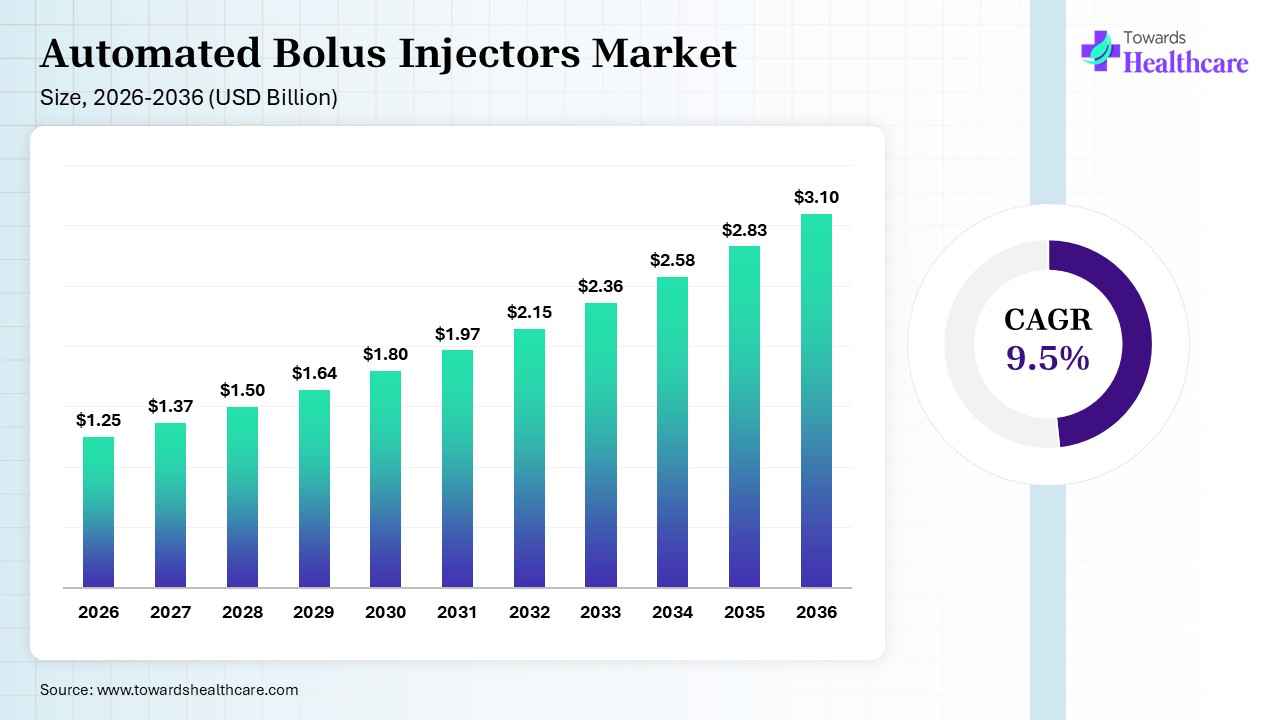
The global automated bolus injectors market is estimate at USD 1.37 billion in 2027 and is projected to reach approximately USD 3.1 billion by 2036, expanding at a CAGR of 9.5% during 2027-2036. Market growth is driven by the shift toward subcutaneous administration of biologics, rising demand for self-administration, and the need to deliver larger drug volumes without prolonged hospital-based infusions.
On-body automated bolus injectors accounted for an estimated 66.7% of market revenue in 2025. Diabetes represented approximately 55.4% of revenue, while homecare settings accounted for 54.2%. North America held an estimated 40.7% of global revenue. Asia Pacific is positioned for faster growth during the forecast period, supported by expanding healthcare access and rising demand for advanced drug-delivery technologies.
The commercial opportunity extends beyond device shipments. Market adoption depends on compatibility between injectable formulations and delivery platforms, regulatory clearance for drug-device combinations, and demonstrated value for patients and healthcare providers. Reliable drug delivery, ease of use, treatment adherence, and reduced dependence on hospital-based administration strengthen the commercial case for these systems.
The competitive landscape includes specialist injector developers, established medical-device manufacturers, component suppliers, contract development and manufacturing organizations, and pharmaceutical companies commercializing therapies through proprietary or partnered delivery platforms. Device engineering, drug compatibility, human-factors validation, manufacturing quality, and long-term pharmaceutical partnerships create significant barriers to entry.
The market analysis separates standalone automated bolus injector hardware from insulin pumps, continuous infusion systems, conventional autoinjectors, and pharmaceutical revenues. This distinction establishes a consistent market boundary and prevents broader wearable-injector industry estimates from being incorrectly applied to the automated bolus injectors market.
Market growth depends on more than the prevalence of chronic diseases. Revenue is determined by the share of patients receiving injectable therapies, drug suitability for bolus delivery, administration frequency, device reuse or disposability, and the price per delivery system. Therapies with large patient populations generate limited injector revenue when standard prefilled pens meet delivery needs. Smaller specialty-drug populations generate substantial device revenue when treatment requires dedicated high-volume delivery platforms.
Market forecasts should incorporate base, upside, and downside scenarios based on product launch timelines, patient conversion rates, competing formulations, biosimilar entry, device discontinuations, and regional market access. These variables determine the pace of adoption, device demand, and revenue growth across the forecast period.
| Segments | 2026 Share | 2026 Market Value (USD Million) |
| On-Body Automated Bolus Injectors | 67% | $837.5 |
| Off-Body Automated Bolus Injectors | 33% | $412.5 |
On-body automated bolus injectors are estimated to lead the market, consistent with the supplied 2025 finding that they accounted for around 66.7% of revenue. Their suitability for delivering larger medication volumes and enabling convenient self-administration supports demand, particularly for therapies used outside clinical settings.
| Segments | 2026 Share | 2026 Market Value (USD Million) |
| Spring-Driven | 27% | $337.5 |
| Motor-Driven | 22% | $275 |
| Electromechanical | 20% | $250 |
| Pump-Based | 23% | $287.5 |
| Other Delivery Mechanisms | 8% | $100 |
Spring-driven and pump-based mechanisms are estimated to account for substantial shares because they can support controlled delivery across different device and formulation requirements. Motor-driven and electromechanical systems offer additional control and design flexibility, while other mechanisms serve specialized applications.
| Segments | 2026 Share | 2026 Market Value (USD Million) |
| Single-Use/Disposable | 72% | $900 |
| Reusable | 28% | $350 |
Single-use devices are estimated to dominate due to their convenience, simplified handling, and suitability for prefilled drug delivery systems. Reusable devices may appeal in applications where device economics, maintenance, and compatibility with repeat dosing support their use.
| Segments | 2026 Share | 2026 Market Value (USD Million) |
| Diabetes | 55% | $687.5 |
| Autoimmune Diseases | 22% | $275 |
| Oncology | 10% | $125 |
| Neurological Disorders | 5% | $62.5 |
| Other Chronic Conditions | 8% | $100 |
Diabetes is estimated to remain the largest application segment, aligning with the supplied 2025 market finding of 55.4% revenue share. Demand for convenient, consistent medication delivery in chronic disease management supports the segment, while biologic treatments for autoimmune diseases and oncology provide additional opportunities.
| Segments | 2026 Share | 2026 Market Value (USD Million) |
| Homecare Settings | 54% | $675 |
| Hospitals and Clinics | 34% | $425 |
| Ambulatory Care Settings | 12% | $150 |
Homecare settings are estimated to account for the largest share, reflecting patient preference for self-administration and the convenience of wearable or portable injection devices. Hospitals, clinics, and ambulatory care facilities remain important for supervised administration, patient training, and treatment requiring clinical oversight.
| Segments | 2026 Share | 2026 Market Value (USD Million) |
| Delivery Volume | 30% | $375 |
| Drug Viscosity | 22% | $275 |
| Formulation Compatibility | 20% | $250 |
| Administration Duration | 16% | $200 |
| Container Configuration | 12% | $150 |
Delivery volume is estimated to be the leading consideration because automated bolus injectors are designed to administer doses that may be impractical for conventional small-volume injection devices. Viscosity, formulation compatibility, administration time, and container design also influence device selection, engineering, and drug-device compatibility assessments.
| Segments | 2026 Share | 2026 Market Value (USD Million) |
| North America | 41% | $512.5 |
| Europe | 27% | $337.5 |
| Asia Pacific | 23% | $287.5 |
| Latin America | 5% | $62.5 |
| Middle East and Africa | 4% | $50 |
North America is estimated to lead the market, consistent with the supplied 2025 regional share of 40.7%. Established biologics markets, adoption of self-injection technologies, and access to advanced drug-delivery devices support demand, while Asia Pacific is expected to grow faster as healthcare access and biologic use expand.
The United States is estimated to represent most North American revenue, supported by broad use of biologics, established pharmaceutical supply chains, and demand for self-administration devices. Canada and Mexico contribute smaller shares, with uptake shaped by reimbursement, healthcare access, and availability of compatible therapies.
Germany, the United Kingdom, and France are estimated to be significant European markets due to established healthcare systems and pharmaceutical industries. Regional demand will also depend on device approvals, biologic adoption, reimbursement conditions, and access to home-based treatment.
China and Japan are estimated to be major contributors to the regional market, while India and South Korea provide further growth opportunities. Increasing use of biologics, greater demand for convenient administration, and expanding healthcare capacity may support growth, although affordability and access remain important factors.
Brazil is estimated to be the largest separately identified market in Latin America. Market expansion across the region will depend on biologic treatment access, healthcare funding, availability of advanced injection devices, and the affordability of long-term therapies.
GCC countries and South Africa are estimated to represent relevant markets within the region, supported by developing healthcare infrastructure and demand for advanced treatment options. Adoption in other markets may depend on specialist care availability, affordability, and access to biologic medicines and compatible delivery devices.
Saudi Arabia and the United Arab Emirates are estimated to account for the largest portions of the GCC allocation. The remaining markets contribute smaller shares, with adoption influenced by healthcare investment, access to specialist treatments, and the availability of advanced drug-delivery devices.
Three forces are reshaping demand in the automated bolus injectors market. First, pharmaceutical companies are expanding subcutaneous alternatives to intravenous administration where clinically appropriate. Second, the shift toward home-based treatment increases demand for devices that reduce reliance on infusion facilities and healthcare professionals. Third, the growth of specialty biologics strengthens demand for delivery platforms designed to handle specific drug volumes, viscosities, and administration times.
These demand drivers translate into commercial sales only when drug-device combinations meet requirements for dose accuracy, drug compatibility, sterility, usability, and product stability. Pharmaceutical development timelines, reimbursement decisions, and manufacturing scale-up directly influence commercialization. Delays in any of these areas slow device adoption, even when the underlying delivery platform is technically ready.
| Market force | Commercial implication |
| Subcutaneous biologics | Expands demand for high-volume delivery platforms where formulation characteristics permit |
| Homecare adoption | Increases the value of simple, reliable self-administration |
| Biosimilar competition | Can expand patient access but create price pressure on associated therapies and devices |
| Device qualification | Raises development costs and increases the value of established OEM partnerships |
| Alternative delivery methods | Creates substitution risk from prefilled syringes, autoinjectors, infusion systems and oral therapies where clinically suitable |
Automated bolus injectors do not have a single standardized market price. Development-stage platforms, customized devices supplied through pharmaceutical partnerships, and commercial single-use injectors operate under different pricing structures. A robust pricing analysis separates realized device selling prices, engineering and development fees, tooling investments, manufacturing costs per unit, and total cost per administration. Revenue from a complete drug-device combination remains distinct from standalone injector revenue.
Manufacturing costs reflect precision components, motors or springs, batteries where applicable, electronic controls, primary drug containers, adhesives, assembly, sterile manufacturing requirements, inspection, and packaging. Complex designs command higher prices but require more extensive validation and increase warranty and quality-management costs.
Pricing power is strongest when an injector is integral to a differentiated therapy and switching platforms requires substantial redesign, testing, and regulatory work. Standardized components, competing delivery platforms, and high-volume purchasing place pressure on margins. Long-term pharmaceutical supply agreements also influence unit economics, with negotiated volume commitments often linked to lower per-unit prices and more predictable demand.
Supply availability in the automated bolus injectors market depends on the ability to manufacture specific devices consistently under validated quality systems. General medical-device assembly capacity does not guarantee commercial readiness. Component qualification, automated assembly validation, supplier changes, and pharmaceutical launch schedules directly affect production volumes and delivery timelines.
Demand forecasting links approved and late-stage drug programs with device requirements, expected treatment volumes, dosing frequency, patient uptake, and manufacturing yield. Supply analysis distinguishes prototype production capability, validated commercial capacity, and actual shipments, as each represents a different stage of manufacturing readiness.
The report assesses commercial capacity visibility, manufacturing locations, production lead times, supplier concentration, and contingency sourcing. These factors determine supply reliability, the ability to meet launch demand, and the resilience of the injector supply chain.
The automated bolus injector value chain covers precision-component sourcing, primary-container manufacturing, device engineering, assembly, quality assurance, pharmaceutical integration, regulatory submissions, and commercialization. Pharmaceutical companies typically control the therapeutic product and clinical strategy, while device specialists provide delivery mechanisms, usability engineering, and manufacturing expertise. This division creates interdependent commercial relationships across the value chain.
The strongest value-capture opportunities center on proprietary delivery mechanisms, drug-specific customization, validated manufacturing processes, and long-term supply agreements. Commodity plastic components offer more limited differentiation. Profitability depends on intellectual-property ownership, engineering and tooling investments, production scale, validation requirements, and contractual allocation of product-liability risks. Suppliers with differentiated engineering capabilities and established pharmaceutical partnerships secure stronger commercial positions. Component-sourcing concentration, sterile manufacturing constraints, and validation bottlenecks increase costs and expose manufacturers to supply disruptions.
The report assesses supplier concentration, engineering and tooling costs, contract development and manufacturing models, pharmaceutical OEM partnerships, intellectual-property ownership, quality-system requirements, production constraints, and margin distribution across development, manufacturing, and commercial supply. These factors determine bargaining power, cost recovery, supply resilience, and long-term value capture. The analysis also supports a detailed value-chain database covering suppliers, component categories, manufacturing facilities, development and manufacturing partners, technology ownership, geographic footprint, production capacity, cost drivers, and partnership structures. This database enables company-level filtering, supplier benchmarking, and comparative assessment of value-chain dependencies.
Homecare accounted for approximately 54.2% of 2025 market revenue, highlighting the importance of treatment convenience and reduced dependence on institutional administration. Diabetes contributed approximately 55.4% of revenue, while autoimmune disease and oncology remain strategically important because of their biologic-treatment requirements.
Customer selection criteria extend beyond acquisition cost. Pharmaceutical manufacturers prioritize formulation compatibility, development timelines, reliable supply, intellectual-property protection, and regulatory readiness. Patients and clinicians prioritize ease of use, comfort, confidence in complete dosing, and clear instructions. Healthcare payers assess total treatment costs, including administration, monitoring, and avoidable facility utilization.
The market combines established medical-device manufacturers, specialist delivery-platform developers, primary-container suppliers, and pharmaceutical companies with commercial therapies tied to particular injection systems. Competition is shaped by the ability to secure pharmaceutical development partnerships and translate prototype technology into validated, commercially scalable products.
The competitive field includes both device-platform revenue and drug-specific delivery ecosystems. These must be distinguished: a pharmaceutical company may generate substantial sales from a therapy administered through a wearable injector without earning equivalent revenue from manufacturing the device itself.
Three competitive groups are strategically important:
Established platform manufacturers: companies with drug-delivery engineering, global quality systems, and experience supporting pharmaceutical customers.
Relevant indicators include injector-platform sales, commercial product adoption, pharmaceutical partnerships, approved drug-device combinations, product-specific unit volumes and recurring manufacturing agreements. Public disclosures rarely provide all these metrics on a consistent basis, limiting the precision of market-share estimates.
| Company | Headquarters | Market position | Core strength |
| Becton, Dickinson and Company | United States | Established platform supplier | Large-volume wearable delivery |
| West Pharmaceutical Services | United States | Established platform supplier | Integrated drug-delivery systems |
| Ypsomed | Switzerland | Delivery-platform specialist | Subcutaneous injector engineering |
| Enable Injections | United States | Specialist developer | enFuse delivery platform |
| Gerresheimer | Germany | Device and packaging supplier | Drug-delivery engineering |
| Nemera | France | Device developer | Drug-delivery device design |
| Stevanato Group | Italy | Integrated supplier | Drug containment and delivery |
| LTS Lohmann Therapie-Systeme | Germany | Drug-delivery specialist | Injectable delivery systems |
| Sonceboz | Switzerland | Technology specialist | Precision drive systems |
| Phillips-Medisize | United States | Contract development and manufacturing | Complex drug-delivery devices |
| Recipharm | Sweden | Contract development and manufacturing | Pharmaceutical manufacturing services |
| Debiotech | Switzerland | Specialist developer | Microfluidics and drug delivery |
| Elcam Medical | Israel | Medical-device manufacturer | Fluid-management components |
| Insulet | United States | Adjacent wearable-delivery participant | On-body insulin delivery |
| Medtronic | Ireland | Adjacent drug-delivery participant | Diabetes delivery technologies |
| Amgen | United States | Pharmaceutical ecosystem participant | Biologics and drug-specific delivery |
| AbbVie | United States | Pharmaceutical ecosystem participant | Specialty biologics |
| United Therapeutics | United States | Specialty pharmaceutical participant | Injectable therapies |
| Apellis Pharmaceuticals | United States | Pharmaceutical ecosystem participant | Specialty injectable treatments |
| Coherus BioSciences | United States | Biologics and biosimilar participant | Injectable therapeutic products |
Portfolio comparisons distinguish on-body systems, off-body configurations, high-volume injectors, electromechanical devices, reusable platforms, and drug-specific systems. BD Libertas, West's SmartDose, Ypsomed's YpsoDose, and Enable Injections' enFuse illustrate different approaches to wearable or large-volume subcutaneous delivery.
A broad portfolio can support multiple pharmaceutical programs, but specialization may offer an advantage where a platform solves a demanding formulation or usability problem. The decisive comparison is therefore not simply the number of products, but their development status, compatibility, scalability, and ability to secure commercial adoption.
Technology benchmarking evaluates mechanical reliability, dose-delivery accuracy, activation design, power requirements, drug-container integration, and usability. Application benchmarking assesses platform suitability across diabetes, autoimmune diseases, oncology, and other relevant injectable therapies.
Commercial advantage depends on reliable delivery of clinically appropriate therapies, scalable manufacturing, and clear benefits over existing administration methods. Sophisticated electronics alone do not establish market leadership; performance, usability, manufacturing readiness, and clinical value determine a platform’s competitive strength.
North America represented approximately 40.7% of global market revenue in 2025, supported by pharmaceutical innovation, established biologics commercialization, and adoption of home-based treatment. Asia Pacific offers a different growth proposition: expanding healthcare access, manufacturing capabilities, and rising demand for injectable therapies.
The competitive analysis distinguishes regional sales presence from actual manufacturing capability. Local assembly alone does not establish supply-chain independence if critical mechanisms, electronics, or qualified components remain imported.
Strategic activity in this market is often more informative when evaluated through development agreements, drug-device integration, and commercial milestones than through acquisition values alone. Pharmaceutical collaborations can provide access to drug candidates and prospective commercial volumes, while device manufacturers contribute engineering, validation, and manufacturing capabilities.
M&A analysis distinguishes completed transactions from announced agreements, asset acquisitions, and collaborations. It evaluates whether each transaction adds a relevant delivery platform, proprietary technology, manufacturing capability, customer relationship, or geographic presence. Transaction values and target revenues are included only where disclosed.
The most interesting opportunities are those where a delivery platform provides solutions to a particular clinical or operational challenge that traditional injection cannot solve as efficiently. Examples of such challenges are high-volume subcutaneous biologics, easier administration at home, delivery platforms compatible with novel specialty drugs, and delivery platforms that lower treatment burden without sacrificing dosing consistency.
Porter's Five Forces assesses supplier power, pharmaceutical buyer power, entry barriers, alternatives, and competitive rivalry. Buyer power is potentially high due to the fact that pharmaceutical companies can negotiate substantial development and supply commitments, while validated platforms and switching costs can strengthen incumbent positions. Entry barriers are also significant where new systems require extensive testing, specialized manufacturing, and combination-product development.
PESTLE analysis assesses healthcare expenditure, reimbursement policy, demographic trends, technological progress, regulatory requirements, and environmental considerations. Sustainability is relevant primarily through single-use materials, electronic components, batteries, and medical-device waste; safe delivery and regulatory compliance remain essential design constraints.
Market attractiveness is assessed across growth, addressable applications, margins, customer access, development costs, and commercialization risk. High-volume delivery opportunities may be attractive where clinical need and drug compatibility align, but development-stage programs require greater caution than platforms with established commercial demand.
As per our experts, the increasing demand for ease and effectiveness in drug administration has led to new possibilities for automatic bolus injector devices, especially for diabetes management. Wearable injectors have attracted attention due to their ability to improve the treatment experience for patients requiring frequent or large-volume injections. However, cost, comfort level, and ease of use will continue to play an essential role in market growth.
The primary market research process was carried out by Payal Rabde, Senior Research Associate, who also designed the methodology and did market segmentation, regional trend analysis, buyer intelligence, competitive analysis, and forecasts, laying the foundation for the analytical part of the report.
Aman Singh, Head of Research, has gathered and checked regulatory policies, company financial information, production information, commodity price information, and various other quantitative information sources, which were obtained independently, thereby increasing the quality of evidence supporting the calculations of the market values.
Aditi Shivarkar, VP Research, has validated and refined the research material, verified facts, corrected inconsistencies, and completed the research document, making it accurate and to the point.
By Product Type
By Technology
By Usage
By Application
By End User
By Drug Characteristics
By Geography


Principal Consultant
Payal Rabde is a Healthcare Market Research Analyst at Towards Healthcare Research & Consulting with 4+ years of experience in pharmaceuticals, biotechnology, medical devices, and life sciences.
Learn more about Payal Rabde

Reviewed By
Aditi Shivarkar is a seasoned professional with over 14 years of experience in healthcare market research. As a content reviewer, Aditi ensures the quality and accuracy of all market insights and data presented by the research team.
Learn more about Aditi Shivarkar