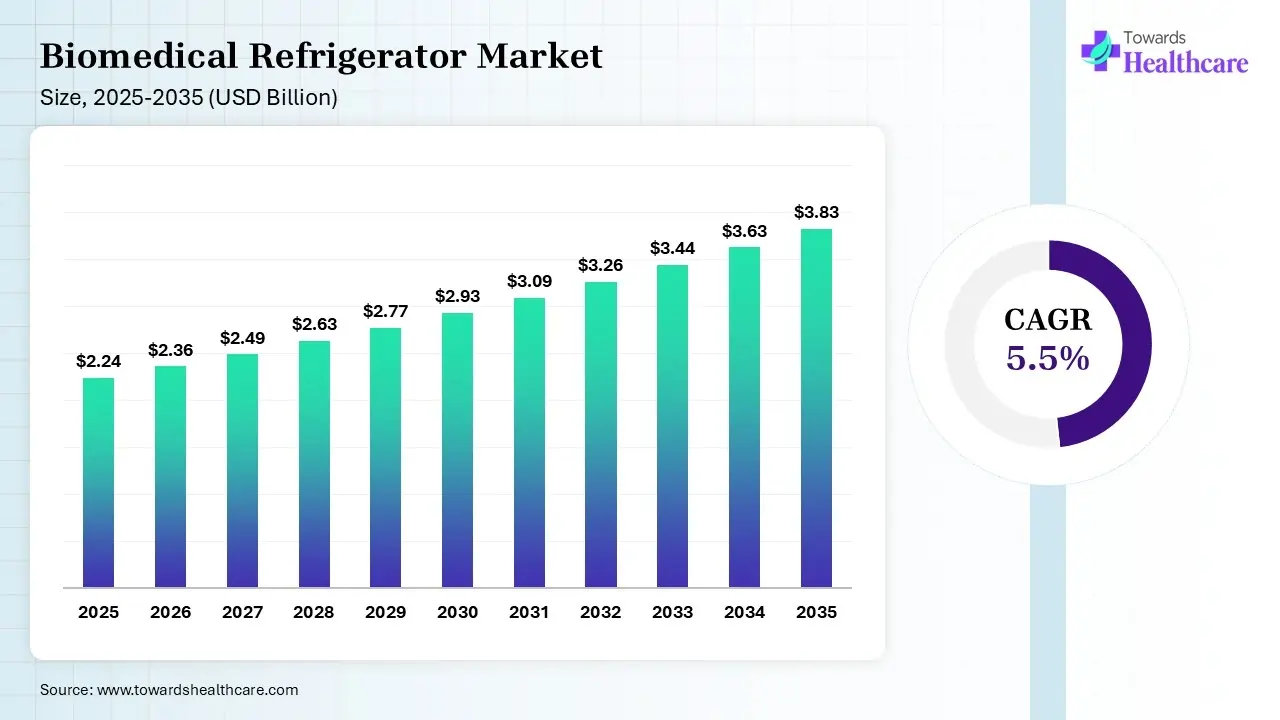
The biomedical refrigerator market was estimated at US$ 2.24 billion in 2025 and is projected to grow from US$ 2.36 billion to US$ 3.83 billion by 2035, rising at a compound annual growth rate (CAGR) of 5.5% from 2026 to 2035. The increasing demand for vaccines and antibiotics, rising demand for blood banks, and growing research & development activities like proteomics and genomics drive the market.
A biomedical refrigerator is a specialized refrigerator that stores biological temperature-sensitive products such as blood, blood components, biological reagents, vaccines, medicines, flammable chemicals, RNA, and DNA. These refrigerators differ from conventional household refrigerators in offering precise temperature control, uniform cooling, and often specialized compartments for organizing samples. They have a microprocessor-based system that accurately measures and monitors interior temperatures using digital sensors such as thermocouples, resistance temperature detectors (RTD), and thermistors. A biomedical refrigerator is commonly used in hospitals, blood banks, diagnostic centers, pharmacies, educational institutes, and research laboratories.
The increasing prevalence of chronic disorders, such as viral diseases, potentiates the development and use of vaccines. Vaccines must be stored in cold temperatures to prevent their degradation, and some antibiotics and biological therapeutics also need to be stored in refrigerators. The rising awareness for blood donation and the prevalence of hematological disorders promote blood banks, increasing the requirement for a biomedical refrigerator. The growing proteomics and genomics research augment the use of biomedical refrigerators for storing proteins, DNA, and RNA.
Cell and gene therapy products such as stem cells, skin grafts, expanded autologous cells, cancer vaccines, cellular immunotherapies, bacterial/viral vectors, plasmid DNA, etc., require cold storage conditions. Stem cells require storage temperatures from -80oC to -196oC, while RNA and DNA require storage temperatures from -70oC to -80oC. The increasing demand for such products and regulatory approvals potentiate the requirement for biomedical refrigerators in various research laboratories and clinical settings. The increasing investments in cell & gene therapy research potentiate their development. According to the DealForma data, cell and gene therapy developers raised $3.5 billion across 65 deals in 2023. The therapy is used to treat several disorders like cancer, cystic fibrosis, diabetes, immunological disorders, heart disease, and hemophilia. Additionally, the latest innovations and the increasing number of clinical trials boost cell and gene therapy while simultaneously increasing the demand for biomedical refrigerators.
Artificial Intelligence (AI) is transforming the biomedical refrigerator market with predictive maintenance, real-time temperature monitoring, and smart inventory management. AI systems reduce energy consumption, prevent costly spoilage of vaccines and biological samples, and ensure regulatory compliance through automated data logging and alerts. AI improves energy efficiency by adjusting cooling cycles and defrost schedules based on real-time usage and environmental conditions. AI algorithms analyze performance data to predict component failures, reducing downtime and extending equipment lifespan.
Advanced sensors and machine learning quickly detect temperature deviations, sending alerts. AI, often integrated with IoT and computer vision, automates inventory tracking and generates compliance reports for regulatory bodies. The combination of AI and IoT is leading to smart refrigeration systems that allow remote management and data analysis in hospitals, labs, and pharmacies. The market is driven by the increasing need for secure storage of vaccines, blood products, and advanced therapies, as well as the demand for energy efficiency. Current innovations focus on self-learning systems that require little to no human intervention for optimization.
The major challenge in the biomedical refrigerator market is the high upfront cost. New biomedical refrigerators generally range from $2,000 to $15,000, depending on the unit’s size, capacity, and features. The latest advancements in the product, such as ultra-low temperature capabilities and explosion-proof construction, increase the product’s price, restricting its use by small and medium enterprises.
| Table | Scope |
| Market Size in 2026 | USD 2.36 Billion |
| Projected Market Size in 2035 | USD 3.83 Billion |
| CAGR (2026 - 2035) | 5.5% |
| Leading Region | North America |
| Historical Data | 2020 - 2023 |
| Base Year | 2025 |
| Forecast Period | 2026 - 2035 |
| Measurable Values | USD Millions/Units/Volume |
| Market Segmentation | By type, By application, By Region |
| Top Key Players | Angelantoni Life Sciences, Arctiko, B Medical Systems, Biomedical Solutions, Inc., Eppendorf AG, Haier Biomedical, NuAire, PHC Holdings Corporation, Philips Kirsch GmbH, SKSurgitech, Terumo Corporation, Vestfrost Solutions |
By type, the under -400C segment held a dominant presence in the biomedical refrigerator market in 2025. Several biological products such as cell and gene therapy products such as stem cells, DNA and RNA, human heart valve allografts, etc. require freezing conditions for their storage. Such ultra-low temperatures are needed for many biosamples like proteins and antibodies to slow down the rate of molecular degradation. The rising demand for such biological products promotes the market. Many organizations are continuously evolving and innovating novel products to maintain ultra-low temperatures.
By application, the pharmacy segment led the biomedical refrigerator market in 2025. Biomedical refrigerators are a primary requirement for several pharmaceutical companies and pharmacy stores. Pharmacy refrigerators are required for the safe storage of pharmaceuticals such as medications and live vaccines. They usually require a temperature between 2oC to 15oC. The increasing demand for antibiotics, cancer therapeutics, and vaccines fosters market growth.
North America held the largest share of the biomedical refrigerator market in 2025. The presence of key players, technological advancements, favorable infrastructure, state-of-the-art research and development facilities, and rising incidences of chronic disorders drive the market. The U.S. Government organizations such as the Food and Drug Administration and the US Agency for International Development impose guidelines about the use and selection of refrigerators for biomedical products. According to the American Red Cross, nearly 16 million blood components are transfused annually in the U.S.
Also, around 29,000 units of RBCs are needed every day in the U.S. Additionally, the growing research on cell and gene therapy and increasing clinical trials potentiate the use of biomedical refrigerators. As of March 2024, a total of 36 gene therapies have been approved by the US FDA. Furthermore, several organs are needed to be stored in cold temperatures. According to the United Network for Organ Sharing, more than 46,000 organ transplants were performed in the U.S. in 2023.
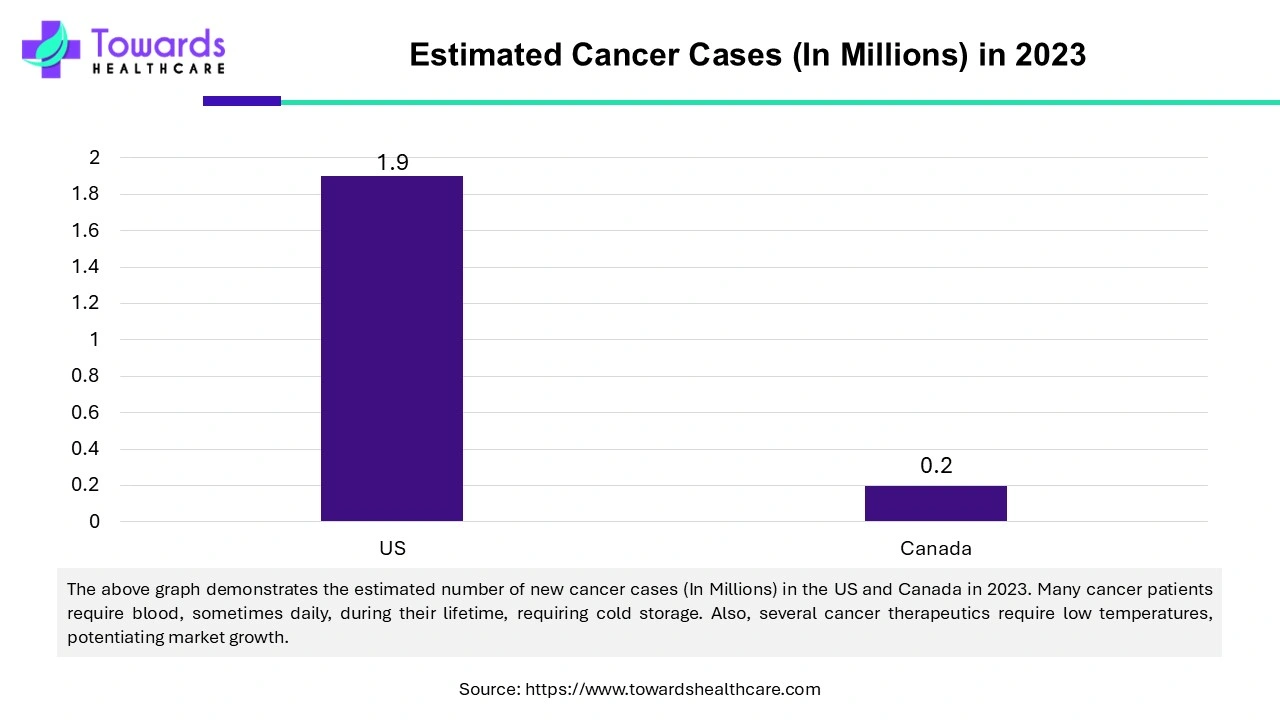
Asia-Pacific is anticipated to grow at the fastest rate in the biomedical refrigerator market during the forecast period. The rising incidences of chronic disorders, technological advancements, favorable government policies, increasing investments, and growing research & development activities. The rising population in the region increases the demand for huge amounts of biomedical products, resulting in more manufacturing and storage of products to meet consumer needs. Countries like China, India, and Japan have favorable infrastructure for manufacturing and storing biomedical products. India dominates the production of vaccines for diseases like measles, BCG, and DPT. The WHO sources 65% to 70% of its vaccine requirements from India. China is the leading manufacturer of antibiotics globally. It was found that around 248,000 tons of antibiotics are produced in China, out of which 160,600 tons were utilized domestically and 88,000 tons were exported. These products require refrigerators for their storage.
Europe is expected to experience significant growth in the biomedical refrigerator market during the forecast period. The increasing demand for the use of vaccines, biologics, biosimilars, etc., is driving Europe. These vaccines and biologics require cold temperatures to maintain their stability. If there is a change in the temperature, then the formulations may get damaged or may even cause toxic effects. Thus, this increases the use of biomedical refrigerators for maintaining the temperature of these formulations.
Germany Market Trends
The industries in Germany are focusing on innovative developments of various therapies as well as treatment options for different diseases. Thus, this raises the demand for the biomedical refrigerator. Their use is increasing as it provides a suitable environment for such samples and maintains their stability through the development process. Similarly, the hospitals are also increasing the use of biomedical refrigerators due to the increasing gene therapies, vaccines, etc.
UK Market Trends
The UK has a well-developed healthcare sector. Furthermore, there is a rise in the disease, leading to an increase in the demand for the use of biologics or biosimilars. This enhances the manufacturing process as well as research in industries and institutes. Hence, due to this, there is a rise in the use of biomedical refrigerators, which is crucial for the management of the stability of the product. Furthermore, the government is also supporting the industries and institutes by providing investments and funding.
Strengths
• The essential and non-negotiable role of equipment in hospitals, pharmacies, and labs for the storage of blood, vaccines, and samples.
• Integration of IoT, smart monitoring, and alarms ensures accurate temperature control.
• A variety of products is available, including blood bank refrigerators, plasma freezers, and ultra-low temperature freezers.
Weaknesses
• Advanced biomedical refrigeration systems require a significant investment from healthcare facilities.
• Regular, specialized, and technical maintenance is necessary to avoid compressor failures and maintain compliance.
• The high energy consumption of freezers, particularly ULT models, increases operational expenses.
Opportunities
• The growing incidence of chronic diseases and the rise in global vaccination initiatives boost demand.
• Increased funding for research and diagnostic laboratories calls for advanced cold storage solutions.
• There is a consistent need to replace older, less efficient units with smart, energy-saving technology.
Threats
• Strict and changing quality and safety regulations for storage equipment can limit market entry.
• The presence of major companies like Thermo Fisher, Haier, Eppendorf puts pressure on prices.
• Limited space in hospitals and clinics makes it difficult to adopt larger and specialized equipment.
By Type
By Application
By Region




Principal Consultant
Shivani Zoting is a dedicated research analyst specializing in the healthcare industry. With a strong academic foundation, a B.Sc. in Biotechnology and an MBA in Pharmabiotechnology, she brings a unique blend of scientific understanding and strategy.
Learn more about Shivani Zoting
Reviewed By
Aditi Shivarkar is a seasoned professional with over 14 years of experience in healthcare market research. As a content reviewer, Aditi ensures the quality and accuracy of all market insights and data presented by the research team.
Learn more about Aditi Shivarkar