

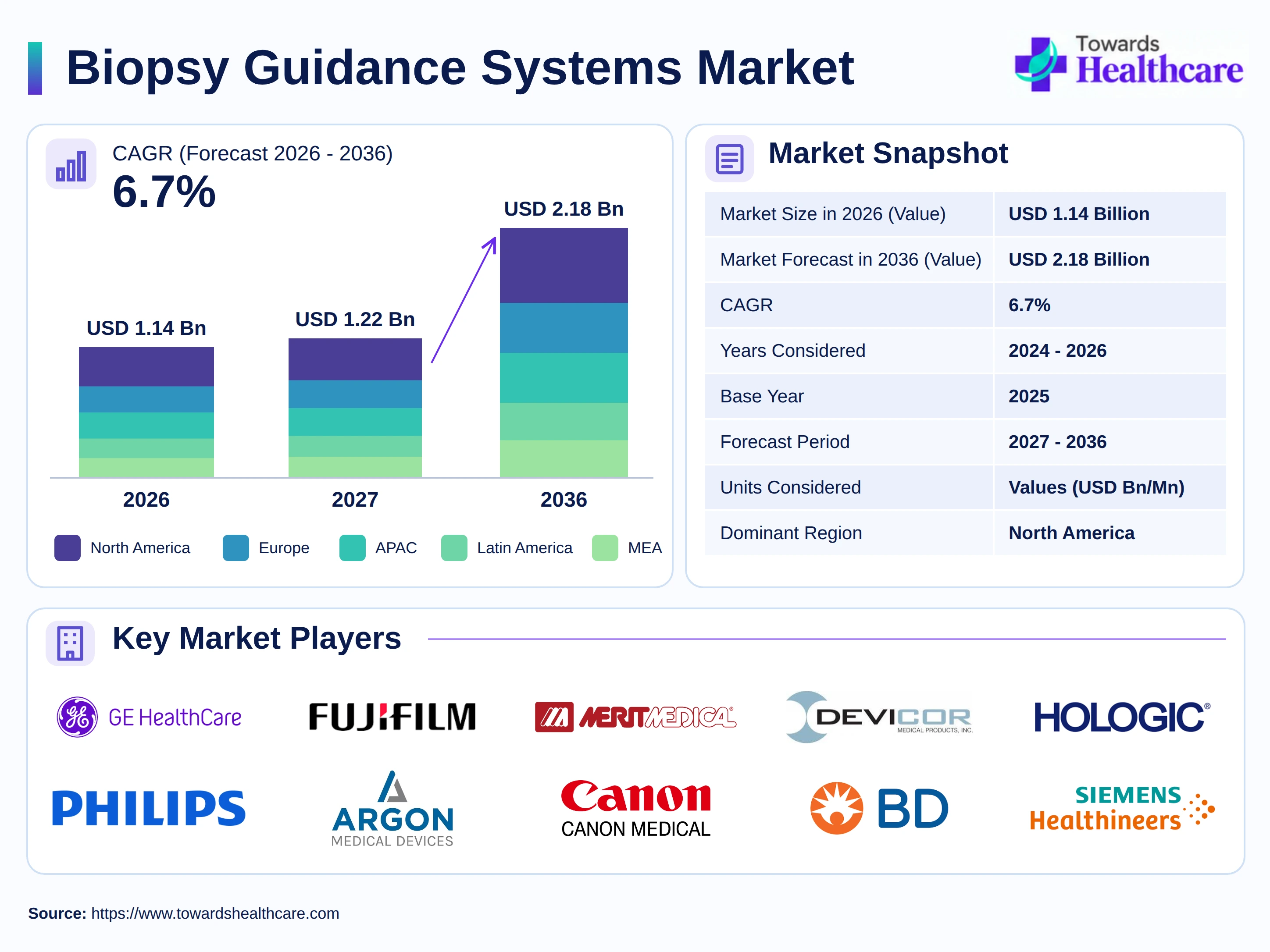
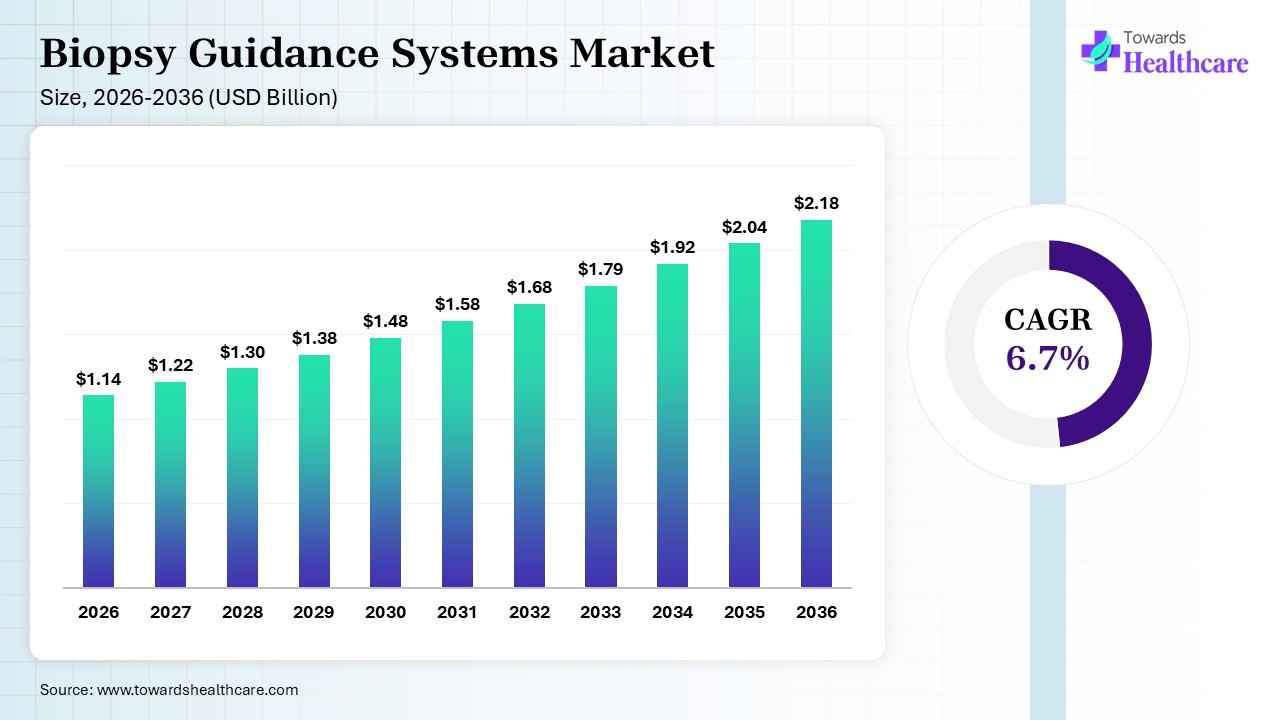
The biopsy guidance systems market size is anticipated to grow to US$ 1.14 billion in 2026 and is projected to reach US$ 2.18 billion by 2036, registering a CAGR of 6.7% from 2026 to 2035. The market is driven by high demand for image-guided diagnostics and other advancements.
Biopsy guidance systems operate at the intersection of diagnostic imaging, interventional radiology, image-guided procedures, and precision oncology. Market growth is driven by rising demand for cancer diagnosis, increased use of minimally invasive procedures, advances in imaging technology, and hospital investments in systems that improve lesion localization, sampling accuracy, and procedural efficiency.
Biopsy guidance systems deliver value across the clinical workflow. Imaging identifies suspicious lesions, guidance technologies direct needles or sampling devices, accessories support tissue collection, and software improves targeting and procedure documentation. Market opportunities therefore vary by imaging modality, anatomical application, procedure setting, business model, and the installed base of imaging platforms.
This analysis focuses on biopsy guidance systems and separates them from the broader biopsy instruments, medical imaging, pathology, and molecular diagnostics markets. It covers capital equipment sales and recurring procedure-related revenue, with particular attention to guidance systems, disposable products, software, and equipment replacement.
Equipment market growth depends on capital investment as well as biopsy volumes. Hospitals can accommodate higher procedure volumes through more efficient use of existing equipment without additional capital spending. However, aging systems, demand for greater targeting precision, and advances in imaging technology support equipment upgrades and replacement. The analysis distinguishes procedure growth from replacement demand, pricing changes, and shifts in product mix.
Suppliers need to demonstrate measurable improvements in procedural efficiency, equipment utilization, and clinical workflows to justify capital investments. Established markets offer opportunities through equipment replacement and adoption of advanced systems. Emerging markets favor suppliers with competitive pricing, reliable service, and strong support networks. The report evaluates these opportunities through revenue potential, unit shipments, installed base expansion, replacement cycles, average selling prices (ASPs), regional demand, and base, upside, and downside forecasts through 2035.
The accompanying dataset tracks historical market development through 2025 and provides forecasts through 2035. It includes revenue, unit shipments, and installed base by modality and application, along with replacement demand, ASPs, and regional breakdowns. Users can assess growth drivers, distinguish replacement demand from volume-driven growth, compare equipment and regional opportunities, and evaluate the impact of pricing pressure and market share changes. These insights support detailed assessments of market demand, capital investment, and competitive positioning.
Market Size & Growth Outlook
Regional Market Spotlight
Segmental Spotlight
The global biopsy guidance system market includes capital equipment and procedure-related consumables across multiple imaging modalities. Market estimates vary by scope. Some definitions cover stereotactic breast biopsy units and dedicated guidance consoles, while others include imaging systems and related biopsy accessories.
North America leads the established market, supported by a mature diagnostic network and widespread use of specialized biopsy equipment. Asia Pacific offers strong growth opportunities as oncology infrastructure, diagnostic imaging capacity, and clinical expertise expand. Ultrasound-guided systems benefit from broad clinical use, while stereotactic and MRI-guided platforms serve more complex breast biopsy procedures.
Market growth depends on new equipment installations, platform replacement, adoption of advanced guidance technologies, and recurring revenue from procedure-related consumables. Each revenue stream has distinct growth and profitability drivers, making installed base analysis essential for assessing market potential.
There are four main segments in the market: mode of guidance, clinical application, equipment setup, and the type of customer. Ultrasound-guided biopsy makes use of real-time imaging, relatively low procedure complexity, and high accessibility. Stereotactic systems are used for accurate sampling of lesions in the breast tissue, including those detected by means of mammography, and MRI-guided systems are used for selected lesions that cannot be targeted by other systems.
It is impossible to calculate precisely the percentage share of each of the categories in the market due to the lack of consistent criteria for inclusion. Thus, the percentage share of each segment is considered as an output of the model.
| Segments | 2026 Share | 2026 Market Value (USD Million) |
| Ultrasound-Guided Biopsy Systems | 32% | $364.8 |
| Stereotactic/Mammography-Guided Biopsy Systems | 18% | $205.2 |
| MRI-Guided Biopsy Systems | 12% | $136.8 |
| CT-Guided Biopsy Systems | 14% | $159.6 |
| MRI-Ultrasound Fusion-Guided Biopsy Systems | 16% | $182.4 |
| Other Image-Guided and Navigation-Enabled Biopsy Systems | 8% | $91.2 |
Ultrasound-guided systems are estimated to lead the modality segment, consistent with the supplied takeaway identifying them as the leading modality in 2025. MRI-ultrasound fusion systems are also important, particularly for prostate biopsy procedures that benefit from combining MRI lesion information with real-time ultrasound guidance.
| Segments | 2026 Share | 2026 Market Value (USD Million) |
| Breast Biopsy | 25% | $285 |
| Prostate Biopsy | 20% | $228 |
| Lung Biopsy | 13% | $148.2 |
| Liver Biopsy | 8% | $91.2 |
| Kidney Biopsy | 6% | $68.4 |
| Lymph Node Biopsy | 7% | $79.8 |
| Thyroid Biopsy | 6% | $68.4 |
| Musculoskeletal and Soft Tissue Biopsy | 5% | $57 |
| Other Organ Biopsies | 10% | $114 |
Breast biopsy is estimated to account for the largest share, supported by screening follow-up and image-guided diagnostic procedures. Prostate biopsy represents another major application and is positioned for strong growth as MRI-ultrasound fusion and targeted sampling techniques become more widely adopted.
| Segments | 2026 Share | 2026 Market Value (USD Million) |
| Dedicated Biopsy Guidance Consoles | 31% | $353.4 |
| Imaging-Integrated Biopsy Guidance Systems | 25% | $285 |
| Software-Based Guidance and Navigation Platforms | 14% | $159.6 |
| Fusion Imaging and Navigation-Enabled Systems | 19% | $216.6 |
| Robotic-Assisted Biopsy Guidance Systems | 11% | $125.4 |
Dedicated biopsy guidance consoles are estimated to hold the largest share, consistent with the supplied takeaway on system configuration in 2025. Imaging-integrated and fusion-enabled systems are also important as healthcare facilities seek to streamline image review, target localization, and procedural workflows.
| Segments | 2026 Share | 2026 Market Value (USD Million) |
| Biopsy Guidance Equipment and Consoles | 32% | $364.8 |
| Imaging-Compatible Positioning Systems | 15% | $171 |
| Needle Guidance and Targeting Accessories | 14% | $159.6 |
| Biopsy Guidance Software | 13% | $148.2 |
| Image Registration and Fusion Software | 11% | $125.4 |
| Compatible Procedural Accessories | 10% | $114 |
| Other System Components | 5% | $57 |
Equipment and consoles are estimated to lead product revenue because they form the core infrastructure for image-guided biopsy procedures. Biopsy guidance software and image registration tools may expand faster as providers adopt fusion imaging, workflow automation, and more precise lesion-targeting capabilities.
| Segments | 2026 Share | 2026 Market Value (USD Million) |
| Capital Equipment Revenue | 42% | $478.8 |
| Software Licensing and Upgrades | 10% | $114 |
| Biopsy Accessories and Components | 13% | $148.2 |
| Recurring Consumables Revenue | 15% | $171 |
| Installation and Clinical Training Services | 5% | $57 |
| Maintenance, Repair and Technical Support | 9% | $102.6 |
| Extended Warranty and Lifecycle Services | 6% | $68.4 |
Capital equipment is estimated to generate the largest share of 2026 revenue because facilities invest in consoles, imaging integration, and guidance hardware. Recurring consumables, software upgrades, and lifecycle services provide repeat revenue after installation and may become increasingly important as the installed base expands.
| Segments | 2026 Share | 2026 Market Value (USD Million) |
| Ultrasound-Guided Core Needle Biopsy | 24% | $273.6 |
| Stereotactic Breast Biopsy | 15% | $171 |
| Vacuum-Assisted Breast Biopsy | 13% | $148.2 |
| MRI-Guided Breast Biopsy | 9% | $102.6 |
| MRI-Ultrasound Fusion-Guided Prostate Biopsy | 16% | $182.4 |
| CT-Guided Percutaneous Biopsy | 14% | $159.6 |
| Other Image-Guided Biopsy Procedures | 9% | $102.6 |
Ultrasound-guided core needle biopsy is estimated to account for the largest procedure share due to its use across multiple accessible tissues and clinical settings. MRI-ultrasound fusion-guided prostate biopsy is another strategically important category, with the supplied market outlook identifying it as a fast-growing procedure type.
| Segments | 2026 Share | 2026 Market Value (USD Million) |
| Hospitals | 43% | $490.2 |
| Breast Imaging and Diagnostic Centers | 15% | $171 |
| Diagnostic Imaging Centers | 12% | $136.8 |
| Ambulatory Surgical Centers | 8% | $91.2 |
| Urology and Specialty Clinics | 9% | $102.6 |
| Interventional Radiology Centers | 7% | $79.8 |
| Academic and Research Institutions | 4% | $45.6 |
| Other Healthcare Facilities | 2% | $22.8 |
Hospitals are estimated to lead the end-user segment, consistent with the supplied takeaway. Their demand reflects the availability of imaging equipment, specialist teams, and facilities for complex diagnostic procedures. Dedicated breast imaging centers, diagnostic imaging centers, and urology clinics also contribute to demand for application-specific guidance systems.
| Segments | Share of Hospital Segment | 2026 Market Value (USD Million) |
| Public Hospitals | 32% | $156.864 |
| Private Hospitals | 38% | $186.276 |
| Specialty and Tertiary-Care Hospitals | 30% | $147.06 |
| Total Hospital Allocation | 100% | $490.2 |
Private hospitals are estimated to account for the largest share of hospital-related spending, with public hospitals and specialty or tertiary-care facilities also contributing substantially. Purchasing patterns vary with capital budgets, procedural volume, and access to advanced imaging and interventional services.
| Segments | 2026 Share | 2026 Market Value (USD Million) |
| Two-Dimensional Image-Guided Systems | 35% | $399 |
| Three-Dimensional Image-Guided Systems | 18% | $205.2 |
| Image Fusion and Multimodal Guidance | 19% | $216.6 |
| Computer-Assisted Navigation Systems | 10% | $114 |
| Automated Targeting Systems | 7% | $79.8 |
| Robotic-Assisted Guidance Systems | 6% | $68.4 |
| Artificial Intelligence-Enabled Targeting and Workflow Support | 5% | $57 |
Two-dimensional image-guided systems are estimated to retain the largest share, reflecting their established role in routine biopsy procedures. Image fusion, three-dimensional visualization, computer-assisted navigation, and AI-enabled workflows are important development areas because they can help clinicians localize targets and plan procedures more precisely.
| Segments | 2026 Share | 2026 Market Value (USD Million) |
| Direct Equipment Purchase | 48% | $547.2 |
| Leasing and Equipment Financing | 15% | $171 |
| Equipment Placement and Consumables Agreements | 12% | $136.8 |
| Bundled Equipment and Service Contracts | 11% | $125.4 |
| Subscription-Based Software and Support | 6% | $68.4 |
| Shared Equipment and Managed-Service Models | 8% | $91.2 |
Direct equipment purchase is estimated to be the largest purchasing model, consistent with the supplied takeaway for 2025. Leasing and bundled service arrangements can help providers manage upfront capital requirements, while subscriptions support ongoing access to software, upgrades, and technical support.
| Segments | 2026 Share | 2026 Market Value (USD Million) |
| North America | 37% | $421.8 |
| Latin America | 5% | $57 |
| Europe | 27% | $307.8 |
| Asia Pacific | 25% | $285 |
| Middle East and Africa (MEA) | 6% | $68.4 |
North America is estimated to lead the regional market, consistent with the supplied 2025 takeaway, supported by established diagnostic imaging infrastructure and adoption of advanced biopsy technologies. Europe and Asia Pacific also represent substantial markets, while growth opportunities in Latin America and MEA are linked to diagnostic capacity expansion and investment in healthcare facilities.
The United States is estimated to account for most North American revenue because of its large hospital network, advanced diagnostic imaging capacity, and adoption of image-guided biopsy technologies. Canada and Mexico contribute through hospital investment, diagnostic services, and regional medical-device supply chains.
Brazil is estimated to be the largest separately identified market in Latin America, reflecting its healthcare infrastructure and demand for diagnostic procedures. Argentina and other countries contribute through public and private healthcare providers, although equipment access and purchasing budgets vary across the region.
Western Europe is estimated to account for the larger portion of European demand due to established diagnostic imaging services, hospital investment, and access to advanced biopsy systems. Eastern Europe contributes through hospital modernization and growing demand for image-guided diagnostic procedures.
Germany, France, and the United Kingdom are estimated to represent significant demand within Western Europe because of their healthcare infrastructure and use of advanced diagnostic imaging. Other markets contribute through hospital procurement and specialist diagnostic services.
Türkiye and Russia and Belarus are estimated to contribute notable shares within this illustrative grouping, alongside Austria and other markets. Demand is influenced by healthcare investment, access to diagnostic imaging, and procurement of biopsy guidance equipment.
China is estimated to represent the largest separately identified Asia Pacific market, while Japan, India, and South Korea also contribute to regional demand. Growth is supported by hospital investment, expanding diagnostic services, and adoption of advanced imaging and image-fusion technologies.
GCC countries are estimated to account for half of the MEA allocation in this illustrative model. South Africa and Egypt represent other separately identified markets, while the remaining share covers healthcare systems across the wider region.
Saudi Arabia and the UAE are estimated to lead the GCC allocation, supported by healthcare investment and demand for advanced diagnostic services. Qatar, Kuwait, Oman, and Bahrain contribute smaller shares in line with their respective healthcare markets and equipment procurement needs.
Around 20 million new cancer cases were diagnosed worldwide in 2022, creating substantial demand for tissue biopsy. However, cancer incidence does not translate directly into demand for biopsy guidance systems. Not every cancer case requires a new image-guided biopsy, and many biopsies proceed without specialized imaging equipment.
Market growth is driven by early diagnosis, wider adoption of image-guided procedures, demand for precise lesion targeting, and increased use of minimally invasive tissue sampling. Key barriers include hospital budget constraints, inconsistent reimbursement policies, shortages of trained specialists, and competition from alternative biopsy techniques.
Technological advances improve targeting accuracy and procedural efficiency, but adoption depends on measurable clinical and economic benefits. Systems that reduce repeat sampling and shorten procedure times offer a stronger case for investment. Advanced platforms with low utilization face challenges in delivering acceptable returns.
Average selling prices vary significantly across biopsy guidance systems. Stereotactic devices, ultrasound-guided systems, MRI-compatible guidance platforms, and navigation systems have different purchase, installation, and maintenance costs. Public pricing data remains limited, and quoted prices often cover different combinations of equipment, accessories, and services.
The key purchasing metric is the total cost of ownership per procedure, including equipment acquisition, maintenance, and consumables. Lower-cost systems suit routine, high-volume procedures, while advanced guidance platforms justify higher investment when complex cases require greater precision.
The report evaluates equipment price ranges by configuration, consumable costs per procedure, service contracts, warranties, installation expenses, and estimated equipment lifespan. It also examines tender discounts, bundled pricing, financing arrangements, and the relationship between equipment utilization and payback periods.
Supply depends on specialized medical device manufacturing, compatibility with imaging systems, component availability, regulatory compliance, and field-service coverage. Demand is driven by equipment replacement, new diagnostic center openings, procedure volumes, and access to trained specialists.
Supply constraints in biopsy guidance systems extend beyond manufacturing capacity. Product qualification, installation support, software validation, and staff training affect implementation timelines. Dependence on specialized components and proprietary supplies adds further constraints.
The study compares regional installations, disclosed manufacturing locations, expected utilization rates, delivery lead times, replacement demand, and service coverage. It also distinguishes supply shortages caused by manufacturing or component constraints from purchasing delays linked to capital approval, hospital infrastructure, and implementation readiness.
The biopsy guidance system value chain covers imaging equipment, mechanical positioning devices, targeting software, biopsy instruments, disposable accessories, installation, clinical support, and after-sales service. Recurring revenue also comes from replacement parts, consumables, and equipment maintenance.
Competitive advantage depends on compatibility with existing imaging systems, equipment reliability, targeting accuracy, and access to skilled technical support. Proprietary components and consumables generate recurring revenue, while high operating costs and integration challenges limit adoption.
The report examines each stage of the value chain, from component sourcing and equipment assembly to software development, clinical validation, distribution, hospital sales, and after-sales service. It also distinguishes company-level profit margins from estimated market-level economics to clarify profitability across the value chain.
Ultrasound-guided, mammography-based stereotactic, MRI-compatible, and MRI-ultrasound fusion-guided biopsy systems address different clinical needs. Each technology follows a distinct development path. Key advances include improved needle guidance, automated targeting, robotic positioning, enhanced visualization, and workflow optimization tools. However, comparable data on adoption rates, diagnostic adequacy, repeat sampling, and procedural efficiency remain limited across these technologies.
Adoption of advanced guidance systems depends on measurable improvements over existing imaging workflows. MRI-ultrasound fusion and automated targeting offer advantages in complex lesion localization, while conventional ultrasound and stereotactic systems remain established options for routine procedures. Successful adoption depends on integration with existing imaging platforms, clinical validation, staff training, and competitive total cost of ownership.
Hospitals need clear clinical or operational benefits to justify the cost of purchasing, installing, and maintaining advanced systems. Relevant benefits include improved targeting accuracy, fewer repeat procedures, shorter procedure times, and better workflow efficiency. Regulatory requirements also influence product development and market access. In the U.S., applicable requirements depend on the device's intended use and regulatory classification. In the EU, medical devices must comply with the applicable regulatory framework, including the Medical Device Regulation (MDR) where relevant. Maintenance requirements, waste disposal, packaging, consumables, and sustainability also affect lifecycle costs and operational planning.
The technology and regulatory dataset tracks biopsy guidance modalities by configuration, software capabilities, automation level, intended clinical use, regulatory status, geographic availability, launch status, and disclosed clinical performance data. Where information is available, the dataset also covers product validation, interoperability, and sustainability at the product and company levels. Filtering and benchmarking enable comparisons of technology maturity, regulatory readiness, market access, and clinical applicability across competing systems.
Healthcare facilities have different biopsy needs based on their specialties, procedure volumes, equipment requirements, and investment priorities. Hospitals, breast imaging centers, diagnostic centers, urology departments, and interventional radiology units evaluate systems based on their clinical applications and expected returns. Breast imaging centers prioritize stereotactic platforms and compatibility with vacuum-assisted biopsy. Prostate centers focus on MRI-ultrasound fusion and software-based targeting systems.
Procurement decisions depend on diagnostic performance, patient safety, compatibility with existing equipment, procedural efficiency, staff training, and total cost of ownership. Existing imaging infrastructure also affects purchasing decisions. Switching to a new platform often requires workflow changes, system integration, and additional staff training, increasing implementation costs.
The report segments customers by facility type, procedure volume, installed equipment, procurement approach, and clinical application to assess purchasing priorities and demand across end-user groups.
The biopsy guidance system market has three main competitor groups: breast biopsy specialists, general diagnostic imaging manufacturers, and companies focused on image fusion, navigation, and robotic guidance. Each group follows a distinct business model and competes through different strengths.
Breast biopsy specialists compete on workflow efficiency, sampling performance, system reliability, and their installed base. Diagnostic imaging manufacturers benefit from integration with CT, ultrasound, and interventional imaging platforms. Navigation and image-fusion specialists compete on targeting precision, software capabilities, and ease of use.
Competitive intensity varies across market segments. Breast biopsy systems have a more concentrated competitive landscape, while the broader image-guided biopsy market includes a wider range of technologies and suppliers.
| Company | Headquarters | Market position | Core strength and applications |
| Hologic | Marlborough, US | Direct leader | Breast biopsy and breast imaging |
| BD | Franklin Lakes, US | Direct/adjacent | Biopsy instruments and sampling |
| Siemens Healthineers | Forchheim, Germany | Imaging ecosystem | Imaging-integrated interventions |
| GE HealthCare | Chicago, US | Imaging ecosystem | Ultrasound and interventional imaging |
| Philips | Amsterdam, Netherlands | Imaging ecosystem | Image-guided intervention |
| Canon Medical Systems | Otawara, Japan | Imaging ecosystem | CT and diagnostic imaging |
| Fujifilm | Tokyo, Japan | Imaging/biopsy | Diagnostic imaging and endoscopy |
| Devicor Medical Products | Cincinnati, US | Direct specialist | Mammotome breast biopsy systems |
| Merit Medical Systems | South Jordan, US | Procedural specialist | Biopsy and interventional devices |
| Cook Medical | Bloomington, US | Procedural specialist | Biopsy and tissue-sampling products |
| Argon Medical Devices | Frisco, US | Procedural specialist | Biopsy needles and accessories |
| KOELIS | La Tronche, France | Technology specialist | Prostate MRI-ultrasound fusion |
| Exact Imaging | Markham, Canada | Technology specialist | High-resolution micro-ultrasound |
| BK Medical | Burlington, US | Imaging specialist | Intraoperative ultrasound |
| Esaote | Genoa, Italy | Regional/global specialist | Ultrasound and MRI |
| CIVCO Medical Solutions | Coralville, US | Accessory specialist | Image-guided procedure accessories |
| Medtronic | Galway, Ireland | Adjacent technology | Navigation and surgical guidance |
| Intuitive Surgical | Sunnyvale, US | Adjacent technology | Robotic platforms and guided procedures |
| Olympus | Tokyo, Japan | Procedural specialist | Endoscopic biopsy workflows |
| Boston Scientific | Marlborough, US | Procedural specialist | Endoscopic and interventional devices |
| Stryker | Portage, US | Adjacent technology | Surgical navigation and imaging |
| Clarius Mobile Health | Vancouver, Canada | Emerging specialist | Portable ultrasound guidance workflows |
A broad product portfolio does not automatically establish market leadership. Dedicated breast biopsy systems compete on workflow efficiency and tissue sampling performance, while navigation platforms focus on lesion localization and anatomical targeting. Imaging manufacturers benefit from broader scanner portfolios and integration with hospital infrastructure.
The analysis compares stereotactic, ultrasound-guided, MRI-guided, fusion-guided, and navigation systems across supported procedures, accessories, software capabilities, and services. It also identifies portfolio gaps in affordable solutions, interoperability, and clinical applications that require limited operator intervention.
Technology leadership is assessed through product maturity, regulatory status, clinical evidence, software integration, usability, and market adoption. Patent counts require careful interpretation because patent families and geographic coverage vary across companies.
The analysis benchmarks automated targeting, needle visualization, MRI-ultrasound fusion, robotic assistance, and workflow software. It distinguishes commercially available features from prototype technologies and development-stage innovations. Actual purchasing activity provides a key measure of market acceptance and commercial relevance.
Competition varies across breast imaging, prostate biopsy, and broader image-guided interventions. Specialized applications favor companies with dedicated platforms, while imaging manufacturers benefit in markets where hospitals prioritize integrated solutions, and compatibility with existing equipment.
North America represents the largest established market, supported by mature diagnostic infrastructure and widespread use of advanced imaging technologies. Europe combines advanced imaging capabilities with country-specific procurement and reimbursement requirements. Asia Pacific offers strong growth potential from a smaller installed base, although equipment costs, affordability, and differences in healthcare infrastructure remain key barriers.
Key Coverage
Manufacturing capacity, quality control, software development, and technical support are critical to the biopsy guidance system market. Production capability alone does not guarantee competitiveness. Installation quality, spare parts availability, regulatory compliance, and service responsiveness directly affect customer satisfaction and retention.
The study compares manufacturing facilities, production investments, supply dependencies, service networks, and local market presence. It distinguishes companies with dedicated biopsy system manufacturing facilities from those that do not publicly disclose their production capacity.
Key Coverage
Sales of biopsy guidance systems often require clinical demonstrations, installation, staff training, and after-sales support. Distributors extend market reach, particularly across geographically dispersed markets with diverse customer bases. Experience in medical imaging strengthens their ability to sell equipment to hospitals and support integration into existing clinical workflows.
Competitive advantage depends on application expertise, training quality, service capabilities, and clinical workflow support. The analysis compares companies by distribution reach, customer concentration, service capabilities, and growth potential across target markets.
Developments from 2023 to 2026 are assessed based on completed product launches, portfolio upgrades, acquisitions, and announced strategic initiatives. Key areas include breast biopsy system enhancements, advanced imaging features, software-guided targeting, prostate fusion technologies, and expansion into related image-guided procedures.
Hologic’s 2025 annual financial disclosures highlighted supply and manufacturing challenges affecting certain needle-based Brevera products. This example underscores the importance of consumable availability in competitive due diligence. Reliable supplies directly support equipment utilization, recurring revenue, and customer retention.
Acquisition opportunities are strongest in companies with proprietary guidance software, specialized clinical expertise, differentiated biopsy technology, or access to underpenetrated markets. Imaging and surgical navigation companies also offer strategic value through complementary technologies and capabilities, even when they do not compete directly in biopsy guidance systems.
The M&A analysis distinguishes biopsy-specific acquisitions from broader medical technology transactions. Key assessment factors include transaction value, target revenue, technology ownership, geographic reach, integration risks, and opportunities to expand consumables and service revenue. Valuations are excluded when transaction terms are not publicly disclosed.
| Opportunity | Strategic rationale | Principal success metric |
| Advanced breast biopsy | Greater targeting and sampling capability | Revenue per installed system |
| Prostate MRI fusion | Specialized lesion localization | Procedures per system |
| Emerging-market installations | Expansion of diagnostic infrastructure | New installations and utilization |
| Software-enabled guidance | Improved workflow and compatibility | Adoption and recurring software revenue |
| Consumables and service | Monetization of installed equipment | Recurring revenue per procedure |
| Lower-cost configurations | Improved affordability | Customer acquisition and payback |
| Interoperable platforms | Reduced integration friction | Installation time and retention |
Opportunity sizing is done using country-wise procedure demand, installed base gaps, pricing of equipment, adoption assumptions, and customers' budget. The opportunity value is given after defining the addressable product category and ensuring no double counting between hardware, software, and consumables.
| Force | Assessment | Market-specific rationale |
| Supplier power | Medium | Specialized components, software, and compatible consumables can create dependencies. |
| Buyer power | Medium-High | Hospital groups and centralized procurement teams can negotiate equipment and service contracts. |
| Threat of new entrants | Medium-Low | Clinical validation, regulatory requirements, distribution, and installed-base access raise barriers. |
| Threat of substitutes | Medium | Alternative imaging approaches, biopsy techniques, and diagnostic pathways affect demand by application. |
| Competitive rivalry | High | Dedicated specialists and broader imaging suppliers compete on performance, integration, and price. |
The report translates these factors into market-access implications, adoption scenarios, and investment priorities by geography.
| Market opportunity | Indicative attractiveness | Main consideration |
| Established breast biopsy centers | Attractive | Replacement demand and established workflows |
| Advanced prostate guidance | Attractive | Specialized technology and clinical adoption requirements |
| Broad imaging-integrated guidance | Attractive | Cross-selling potential and existing hospital relationships |
| Emerging-market installations | Moderate-Attractive | Growth potential offset by affordability and service constraints |
| Undifferentiated equipment offerings | Moderate-Challenging | Price competition and limited differentiation |
| Software and recurring services | Attractive | Installed-base leverage, subject to demonstrated value |
These classifications are based on qualitative assessments and require validation against segment growth, profit margins, market entry costs, customer budgets, and competitive intensity.
The reason behind forecast uncertainty is that the definition of biopsy guidance systems differs according to the market estimates.
Future profitability will depend on specialized breast biopsy procedures, prostate targeting technologies, consumable compatibility, software-guided targeting, and lifecycle services. Competitive advantage will rest on proven clinical value, equipment utilization, system reliability, and recurring revenue from consumables and services.
By Guidance Modality
By Clinical Application
By System Configuration
By Product Type
By Revenue Type
By Procedure Type
By End User
By Technology
By Purchasing Model
By Region



Principal Consultant
Payal Rabde is a Healthcare Market Research Analyst at Towards Healthcare Research & Consulting with 4+ years of experience in pharmaceuticals, biotechnology, medical devices, and life sciences.
Learn more about Payal Rabde

Reviewed By
Aditi Shivarkar is a seasoned professional with over 14 years of experience in healthcare market research. As a content reviewer, Aditi ensures the quality and accuracy of all market insights and data presented by the research team.
Learn more about Aditi Shivarkar