


The global cell dissociation market size is calculated at US$ 461.55 in 2025, grew to US$ 524.23 million in 2026, and is projected to reach around US$ 1649.06 million by 2035. The market is expanding at a CAGR of 13.58% between 2026 and 2035. Cell dissociation is an essential step in diagnostics, study of diseases, isolation of various cell products, etc due to which the cell dissociation market is growing.
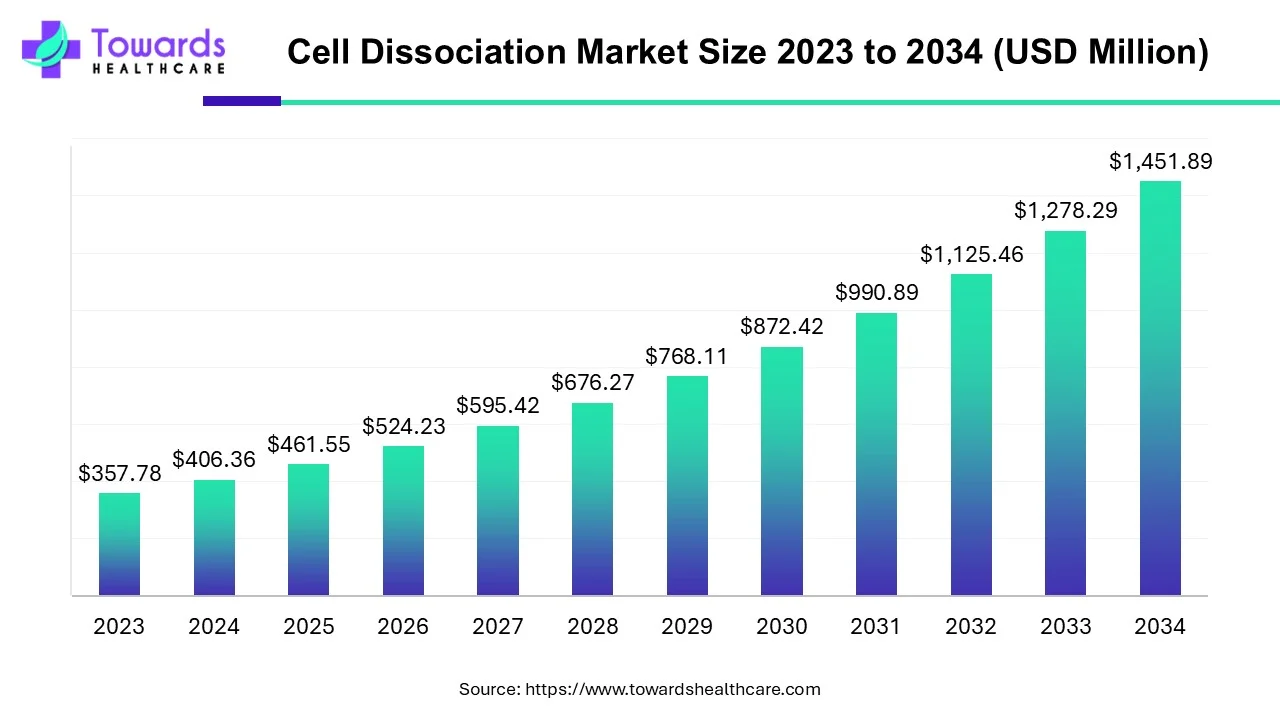
Cell dissociation is the process by which cells separate from the surface they have been treated in order to form suspensions during cell passage. Cell propagation, cell counting for analysis, and reseeding for subculture all depend on these suspensions. One of the most important steps in preparing samples for study and medical use is cell dissociation, which is the process of dividing tissue or cell culture into individual cells. Enzymatic, mechanical, and chemical approaches are among the various methods of cell dissociation that are employed to guarantee the viability and usefulness of cells for subsequent research. Cell multiplication, vaccine development, and cancer treatment research are just a few of the many scientific applications that depend on the dissociation and disaggregation of cell tissue.
In cell dissociation operations, artificial intelligence is becoming a game-changer, especially when it comes to protocol optimization and enhancing cell viability. For example, in October 2023, Molecular Devices, LLC. Introduced the end-to-end, machine learning-enabled CellXpress.ai Automated Cell Culture System, which is still pursuing a patent. The CellXpress.ai cell culture system simplifies regular tasks while enabling researchers to produce dependable, repeatable, and physiologically significant results at scale by utilizing automation and artificial intelligence. Large datasets can be analyzed by AI-driven algorithms to anticipate the optimal dissociation techniques for particular cell types, cutting down on the amount of time needed for trial and error.
Driver
Growing Cell-based R&D and Therapeutics
The growing focus on cell-based research and regenerative medicine is one of the key trends influencing the worldwide market. The need for efficient cell dissociation methods to separate and cultivate cells is growing as stem cell treatments and tissue engineering progress. Furthermore, this need is especially strong in drug development and customized therapy, where primary cell separation is essential. Furthermore, the need for effective dissociation products in clinical and laboratory settings is being driven by rising government and private sector funding for cell-based research, including studies of stem cells and tumor cells. This is propelling the expansion of the cell dissociation market.
Restraint
Consistency & Standardization Issues
It is still difficult to create uniform procedures for many cell types and tissues. To determine the circumstances that are most effective for their particular requirements, researchers frequently need to test out several dissociation methods and parameters. It might be challenging to compare data from several research due to the heterogeneity in cell dissociation outcomes caused by the absence of uniform techniques.
Opportunity
Development of Organoids & 3D Organs
Current research is being conducted on artificial organ cultures, including the liver, kidney, and pancreas. With the capacity to develop into a vast array of organs and cells, embryonic and adult stem cells are cultivated using a variety of techniques. Treating serious medical conditions can be accomplished by controlling the growth and differentiation of these cells. The industry has a significant chance to grow as a result of the growing need for replacement procedures, especially for tissues and organs.
| Metric | Details |
| Market Size in 2026 | USD 524.23 Million |
| Projected Market Size in 2035 | USD 1649.06 Million |
| CAGR (2026 - 2035) | 13.58% |
| Leading Region | North America by 38% |
| Historical Data | 2020 - 2023 |
| Base Year | 2025 |
| Forecast Period | 2026 - 2035 |
| Measurable Values | USD Millions/Units/Volume |
| Market Segmentation | By Product, By Type, By End-use, By Region |
| Top Key Players | Merck KGaA, Thermo Fisher Scientific, Danaher Corp., STEMCELL Technologies, Sartorius AG, BD, Miltenyi Biotec, PAN-Biotech, HiMedia Laboratories, F. Hoffmann-La Roche Ltd., S2 Genomics, Inc. |
| Segments | Shares % |
| Enzymatic Dissociation | 55% |
| Non-enzymatic Dissociation | 30% |
| Instruments & Accessories | 15% |
The Enzymatic Dissociation Segment Dominated
By product, the enzymatic dissociation segment held the largest cell dissociation market share of 55% in 2025. Enzymatic dissociation breaks down cell culture samples by using certain proteins. Enzymes such as collagenase or trypsin are used in the procedure to break down tissue fragments and liberate the target cells. This method is very effective when the right cell dissociation enzyme is utilized. The best approach to maximize cell output is to do extensive study. By reducing the quantity of fibrous connective tissue, enzymes can increase the number of cells produced.
The Non-Enzymatic Dissociation Segment: Fastest
By product, the non-enzymatic dissociation segment is expected to be the fastest-growing in the cell dissociation market during the forecast period. Profitable business prospects are anticipated as non-enzymatic tissue dissociation advances. To get around the drawbacks of conventional enzymes, non-enzymatic options for cell dissociation are being created. There is no chance of injury from protein-digesting enzymes like trypsin when cells are exposed to the non-enzymatic cell dissociation solution for extended periods of time.
| Segments | Shares % |
| Tissue Dissociation | 60% |
| Cell Detachment | 40% |
The Tissue Dissociation Segment Led in 2025
By type, the tissue dissociation segment led the cell dissociation market by 60% in 2025. A crucial method in biomedical research is tissue dissociation, which divides tissue samples into individual cells or smaller cellular groupings. For fields where exact cell isolation is necessary, such as stem cell research, cancer investigations, and regenerative medicine, this procedure is crucial. The efficiency and repeatability of cell separation have been greatly improved by recent developments in tissue dissociation technologies, such as automated methods and specialized enzymes, guaranteeing high-quality cells for use in later processes.
The Cell Detachment Segment: Fastest CAGR
By type, the cell detachment segment is expected to grow at the fastest rate in the cell dissociation market during the forecast period. Cell detachment is essential for growing cells that adhere to surfaces. Trypsinization is the most common separating technique. The main factors propelling this segment's growth are the rising funding for the cell culture introduction of novel goods and the calculated actions taken by top industry participants.
| Segments | Shares % |
| Pharmaceutical & Biotechnology Companies | 70% |
| Research & Academic Institutes | 30% |
The Pharmaceutical & Biotechnology Companies Segment: Dominated & Fastest
By end-user, the pharmaceutical & biotechnology companies segment held the largest share of 70% of the cell dissociation market in 2025 and is estimated to grow at the fastest CAGR during the forecast period. Investments in biotechnology and pharmaceutical firms specializing in cell-based treatments, regenerative medicine, and immuno-oncology have increased significantly from both the public and private sectors. Because enhanced tissue dissociation technologies are essential for drug discovery, cell isolation, and cell culture, this is increasing the need for these solutions. The tissue dissociation industry is expanding as a direct result of expectations that worldwide investment in biotechnology would increase at a pace of more than 9% per year.
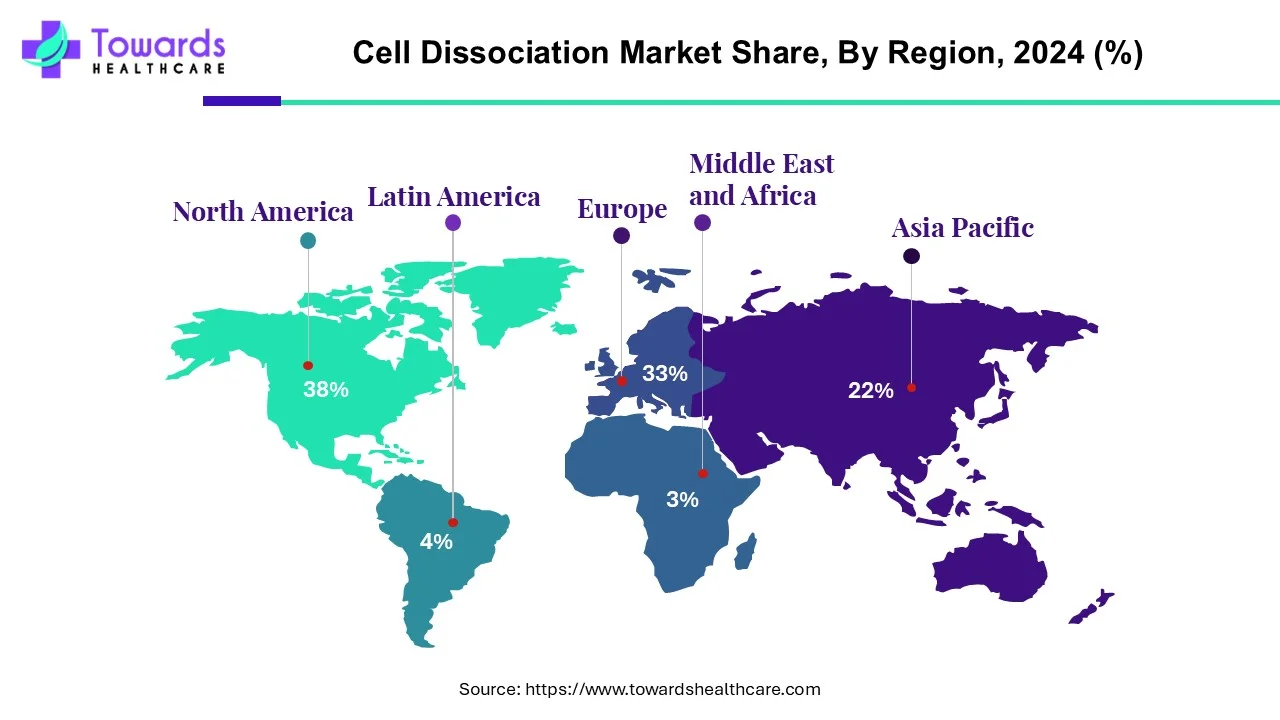
North America dominated the cell dissociation market share by 38% in 2025. The high percentage in the region can be attributed to the government's increased investment initiatives, the rising incidence of chronic illnesses, and the superior infrastructure for clinical and laboratory research. An estimated 1.9 million new cases of cancer and 0.6 million deaths from cancer are expected to occur in the United States (US) in 2023, according to the American Cancer Society's Cancer Facts and Figures 2023 study.
Furthermore, in 2019, there were 54.1 million people in the US who were 65 years of age or older, making up 16% of the entire population. By 2040, it is anticipated to have increased to 21.6%. The high prevalence of chronic diseases and the growing number of senior people in the country are therefore anticipated to create more opportunities for the creation of innovative biopharmaceuticals, which will support the growth of the market being studied.
The U.S. Cell Dissociation Market Trends
The market is expanding due to increased investment in biomedical research, growing demand for regenerative medicine, and advancements in enzymatic and non-enzymatic technologies supporting efficient cell separation.
The Canada Cell Dissociation Market Trends
Canada’s market is growing due to advancements in cell-based research, rising chronic disease cases, improved dissociation technologies, and supportive government initiatives that promote innovation in biotechnologies and healthcare.
Asia Pacific is estimated to host the fastest-growing cell dissociation market by 22% share in 2025 during the forecast period. Motivated by noteworthy advancements in the field of biotechnology. The biotech landscape in India has seen a significant change as people become more conscious of the technology's potential uses in industry, healthcare, agriculture, and the environment. New collaborations between the Indian industry and the international scientific community are being fostered by this awareness, as well as a rise in R&D projects, technology-transfer operations, and the construction of cutting-edge infrastructural facilities.
By creating biotechnology parks, incubators, and programs meant to close the gap between lab research and real-world application, some Indian state governments are aggressively advancing biotechnology applications. The biopharmaceutical business, which combines the best aspects of biology, medicine, and microbiology through bioengineering pharmaceutical technology, is expanding rapidly because of this favorable environment. Pharmaceutical engineering makes considerable use of biotechnology, including fermentation, cell, and genetic engineering.
The China Cell Dissociation Market Trends
China’s market is growing as a result of expanding pharmaceutical and biotech sectors, a surge in clinical research activities, increasing stem cell studies, and strong academic collaborations driving innovation.
Even if China's biopharmaceutical sector has advanced significantly, there are still certain aspects that need to be strengthened and improved, especially in terms of innovation. Nevertheless, the region's tremendous potential to spur innovation and expansion in the biotechnology industry is shown by the speed at which science and technology are developing there.
The India Cell Dissociation Market Trends
The Indian market is expanding due to increased R&D investment, advancements in biotechnology, rising chronic disease prevalence, technological innovations, government support, and India’s strategic position in global pharmaceuticals.
Europe’s market is growing by 33% share due to strong research infrastructure, government support, advancement in regenerative medicine, and technological innovations in automated and non-enzymatic dissociation methods, driving increased demand.
The UK Cell Dissociation Market Trends
The market is growing due to innovations in cell separation technologies, increased research funding, expanding regenerative medicine, and the rising demand for cell-based therapies driven by chronic disease prevalence.
The Germany Cell Dissociation Market Trends
Germany's market is growing due to advancements in cell-based therapies, technological innovations in automation and non-enzymatic methods, strong research investments, and government support for biotechnology and regulatory approvals.
| Company | Offerings |
| Merck KGaA | Key products consist of tissue dissociation kits, trypsin, collagenase, and various enzymes aimed at maintaining high viability in stem cell research and 3D cell culture/organoid processes. |
| Thermo Fisher Scientific | Thermo Fisher Scientific offers a wide range of products mainly under the Gibco™ brand. Key products include the gentle, high-efficiency TrypLE™ enzymes, traditional porcine-derived trypsin/EDTA, and specialized enzymes such as collagenase. |
| Danaher Corp. | The Danaher Corporation plays a significant role through Cytiva, Pall Corporation, and Beckman Coulter, providing integrated, automated, and high-throughput systems. Their products emphasize cell processing, single-use technology, and GMP-grade tools for biopharmaceutical production. |
| STEMCELL Technologies | The portfolio includes the automated STEMprep™ Tissue Dissociator system, specialized enzymatic kits, and gentle, non-enzymatic reagents for human pluripotent stem cell (hPSC) passaging. |
| Sartorius AG | Sartorius AG offers a specialized range for the cell dissociation market, concentrating on animal component-free (ACF) reagents and advanced cell culture tools to ensure high viability and consistency. |
| BD | The company's products emphasize high-yield, gentle tissue dissociation for single-cell research, mainly highlighting the BD Horizon™ Dri Tumor & Tissue Dissociation Reagent (TTDR). |
| Miltenyi Biotec | Miltenyi Biotec provides a wide range of cell dissociation tools, focusing on the gentleMACS™ Dissociator technology along with specific kits for different tissues. |
| PAN-Biotech | PAN-Biotech is a key player in the cell dissociation industry, delivering high-quality, ready-to-use enzymatic and non-enzymatic solutions, with a focus on Accutase® for gentle cell detachment and Pancoll for cell separation. |
| HiMedia Laboratories | The portfolio includes specialized products like the ZymeFree™ enzyme-free reagent that helps maintain cell surface protein integrity, as well as various enzymatic agents for effective cell detachment. |
| F. Hoffmann-La Roche Ltd. | F. Hoffmann-La Roche Ltd. (Roche) provides a broad selection of high-purity enzymes and reagents for cell dissociation, prominently featuring its Liberase Purified Enzyme Blends and Dispase II. |
Strengths
Weaknesses
Opportunities
Threats
This collaborative endeavor demonstrates how collaborative research may speed up the development of life-changing medications for patients worldwide, according to Jay Rosanelli, CEO of Syenex. We are excited to collaborate with CellFE and demonstrate how this innovative hybrid approach may significantly streamline the production of generic medications.
By Product
By Type
By End-use
By Region





Principal Consultant
Shivani Zoting is a dedicated research analyst specializing in the healthcare industry. With a strong academic foundation, a B.Sc. in Biotechnology and an MBA in Pharmabiotechnology, she brings a unique blend of scientific understanding and strategy.
Learn more about Shivani Zoting
Reviewed By
Aditi Shivarkar is a seasoned professional with over 14 years of experience in healthcare market research. As a content reviewer, Aditi ensures the quality and accuracy of all market insights and data presented by the research team.
Learn more about Aditi Shivarkar










