Pipeline Programs

CGT Companies Tracked

Manufacturing Facilities


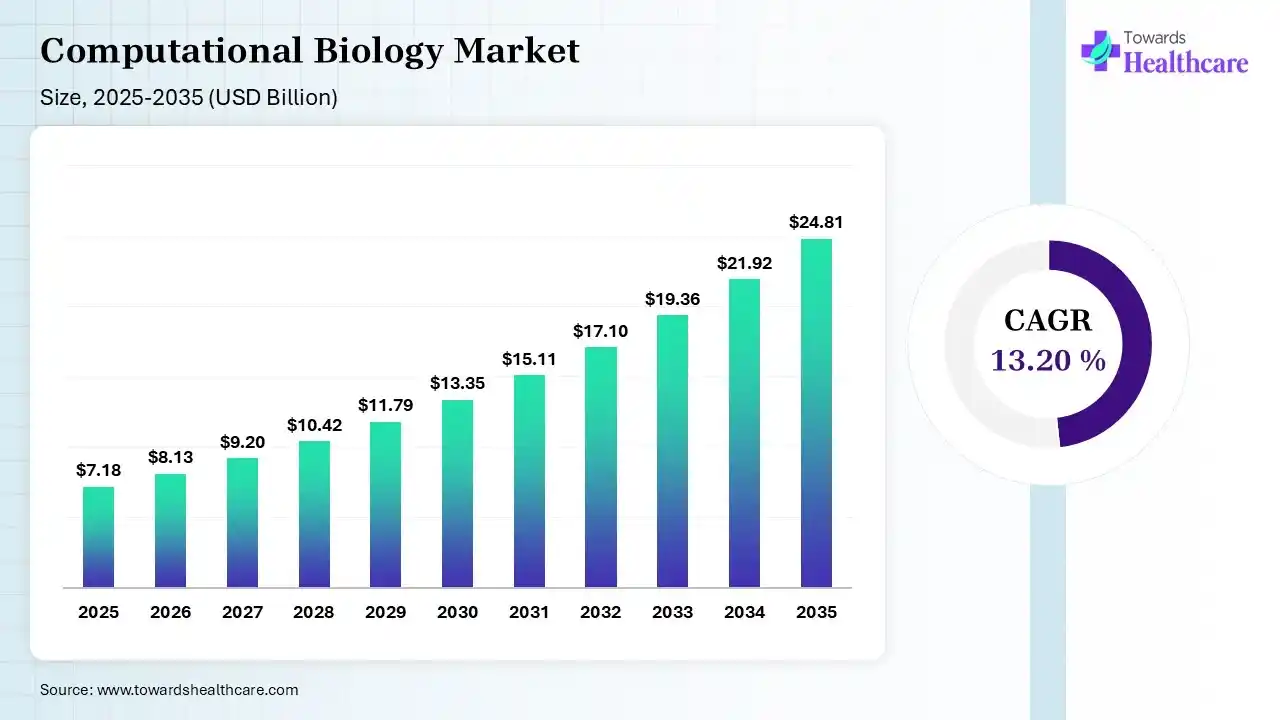
The global computational biology market size touched US$ 7.18 billion in 2025, grew to USD 8.13 billion in 2026 and is forecast to reach USD 24.81 billion by 2035, with an expected CAGR of 13.20% over the forecast period from 2026 to 2035.
Developing and using computational methods to evaluate massive datasets of biological data, including genetic sequences, cell populations, or protein samples, in order to generate novel biological discoveries or make predictions is the multidisciplinary topic of the computational biology market and bioinformatics market. Simulation, mathematical modeling, and analytical techniques are some of the computational techniques employed. Drug development might become more efficient with the use of cutting-edge computing techniques like artificial intelligence, computer-aided drug design, and computational biology, which reduce both the time and cost involved. Several novel pharmaceuticals have been approved for commercialization as a result of the widespread use of computational techniques in recent years to increase the efficacy and effectiveness of drug development and pipeline.
Computational biology is an interdisciplinary field that uses computational methods, mathematical models, and biological data to understand complex processes and support scientific research. The computational biology market is expanding as researchers handle increasingly complex genomic, molecular, and clinical datasets. A major trend is the integration of artificial intelligence, machine learning, cloud computing, and advanced data analytics to accelerate biological discoveries. Technological progress in genome sequencing, protein structure prediction, molecular modelling, single-cell analysis, and multi-omics platforms is improving research capabilities. Future opportunities include AI-assisted drug discovery, precision medicine, biomarker identification, synthetic biology, and personalized therapeutic development. Growing pharmaceutical R&D, increasing genomic research, rising demand for faster drug development, expansion of biological databases, and the need to interpret complex datasets are key growth drivers. Greater collaboration between biotechnology, pharmaceutical academia, and technology organizations is further strengthening adoption.
Internal factors include software capabilities, algorithm accuracy, computing infrastructure, data quality, R&D expertise, platform scalability, and integration with AI and machine learning. External factors include growing genomic datasets, increasing pharmaceutical R&D, demand for precision medicine, expansion of multi-omics research, and rising adoption of cloud-based analysis. Advances in protein modeling, generative AI, molecular simulation, and high-performance computing are expanding applications. However, data privacy concerns, interoperability challenges, shortage of skilled professionals, complex biological datasets, and high computational requirements can limit adoption. Increasing collaboration between technology companies, research institutions, pharmaceutical firms, and biotechnology organizations is creating new opportunities for computational biology solutions across drug discovery, biomarker research, disease modeling, and personalized healthcare.
Computational biology is an interdisciplinary field that applies computational methods, mathematical models, and data analytics to understand biological systems, analyze complex biological data, and support scientific research. The computational biology market is growing due to the increasing adoption of genomics, proteomics, and multi-omics research, along with rising demand for AI-driven drug discovery and precision medicine. Growing investment in biotechnology, pharmaceutical research, and personalized healthcare, coupled with increasing collaborations between research institutions, and technology companies, between research institutions and technology companies, are further driving innovation and expanding the adoption of computational biology solutions across the global life science industry.
Drug Discovery Drives the Computational Biology Market
Deep learning and computational methods are becoming more and more important in the drug development process. For more than thirty years, computer-aided technologies for drug discovery and design have been crucial in the creation of small compounds with significant therapeutic potential. The speed at which techniques and algorithms are developing has reduced the amount of time and money needed to identify potential medication candidates. Computational biology has made contributions to drug development in the areas of ligand-binding molecular mechanisms, binding/active site identification, and structural refinement of ligand-target binding poses.
Data Quality & Integration Restraints the Market
In computational biology, managing the integration and quality of biological data is one of the major obstacles. Computational analysis and modeling may be less accurate and reliable when dealing with biological data that is noisy, inadequate, inconsistent, or diverse. It may also be challenging to combine and compare biological data as it may come from many sources, formats, levels, and scales. For data preparation, cleaning, standardization, annotation, and integration, computational biologists must create and use reliable techniques and tools in order to overcome these obstacles. To make sure that the data and the findings are reliable and repeatable, they must also work along with experimental biologists and bioinformaticians.
AI Creates New Opportunities for the Market
The nexus between computational biology and artificial intelligence (AI) has created novel prospects in the field of life sciences. AI proves to be a potent instrument, providing innovative answers to the problems presented by the enormous and intricate datasets found in computational biology and bioinformatics. Artificial Intelligence (AI) facilitates the identification of putative regulatory elements, gene function predictions, and genetic variants linked to illness. By expediting the identification of viable therapeutic options, improving chemical structures, and forecasting drug-target interactions, artificial intelligence presents a paradigm change in this field. The use of AI in the field of computational biology is evidence of how human creativity has the power to revolutionize scientific research.
For instance,
| Table | Scope |
| Market Size in 2026 | USD 8.13 Billion |
| Projected Market Size in 2035 | USD 24.81 Billion |
| CAGR (2026 - 2035) | 13.20% |
| Leading Region | North America by 50% |
| Historical Data | 2020 - 2023 |
| Base Year | 2025 |
| Forecast Period | 2026 - 2035 |
| Measurable Values | USD Millions/Units/Volume |
| Market Segmentation | By Service, By Application, Others, By Region |
| Top Key Players | Fios Genomics, Xaira Therapeutics, Simulations Plus, Inc., QIAGEN, Genedata AG, Aganitha AI Inc., Compugen, Schrodinger, Inc., Thermo Fisher Scientific, Inc., Illumina, Inc., DNAnexus, Inc. |
| Segments | Shares % |
| Software Platform | 42% |
| Infrastructure & Hardware | 33% |
| Databases | 25% |
The software platforms segment dominated the computational biology market by 42% share in 2025. For the purpose of organizing vast volumes of data, directing experimental research, and gaining knowledge and insight into biological processes that would otherwise be impossible, information science and computational science offer vital tools for next-generation biological scientific endeavors. Proteomics, transcriptomics, metabolomics and genomics are a few of the leading areas of biology that are producing large volumes of data. In order to conduct their study, computational biologists employ a variety of tools and algorithms. Software platforms for computational biology include Saturn Cloud, Terra, Lamin, DNANexus, Seven Bridges, Illumina, LatchBio, Lifebit, Dockstoe and BC Platforms.
For instance,
By service, the infrastructure & hardware segment is anticipated to grow at a significant rate during the forecast period. Access to the hardware and software required to complete computation-intensive tasks is provided via the computational infrastructure for researchers. By dividing the burden among several separate computer units, infrastructures may be employed to significantly lower the prohibitive running times of these techniques. Hardware and software infrastructure should be well-established in an organization. This is particularly true of financial prospects. In particular, having a strong bioinformatics and computational infrastructure may raise the likelihood of getting a grant to a researcher whose primary line of inquiry makes extensive use of data.
| Segments | Shares % |
| Clinical Trial | 28% |
| Drug Discovery & Disease Modelling | 24% |
| Preclinical Drug Development | 18% |
| Computational Genomics | 15% |
| Computational Proteomics | 9% |
| Others | 6% |
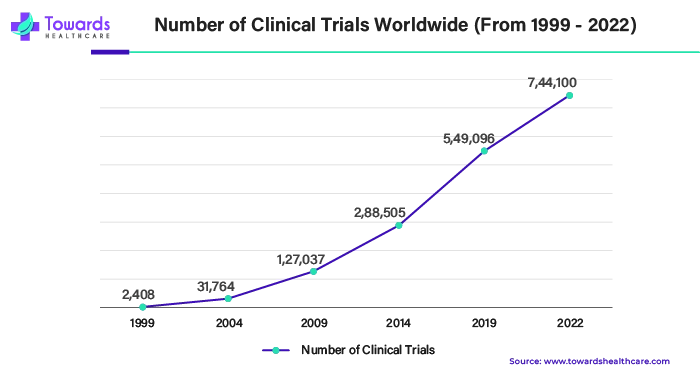
By application, the clinical trials segment held the dominant share of the computational biology market by 28% share in 2025. Clinical trial optimization is greatly aided by computational biology, which uses sophisticated algorithms to evaluate vast amounts of biological data. This helps scientists find possible targets for drugs, forecast how patients will react to therapies, and adjust dosage schedules. Computational models can expedite and save time and costs in the drug discovery process by modeling different situations. More individualized and focused medicines may result from the identification of biomarkers using computational biology that reflects therapy efficacy or possible side effects. Computational biology is being used in clinical trials to predict possible medication interactions and adverse events, which will improve the evaluation of novel medicines' safety and effectiveness in the long run. Through the delivery of safer and more effective medicines, this interdisciplinary approach ultimately benefits patients by accelerating the discovery of novel therapeutics.
By application, the computational genomics segment is anticipated to grow with the fastest CAGR during the forecast period. Because of the massive volume of high-dimensional data produced by improved sequencing and other molecular profiling methods, computational biology is essential to genetics and genomic research. Research in these fields has been quickly expanding. Researchers may find genetic risk factors for illnesses, predict medication responses, and create novel therapies by processing and analyzing large-scale multi-omics and health data with the use of state-of-the-art computational techniques. Genetics and genomics research has been brought to a new level of sophistication by the computational biology market, which has enabled previously unattainable methods of data analysis and interpretation.
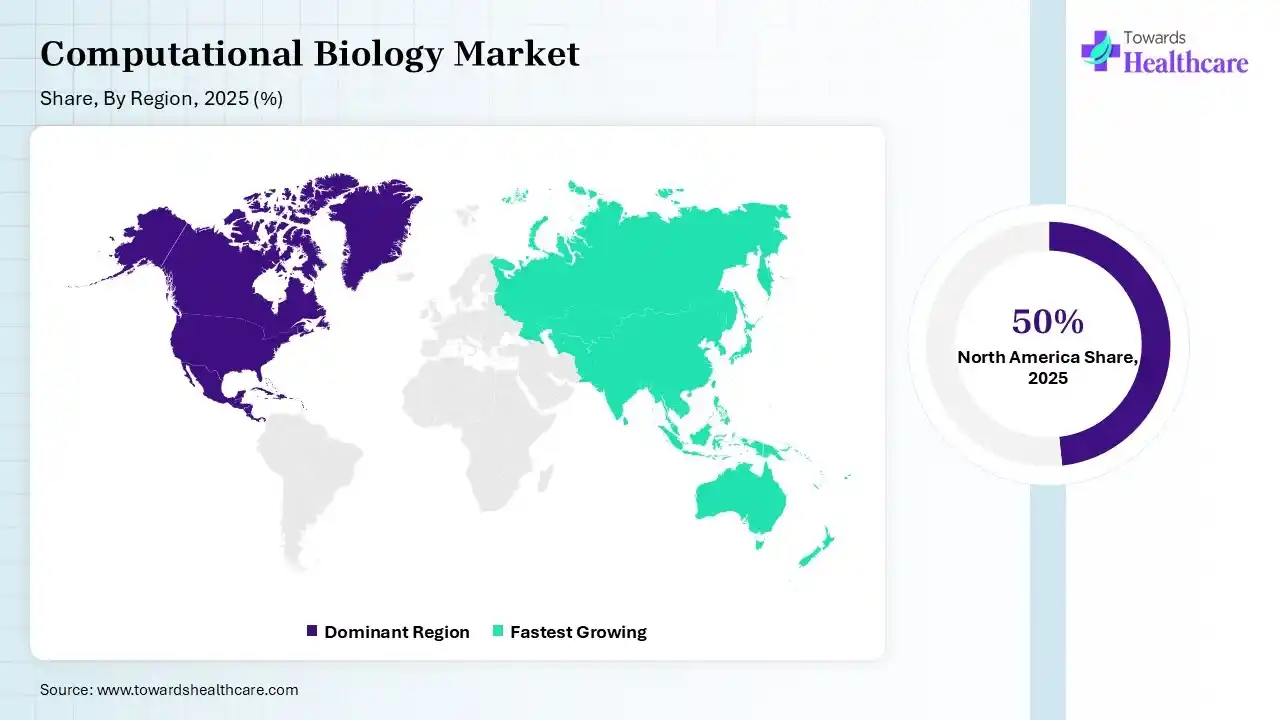
North America held the largest computational biology market share of 50% in 2025. It is projected that factors, including rising financing and investments, as well as market participants' involvement in computational biology, would drive the region's analyzed market expansion. Furthermore, in an effort to quickly create successful medicines, governments, medical institutions and researchers are working together more frequently as a result of customized medicine. The computational biology market is expanding rapidly since the U.S. is one of the main nations that funds and promotes advancements in the field.
The National Human Genome Research Institute established the "Computational Genomics and Data Science Program" in the United States. Throughout all extramural research programs and divisions, the CGDS fosters the creation of cutting-edge computational methods, creative data analysis tools, and data resources of scientific value. A Draft 2023–2028 Data Science Strategic Plan was made public by the NIH in December 2023 in order to receive feedback from the general public. NIH will be better equipped to handle the fast increase in both the volume and variety of data, as well as the development of sophisticated new technologies, thanks to the updates to the Strategic Plan for Data Science, which builds on the achievements of the first plan. Furthermore, the clinical trials being conducted by prominent players from different sectors are contributing to the growth of the computational biology market. To increase the capacity for clinical trials in the US, the White House Office of Science and Technology Policy (OSTP) is spearheading a whole-of-government initiative.
U.S. Leads Innovation in Computational Biology
The U.S. computational biology market is growing due to substantial investments in biotechnology, pharmaceutical R&D, and precision medicine. Strong adoption of AI, bioinformatics, and high-performance computing is accelerating genomic research and drug discovery. The presence of leading biotechnology companies, world-class research institutions, and supportive government funding for life science research further strengthens innovation, driving the widespread adoption of computational biology solutions across the country.
Canada Strengthens Computational Biology Innovation
The Canada computational biology market is expanding due to increasing investments in genomics research, precision medicine, and biotechnology innovation. Growing adoption of AI, bioinformatics, and high-performance computing is accelerating biological data analysis and drug discovery. Strong collaborations among research institutions, healthcare organizations, and biotechnology companies, along with supportive government funding for life science research, are further driving market growth and technological advancements.
Asia Pacific is expected to grow by 16% share at the fastest CAGR during the forecast period. This trend is mostly caused by the region's biopharmaceutical industries, particularly those in China and India, expanding quickly. As a result, investments in the life science and healthcare IT sectors are increasing. The growing number of bioinformatics-focused businesses is also expected to hasten the expansion of the industry in the area. Growth in the industry is also being driven by increased government spending on improved healthcare IT. Accordingly, it is projected that rising startups, expanding R&D services, and similar government activities would boost the computational biology market in the Asia Pacific area.
For instance,
India Emerges as a Computational Biology Hub
The India computational biology market is growing due to rising investments in biotechnology, pharmaceutical research, and genomics. Increasing adoption of AI, bioinformatics, and cloud computing is accelerating drug discovery, precision medicine, and biological data analysis. The presence of a skilled research workforce, expanding biotechnology startups, supportive government initiatives, and growing collaboration between academic institutions and life science companies are further driving market expansion.
China Accelerates Computational Biology Leadership
The China computational biology market is increasing due to rising investments in biotechnology, genomics and artificial intelligence research. Growing adoption og bioinformatics platforms, high-performance computing, and precision medicine os accelerating biological data analysis and drug discovery. Additionally, strong government support, expanding pharmaceutical R&D activities, and collaborations between research and fueling sustained market growth.
Europe is predicted to grow by 25% share at a notable rate in the foreseeable future. The growing awareness about the benefits of computational biology and bioinformatics is the major growth factor of the market. More than 4,000 higher education institutions are offering a wide range of Bachelor's, Master's, and Doctorate degrees in bioinformatics. Several researchers are deploying computational tools to develop and assess the safety and efficacy of biologics. Favorable government support and suitable regulatory frameworks facilitate new drug discovery. The increasing number of new product launches contributes to market growth. The European Medicines Agency approved 114 medicines for market authorization.
Germany Market Trends
The German government aims to form a new “Pharma Strategy” and has launched a “Strategy Paper 4.0 – Improving the General Conditions for the Pharmaceutical Sector in Germany”. The government anticipates faster approvals for clinical trials, faster access to innovative medicines, more digitalization, and greater supply security.
UK Market Trends
The UK government plays a significant role in supporting computational biology research for new drug discovery. The government announced an investment of £82.6 million to support UK-based companies tackling cancer and accelerate drug discovery using AI. The funding will be divided, providing £37.9 million into three innovative British research projects and £44.7 million in co-investment across three projects from other sources.
Latin America is building demand for the computational biology market through genomics, disease research, and academic partnerships. Brazil and Argentina are important contributors. Cloud tools can help smaller laboratories handle large datasets without costly hardware. Over the next decade, growth may improve with public research funding, shared genomic databases, better training, and wider use of computational methods in drug discovery.
Brazil Market Trends
Brazil gives the computational biology market a strong base through genomics, agricultural research, infectious disease studies, and large research institutions. Local laboratories use computational tools to study biological data. Future growth can come from stronger university industry partnerships and better cloud access. More funding for bioinformatics training, clinical genomics, and biotechnology startups could expand adoption across healthcare and research settings.
Argentina Market Trends
Argentina is creating opportunities for the computational biology market through university research, genomics, and biotechnology programs. Researchers need tools that can process sequencing and biological datasets. The country can gain momentum by improving computing infrastructure and connecting research centers with companies. Over the coming decade, stronger training programs, shared databases, cloud platforms, and support for biotech startups could widen computational biology use.
Middle East and Africa is expected to grow significantly during the forecast period. MEA is developing the computational biology market as countries invest in genomics, digital health, and biotechnology. The Gulf is moving faster, while African markets show opportunities in disease surveillance and research. Wider access to cloud computing can reduce infrastructure barriers. During the next decade, growth could be supported by national genome programs, research partnerships, skilled workforce development, and improved health data systems.
UAE Market Trends
The UAE is positioning the computational biology market around genomics, artificial intelligence, and healthcare research. National genome initiatives are creating datasets that need analysis. New academic programs are helping build specialist skills. Over the next decade, growth can accelerate through research partnerships, cloud infrastructure, precision medicine projects, and biotechnology investment. These efforts may attract global companies and strengthen regional life science innovation.
Saudi Arabia Market Trends
Saudi Arabia is giving the computational biology market momentum through Vision 2030, genome research, and healthcare modernization. National programs encourage precision medicine and biological data capabilities. Universities and hospitals are expanding research activity. In the next decade, growth could come from genome sequencing, talent development, international collaborations, and biotechnology investment. Better computing infrastructure and clinical use of genomic data may support demand.
| Ecosystem Category | Key Participants | Role in Market |
| Technology Providers | NVIDIA, Intel, AMD, Amazon Web Services (AWS), Google Cloud | Supply high-performance computing, GPUs, cloud infrastructure, and AI acceleration for computational biology workloads. |
| Product Manufacturers | Illumina, Thermo Fisher Scientific, PacBio, Oxford Nanopore Technologies | Generate genomic and molecular data that fuels computational biology workflows. |
| Service Providers | SOPHiA GENETICS, DNAnexus, Genedata, Seven Bridges, Lifebit | Deliver genomic analysis, cloud-based bioinformatics, and precision medicine platforms. |
| Platform Providers | Schrödinger, Recursion Pharmaceuticals, Insilico Medicine, BenevolentAI, QIAGEN Digital Insights | Provide AI-driven computational biology, molecular modeling, and drug discovery platforms. |
| CROs/CDMOs | Charles River Laboratories, Labcorp Drug Development, IQVIA, Evotec, WuXi AppTec | Integrate computational biology into drug discovery, biomarker identification, and clinical research services. |
| Software Vendors | QIAGEN, Dassault Systèmes (BIOVIA), Genedata, Schrödinger, DNAnexus | Develop computational biology software for genomics, molecular simulation, and biological data analysis. |
| Research Institutions | Broad Institute, EMBL-EBI, Wellcome Sanger Institute, NIH, European Bioinformatics Institute | Develop algorithms, genomic databases, AI models, and computational biology research. |
| End-User Industries | Pharmaceuticals, Biotechnology, Diagnostics, Academic Research, Healthcare Providers, Precision Medicine Companies | Utilize computational biology for research, diagnostics, and therapeutic development. |
| Tier 1 | Tier 2 | Tier 3 | |
| Competitive Influence Share | 55–70% | 20–30% | 10–15% |
| Tier 1 | |||||
| Companies | Headquarters | Country | Why Relevant to This Market | Key Products/Service | |
| Thermo Fisher Scientific | Waltham, Massachusetts | USA | End-to-end life sciences and bioinformatics ecosystem with strong genomics and computational capabilities | Ion Torrent, bioinformatics software, cloud analytics, genomic workflows | |
| Illumina | San Diego, California | USA | Global sequencing leader with integrated computational genomics platforms | DRAGEN Bio-IT Platform, sequencing analytics, multiomics solutions | |
| QIAGEN | Hilden | Germany | Major bioinformatics and molecular diagnostics provider with extensive computational biology offerings | QIAGEN Digital Insights, CLC Genomics Workbench, Ingenuity Pathway Analysis | |
| Tier 2 | |||||
| DNAnexus | Mountain View, California | USA | Leading cloud-native genomics and biomedical data analysis platform | Precision health platform, genomic data management, federated analytics | |
| SOPHiA GENETICS | Rolle | Switzerland | Strong AI-driven clinical genomics and multimodal analytics provider | SOPHiA DDM Platform, genomic interpretation tools | |
| Tier 3 | |||||
| Recursion Pharmaceuticals | Salt Lake City, Utah | USA | AI-first computational biology company combining large-scale biological datasets with machine learning | Recursion OS, AI drug discovery platform | |
| Insilico Medicine | Hong Kong | China | Pioneer in generative AI and computational drug discovery | PandaOmics, Chemistry42, AI-designed therapeutics | |
| BenevolentAI | London, England | United Kingdom | Knowledge graph-driven computational biology and drug discovery innovator | Benevolent Platform, target identification systems | |
Strengths
Weaknesses
Opportunities
Threats
By Service
By Application
By Region






Principal Consultant
Payal Rabde is a Healthcare Market Research Analyst at Towards Healthcare Research & Consulting with 4+ years of experience in pharmaceuticals, biotechnology, medical devices, and life sciences.
Learn more about Payal Rabde

Reviewed By
Aditi Shivarkar is a seasoned professional with over 14 years of experience in healthcare market research. As a content reviewer, Aditi ensures the quality and accuracy of all market insights and data presented by the research team.
Learn more about Aditi Shivarkar