


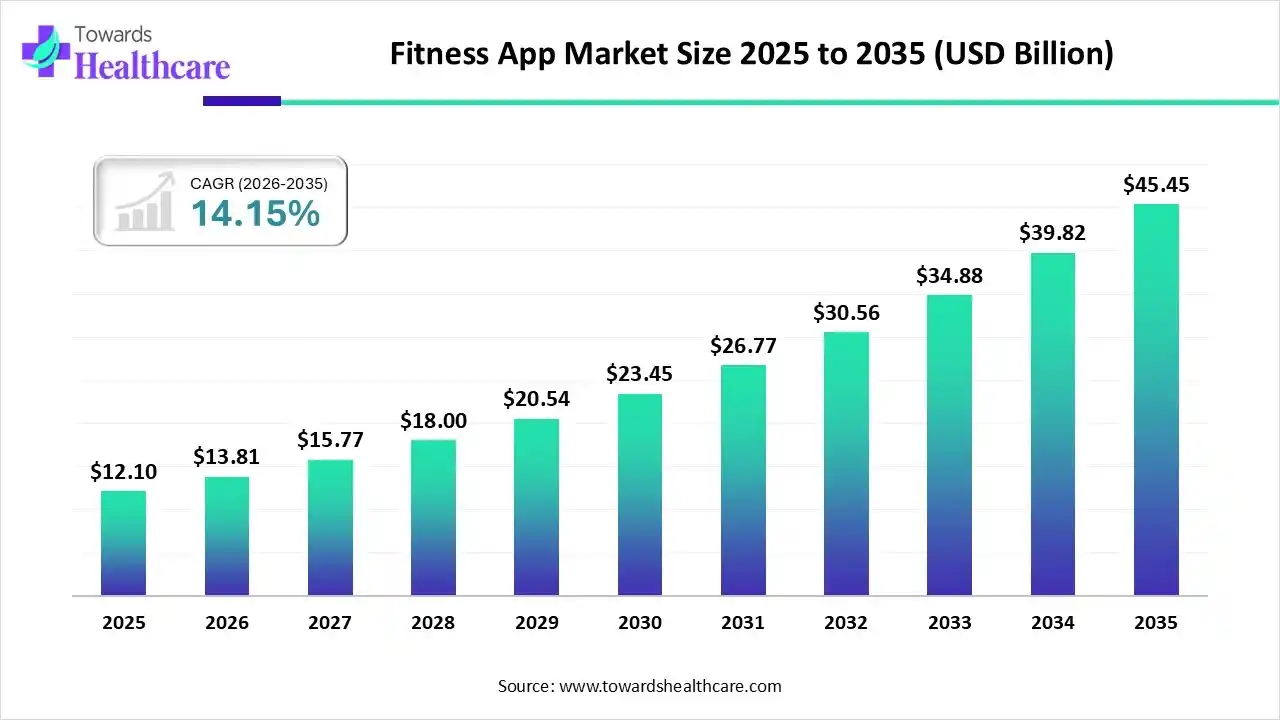
The global fitness app market size is calculated at US$ 12.1 billion in 2025, grew to US$ 13.81 billion in 2026, and is projected to reach around US$ 45.45 billion by 2035. The market is expanding at a CAGR of 14.15% between 2025 and 2034.
| Key Elements | Scope |
| Market Size in 2026 | USD 13.81 Billion |
| Projected Market Size in 2035 | USD 45.45 Billion |
| CAGR (2026 - 2035) | 14.15% |
| Leading Region | North America |
| Market Segmentation | By Type, By Platform, By Device, By Region |
| Top Key Players | MyFitnessPal, Inc., Google (Alphabet Inc.), Nike, Inc., Under Armour, Inc., Adidas AG, ASICS Corporation, Fitbit, Inc. (part of Google), Strava, Inc., Peloton Interactive, Inc., Noom, Inc., Calm, Headspace Inc., Samsung Electronics Co., Ltd., Azumio, Inc., Sweat, Freeletics GmbH, Garmin Ltd., Sworkit Health, Jefit, Inc., Polar Electro |
Growing consumer awareness of the benefits of a healthy lifestyle and rising smartphone, tablet, and wearable device usage have contributed to the expansion of the fitness app market. Additionally, the global fitness app market share has increased due to growing awareness of diet-related illnesses.
Wearable integration becomes standard for daily exercise tracking. Users connect smartwatches to monitor heart rates and sleep patterns effortlessly. Simple workout logging keeps people motivated. Daily streak features encourage consistent healthy habits. The future focuses on seamless lifestyle tracking rather than complicated data charts.
Social fitness challenges drive massive user engagement globally. Friends share workout milestones and compete in virtual community leaderboards. Group accountability makes staying active much easier. Brands build social networks right inside apps. Future growth relies heavily on building strong communities that keep users coming back.
Hybrid gym memberships reshape modern workout routines. People combine physical studio classes with digital mobile home training. Flexible schedules attract busy professionals seeking variety. Fitness providers offer all-inclusive digital packages. The outlook points toward unified platforms blending local gym access with personalized mobile coaching tools.
The demand for digital wellness solutions, the increasing prevalence of lifestyle-related disorders, and growing health consciousness are driving robust growth in the global fitness app market. Over time, the popularity of fitness apps has increased in tandem with a growing awareness of the benefits of physical activity and leading a healthy lifestyle. In the global fitness industry, fitness apps have become popular, leading to new training behavior patterns.
AI is changing the fitness sector by making companies more user-focused and efficient. AI improves user engagement, lowers attrition, and creates new opportunities through everything from virtual coaching and customized exercise regimens to predictive analytics and automated processes. By evaluating user data to spot possible health risks and offer early interventions, AI fitness apps will have a bigger impact on preventive healthcare.
Why Exercise & Weight Loss Dominated the Fitness App Market in 2024?
The exercise & weight loss segment accounted for the largest share of market revenue in 2024 due to the rising cases of obesity and diabetes. Mobile apps encourage a variety of tactics, such as social support and educational content, as well as self-monitoring of weight, exercise, and diet. According to the World Obesity Federation's World Obesity Atlas 2024, estimates for 2035 indicate that 1.53 billion people will suffer from obesity, and over 1.77 billion will be overweight. The WHO estimates that 44% of diabetes cases are caused by obesity, and by 2025, the number of people with obesity-related diabetes is predicted to double to 300 million.
Activity Tracking
The activity tracking segment is expected to grow at the fastest CAGR in the fitness app market during the forecast period. In order to promote healthy behaviors and provide public health interventions, technologies like fitness trackers and smartphone apps are essential. Running and cycling distances can be monitored by tracking apps. These apps can even track the user's swimming pool laps, calories burned, and other metrics when paired with wearable technology. Gamification elements could keep people motivated and committed to their objectives.
Diet & Nutrition
The diet & nutrition segment is expected to grow at a significant CAGR during the forecast period. Apps can be a useful tool for assessing and tracking diet-related health risk factors and eating habits. Apps can help people take control of their dietary decisions and give them autonomy. For people who prefer less face-to-face interaction with medical professionals, the ability to monitor food intake, set goals, and track progress in private may be appealing.
Why did the iOS Segment Dominate in the Fitness App Market in 2024?
The iOS segment accounted for the largest share of market revenue in 2024. One of the most powerful and well-known companies in the world, Apple is credited with helping to popularize smartphones with the iPhone. Sales of iPhones accounted for 51% of Apple's $390.8 billion in revenue in 2024. The United States, Apple's home nation, has consistently seen the company's greatest success.
Android
The Android segment is expected to grow at the fastest CAGR in the fitness app market during the forecast period. With more than 3 billion active users across 190 countries, Android is the most widely used operating system worldwide. In most nations, Android is the most popular platform. It holds more than 85% of the market share in countries such as Brazil, India, Indonesia, Iran, and Turkey. Xiaomi and Oppo are the next biggest producers of Android smartphones, after Samsung.
How Smartphones Dominated the Fitness App Market in 2024?
The smartphones segment accounted for the largest share of market revenue in 2024. The significance of mobile devices among internet-using gadgets has gradually grown. By the end of 2022, there were 6.6 billion smartphone subscriptions globally, and by 2026, that number is expected to more than double from 3.6 billion in 2016 to 7.5 billion.
Wearable Devices
The wearable devices segment is expected to grow at the fastest CAGR in the fitness app market during the forecast period. From simple fitness trackers to sophisticated medical devices that allow continuous health monitoring, wearable technology has advanced quickly. Wearable technology, such as wristbands, smartwatches, and earbuds, has already become very popular worldwide.
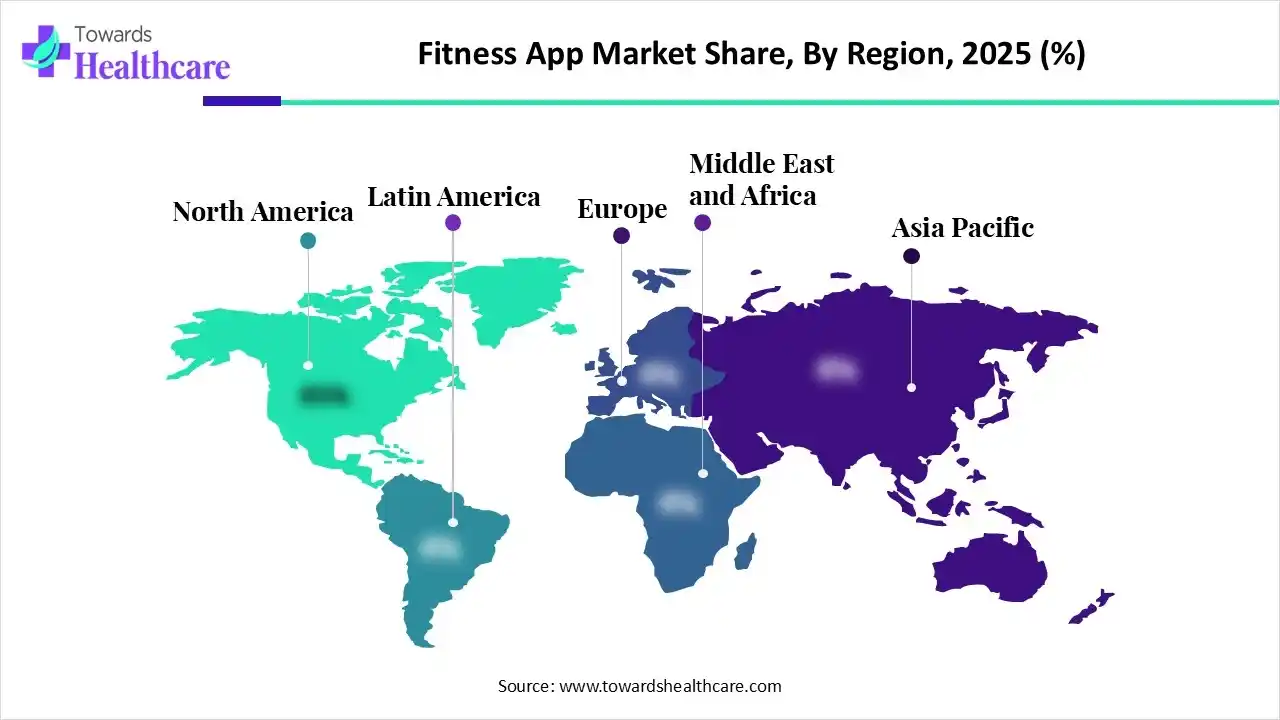
North America dominated the fitness app market in 2024 due to its sophisticated ecosystem, rising health and fitness consciousness, and high smartphone penetration. With the widespread use of wearables like the Apple Watch, Fitbit, and Garmin, as well as fitness-focused apps like Peloton and Nike Training Club, the area benefits from a culture of fitness. High disposable income, growing innovation and product launches, and significant investments in healthcare mobile applications all contribute to the market's strength.
U.S. Obesity & Diabetes Fuel Fitness App Demand
Some of the major drivers of the fitness app market in the U.S. are chronic conditions such as diabetes and obesity, along with technological advancements in developing fitness devices and apps. The adult obesity rate in the United States was 37% in 2024–2025, a slight decrease from its peak in 2022, but still high, and 11.6% of the population (38.4 million) had diabetes, including 8.7 million who were undiagnosed. Obesity and diabetes continue to be serious health issues.
Digital Wellness Boom Across Canadian Provinces
Canada embraces active outdoor lifestyles through connected mobile tracking tools. Users love applications that seamlessly sync with smartwatches for hiking and running stats. Local developers focus heavily on bilingual English and French programming. The competitive landscape features established global giants alongside boutique regional startups. Opportunities expand as corporate wellness programs reward employees for meeting daily movement goals. Privacy remains a top priority for users protecting personal health metrics.
Asia Pacific is estimated to host the fastest-growing fitness app market during the forecast period. Growing health consciousness, growing smartphone adoption, and rising disposable incomes are some of the factors causing this. Fitness apps are becoming more and more popular in nations with younger populations, such as China and India, as they meet the growing need for easy, at-home exercise options. Numerous local developers are joining the market with applications designed to meet local fitness requirements, such as diets and customs like yoga and Tai Chi. Increasing investments in digital health infrastructure benefits the region as well.
Smartphones Propel China's Fitness App Growth
Fitness awareness and widespread smartphone use are the main drivers of the fitness app market in China. With over 975 million smartphone users as of late 2025 and an estimated 1.2 billion by 2029, China has the largest smartphone user base in the world. Smartphones have become an integral part of everyday life. As of June 2025, there were more than 1.12 billion internet users in China. As of June 2025, 322 million people in rural China were among the 161 million internet users who were 60 years of age or older. These groups' respective rates of internet penetration were 52% and 69.2%.
India Mobile Fitness Revolution Takes Off
India witnesses explosive smartphone adoption driving massive fitness app downloads. Young urban populations prefer affordable freemium subscription models for home workouts. Local startups compete by offering yoga routines and culturally tailored diet plans. Regional language support attracts millions of users outside major metropolitan areas. Opportunities thrive for creators launching short-form exercise routines tailored to busy daily schedules. Data cost reductions accelerate continuous digital health engagement nationwide.
Europe is expected to grow at a significant CAGR in the fitness app market during the forecast period. With differing degrees of adoption and maturity among nations, the European market is diverse. In terms of market size and revenue, the Western European sub-regions, which include the UK, Germany, and France, are in the lead. Due to laws like the GDPR, which have made security a major concern for both consumers and app developers, the European market is characterized by a strong emphasis on data privacy.
Germany's Diabetes Rise Drives Fitness App Growth
The fitness app market in Germany is majorly driven by to rise in chronic conditions like diabetes. It is projected that there will be 10.4 million diabetics in Germany by 2050, up from 7.1 million in 2021. The International Diabetes Federation predicts that the prevalence of diabetes among Germans between the ages of 20 and 79 will stay mostly stable, with a minor decrease from 6.2 million in 2021 to 6.1 million in 2045. These findings suggest that older age groups are primarily responsible for the rise in diabetes cases.
UK Hybrid Gyms Drive Engagement
The UK fitness app market blends traditional gym memberships with digital tracking companion apps. Government health initiatives encourage citizens to adopt preventative digital wellness routines. Fitness brands compete fiercely through community challenges and virtual coaching features. Subscription fatigue pushes companies to deliver unique hyper-personalized fitness content. Growth opportunities target older demographics seeking gentle mobility and joint health guidance through user-friendly mobile interfaces.
South America is expected to grow significantly in the fitness app market during the forecast period. South America’s fitness apps expand as mobile access rises, reaching nearly 400 million with mobile internet. Diabetes and obesity pressures are growing regionally, prompting app-driven prevention and telehealth adoption. Governments and NGOs increasingly fund digital health pilots to boost activity.
Brazil’s Body: Running, Risks, Responses
Brazil’s fitness market scales alongside rising obesity measured at about 24.3 percent in 2023, driving demand for weight management apps. Smartphone penetration and community 'Academia da Saúde' programmes support digital exercise, prevention, and public health interventions and digital coaching uptake.
Argentina Urban Fitness Shifts to Mobile
Argentina navigates economic hurdles while embracing mobile fitness solutions. Urban fitness enthusiasts turn to free app workouts due to rising traditional gym costs. Independent local trainers launch personalized coaching services through social media and custom apps. The competitive landscape relies heavily on adaptable pricing strategies. Opportunities exist for lightweight applications that function smoothly despite intermittent internet connectivity issues in certain neighborhoods. Community group challenges keep user motivation high.
The Middle East and Africa are expected to grow at a lucrative CAGR in the fitness app market during the forecast period. The Middle East and Africa face escalating diabetes and obesity burdens, with the Eastern Mediterranean flagged among the highest global diabetes prevalence. Mobile health adoption accelerates as governments roll out digital strategies and community programmes to expand preventive care and fitness access.
GCC Moves: Challenge, Apps, Government Action
GCC nations show strong smartphone adoption and active promotion of movement through the Dubai Fitness Challenge and public health platforms. Saudi reports obesity near 23 percent, while regional studies highlight rising diabetes, driving widespread uptake of fitness apps and telehealth services.
Saudi Arabia Visionary Health Transformations
Saudi Arabia promotes active lifestyles rapidly under national transformation visions. High smartphone penetration and disposable income fuel demand for luxury fitness ecosystems. Global apps partner with regional telecom companies to offer frictionless billing options. The competitive environment welcomes international fitness brands introducing Arabic language interfaces. Opportunities center on female-focused privacy features and specialized weight management programs supporting national preventive healthcare goals.
| Name | Headquarters | Market Position & Strength/Differentiation | Recent Product Focus |
| MyFitnessPal, Inc. | Austin, Texas, USA | Leading nutrition-tracking platform with an extensive food database and strong personalization | Advanced AI-powered meal logging and enhanced nutrition insights |
| Google (Alphabet Inc.) | Mountain View, California, USA | Core health-tracking ecosystem leveraging Android scale and deep device interoperability. | Expanded wearable integrations and improved activity-metric accuracy in Google Fit |
| Nike, Inc. | Beaverton, Oregon, USA | Premium digital training brand with athlete-driven programs and a strong global community | New performance-focused training series and upgraded Nike Training Club content |
| Under Armour, Inc. | Baltimore, Maryland, USA | Performance analytics leader with connected-footwear data and a strong training ecosystem | Enhanced MapMyFitness analytics and upgraded connected-footwear metrics |
| Adidas AG | Herzogenaurach, Germany | Strong sports heritage translated into engaging digital fitness experiences. | Expanded adaptive running plans and personalized digital coaching features |
Company Overview:
Corporate Information:
Headquarters: New York, New York, USA | Year Founded: 2012 | Ownership Type: Publicly Traded (NASDAQ: PTON)
History and Background:
Key Milestones/Timeline:
Business Overview:
Business Segments/Divisions:
Geographic Presence:
USA, UK, Canada, Germany, Australia, and Austria.
Key Offerings:
End-Use Industries Served:
Key Developments and Strategic Initiatives:
Mergers & Acquisitions: Not a primary strategy; focus is on organic platform growth.
Partnerships & Collaborations:
Product Launches/Innovations:
Technological Capabilities/R&D Focus:
Competitive Positioning:
SWOT Analysis:
Recent News and Updates:
Press Releases:
Company Overview:
Corporate Information:
History and Background:
Key Milestones/Timeline:
Business Overview:
Business Segments/Divisions:
Geographic Presence:
Strong Global Presence (High engagement in North America, Europe, and Asia).
Key Offerings:
End-Use Industries Served:
Individual Consumers (Digital Health and Wellness)
Key Developments and Strategic Initiatives:
Product Launches/Innovations:
Technological Capabilities/R&D Focus:
Competitive Positioning:
SWOT Analysis:
Recent News and Updates:
Press Releases:
In May 2026, “We’re updating the Fitbit app to become the Google Health app, a centralized place for your health and wellness data. This new era debuts a comprehensive, redesigned wellness destination that brings together the best of Fitbit’s pioneering spirit with the helpfulness of Google,” said Google in a blog post
By Type
By Platform
By Device
By Region




Principal Consultant
Payal Rabde is a Healthcare Market Research Analyst at Towards Healthcare Research & Consulting with 4+ years of experience in pharmaceuticals, biotechnology, medical devices, and life sciences.
Learn more about Payal Rabde

Reviewed By
Aditi Shivarkar is a seasoned professional with over 14 years of experience in healthcare market research. As a content reviewer, Aditi ensures the quality and accuracy of all market insights and data presented by the research team.
Learn more about Aditi Shivarkar









