


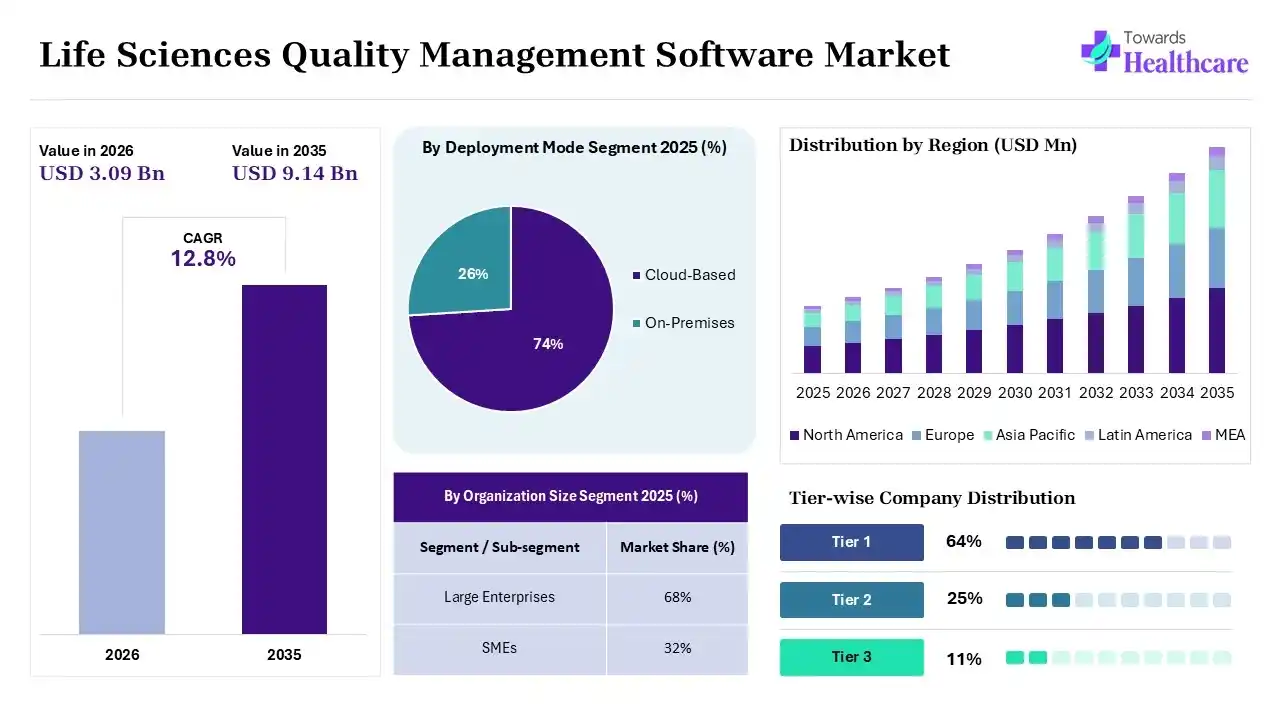
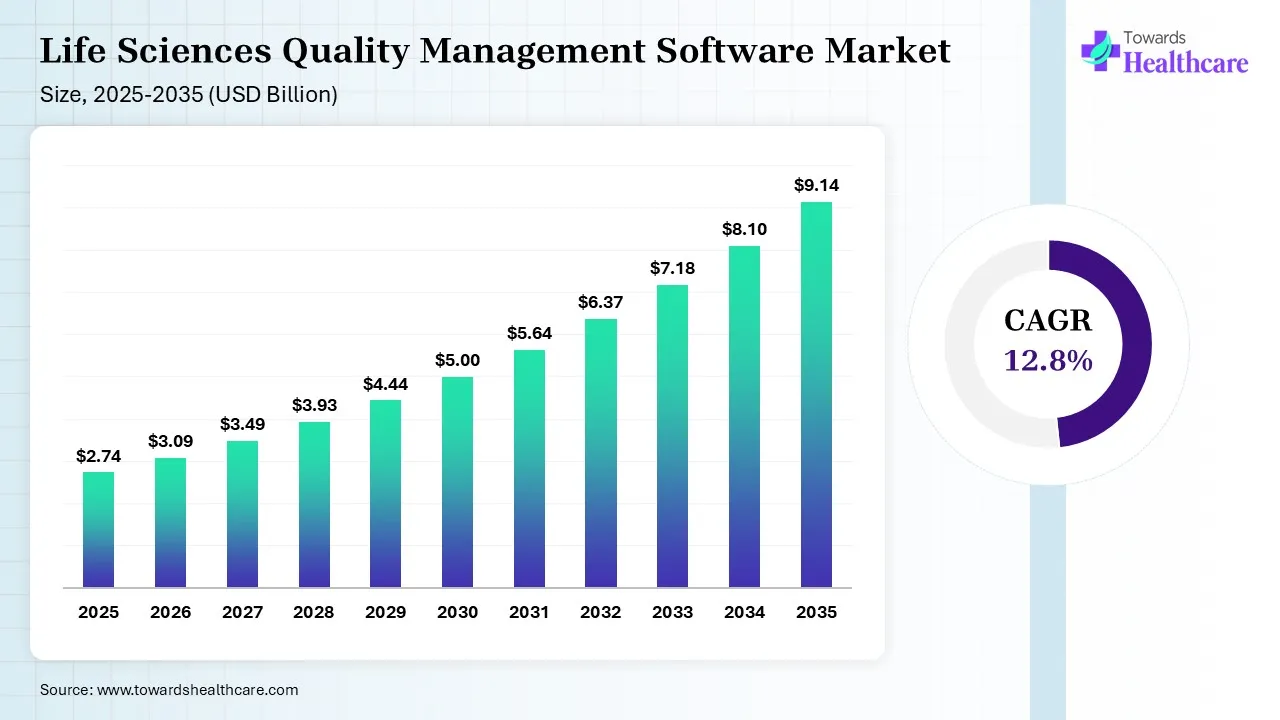
The global life sciences quality management software market size is calculated at USD 2.74 billion in 2025, where it continues to grow in 2026 at USD 3.09 billion due to expanding manufacturing capabilities. It is expected to reach USD 9.14 billion by 2035 with a CAGR of 12.8% due to increasing advancements in quality management software. North America accounted for 41% of the market in 2025 due to a high rate of quality management software adoption.
What is Life Sciences Quality Management Software?
Life sciences quality management software refers to the platforms used by life science organizations for the management of quality processes, audits, documentation, risks, and regulatory requirements to maintain product quality, safety, and regulatory compliance.
The growth in the use of digital technologies like health apps, wearable monitors, and sensors across the life science sector increased the need for digital platforms for R&D and manufacturing processes. The focus on improving product quality and regulatory compliance increased the adoption of automated quality management platforms. Furthermore, cultural shifts and collaborations increased digital quality maturity, which encouraged investments in digital quality management solutions.
Life sciences quality management software is used from R&D and clinical development through manufacturing, commercialization, and post-market surveillance, due to its document control, risk management, audit management, compliant tracking, and regulatory compliance.
Based on the information gathered by Payal Rabde, the market is driven by a rise in stringent regulatory compliance requirements and rising demand for cloud-based platforms. Additionally, the growing relationships among software vendors, cloud providers, pharmaceutical companies, biotech firms, medical device manufacturers, CROs, CDMOs, regulators, implementation partners, and technology providers are also expected to drive market expansion.
It covers emerging technology, regulatory, operational, and business trends influencing future market growth.
Growing Adoption of Cloud-Based Quality Platforms
A rise in the migration toward SaaS-based quality management systems offering faster deployment, regular software updates, and regulatory compliance are encouraging the adoption of cloud-based quality platforms.
Increasing Integration with Enterprise Systems
Growing demand for integration with enterprise systems such as ERP, MES, LIMS, PLM, CRM, and regulatory management platforms for seamless data transfer and improved operational efficiency is also increasing the adoption of life sciences quality management software.
AI and Predictive Quality Analytics
Increasing adoption of AI, machine learning, predictive risk analysis, and automated compliance monitoring for faster identification of quality risk, deviation, and to improve productivity are also promoting their innovations.
Mobile Quality Management Applications
A rise in the use of mobile inspections, digital audits, and remote approvals to improve quality data and productivity are also increasing the development of new mobile quality management solutions.
Digital Validation and Electronic Records
Increasing demand for paperless validation and electronic documentation is encouraging the adoption of digital validation and electronic records, enhancing operational efficiency and regulatory compliance.
It highlights modern software architecture including cloud-native, hybrid deployment, API integration, and microservices.
It outlines major regulations impacting life sciences quality management software adoption.
It covers growing investments in life sciences digital quality platforms.
It encompasses product innovations transforming life sciences quality management.
It highlights software buying patterns across different customer groups.
Key Purchase Decision Criteria
Vendor Evaluation Parameters
Average Procurement Timeline
Budget Allocation Trends
Software Replacement Cycle
It encompasses SaaS subscription, perpetual licensing, enterprise licensing, and usage-based pricing.
It covers growing demand for life science quality management software across pharmaceutical, biotechnology, medical devices, CROs, CDMOs, and laboratories.
| Table | Scope |
| Market Size in 2026 | USD 3.09 Billion |
| Projected Market Size in 2035 | USD 9.14Billion |
| CAGR (2026 - 2035) | 12.8% |
| Leading Region | North America by 41% |
| Historical Data | 2020 - 2023 |
| Base Year | 2025 |
| Forecast Period | 2026 - 2035 |
| Measurable Values | USD Millions/Units/Volume |
| Market Segmentation | By Deployment Mode, By Solution, By Organization Size, By End User, By Application, By Region |
| Top Key Players | Veeva Systems, Sparta Systems (Honeywell), MasterControl, Greenlight Guru, Qualio |
| Segment | Share 2025 (%) |
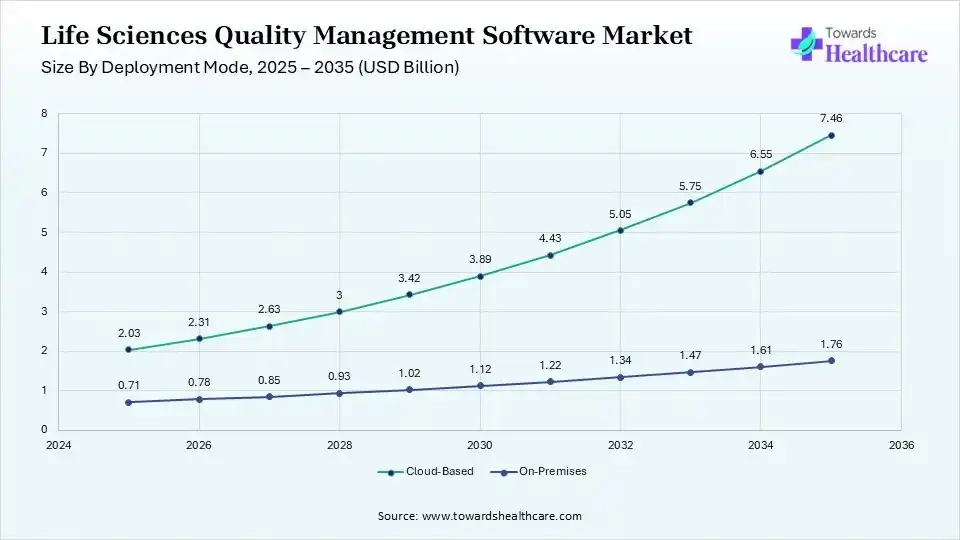
| Cloud-Based | 74% |
| On-Premises | 26% |
The Cloud-Based Segment Dominated the Market With 74% in 2025
The cloud-based segment led the life sciences quality management software market with a 74% share in 2025 and is expected to witness the fastest growth during the forecast period, as it accelerated remote collaboration across global facilities. It also enabled faster software updates and regulatory compliance. Reduced infrastructure investment and improved scalability also increased its use.
The on-premises segment held the second-largest share of 26% of the market in 2025, as it supports organizations with strict internal IT policies. Provides complete control over sensitive quality data, which drives its demand. As per the survey conducted by Payal Rabde, it remains preferred by legacy manufacturing sites.
| Segment | Share 2025 (%) |
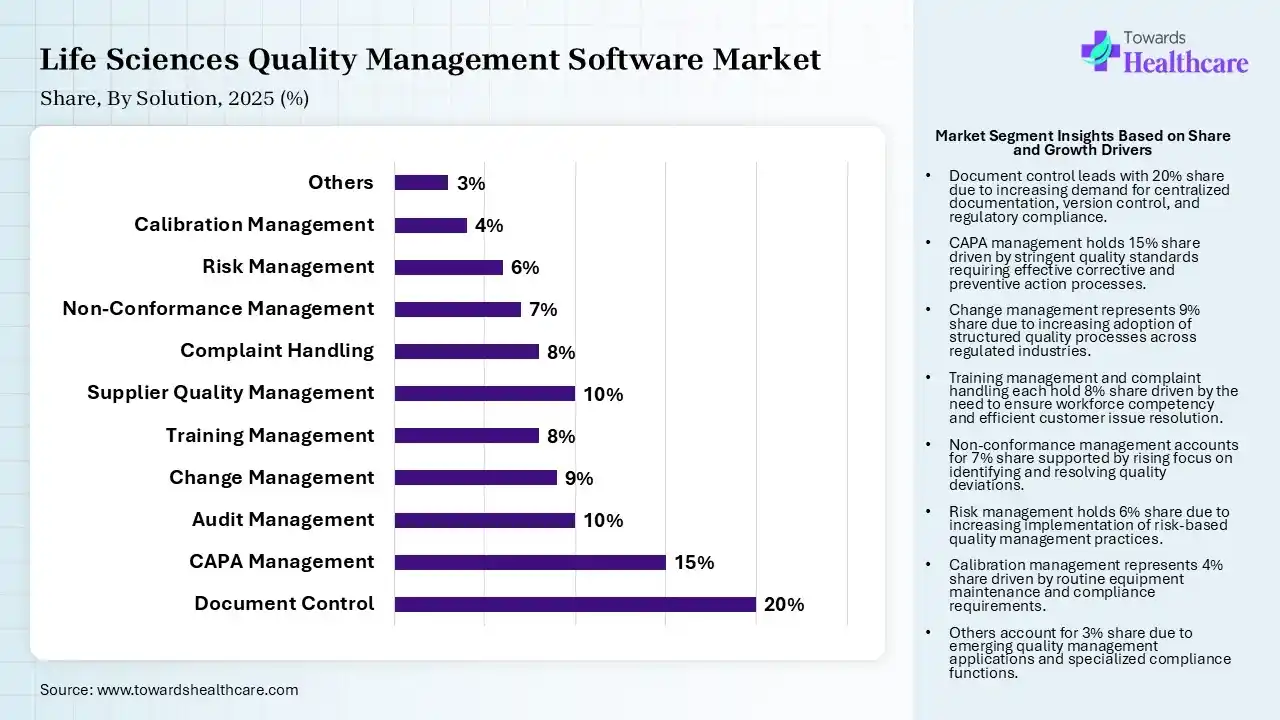
| Document Control | 20% |
| CAPA Management | 15% |
| Audit Management | 10% |
| Change Management | 9% |
| Training Management | 8% |
| Supplier Quality Management | 10% |
| Complaint Handling | 8% |
| Non-Conformance Management | 7% |
| Risk Management | 6% |
| Calibration Management | 4% |
| Others | 3% |
The Document Control Segment Dominated the Market With 20% in 2025
The document control segment accounted for the highest revenue share of 20% of the life sciences quality management software market in 2025, as it centralized SOPs and controlled documents. Simplified version management and approval workflows also increased their use. Supported regulatory inspections efficiently, which encouraged their adoption.
The CAPA (corrective and preventive action) management segment held the second-largest share of 15% of the market in 2025 and is expected to show the highest growth during the forecast period, as it improves root-cause investigations and corrective actions. Automates issue resolution workflows, which drives their demand. Strengthens continuous quality improvement, promoting their use.
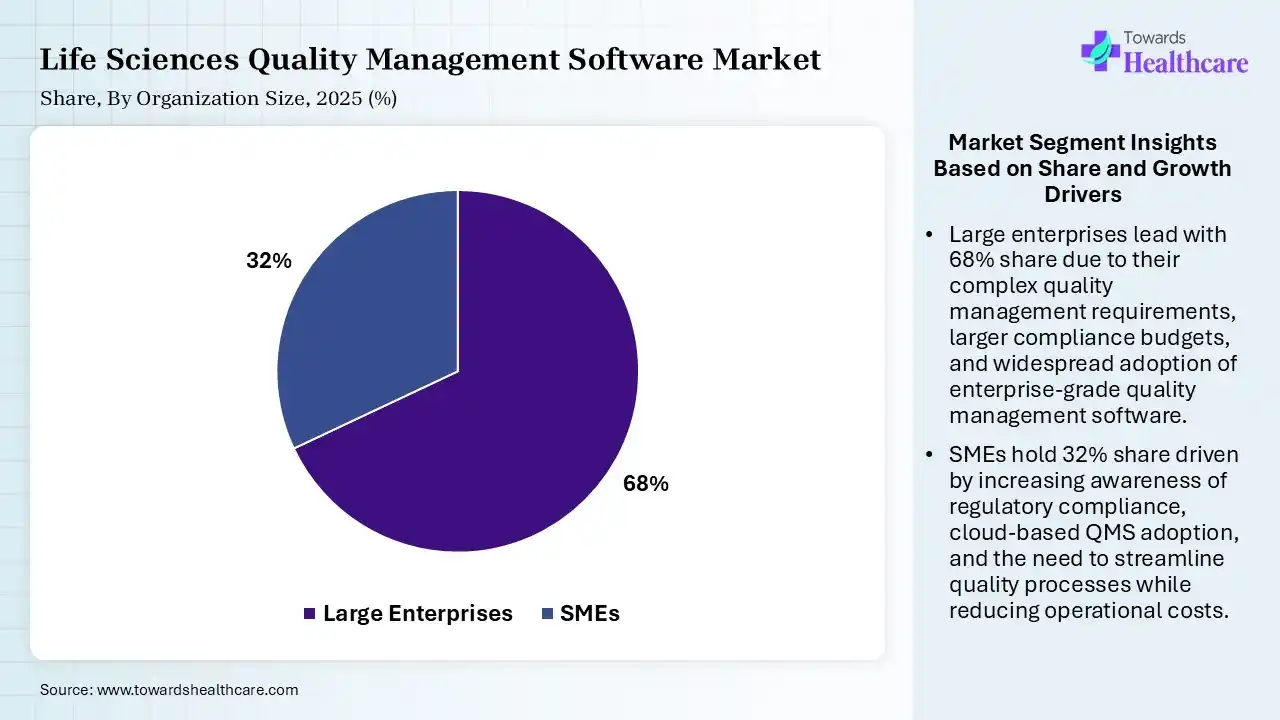
| Segment | Share 2025 (%) |
| Large Enterprises | 68% |
| SMEs | 32% |
The Large Enterprises Segment Dominated the Market With 68% in 2025
The large enterprises segment held a major revenue share of 68% of the life sciences quality management software market in 2025, driven by heavy investment in enterprise-wide digital quality systems. They managed multi-site compliance efficiently, which increased the demand for life sciences quality management software. They supported global regulatory operations, which encouraged their use.
The small & medium enterprises (SMEs) segment held the second-largest share of 32% of the market in 2025 and is expected to expand rapidly during the forecast period, due to growing adoption of cloud-based platforms with lower upfront costs. The platforms improve regulatory readiness, which increases their use in SMEs. Accelerating digital transformation initiatives also fuels their demand.
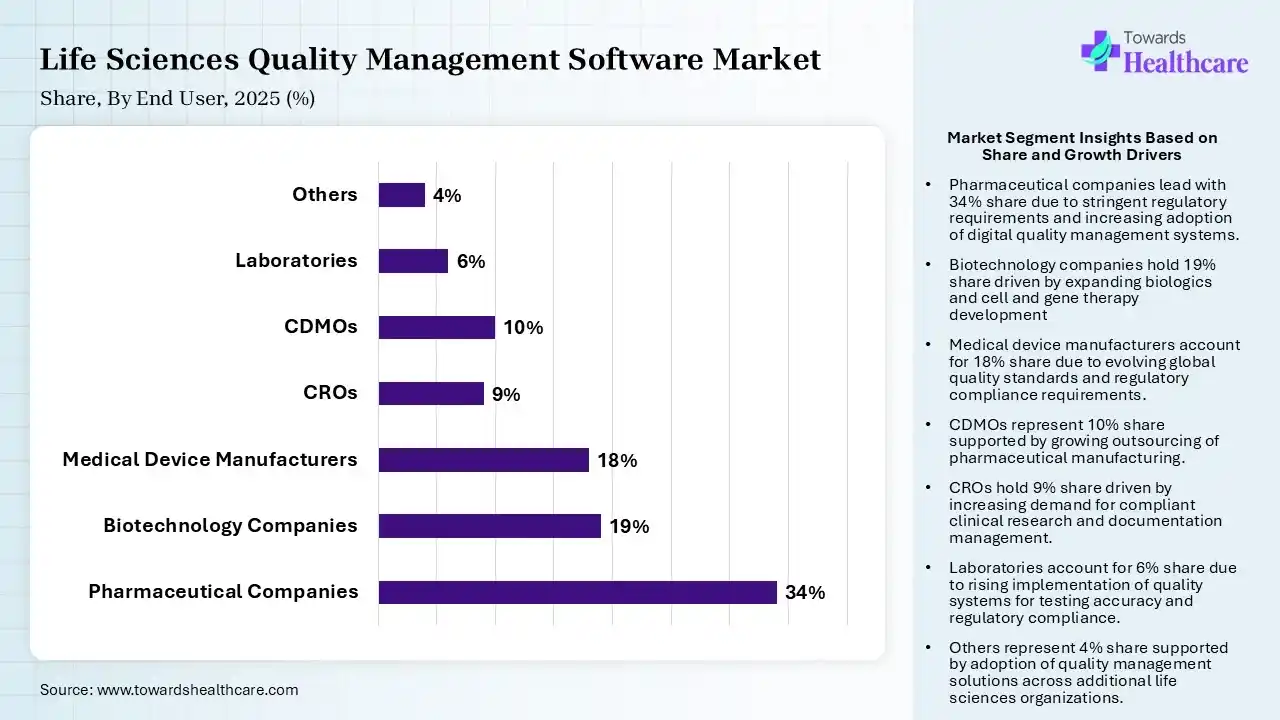
| Segment | Share 2025 (%) |
| Pharmaceutical Companies | 34% |
| Biotechnology Companies | 19% |
| Medical Device Manufacturers | 18% |
| CROs | 9% |
| CDMOs | 10% |
| Laboratories | 6% |
| Others | 4% |
The Pharmaceutical Companies Segment Dominated the Market With 34% in 2025
The pharmaceutical companies segment contributed the biggest revenue share of 34% of the life sciences quality management software market in 2025, driven by increased regulatory compliance investments. A rise in demand for modernized manufacturing quality systems also increased the adoption of life sciences quality management software. They managed global product portfolios efficiently, which increased their use. The Indian pharmaceutical industry also contributed to their growth, with the total value of pharmaceutical exports of ₹2,45,962 crore for FY 2024-25.
The biotechnology companies segment held the second-largest share of 19% of the market in 2025 and is expected to gain the highest share during the forecast period, due to expanding biologics and cell & gene therapy development. They also require digital quality documentation, which drives the demand for life sciences quality management software. These platforms support rapid innovation cycles, which encourages their adoption.
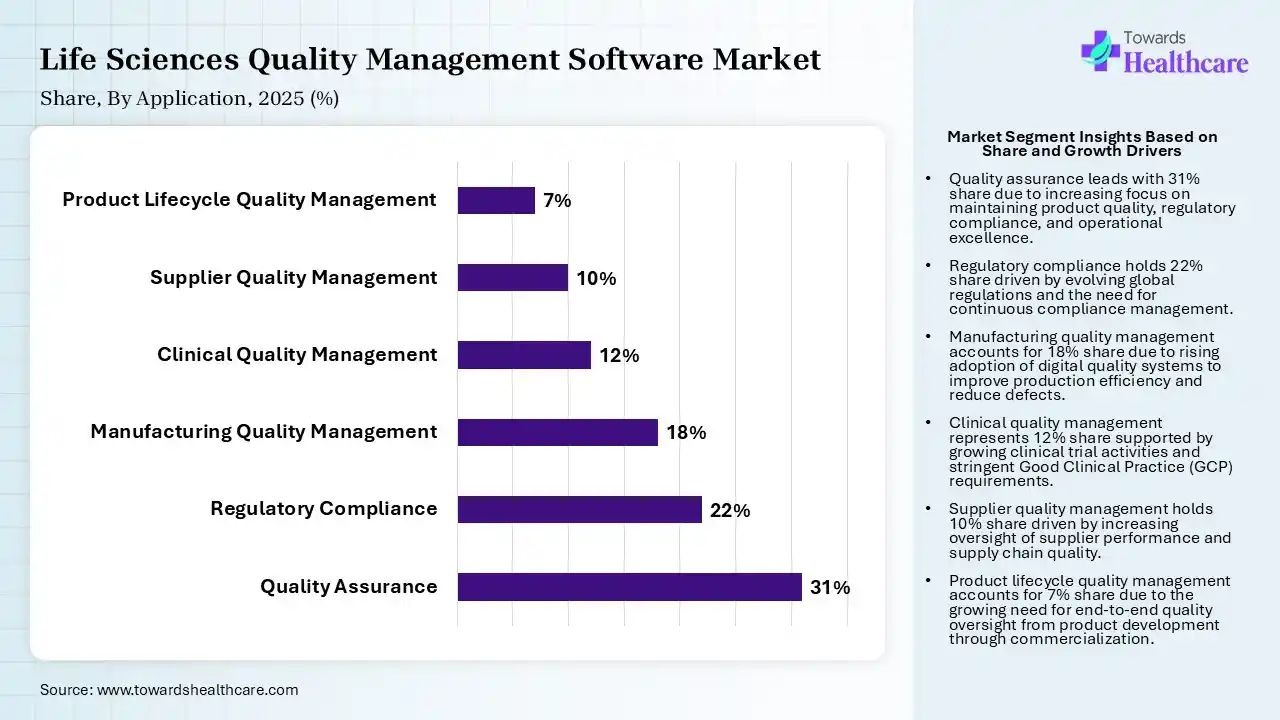
| Share 2025 (%) | Share 2025 (%) |
| Quality Assurance | 31% |
| Regulatory Compliance | 22% |
| Manufacturing Quality Management | 18% |
| Clinical Quality Management | 12% |
| Supplier Quality Management | 10% |
| Product Lifecycle Quality Management | 7% |
The Quality Assurance Segment Dominated the Market With 31% in 2025
The quality assurance segment held the largest revenue share of 31% of the life sciences quality management software market in 2025, driven by its standardized enterprise quality processes. Based on the analysis of Payal Rabde, the life sciences quality management software improved inspection readiness, which increased its utilization. They also reduced compliance gaps, which contributed to a rise in their use.
The clinical quality management segment held the second-largest share of 12% of the market in 2025 and is expected to grow with the fastest CAGR during the forecast period, due to expanding quality oversight in decentralized trials. The life sciences quality management software also improves protocol compliance, which drives its demand. It also strengthens clinical documentation, encouraging their use.
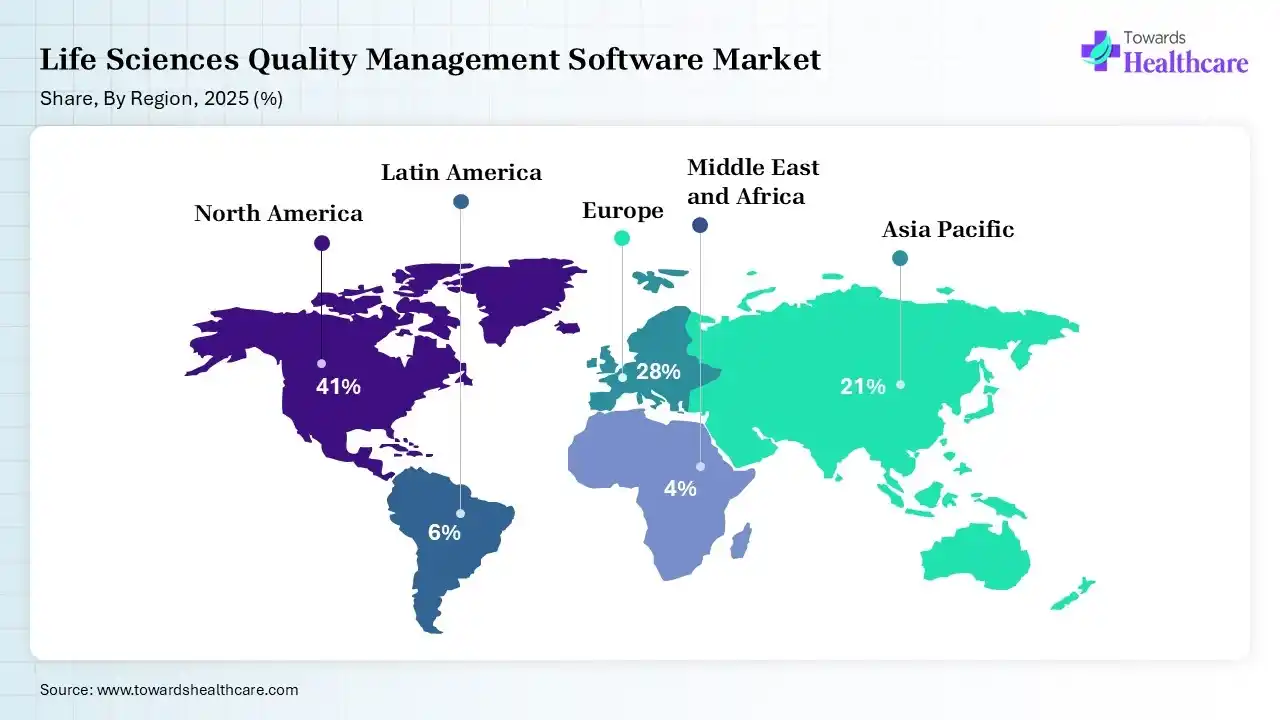
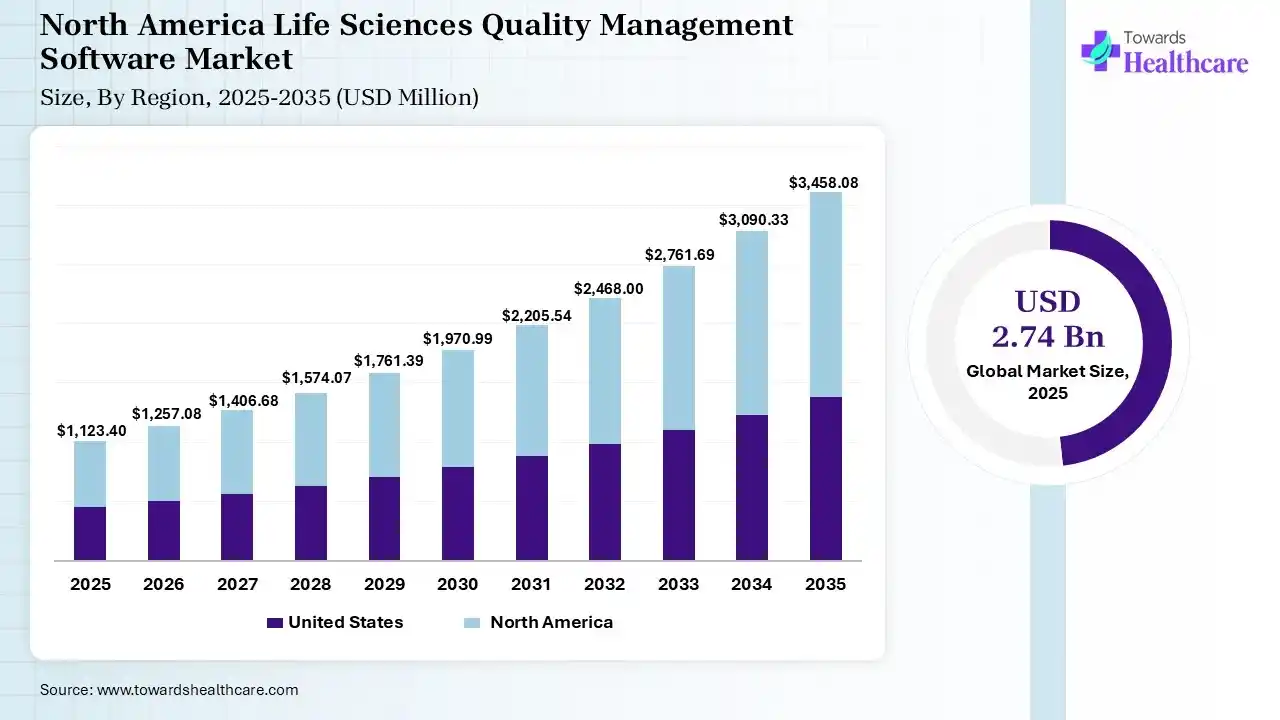
North America dominated the life sciences quality management software market with 41% in 2025, due to the presence of a mature pharmaceutical industry, which increased software adoption. Strong FDA compliance requirements also accelerated investments, which increased innovations. High digitalization also supported enterprise deployment, which increased their demand, where growth in healthcare investments also increased their use and innovations. The presence of advanced medical device companies also increased their advancements, which contributed to market growth.
US Market Growth
U.S. held a 33% share of the life sciences quality management software market in 2025, driven by the largest life sciences software market. Strong cloud adoption also encouraged their innovations. Continuous regulatory modernization also increased the adoption of life sciences quality management software. Growth in investments and a rise in the demand for advanced quality management platforms also increased their use. According to the information gathered by Payal Rabde, companies like Honeywell Technologies, with sales of $9.7 billion in the second quarter of 2026, also contributed to their leadership.
Mexico Market Growth
Mexico held a 3% share in the market in 2025 and is expected to grow with the highest CAGR during the studied years, due to manufacturing expansion, which drives quality automation. International compliance requirements also increase adoption of life sciences quality management software. Growing pharmaceutical production is also increasing their demand, where expanding life sciences infrastructure is also driving their utilization. New collaborations and stringent regulatory requirements are also increasing their demand.
Europe held a 28% share of the life sciences quality management software market and is expected to grow significantly during the forecast period, due to strong GMP regulations, which encourage software implementation. Growing pharmaceutical manufacturing investments are also accelerating life sciences quality management software innovations. At the same time, increasing digital quality transformation and new healthcare initiatives are also encouraging their adoption, where growing R&D activities are also enhancing market growth.
Germany Market Growth
Germany held an 8% share in the life sciences quality management software market in 2025, driven by a large pharmaceutical manufacturing base. Strong Industry 4.0 adoption and high regulatory standards increased the demand for life sciences quality management software. The growth in the demand for operational excellence, document management, and regulatory compliance also increased their use. Expansion of manufacturing facilities and the life sciences sector also increased their adoption rates.
UK Market Growth
UK held a 6% share in the market in 2025 and is expected to witness the fastest growth over the forecast period, due to expanding life sciences innovation. Growing cloud deployments and increasing digital compliance investments are also promoting advancements in life sciences quality management software. Growing regulatory requirements and healthcare IT infrastructure are also increasing their demand. Expanding government initiatives and R&D activities are also fueling their demand and accelerating their innovations.
Asia Pacific held a 21% share of the life sciences quality management software market in 2025 and is expected to grow at the fastest CAGR during the forecast period, due to rapid pharmaceutical production expansion. Increasing regulatory harmonization and strong cloud adoption are also supporting digital quality management, which drives the demand for life sciences quality management software. Increasing interest in product quality improvements, adoption of automated technologies, and AI innovations are also encouraging their use, which is promoting market expansion.
China Market Growth
China held a 7% share of the life sciences quality management software market in 2025, driven by expansion of biopharmaceutical manufacturing. Strong regulatory reforms and large-scale digital transformation also increased the use of life sciences quality management software. Growth in government support and healthcare investments also increased their adoption, where expansion of R&D activities and clinical trials also contributed to their increased use. At the same time, a rise in collaborations also increased their innovations.
India Market Growth
India held a 4% share in the market in 2025 and is expected to expand rapidly in the coming years, due to rapid pharmaceutical exports. Growing GMP compliance investments are also accelerating advancements in life sciences quality management software. Expanding CDMO sector and medical device industries are also increasing their innovations and utilization. Increasing healthcare investments and government initiatives are also encouraging their use, where a shift towards AI, risk management solutions, and automation are also driving their demand.
Latin America held a 6% share in the life sciences quality management software market in 2025 and is expected to show lucrative growth during the forecast period, due to pharmaceutical modernization improving software demand. Regulatory improvements also support adoption of life sciences quality management software. Quality investments increase steadily, which encourages their use, where expanding medical device industries and contract manufacturing activities are also increasing their innovations, fueling the market expansion.
Brazil Market Growth
Brazil held a 3% share in the life sciences quality management software market in 2025 and is expected to gain the highest market share during the forecast period, driven by the largest regional pharmaceutical market. Regulatory modernization expanded adoption of life sciences quality management software, where manufacturing upgrades continued their expansion. A rise in healthcare investments and clinical activities also increased their adoption. Furthermore, growth in the demand for product quality enhancement and automated audits also increased their demand.
The rest of Latin America held a 2% share in the market in 2025, due to regional manufacturing expansion. Increasing quality standards and growing software implementation are also increasing the demand for life sciences quality management software. Expanding healthcare investments and growing life science industries are also increasing their adoption. Growing digital transformation initiatives and contract manufacturing are also encouraging their use, where stringent regulations are also promoting their utilization and innovations.
MEA held a 4% share in the life sciences quality management software market in 2025 and is expected to show notable growth during the forecast period, due to expanding healthcare manufacturing investments. Regulatory frameworks also strengthen the demand for life sciences quality management software, where digital transformation supports quality management, promoting their use. Expanding multinational companies and automated technologies are also encouraging their utilization and innovations, propelling the market growth.
GCC Market Growth
GCC Countries held a 2% share in the life sciences quality management software market in 2025 and are expected to show the fastest growth over the forecast period, driven by government investments that strengthened pharmaceutical manufacturing. Expansion of digital compliance initiatives and growth in smart manufacturing capabilities also increased adoption of life sciences quality management software. Stringent regulations also increased their use, where the expansion of the life sciences sector also increased their use as well as promoted their innovations.
The rest of the Middle East & Africa held a 1% share in the market in 2025, due to emerging pharmaceutical industries adopting digital quality solutions. Depending on Payal Rabde’s survey, expanding manufacturing capabilities also drives the demand for life sciences quality management software, where regulatory compliance improvements also drive their adoption. Expanding medical device companies and demand for cloud-based solutions are also accelerating the development of advanced quality management platforms, encouraging their innovations.
| Companies | Headquarters | Solutions |
| Veeva Systems | Pleasanton, U.S. | Veeva Vault QMS |
| Sparta Systems (Honeywell) | Hamilton, U.S. | TrackWise Digital |
| MasterControl | Salt Lake City, U.S. | MasterControl Quality Excellence |
| Greenlight Guru | Indianapolis, U.S. | Greenlight Guru Quality |
| Qualio | San Francisco, U.S. | Qualio |
In June 2026, after the acquisition of cResults by Title21 Health Solutions, its CEO, Tony Pare, highlighted, “The acquisition of cResults is a natural extension of Title21’s commitment to delivering best-in-class digital solutions for the life sciences industry.” “For years, our clients have requested smarter tools for planning and scheduling their quality operations, tools that connect seamlessly with their quality management systems and give them real visibility into resource capacity and workload. The cResults portfolio fulfills this need. The Smart-QX platforms are deployed at some of the world’s leading life sciences organizations, and the ROI results in process and resource optimization are well documented. By bringing cResults into the Title21 family, we are delivering on a commitment we have made to our clients and unlocking the next generation of integrated quality operations for the industry.”
It evaluates market concentration, competitive intensity, and strategic positioning.
Market Share Analysis of Leading Companies
The market share analysis of leading companies depends on the product portfolio, geographical presence, regulatory compliance, automation capabilities, and services.
Competitive Benchmarking Matrix
The competitive benchmarking matrix focuses on regulatory compliance, risk management, ease of implementation, automation, and security features.
Product Portfolio Comparison
Veeva Systems, IQVIA, and ETQ (Hexagon) are the top companies in the product portfolio comparison.
Pricing Positioning
Based on the pricing positioning, Veeva Systems, MasterControl, and Qualio dominated the market.
Geographic Presence Comparison
Veeva Systems, MasterControl, and Honeywell led the market in the geographic presence comparison.
Technology Capability Comparison
Technology capability comparison marked the dominance of MasterControl, Veeva Systems, and Honeywell.
Cloud Capability Benchmark
MasterControl, Veeva Systems, and Honeywell contributed to the market expansion by cloud capabilities.
AI Feature Benchmark
Based on the AI feature benchmark, MasterControl, Honeywell, and Veeva Systems were the market leaders.
Customer Base Comparison
MasterControl, Honeywell, and Veeva Systems held a dominant position based on customer base comparison.
| Company Overview | Science-based and technology-powered company offering a virtual twin for human-centric experiences. |
| Financial Performance | Total revenue of €1.56 billion |
| Software Portfolio | 3DEXPERIENCE, 3DVIA, BIOVIA, CATIA, DELMIA, etc |
| Geographical Presence | Paris, U.S., China, Japan, India, Brazil, Canada, and Germany |
| Strategic Initiatives | Partnership with PariSanté Campus |
| Recent Developments | Launched Medidata Plus |
| Future Outlook | Vision for 2040 is grounded in a generative economy: a model inspired by the generative processes of the organic world, driving new perspectives behind sustainable approaches for producing, treating, living, and learning. |
| SWOT Analysis |
Strengths:
Weakness:
Opportunities:
Threats:
|
| Company Overview | Brings together decades of expertise building trusted software for organizations where EHS, quality, and compliance can't fail. |
| Software Portfolio | Integrated EHS platform, regulatory compliance platform, and live dashboards |
| Geographical Presence | Scotland, England, Texas, San Francisco, India, Australia, and UAE |
| Strategic Initiatives | Acquisition of Work Wallet |
| Recent Developments | Recognised in the Verdantix Green Quadrant: Process Safety Management Software (2026), which positioned the company as a ‘Leader’. |
| SWOT Analysis |
Strengths:
Weakness:
Opportunities:
Threats:
|
| Company Overview | Empowers sponsors, contract research organizations (CROs), and research sites with secure, cloud-based solutions and expert research services. |
| Services Portfolio | Clinical trial operations, clinical data collection, pharmacovigilance, data intelligence, etc. |
| Geographical Presence | North America, Latin America, Europe, Asia Pacific, and MEA |
| Strategic Initiatives | Nova Scotia Health has successfully implemented a new clinical information system from Oracle Health |
| Recent Developments | Announced Project Jupiter has delivered nearly $80 million in tax revenue |
| SWOT Analysis |
Strengths:
Weakness:
Opportunities:
Threats:
|
It highlights quantitative forecasts supported by market assumptions, adoption trends, and investment outlook.
It includes strategies to strengthen product differentiation, accelerate cloud migration, expand AI capabilities, and enhance regulatory compliance support.
Based on Payal Rabde's analysis, the life sciences quality management software market is expected to show significant growth during the forecast period due to a wide range of factors. The evolving regulatory requirements, increasing digital transformation initiatives, advancements in AI platforms, and growing demand for cloud-based solutions are increasing the adoption as well as innovation of life sciences quality management software. Growing demand for mobile applications, integration with enterprise systems, expanding manufacturing capability, and healthcare investments are also increasing their utilization. Segments such as cloud-based, CAPA (corrective and preventive action) management, pharmaceutical companies, quality assurance, and clinical quality management are expected to show considerable growth, which will increase the opportunities for investments. Furthermore, companies including Veeva Systems, MasterControl, Sparta Systems (Honeywell), Dassault Systèmes, IQVIA, and ETQ (Hexagon) are anticipated to expand, promoting innovation and collaborations, which will attract new investments and funding.
By Deployment Mode
By Solution
By Organization Size
By End User
By Application
By Region










Principal Consultant
Payal Rabde is a Healthcare Market Research Analyst at Towards Healthcare Research & Consulting with 4+ years of experience in pharmaceuticals, biotechnology, medical devices, and life sciences.
Learn more about Payal Rabde

Reviewed By
Aditi Shivarkar is a seasoned professional with over 14 years of experience in healthcare market research. As a content reviewer, Aditi ensures the quality and accuracy of all market insights and data presented by the research team.
Learn more about Aditi Shivarkar










