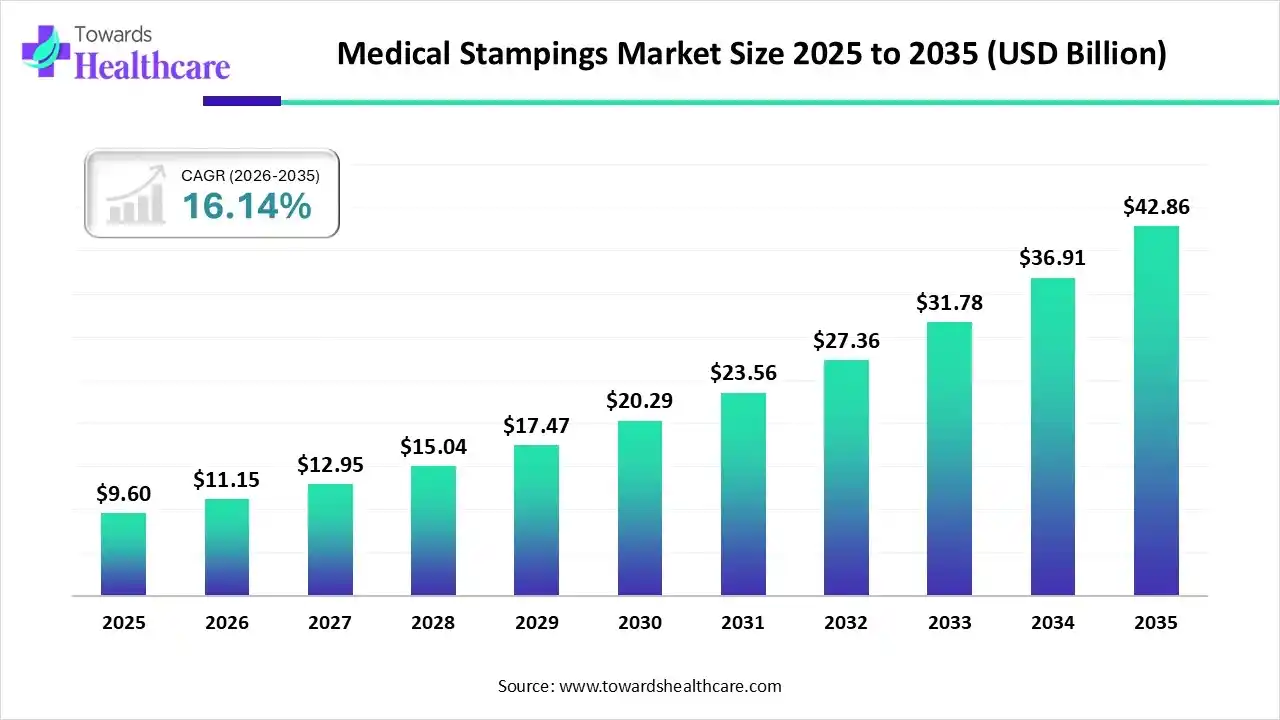
The global medical stampings market size was estimated at USD 9.6 billion in 2025 and is predicted to increase from USD 11.15 billion in 2026 to approximately USD 42.86 billion by 2035, expanding at a CAGR of 16.14% from 2026 to 2035. The medical stampings market is growing, as these provide greater precision, consistency, and affordability for high-volume manufacturing of intricate and healthcare-grade components.
The medical stampings market is increasing due to stamping providing an affordable opportunity to manufacture precision medical tools. Healthcare advances continue pushing healthcare components and devices into novel technological terrains. Healthcare components comply with manufacturing approaches and morals; they meet performance and durability necessities in addition to safety values. Metal stamping technology to choose from, metal-stamped components and parts play a significant role in the healthcare and medical sectors. From medical tools to device components, metal stamping provides a profitable way to manufacture precision, high-performance healthcare tools and parts.
Precision metal stamping plays an essential role in creating modern healthcare products. This process uses specialized machinery to shape raw metal sheets into highly specific, complex components. Many surgical instruments, implantable devices, and diagnostic machines depend completely on these exact parts. As medical technology advances, the demand for smaller and more intricate components grows daily. Factories must follow strict cleanliness and quality standards to ensure every piece is safe for patient use. Using automation and advanced inspection tools helps manufacturers minimize errors during production. This careful process ensures that hospital equipment remains reliable and effective during critical operations. Ultimately, this industry keeps improving to support doctors and save patient lives worldwide.
Integration of AI-driven technology in medical stamping drives market growth, as AI-based technology transforms raw data into actionable insights, allowing precision medical affairs and modified engagement with medical care providers. AI-based technology enhances patient results and improves the strategic value of healthcare affairs in the biopharmaceutical manufacturing. AI-based technology transforms raw data into actionable insights, enabling precision medical affairs and modified engagement with medical providers. AI-based services offer unprecedented precision, removing human mistakes and streamlining manufacturing processes.
| Table | Scope |
| Market Size in 2026 | USD 11.15 Billion |
| Projected Market Size in 2035 | USD 42.86 Billion |
| CAGR (2026 - 2035) | 16.14% |
| Leading Region | North America by 39% |
| Key Applications | Surgical instruments, orthopedic implants, cardiovascular devices, diagnostic equipment, implantable devices, catheters, syringes, medical electronics housings, drug delivery components |
| Primary End Users | Medical device OEMs, hospitals, surgical equipment manufacturers, biotechnology companies, pharmaceutical device divisions, diagnostic companies |
| Key Growth Drivers | Increasing medical device production, demand for minimally invasive procedures, growth of implantable devices, precision manufacturing adoption, aging population, outsourcing by medical OEMs |
| Measurable Values | USD Millions/Units/Volume |
| Market Segmentation | By Product, By Application, By Region |
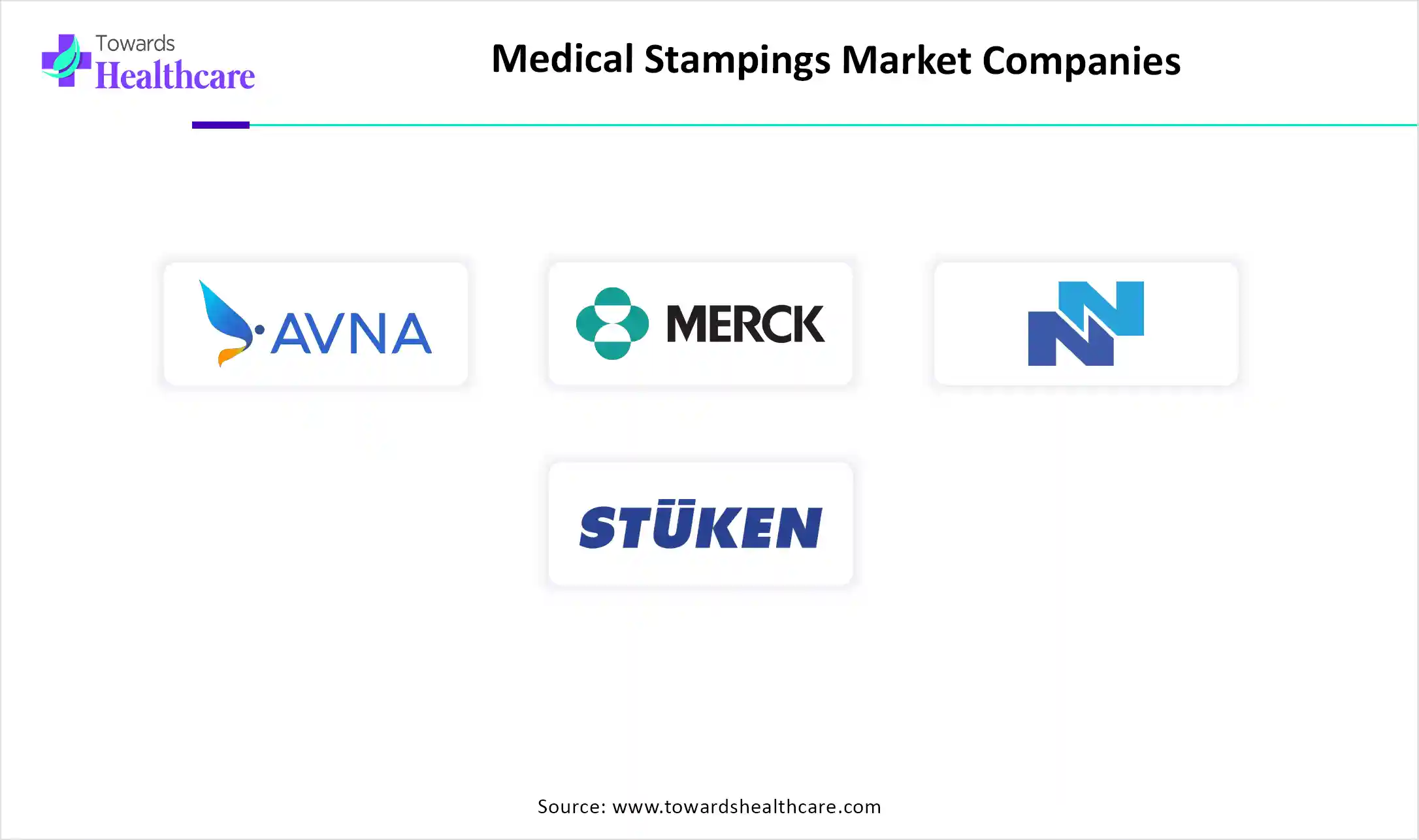
| Top Key Players | AVNA Inc., Meier Tool & Engineering, Inc., Merck & Co., Inc., NN Inc., NNI Precision, STÜKEN |
| Segments | Shares % |
| Retainers & Spring Seats | 18% |
| Battery Clips & Electrical Contacts | 15% |
| Brackets, Housings & Mounting Plates | 13% |
| Terminals & Lead Frames | 12% |
| Shielding Cans & Covers | 10% |
| Clips, Latches & Buttons | 9% |
| Electric & Power Stampings | 7% |
| Structural & Mechanical Stampings | 6% |
| Safety & Protection Stampings | 5% |
| Blade Guards & Safety Shields | 5% |
Which Retainers & Spring Seats Led the Medical Stampings Market in 2025?
In 2025, the retainers & spring seats segment held the dominant market by 18% share in 2025, due to retainers supports treat speech impairments by regulating tongue placement so that it forms sounds in an accurate way. These retainers are used after orthodontic management or as substitutes for braces when only minor tooth alterations are required. They support the natural curvature of the spine, lessening pressure on the lumbar discs during long, seated measures.
Terminals & Lead Frames
Whereas the terminals & lead frames segment is the fastest-growing in the market, as it offers crucial electrical, structural, and thermal benefits in healthcare electronic devices such as sensors, implants, and imaging tools, and in specialized protective apparatus. They offer a stable, conductive path between the semiconductor chip and the exterior circuit. Lead-impregnated materials efficiently absorb and block X-rays and gamma rays.
| Segments | Shares % |
| Injector Pens | 24% |
| CGM Devices | 18% |
| Diagnostic Devices | 14% |
| Injection Pumps | 11% |
| Implantable Cardiovascular Devices | 10% |
| Orthopedic Devices | 8% |
| Surgical & Procedural Instruments | 7% |
| Wearable Injectors | 5% |
| Autoinjectors | 3% |
Why did the Injector Pens Segment Dominate the Market in 2025?
The injector pens segment is dominant in the Medical Stampings Market by 24% share in 2025, and is expected maintain the fastest growth as Injection pens offer a convenient and precise method for self-administration of medications, enhancing patient adherence and overall treatment outcomes. These devices are increasingly applied for intensive insulin therapy, providing superior accuracy for low doses compared to syringes. Pen injectors are often compressed and transportable, making them simple to carry and use anywhere, which is particularly applicable for patients who are required to administer medication numerous times a day.
Wearable Injectors
Whereas the wearable injectors segment is the fastest-growing in the market, as wearable injectors significant substitute for patients in their home-based environments. Wearable injectors are applied as a substitute to necessitating the patient to be admitted to a healthcare facility for healthcare support of an injection. It is used for high-volume medicines, pharmaceutical formulae with high viscosities, and regimens that necessitate timed injection of a medicine over a sustained period.
In 2025, North America dominated the medical stampings market by 39% share due to increasing high initial spending costs in healthcare, deterring major organizations from committing to large-scale applications. The ageing population has a profound influence on the healthcare tools sectors in key areas, including a growing demand for assistive and mobility devices like wheelchairs, walkers, and prosthetics. The presence of well-established industry players, medical societies, and particular suppliers in the region hastens innovation in healthcare device production, which contributes to the growth of the market.
U.S. Market Trends
The U.S. is the largest medical device sector in the world, encompassing over 40% of the worldwide medtech. U.S. healthcare builders are progressively adopting advanced, high-speed stamping, leveraging in-die sensors and simulations to identify defects early and replace slower traditional technology. With over 50% of U.S. adults having major chronic conditions (MCC), the demand for medical tools is transforming toward continuous, remote, and AI-driven services intended to manage challenging, long-term medical care requirements.
Canada Market Trends
Canada is investing heavily in local healthcare infrastructure. Hospitals across the country are updating their surgical tools. Local manufacturers focus on eco-friendly production methods. This shift attracts green energy investments. High regulatory standards ensure all new devices are extremely safe. Growing patient demands continue to drive steady regional industry expansion.
Asia Pacific is expected to see rapid growth in the medical stampings market by 23% share, driven by the APAC medical care sector, which has huge growth potential, and organizations that drive innovation. Increasing aging populations, growing demand for medical care access, and the regional disparity in healthcare infrastructure and solutions. The massive growth of the medical care industry in the Asia Pacific is largely because of the emergence of healthtech, which is the application of technology to advance the practice of healthcare. Developing Asia Pacific to support and enhance health care provision for poverty reduction and improved consumer spending in healthcare, which drives the growth of the market.
India Market Trends
India offers advanced-quality healthcare components and tools at significantly affordable costs compared to other countries, making it a competitive worldwide production hub. The accessibility of a massive, skilled workforce, often trained in various areas, ensures compliance with international standards. Also, India is the fourth-largest market for healthcare devices, which is increasing the need for medical stamping in this region.
China Market Trends
China is rapidly boosting its medical manufacturing power. Factories are adopting advanced automation and robotics. This tech allows massive production at very low costs. Domestic demand is soaring due to an aging population. Government funding heavily supports new medical technology parks. The country is quickly becoming a global hub for medical components.
Europe is growing significantly in the medical stampings market by 28% share, as European healthcare stamping organizations are distributed across the healthcare industry group, with Germany being the central, majorly focusing on high-end precision stamping; Eastern and Southern Europe are affordable manufacturing bases, helping the whole healthcare sector, which drives the growth of the market.
UK Market Trend
The UK focuses strongly on high-tech medical innovations. Strong partnerships exist between top universities and manufacturers. This collaboration creates cutting-edge designs for surgical instruments. The National Health Service actively adopts these new efficient tools. Strict quality controls keep British parts highly respected. Digital integration is speeding up the entire design process.
Germany Market Trends
Germany leads Europe in precision engineering and high-quality materials. German companies create incredibly durable components for complex devices. They utilize advanced metal alloys for maximum safety. Local factories are moving toward fully digital smart manufacturing. High export rates spread German medical tools worldwide. Continuous research ensures they maintain a top reputation.
Growing production of local medical devices in the region is one of the major factors fueling the growth of the medical stampings market in the region. Growing public and private investments in hospitals, clinics, and diagnostic facilities are raising the overall demand for surgical, procedural, and diagnostic instruments, also propelling the market’s growth. Increased healthcare accessibility and a growing patient population are driving higher volumes of surgical and minimally invasive procedures, which utilize precision-stamped metal and stainless steel parts, elevating the market’s growth. Steady economic growth, rising disposable incomes, and improving healthcare spending are also helping the growth of the market in the region.
Brazil Market Trends
Brazil is the largest healthcare market in Latin America, acting as a primary regional anchor driving demand and localized manufacturing for medical components, including precision metal parts. Brazil's growing medical device contract manufacturing sector is also a major reason for the growth of the market. High procedure intensity directly translates to recurring requirements for precision metal stampings, clips, contacts, and surgical blades, further fueling the market’s growth.
Argentina Market Trends
Argentina contributes to the growth of the Latin America Medical Stampings Market primarily through its expanding domestic healthcare infrastructure, rising demand for precision-engineered medical components, and a growing contract manufacturing sector. Argentina serves as a primary engine for the broader Latin America Medical Stampings Industry, elevating the demand for stamped metal contacts, housings, and microcomponents used in medical devices, further fueling the growth of the market. High prevalence of chronic conditions like cardiovascular disease, local hospitals and diagnostic labs require continuous supplies of diagnostic and treatment equipment, helpful for the growth of the market.
The Middle East and Africa (MEA) region contributes to the medical stampings market through rising local medical-device production, major investments in specialty hospitals, and the high regional burden of chronic diseases. Driving the demand for precision-stamped metal components used in glucose monitors, insulin-delivery systems, and cardiac monitors is also one of the major factors fueling the growth of the market.
UAE Market Trends
Growing prevalence of lifestyle-related health issues such as obesity and diabetes leading to growing demand for diagnostic, monitoring, and insulin delivery systems, relying heavily on precision-stamped metal components, also fuel the growth of the market. Government-led healthcare investments, smart hospital initiatives, and multi-hospital expansions increase the installation base for surgical, diagnostic, and clinical instruments containing stamped metal parts, also elevating the market’s standards in the region.
South Africa Market Trends
South Africa acts as the primary gateway and manufacturing/distribution center for medical technologies and components in Sub-Saharan Africa, fueling the growth of the market. The growth of the market is also supported by a large public health procurement framework alongside a dominant private hospital network (Netcare, Mediclinic, and Life Healthcare Group) that continuously upgrades diagnostic, surgical, and patient-aid infrastructure.
| Ecosystem Category | Description |
| Technology Providers | Companies providing precision stamping technologies, CNC machining, tooling, automation, metal forming, and manufacturing systems |
| Product Manufacturers | Contract manufacturers producing stamped medical components, assemblies, and finished device parts |
| Service Providers | Precision engineering companies offering prototyping, tooling, stamping, validation, and cleanroom manufacturing services |
| Platform Providers | Manufacturing platforms integrating digital production, automation, inspection, and quality management |
| CROs/CDMOs | Limited relevance; some medical device contract manufacturers provide outsourced product development and manufacturing services |
| Software Vendors | CAD/CAM, simulation, manufacturing execution systems, and quality management software providers supporting stamping workflows |
| Research Institutions | Advanced manufacturing institutes, materials research organizations, medical engineering centers |
| End-User Industries | Medical devices, diagnostics, surgical technology, orthopedics, cardiovascular, drug delivery, healthcare equipment |
R&D:
Manufacturing Processes:
| Tier 1 | Tier 2 | Tier 3 | |
| Typical Market Influence | 55% | 30% | 15% |
| Tier 1 | ||||
| Company Name | Headquarters | Country | Why Relevant to This Market | Key Products/Services |
| Integer Holdings Corporation | Plano, Texas, USA | USA | One of the largest medical device contract manufacturers with significant precision component manufacturing capabilities | Precision metal components, implantable device components, catheter components, medical assemblies |
| TE Connectivity | Galway, Ireland | Ireland | Major supplier of medical device components with advanced metal stamping and precision manufacturing operations | Stamped metal components, connectors, sensors, medical device assemblies |
| Flex Ltd. | Singapore | Singapore | Global manufacturing partner providing medical device production and precision manufacturing services | Medical device components, assemblies, precision manufacturing |
| Tier 2 | ||||
| Company Name | Headquarters | Country | Why Relevant to This Market | Key Products/Services |
| Minnesota Rubber and Plastics | Roseville, Minnesota, USA | USA | Specialized medical component manufacturer with precision production capabilities | Medical components, molded and stamped assemblies |
| Mack Molding | Arlington, Vermont, USA | USA | Provides medical device contract manufacturing and precision engineering | Medical device assemblies, precision components |
| Klein Tools | Lincolnshire, Illinois, USA | USA | Experienced metal forming and precision manufacturing supplier | Metal stamped components and engineered parts |
| Tier 3 | ||||
| Company Name | Headquarters | Country | Why Relevant to This Market | Key Products/Services |
| Medical Engineering Technologies | East Sussex, UK | UK | Supports medical device development requiring precision engineering capabilities | Device engineering and validation support |
| Pembleton Manufacturing | Janesville, Wisconsin, USA | USA | Provides precision metal fabrication and stamping capabilities | Precision stamped medical components |
| MicroGroup | Medway, Massachusetts, USA | USA | Specialized supplier for minimally invasive medical devices | Precision tubing, components, medical assemblies |
In July 2025, “Our new structure represents a significant step forward in aligning our brand with the value we bring to our customers,” said Elisabeth Weissenrieder-Bennis, President of Weiss-Aug. “By retiring legacy names from past acquisitions and uniting our capabilities under these focused business units, we are better positioned to deliver industry-specific expertise, drive innovation, and scale with our customers’ needs.”
Strengths
Weaknesses
Opportunities
Threats
By Product
By Application
By Region



Principal Consultant
Rohan Patil is a seasoned market research professional with over 5+ years of focused experience in the healthcare sector, bringing deep domain expertise, strategic foresight, and analytical precision to every project he undertakes.
Learn more about Rohan Patil

Reviewed By
Aditi Shivarkar is a seasoned professional with over 14 years of experience in healthcare market research. As a content reviewer, Aditi ensures the quality and accuracy of all market insights and data presented by the research team.
Learn more about Aditi Shivarkar