


The global mental health platform market size is expected to be worth around USD 37.26 Billion by 2035, from USD 7.15 billion in 2025, growing at a CAGR of 17.95% during the forecast period from 2026 to 2035.
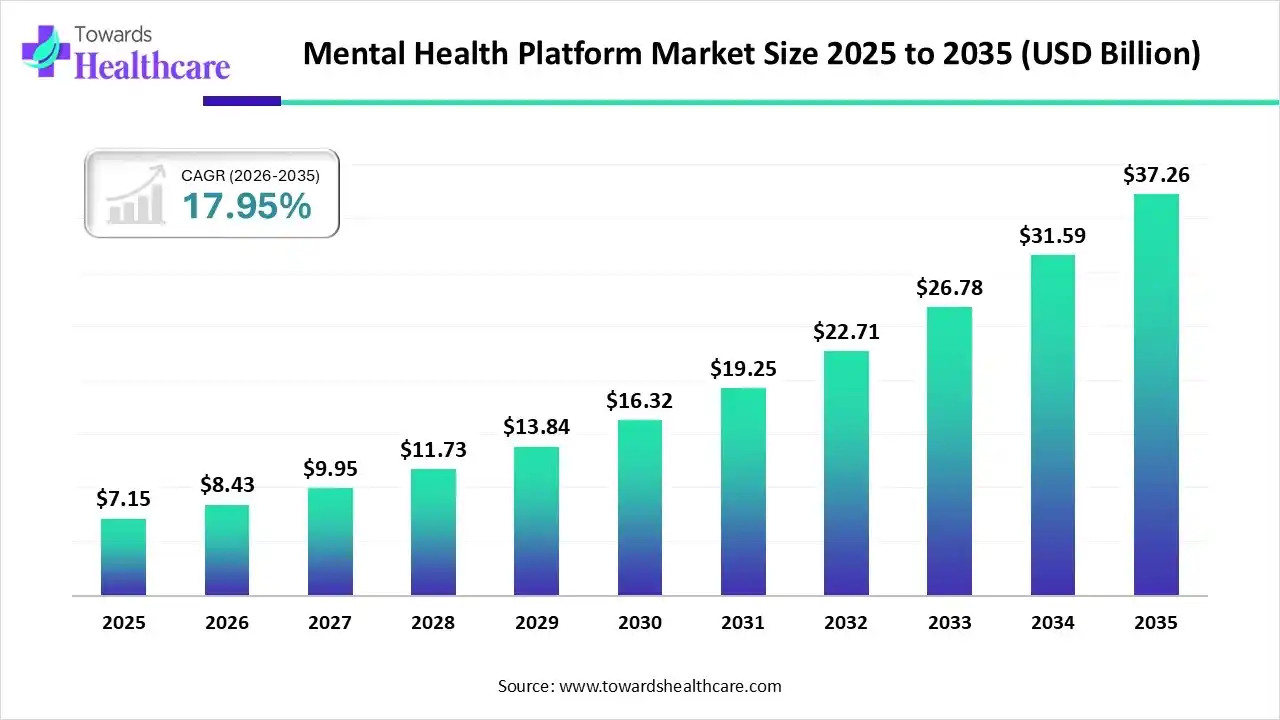
The mental health platform market is experiencing robust growth, driven by growing awareness about mental health issues and increasing demand for personalized approaches. Government bodies conduct campaigns and support regular counseling sessions for overall mental health wellness. The increasing investments and collaboration among healthcare professionals contribute to market growth. The growing research activities potentiate the development of innovative mental health platforms.
The mental health platform market refers to developing digital mental health apps and non-digital tools for promoting mental well-being. Mental health platforms play a vital role in addressing emotional, psychological, and behavioral issues through professional support. They provide emotional support, enhance interpersonal skills, help build and maintain healthy relationships, and support behavioral change. They are useful for patients of all age groups, from children and adolescents to the geriatric population.
By leveraging AI in mental health platforms, healthcare professionals can receive real-time updates about patients and manage their conditions from a remote location. AI and machine learning (ML) algorithms can analyze vast amounts of data and study behavioral patterns in patients. AI-based chatbots and natural language processing (NLP) can help patients express their emotional concerns and suggest appropriate measures based on their conditions. AI and ML are also emerging as promising approaches to automate cognitive assessments.
A mental health platform refers to a digital system, including a mobile app, web service, or telehealth portal that integrates tools like virtual therapy, AI support, mood tracking, and self-guided care into a single accessible service. The market is mainly driven by increasing demand for mental health integrated with lower social stigma, driving more people to seek help. Workforce wellness, cost, and convenience are driving the offering of affordable and on-demand care. Key trends focus on AI-powered platforms for real-time crisis detection and personalized exercises, wearable integration, and all-in-one scalability. Future opportunities include expanding digital mental health solutions in emerging markets, specialized app-based care for substance use disorders and severe mood conditions, and preventive wellness services such as sleep tracking and mindfulness coaching, which further drive the market expansion.

| Countries | Prevalence Rate |
| United States | 22.30% |
| India | 12.60% |
| Australia | 21% |
| United Kingdom | 19.70% |
| Key Elements | Scope |
| Market Size in 2026 | USD 8.43 Billion |
| Projected Market Size in 2035 | USD 37.26 Billion |
| CAGR (2026 - 2035) | 17.95% |
| Leading Region | North America by 38% |
| Historical Data | 2020 - 2023 |
| Base Year | 2025 |
| Forecast Period | 2026 - 2035 |
| Measurable Values | USD Millions/Units/Volume |
| Market Segmentation | By Component, By Application, By Deployment Mode, By End-User, By Region |
| Top Key Players | Lyra Health, Inc., Grow Therapy, Wysa, Avika Mind Health, BetterHelp, Headspace, Kintsugi Voice, Talkspace, Unmind |
| Segments | Shares % |
| Software | 40% |
| Services | 60% |
Which Component Segment Dominated the Mental Health Platform Market?
The software segment held a dominant position in the market share of 40% in 2025, due to the availability of user-friendly software tools. Mental health software enables customization of patient data and reduces the risk of data leakage. The demand for software tools is increasing, with the advent of cloud and continually evolving business models. Software-as-a-Service (SaaS) is delivered over the internet on a subscription basis, eliminating the need for a suitable infrastructure.
Services
The services segment is expected to grow at the fastest CAGR in the market during the forecast period. Service-as-software is emerging as a new concept to ensure better automation and easier scalability. It is comparatively more cost-effective than SaaS as patients do not need to pay an annual subscription. In addition, service providers have relevant expertise to solve tailored complex problems.
| Segments | Shares % |
| Stress Management | 30% |
| Meditation | 10% |
| Wellness | 15% |
| Therapy | 35% |
| Others | 10% |
How the Stress Management Segment Dominated the Mental Health Platform Market?
The stress management segment held the largest revenue share of 30% of the market in 2025, due to the rising stress cases among individuals of all age groups. According to a recent cross-sectional study analyzing data from 149 countries from 2007 to 2021, more than half of the population experienced emotional stress in 20 countries. Of these, 85% countries had worse psychological stress in 2020 than in 2008. Mental health platforms help manage stress, sleep, and productivity.
Therapy
The therapy segment is expected to grow with the highest CAGR in the market during the studied years. Mental health platforms offer personalized therapy through confidential counseling sessions. They help identify triggers for emotions and allow patients and providers to discover deep-rooted concerns. The increasing prevalence of mental health disorders potentiates the demand for mental health platforms.
| Segments | Shares % |
| Cloud | 55% |
| On-premises | 45% |
Why Did the Cloud Segment Dominate the Mental Health Platform Market?
The cloud segment contributed the biggest revenue share of 55% of the market in 2025, due to high scalability and technological advancements. Cloud-based tools enable patients and providers to access patient data from anywhere and at any time. They eliminate the need for a suitable infrastructure to install hardware components, reducing upfront costs and local maintenance burden, such as hardware fixes. They also offer greater flexibility when scaling up or down operations.
On-premises
The on-premises segment is expected to grow steadily in the upcoming period. On-premises tools provide complete control over patient data and customization. They are not operated on the internet, providing greater security and reducing the risk of data leakage. They prevent downtime risks from internet failures or regional outages, providing high reliability. Providers do not need to purchase or renew software licenses annually.
| Segments | Shares % |
| Individuals | 20% |
| Enterprises | 25% |
| Healthcare Providers | 45% |
| Others | 10% |
Which End-User Segment Led the Mental Health Platform Market?
The healthcare providers segment led the market by 20% share in 2025, due to the need to serve a larger patient population. Healthcare providers adopt advanced mental health platforms to provide tailored therapy, comprehensive digital care, and specialized practice management tools. Mental health platforms can reduce burnout and enhance productivity, decreasing workload on providers. They provide data-driven insights about patients’ health and suggest appropriate treatment outcomes.
Individuals
The individuals segment is expected to witness the fastest growth in the market over the forecast period. Individuals are becoming aware of mental health platforms and their benefits. Platforms eliminate the need for individuals/patients to visit any healthcare organization, saving patients’ time and costs. Patients can receive their treatment from providers located in diverse geographical areas. They can share their confidential data with software tools.
North America dominated the global market by 38% in 2025. The presence of key players, availability of a robust healthcare infrastructure, and favorable government support are major factors that contribute to market growth in North America. Employers in the U.S. and Canada are more concerned about their employees’ mental health conditions, necessitating them to leverage mental health platforms. Government and private organizations offer suitable reimbursement policies for patients, reducing their financial burden.
US Market Trends
Key players, such as Lyra Health, Inc., Grow Therapy, and Wysa, are major contributors to the market in the U.S. The Center for Medicaid and Medicare Services (CMS), a government-backed program, provides insurance coverage for mental health disorders. It is estimated that the Medicaid program accounts for one quarter of all U.S. spending on mental health and substance use disorders.
Canada Strengthens Mental Health Platform Landscape
Canada's mental health platform market is growing significantly because it aligns localized e-mental health frameworks with federal funding. The Mental Health Commission of Canada (MHCC) established an E-Mental Health Strategy to support provinces in developing digital mental health interventions like telemedicine and virtual peer support. Recent federal initiatives, including the Mind over Media project with a major goal of exploring the relationship between digital platforms and youth well-being, have been launched, although limitations remain in addressing fragmented provincial systems and ensuring internet access in remote areas to foster further adoption.
Asia-Pacific is expected to grow at the fastest CAGR in the market by 20% share during the forecast period. The growing demand for telehealth, the increasing geriatric population, and the rising prevalence of mental health disorders boost the market. Government bodies have launched initiatives to encourage the local population to screen for and diagnose mental health conditions at an early stage. They also make constant efforts to increase accessibility of platforms and provide funding for the same.
India Market Trends
The Indian government offers Tele-MANAS, a telehealth platform, for mental health disorders. From 2022 to 2025, approximately 20 lakh calls were received and served, transforming mental healthcare accessibility. It aims to provide universal access to equitable, affordable, and quality care through 24x7 tele-mental health services, benefiting 15% of the Indian adult population suffering from mental health illnesses.
China Revolutionizes Mental Health Platform Market
China’s mental health platform market is growing notably, with its national public health campaigns aiming to close treatment gaps by integrating mental health screenings into routine diagnosis across public medical institutions. China has a high number of digital therapeutics, focusing primarily on direct treatment methods. Comprehensive legal measures oversee these platforms for user data protection and prevent monopolistic practices within massive domestic mental health outreach ecosystems.
Europe is expected to grow at a considerable CAGR in the upcoming period by 25% share. Government bodies launched initiatives to leverage digital tools in the healthcare sector. The increasing investments and collaboration among healthcare professionals have led to the adoption of mental health platforms. The Mental Health Europe organization aims to promote mental health, protect rights, and ensure care and inclusion for patients with psychological disabilities. The growing awareness of mental health challenges and the rising adoption of advanced technologies augment the market.
UK Market Trends
In December 2024, the Medical Research Council (MRC) of the UK government established a £22.5 million Mental Health Research Platform to harness the full power of the UK’s research and innovation system to tackle large-scale, complex challenges. Additionally, Innovate UK invested over £3.6 million in business-led projects to develop therapeutic extended reality (XR) solutions for mental healthcare services.
Germany Accelerates Mental Health Platform Adoption
Germany’s mental health platform market is growing significantly due to its well-established, robust framework for digital mental health applications through its Digital Health Applications (DiGA) pathway that allows certified software to be prescribed and reimbursed by health insurance. The German Federal Office for Information Security enforces strict IT security mandates by ensuring consumer apps must meet high validation standards for insurance compensation and thereby further contributing to market adoption.
The mental health platform market in South America is expanding quickly because of the significant unmet need for affordable and accessible care. This growth is influenced by a lack of traditional professionals and a rise in digital usage. Telehealth applications and online therapy services provide scalable and cost-effective options for rural and disadvantaged regions. With more smartphones and better internet access, telemedicine and mental health apps can be widely distributed. Digital platforms present cheaper alternatives to conventional therapy, making mental health services available to a larger, often lower-income population.
Brazil Market Trends
Brazil has become a leading player in the mental health platform market due to strong demand, fast digital adoption, and a favorable regulatory framework. The mental health apps sector in the country is driven by a large, connected population looking for alternatives to traditional healthcare. The shift to remote care has become the norm, making digital mental health services standard and increasing telehealth usage during the crisis. This digital infrastructure enables mental health apps (mHealth) to connect with extensive parts of the population, including those in remote locations.
The Mental Health Platform Market by 7% share in the Middle East and Africa (MEA) is experiencing significant growth, driven by rapid digital health adoption, strong government support, and heightened mental health awareness. The UAE and Saudi Arabia lead in mental health investments, launching programs and fostering digital health startups to enhance healthcare. The UAE excels in telehealth platform usage, with increased education efforts reducing stigma and boosting app demand.
UAE Market Trends
The UAE is a key player in the Mental Health Platform Market, particularly in the GCC, due to high digital adoption, proactive government initiatives, and rising mental wellness awareness. The diverse expatriate community faces unique stressors and lacks traditional support, creating a demand for 24/7 digital mental health services. Corporate wellness programs are also integrating these platforms into employee benefits. The UAE, through the Dubai Health Authority (DHA) and the Department of Health (DoH) Abu Dhabi, supports AI-driven triage, chatbots, and integrated telehealth systems, enhancing user engagement with multilingual support and personalized therapy options.

| Period | Number of M&A Deals in the Behavioral Health Sector |
| Q4 2024 | 32 |
| Q1 2025 | 41 |
| Q2 2025 | 28 |
| Q3 2025 | 31 |
| Companies | Headquarters | Offerings |
| Lyra Health, Inc. | California, United States | It provides an AI-powered platform to deliver evidence-based mental healthcare that boosts employee well-being and drives business impact. |
| Grow Therapy | New York, United States | The company offers virtual and in-person care across all lines of business to access high-quality, insurance-covered therapy and psychiatric care |
| Wysa | Massachusetts, United States | It is a clinically-approved AI-powered well-being chatbot that helps reflect and grow through structured conversations |
| Avika Mind Health | Hyderabad, India | It develops a VR therapy platform that enhances mental health care through immersive, scenario-based experiences. |
| BetterHelp | California, United States | It is the world’s largest online therapy platform, having over 32,000 therapists and 457 million+ counseling sessions. |
| Headspace | California, United States | It offers mental health wellness resources and apps for meditation & sleep, and online therapy & counseling. |
| Kintsugi Voice | California, United States | Kinstugi Voice is an API-first platform that uses novel voice biomarkers in speech to identify, prioritize, and care for mental health in real time. |
| Talkspace | New York, United States | It has over 1 million users and helps women address hormonal shifts, evolving identities, and societal expectations. |
| Unmind | London, United Kingdom | Unmind is a mental health platform that empowers staff to proactively improve their mental well-being. |
Strengths
Weaknesses
Opportunities
Threats
By Component
By Application
By Deployment Mode
By End-User
By Region





Principal Consultant
Payal Rabde is a Healthcare Market Research Analyst at Towards Healthcare Research & Consulting with 4+ years of experience in pharmaceuticals, biotechnology, medical devices, and life sciences.
Learn more about Payal Rabde

Reviewed By
Aditi Shivarkar is a seasoned professional with over 14 years of experience in healthcare market research. As a content reviewer, Aditi ensures the quality and accuracy of all market insights and data presented by the research team.
Learn more about Aditi Shivarkar









