
Pipeline Programs

CGT Companies Tracked

Manufacturing Facilities


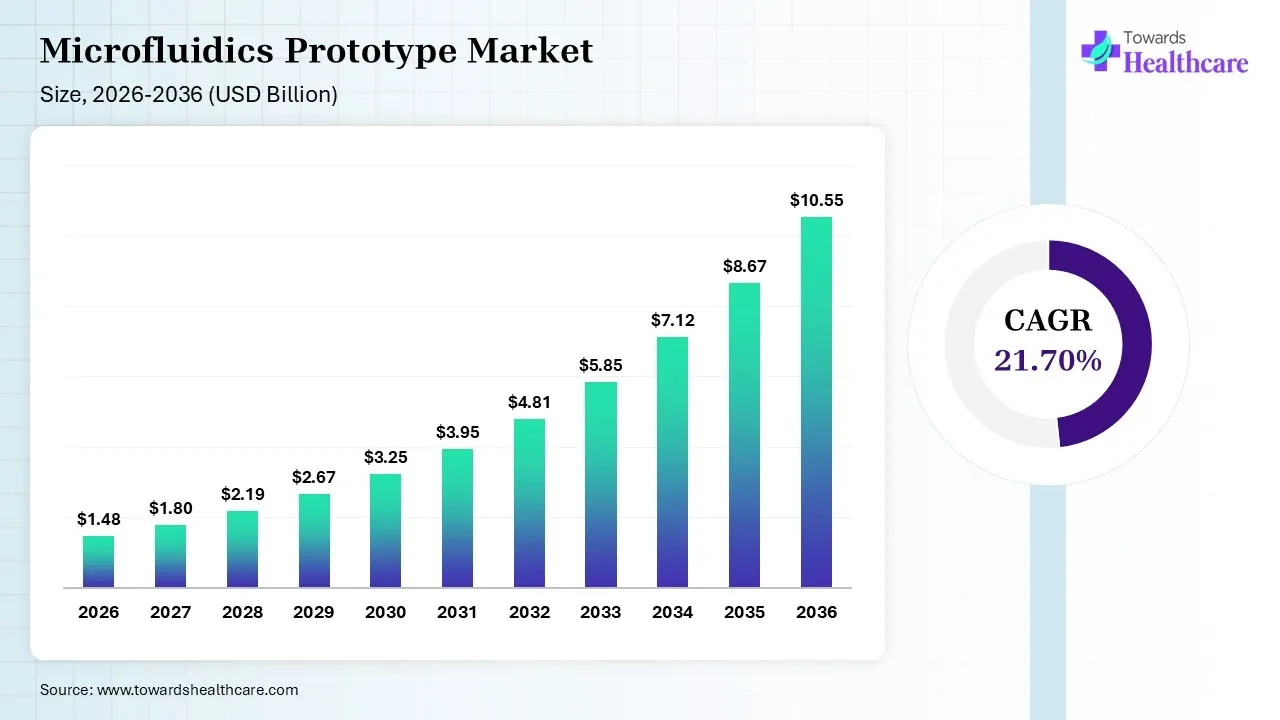
The microfluidics prototype market is estimated at USD 1.48 billion in 2026, with its value projected to rise to USD 10.55 billion by 2036 at a CAGR of 21.70% over the forecast period. Growth is driven by rising demand for pharmaceutical research, diagnostic testing, and organ-on-chip technologies. Microfluidic prototypes help researchers design and test devices that handle tiny volumes of fluids with precision. These devices support drug discovery, point-of-care diagnostics, cell culture, and molecular analysis, making laboratory testing more efficient and enabling the development of new research and diagnostic tools.
Market Size & Growth Outlook
Regional Market Spotlight
Segmental Spotlight
Microfluidics prototypes are early-stage devices used to design, test, and validate systems that manipulate small volumes of fluids through microscale channels. These prototypes support drug discovery, diagnostic development, cell analysis, and organ-on-chip research by helping researchers evaluate fluid flow, material compatibility, and assay performance before commercial production.
Advances in biomedical research and the growing demand for compact diagnostic devices are driving the adoption of microfluidic prototypes in drug testing and personalized medicine research. Techniques such as soft lithography and 3D printing allow researchers to modify designs, evaluate device performance, and refine prototypes more efficiently. The growing role of 3D printing in microfluidic prototyping is further demonstrated by a September 2025 study in Scientific Reports, which introduced an open-source platform for automating device design, verification, and fabrication, using a calcium-quantification assay to validate the approach. This progress highlights the potential of automated prototyping to simplify device development and accelerate testing.
Analyst View: Demand for microfluidics prototypes is supported by pharmaceutical R&D and diagnostic innovation. Manufacturers offering rapid design iteration, reliable fabrication, and application-specific integration are well positioned to serve research and product development teams.
3D printing and rapid prototyping: Additive manufacturing supports complex channel geometries and shorter design cycles. It helps researchers test device configurations before committing to more expensive fabrication processes.
Organ-on-chip development: Microfluidic prototypes support cell culture and human-relevant disease models. These systems help researchers investigate biological responses under controlled conditions.
Point-of-care diagnostics: Compact fluidic devices support portable testing and cartridge-based diagnostic platforms. Prototype development remains important for evaluating fluid handling, detection accuracy, and device usability.
Analyst View: Rapid fabrication and biomedical applications shape market development. Demand for flexible prototyping methods remains closely linked to the need for faster device validation and application-specific designs.
AI is improving microfluidic prototype development through computational modeling, image analysis, and automated experimental data processing. Machine learning algorithms help researchers predict fluid behavior and identify parameters for testing, while automated imaging supports cell monitoring and assay analysis. These capabilities enable faster design validation and more efficient research workflows.
A practical example is a 2025 study published in Digital Discovery, which introduced DropMicroFluidAgents, an AI-based framework that uses large language model agents and machine learning to automate droplet microfluidic device design and generate computer-aided design (CAD) scripts. The approach illustrates how AI can reduce trial-and-error during prototype development and support faster design optimization
Analyst View: AI integration strengthens the analytical capabilities of microfluidic platforms. Its commercial impact depends on integration with design software, laboratory workflows, and experimental validation.
Growth in Pharmaceutical Research and Diagnostic Development
Pharmaceutical and biotechnology companies account for 29% of the market in 2026. Drug discovery, screening and assay development rely on prototypes to evaluate fluid control and experimental performance. Microfluidic platforms also support miniaturized diagnostic workflows and biological testing. These applications sustain demand for custom chips and integrated prototype systems.
Fabrication Complexity and Scale-Up Challenges
Microfluidic development involves precise channel fabrication, material selection, and fluidic integration. Moving from laboratory prototypes to repeatable production requires consistent manufacturing quality and reliable device performance. Research on fabrication methods highlights differences in resolution, cost, and production suitability across available techniques.
Expanding Organ-on-Chip Research and Advanced Microfluidic Prototyping
Organ-on-chip research uses microfluidic devices to recreate aspects of human tissue function. These platforms support disease modeling and drug evaluation. The development of thermoplastic devices through 3D printing also expands options for prototype design and testing.
Analyst View: Pharmaceutical research and diagnostic development provide the main demand base. Fabrication consistency and the transition from prototypes to scalable manufacturing remain important commercial considerations.
| Segment | Share 2026 | Market value |
| Microfluidic chips | 32.50% | USD 481.00 million |
| Microfluidic pumps | 12.50% | USD 185.00 million |
| Sensors and detectors | 14.00% | USD 207.20 million |
| Connectors, valves and tubing | 11.00% | USD 162.80 million |
| Accessories and consumables | 15.00% | USD 222.00 million |
| Integrated prototype systems and others | 15.00% | USD 222.00 million |
Microfluidic Chips Lead with a 32.5% Share in 2026
Microfluidic chips lead the component segment with a 32.5% share, valued at USD 481 million. Their role in controlling fluid movement and integrating laboratory functions supports demand across drug discovery, diagnostics, and cell analysis. Accessories and consumables account for 15% of the market, reflecting recurring requirements during prototype testing and assay development.
Analyst View: Microfluidic chips remain the core component category. Consumables and integrated systems support continued demand throughout design, testing, and validation.
| Segment | Share 2026 | Market value |
| Soft lithography and PDMS molding | 27.00% | USD 399.60 million |
| 3D printing and additive manufacturing | 19.00% | USD 281.20 million |
| CNC micromachining and laser processing | 12.00% | USD 177.60 million |
| Hot embossing and injection molding for pilot prototypes | 10.00% | USD 148.00 million |
| Hybrid, paper-based and other fabrication methods | 13.00% | USD 192.40 million |
| Microfluidic foundry and outsourced fabrication services | 1.00% | USD 14.80 million |
Soft lithography and PDMS molding Capture the Largest Market Value at USD 399.60 million
Soft lithography and PDMS molding lead the fabrication technology segment with a 27% share, valued at USD 399.6 million in 2026, supported by their precision and suitability for iterative research. The continued relevance of these methods is reflected in a 2024 study published in Micromachines, which demonstrated a flexible printed-circuit-board-based molding approach for producing accurate PDMS microfluidic chips for biomedical research.
Analyst View: Soft lithography holds the largest share in the 2026 estimates. Additive manufacturing provides an alternative for complex designs and rapid development.
| Segment | Share 2026 | Market value |
| Drug discovery and screening | 21.00% | USD 310.80 million |
| Point-of-care and in-vitro diagnostics | 20.00% | USD 296.00 million |
| Organ-on-chip and cell culture | 18.00% | USD 266.40 million |
| Genomics, proteomics and molecular analysis | 13.00% | USD 192.40 million |
| Cell separation and cell handling | 10.00% | USD 148.00 million |
| Chemical synthesis and formulation development | 7.00% | USD 103.60 million |
| Environmental, food safety and industrial analysis | 6.00% | USD 88.80 million |
| Other research applications | 5.00% | USD 74.00 million |
Drug Discovery and Screening Account for 21% Share of the Market in 2026
Drug discovery and screening represent the largest application segment, valued at USD 310.8 million. Microfluidic prototypes support controlled experiments and screening workflows during early-stage pharmaceutical research. Point-of-care and in-vitro diagnostics follow closely with a 20% share, supported by portable testing and cartridge-based diagnostic development. Organ-on-chip and cell culture account for 18%, reflecting demand for controlled cellular environments.
Analyst View: Drug discovery remains the leading application. Diagnostics and organ-on-chip research form substantial complementary demand areas.
| Segment | Share 2026 | Market value |
| Polydimethylsiloxane (PDMS) | 28.00% | USD 414.40 million |
| Thermoplastics, including PMMA, COC and COP | 25.00% | USD 370.00 million |
| Glass | 16.00% | USD 236.80 million |
| Silicon | 9.00% | USD 133.20 million |
| Paper and porous materials | 8.00% | USD 118.40 million |
| Hydrogels and biocompatible materials | 7.00% | USD 103.60 million |
| Other materials and composites | 7.00% | USD 103.60 million |
PDMS Leads the Material Segment with a 28% Share in 2026
PDMS leads the material segment with a 28% share, valued at USD 414.4 million in 2026, due to its transparency, flexibility, and suitability for microfluidic prototyping. Its use in biomedical research is highlighted by a 2025 study published in RSC Advances, which developed a PDMS-based microfluidic device to create controlled concentration gradients for testing anticancer drugs.
Analyst View: PDMS remains the leading material for prototyping. Thermoplastics represent a significant alternative for developers preparing devices for larger production volumes.
| Segment | Share 2026 | Market value |
| Pharmaceutical and biotechnology companies | 29.00% | USD 429.20 million |
| Academic and research institutions | 22.00% | USD 325.60 million |
| Diagnostic and medical device companies | 18.00% | USD 266.40 million |
| Contract research organizations (CROs) | 10.00% | USD 148.00 million |
| Microfluidics startups and product developers | 9.00% | USD 133.20 million |
| Industrial, chemical and environmental laboratories | 7.00% | USD 103.60 million |
| Government laboratories and other users | 5.00% | USD 74.00 million |
Pharmaceutical and Biotechnology Companies Hold USD 429.20 Million in 2026
Pharmaceutical and biotechnology companies lead the end-user segment with a 29% share, valued at USD 429.2 million. Their demand is linked to drug screening, biologics research and process development. Academic and research institutions account for 22%, valued at USD 325.6 million, supported by laboratory research and interdisciplinary development.
Analyst View: Pharmaceutical and biotechnology companies form the largest customer group. Academic research remains an important source of prototype development and early-stage innovation.
| Region | Share 2026 | Market value |
| North America | 36.50% | USD 540.20 million |
| Asia Pacific | 27.50% | USD 407.00 million |
| Europe | 27.00% | USD 399.60 million |
| Latin America | 4.50% | USD 66.60 million |
| Middle East & Africa | 4.50% | USD 66.60 million |
North America holds a 36.5% market share, valued at USD 540.2 million in 2026, supported by strong biotechnology investment, research funding, and advanced microfabrication infrastructure. The region’s innovation is reflected in a 2026 research initiative by George Mason University and Phase Inc., supported by a U.S. National Science Foundation grant, to advance 3D-printed microfluidic devices through automated design, scalable PDMS chip manufacturing, and automated fluid handling. The project aims to make microfluidic prototyping more reliable and accessible for biomedical research, including drug discovery and disease studies, reinforcing North America’s role in microfluidic technology development.
Asia Pacific accounts for 27.5% of the market, valued at USD 407 million in 2026, driven by expanding biotechnology manufacturing, diagnostic development, and biomedical research. Growing interest in lab-on-a-chip technologies and compact diagnostic systems is creating opportunities for prototype development, enabling researchers and manufacturers to test device designs before commercial production.
Analyst View: North America holds the largest regional share in 2026. Asia Pacific represent substantial markets with established research and technology development activities.
The microfluidics prototype market comprises interconnected stages, from material sourcing to device development and end use. Raw material suppliers, including Dow, DuPont, Merck KGaA, and Corning, provide polymers, glass, and specialty materials used in prototype fabrication. Component providers such as Fluigent, Dolomite Microfluidics, Elveflow, and TE Connectivity supply fluid-control systems, connectors, and interfaces that regulate fluid movement.
Specialized manufacturers, including Micronit, Micralyne, ALine, and Microfluidic ChipShop, develop and fabricate microfluidic chips using soft lithography, micromachining, and 3D printing. Companies such as uFluidix, Potomac Photonics, and Parallel Fluidics support custom fabrication, device integration, and prototype testing.
Distribution channels, including Darwin Microfluidics, Blacktrace Holdings, and scientific equipment distributors, connect suppliers with research customers. End users include pharmaceutical companies, diagnostic developers, contract research organizations, and academic laboratories, which use prototypes for drug discovery, diagnostics, cell analysis, and organ-on-chip research.
Analyst View: Manufacturing expertise and component integration define key stages of the ecosystem. Reliable fabrication and fluidic performance remain central to prototype development.
| Category | Companies |
| Leaders | Micronit, Dolomite Microfluidics |
| Strong challengers | Microfluidic ChipShop, Micralyne, ALine, Inc., Fluigent |
| Specialists | Parallel Fluidics, Potomac Photonics, thinXXS Microtechnology |
| Emerging and regional players | Blacktrace Holdings, Alvéole, MicroLIQUID, Darwin Microfluidics, Microfluidic Foundry |
Micronit develops microfluidic devices and provides prototyping services for research and industrial applications. Its services support the development of devices from initial designs to physical prototypes. For example, its prototyping services help customers develop microfluidic devices for life sciences research and diagnostics.
Dolomite Microfluidics provides microfluidic instruments and systems for applications involving droplet generation, flow control, and particle production. Its microfluidics solutions support researchers working on controlled fluid handling and experimental development.
Microfluidic ChipShop manufactures microfluidic chips, connectors, and lab-on-a-chip components. Its product portfolio serves research and development activities involving microfluidic device design and testing.
ALine provides microfluidic engineering and product development services. Its work focuses on translating microfluidic concepts into functional devices for research and commercial applications. More information is available through its official website.
Micralyne specializes in microfabrication services for microfluidic and other microscale devices. Its official website outlines its capabilities in developing specialized components for applications requiring precision fabrication.
Analyst View: The market includes established prototype manufacturers, component suppliers and specialist fabrication companies.
https://pubs.rsc.org/dd/article/4/10/2827/889148/DropMicroFluidAgents-DMFAs-autonomous-droplet
The microfluidics prototype market is positioned for growth as pharmaceutical research, diagnostic development, and organ-on-chip applications increase demand for specialized devices. Microfluidic chips represent the largest component segment, while soft lithography and PDMS molding remain the leading fabrication technology. Future market development depends on advances in fabrication methods, reliable device integration, and the ability to transition validated prototypes into scalable manufacturing processes.
By Component Type
By Fabrication Technology
By Application
By Material
By End User
By Region


Principal Consultant
Payal Rabde is a Healthcare Market Research Analyst at Towards Healthcare Research & Consulting with 4+ years of experience in pharmaceuticals, biotechnology, medical devices, and life sciences.
Learn more about Payal Rabde

Reviewed By
Aditi Shivarkar is a seasoned professional with over 14 years of experience in healthcare market research. As a content reviewer, Aditi ensures the quality and accuracy of all market insights and data presented by the research team.
Learn more about Aditi Shivarkar