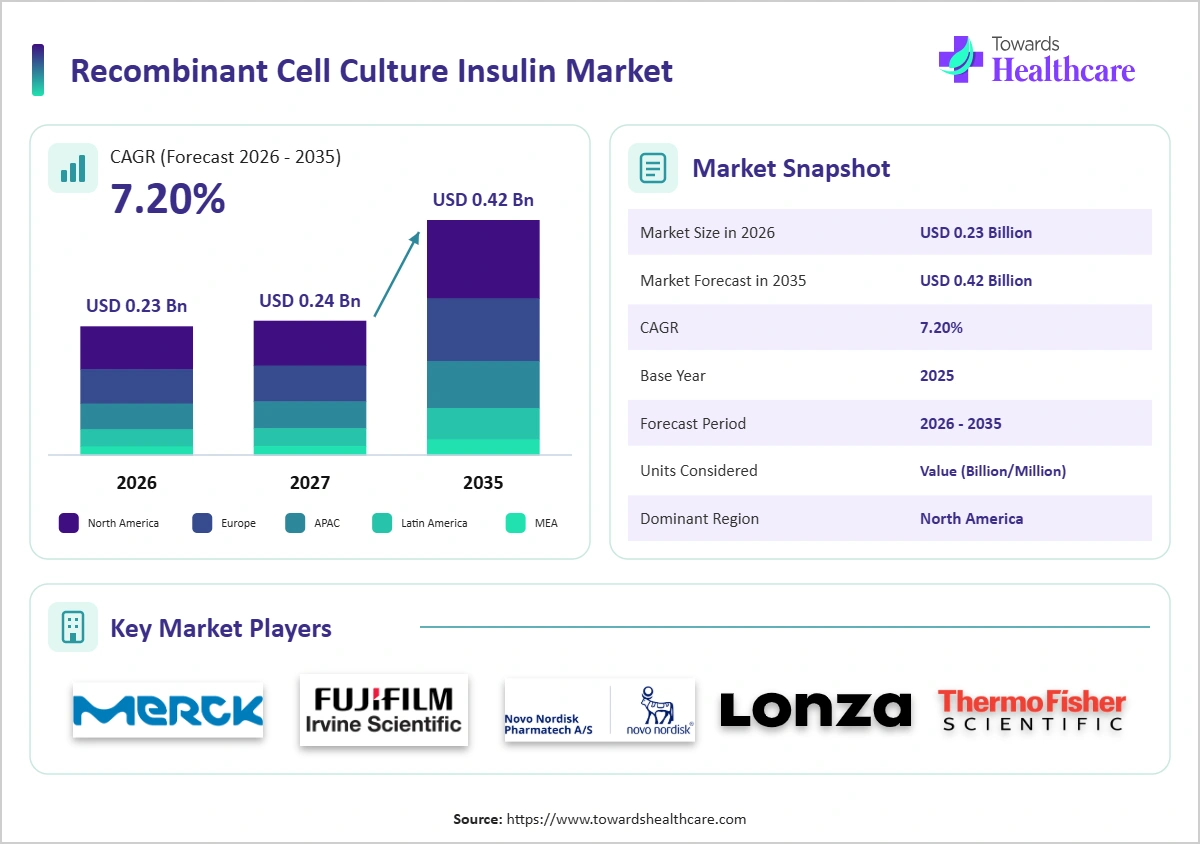
The recombinant cell culture insulin market is expected to expand from USD 0.21 billion in 2025 to USD 0.42 billion by 2035, driven by increasing biologics manufacturing and growing cell and gene therapy production. The rising adoption of serum-free and chemically defined media is further supporting demand for recombinant insulin as an essential media supplement. With these factors contributing to market expansion, the market is anticipated to reach USD 0.30 billion by 2030, growing at a CAGR of 7.20% from 2026 to 2035.
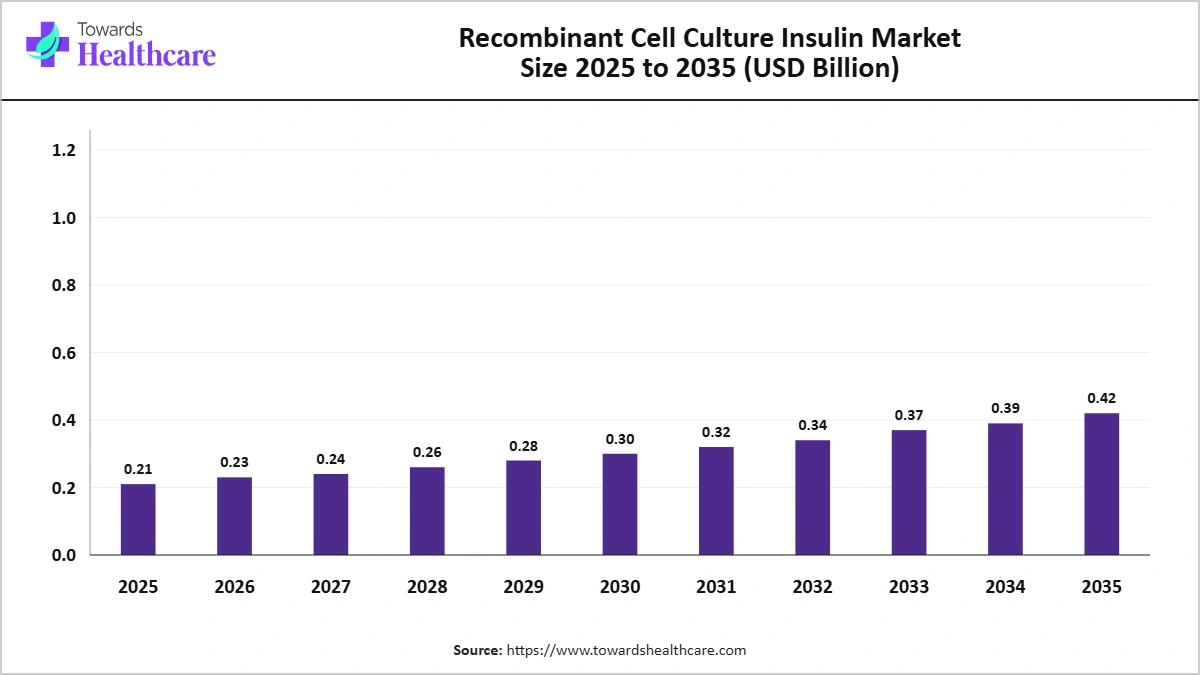
Analyst View: The market estimate is based on an assessment of biologics media consumption, insulin concentrations used in cell culture processes, and pricing across different product grades. These estimates were further validated using supplier information to ensure consistency.
The recombinant cell culture insulin market is small and specialised. It grows with biologics and cell therapy, and buyers want animal-free, GMP-grade insulin.
| Driver | Impact | ≈ CAGR Contribution | Time Horizon | Key Regions |
| Biologics production | High | +2.81 pp | Short to long term | Global, strongest in North America |
| Serum-free shift | Medium | +2.37 pp | Medium to long term | Global, fastest uptake in Asia Pacific |
| Cell and gene therapy | Medium | +2.02 pp | Short to medium term | Global |
| Productivity | Low | +1.58 pp | Long term | Developed and emerging markets |
Note: Contributions are indicative estimates of each factor's effect on annual growth.
Sources: Expert interviews, secondary sources, Towards Healthcare database and Towards Healthcare analysts.
Biologics production, the serum-free shift, and cell and gene therapy drive most growth in the recombinant cell culture insulin market.
Market Restraints - Impact & Negative CAGR Contribution (2026-2035)
| Restraint | Impact | ≈ Negative CAGR Contribution | Time Horizon | Key Regions |
| Alternatives | High | -0.71 pp | Short to medium term | Global |
| Concentration | High | -0.52 pp | Medium term | Price-sensitive and emerging markets |
| Price pressure | Medium | -0.35 pp | Short term | North America and other mature markets |
Note: Contributions are indicative estimates of each factor's effect on annual growth.
Sources: Expert interviews, secondary sources, Towards Heathcare database, and Towards Heathcare analysts.
Alternative additives are the main restraint, followed by supplier concentration and price pressure.
Cell Therapy Media
Growing investment in cell therapy creates opportunities for specialized insulin-based media supplements that support cell growth and expansion.
Expansion of Asian CDMOs
Increasing investments in new manufacturing facilities across Asia create opportunities for recombinant insulin suppliers to serve the growing demand for biologics production.
Plant-Derived Insulin
Advancements in plant-based production systems offer opportunities to develop alternative insulin sources and diversify supply chains.
Note: 2025 is the base year; 2035 shares and CAGRs are forecasts.
Sources: Expert interviews, secondary sources, Towards Heathcare database, and Towards Heathcare analysts.
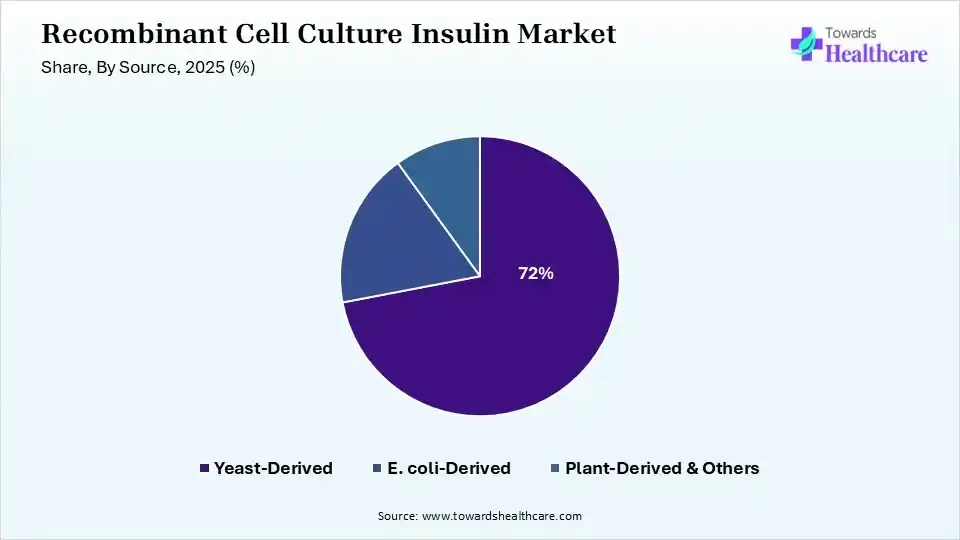
Yeast-derived insulin dominates the recombinant cell culture insulin market, accounting for 72.00% of the total share in 2025. Its strong market position reflects its established use in animal-free cell culture media and biopharmaceutical manufacturing. Novo Nordisk Pharmatech's Insulin Human AF supports the production of more than 100 marketed drugs, highlighting the commercial acceptance of this source.
E. coli-derived insulin supported by its established production processes and availability from specialized reagent manufacturers. It serves research applications and selected GMP-grade manufacturing requirements. Its use in recombinant protein production and cell culture research sustains demand across biopharmaceutical applications.
Plant-derived and other insulin sources growing interest in alternative expression systems is creating opportunities to diversify insulin production. Advancements in plant-based biotechnology and the demand for animal-free inputs are further supporting segment growth.
GMP-grade insulin dominates the recombinant cell culture insulin market, accounting for 68.00% of the total share and growing at a CAGR of 7.39%. Its leading position is supported by increasing demand for high-quality, consistent, and traceable inputs in commercial biopharmaceutical manufacturing. Growing biologics production and stringent quality requirements further strengthen demand for GMP-grade products.
Research-grade insulin supported by its widespread use in academic institutions, biotechnology research, and early-stage drug development. It is commonly used in laboratory-scale cell culture experiments and process optimization. Increasing research activities in cell biology, stem cells, and regenerative medicine continue to support segment demand.
mAbs & recombinant proteins represent the largest application segment, accounting for 52.00% of the market in 2025. Growing biologics production and the need to improve cell culture productivity support demand for recombinant insulin. Novo Nordisk Pharmatech data indicate that low insulin concentrations increased IgG output by 1.5-fold in CHO-K1 cells, highlighting its role in improving protein production efficiency.
Cell and gene therapy recombinant insulin is used in specialized culture media for T-cell expansion, stem cell growth, and HEK293-based viral vector production. Increasing investment in advanced therapies and cell-based manufacturing is expected to support segment growth.
Vaccine applications supported by the use of insulin-supplemented media in cell-based vaccine production. Growing demand for vaccines and improvements in biopharmaceutical manufacturing processes are creating opportunities for recombinant insulin suppliers.
Stem cell and regenerative research recombinant insulin supports cell growth and metabolic activity in specialized culture media used for stem cell maintenance and expansion. Increasing research into tissue engineering, regenerative medicine, and cell differentiation is supporting demand.
Other applications accounted for the remaining market share and include various biotechnology research and cell culture activities. The use of recombinant insulin in specialized laboratory processes and emerging biopharmaceutical applications contributes to this segment.
Biopharmaceutical companies dominate the recombinant cell culture insulin market, accounting for 64.00% of the total share in 2025. Their leading position is supported by extensive use of recombinant insulin in monoclonal antibody production, recombinant protein manufacturing, and other biologics processes. Increasing investments in biologics development and commercial-scale manufacturing continue to drive demand from this segment.
Contract development and manufacturing organizations (CDMOs) increasing outsourcing of biologics manufacturing and the expansion of specialized production facilities are supporting segment growth. Rising demand for flexible manufacturing capacity and cost-efficient production processes further strengthens insulin consumption among CDMOs.
Academic and research institutes driven by growing investments in biotechnology research and laboratory-scale cell culture activities. Recombinant insulin is used in studies involving cell growth, stem cell development, and protein expression. Expanding research into regenerative medicine and advanced therapies is expected to sustain demand.
Analyst View: Cell and gene therapy applications and CDMOs are expected to gain market share at a faster pace, supported by increasing investment in advanced therapies and outsourced biologics manufacturing. However, yeast-derived GMP-grade insulin and monoclonal antibody production are likely to remain the largest segments, reflecting their established commercial applications and strong manufacturing demand.
Note: 2025 is the base year; 2035 shares and CAGRs are forecasts.
Sources: Expert interviews, secondary sources, Towards Heathcare database, and Towards Heathcare analysts.
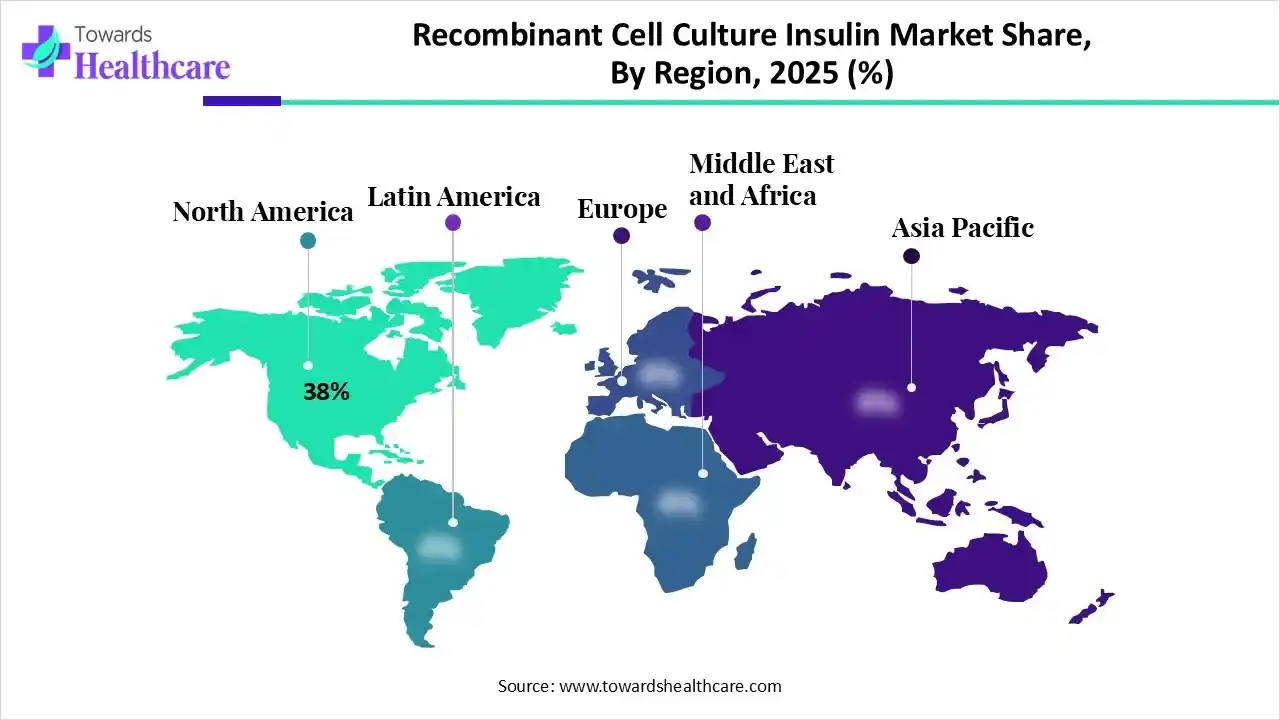
North America dominated the recombinant cell culture insulin market, accounting for 38.00% of the global revenue share in 2025. Its leading position is supported by the region's extensive biologics manufacturing infrastructure, strong presence of biopharmaceutical companies, and growing production of monoclonal antibodies and recombinant proteins. Continued investment in advanced biologics and cell culture technologies further supports regional demand.
Europe supported by the presence of established insulin manufacturers, biopharmaceutical companies, and cell culture media suppliers. The region benefits from the strong industry presence of companies such as Novo Nordisk and a well-developed biologics manufacturing ecosystem. Increasing demand for animal-free media components also contributes to market growth.
Asia Pacific expanding biosimilar manufacturing, rising investments in biologics production and the growth of CDMOs across China, South Korea and India are driving regional demand. Increasing biotechnology investments and manufacturing capacity are expected to create further opportunities for recombinant insulin suppliers.
Latin America growing investments in biopharmaceutical manufacturing and increasing demand for biologics are supporting regional development. Gradual improvements in biotechnology infrastructure are also creating opportunities for recombinant insulin suppliers.
The Middle East and Africa growth is supported by emerging investments in pharmaceutical manufacturing, expanding healthcare infrastructure, and efforts to strengthen regional biotechnology capabilities. Increasing interest in local biologics production may create future opportunities for market participants.
Analyst View: North America is expected to maintain its leading position due to its established biologics manufacturing base and strong biopharmaceutical industry. Meanwhile, Asia Pacific is likely to experience the fastest growth, driven by expanding CDMO capacity, biosimilar production, and increasing investments in biotechnology across major economies.
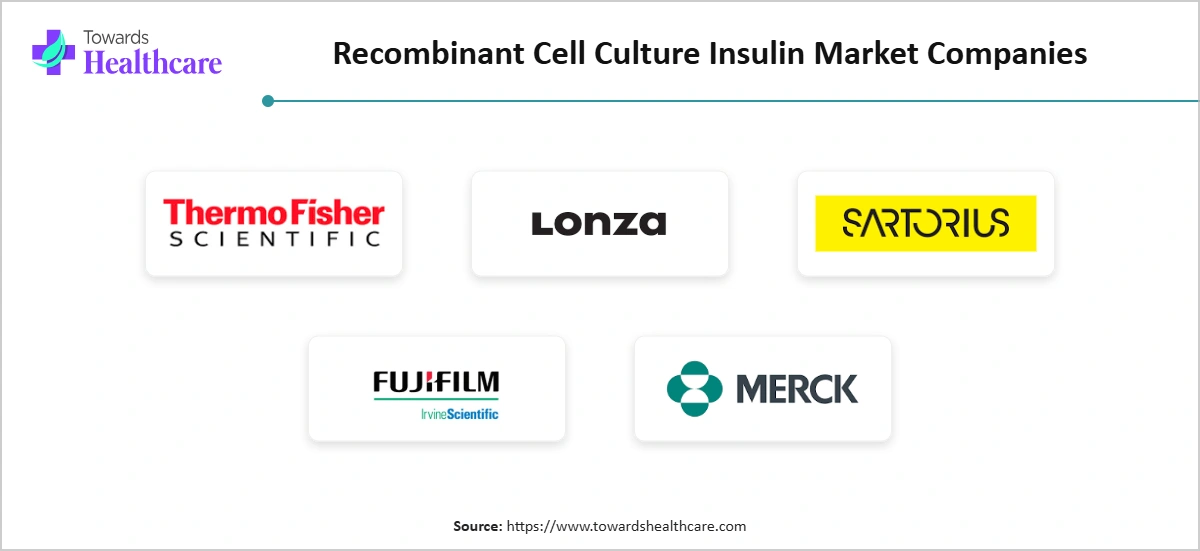
| Rank | Company Name | 2025 Share (%) | Key Products / Business | Headquarters |
| 1 | Novo Nordisk Pharmatech | 38.00% | Insulin Human AF for cell culture | Denmark |
| 2 | Merck KGaA | 12.00% | recombinant insulin and media | Germany |
| 3 | Thermo Fisher Scientific | 9.00% | insulin supplements and media | United States |
| 4 | FUJIFILM Irvine Scientific | 4.00% | media supplements | United States |
| 5 | Lonza | 3.00% | media and supplements | Switzerland |
| 6 | Sartorius | 3.00% | media and supplements | Germany |
| 7 | Bio-Techne | 2.00% | growth factors and supplements | United States |
| 8 | Sino Biological | 2.00% | recombinant proteins | China |
| 9 | Gold Biotechnology | 1.00% | research-grade insulin | United States |
Note: Company shares are 2025 estimates.
Sources: Company press releases, expert interviews, secondary sources, Towards Heathcare database, and Towards Heathcare analysts.
Novo Nordisk Pharmatech led the recombinant cell culture insulin market, capturing an estimated 38.00% of the total revenue share in 2025. Merck KGaA followed with a 12.00% share, while Thermo Fisher Scientific held 9.00%. Novo Nordisk Pharmatech maintains its strong position through its Insulin Human AF product for cell culture applications. Merck KGaA competes through its recombinant insulin and cell culture media portfolio, while Thermo Fisher Scientific offers insulin supplements and specialized media products.
Other notable participants include FUJIFILM Irvine Scientific, Lonza, Sartorius, Bio-Techne, Sino Biological and Gold Biotechnology. These companies compete through cell culture media, specialized supplements, growth factors, recombinant proteins, and research-grade insulin products. The top companies collectively accounted for an estimated 76.19% of market revenue in 2025, while the remaining 23.81% was distributed among several smaller reagent suppliers.
The market exhibits a relatively concentrated competitive structure, with Novo Nordisk Pharmatech holding a strong position in GMP-grade insulin supply. Competition primarily revolves around product purity, animal-free manufacturing, regulatory documentation, supply chain reliability, and pricing. As demand for biologics and advanced cell culture media increases, suppliers are focusing on product quality, manufacturing consistency, and dependable supply to strengthen their market positions.
Novo Nordisk Pharmatech, based in Denmark, maintained a strong position in the recombinant cell culture insulin market, accounting for an estimated 38.00% of revenue in 2025. Its competitive strength is primarily driven by Insulin Human AF, a product designed for cell culture applications. The company holds a Leader position in the Towards Heathcare Companies Quadrant, supported by its established market presence and specialized insulin portfolio.
Merck KGaA, headquartered in Germany, secured approximately 12.00% of the market revenue in 2025. Its competitive strategy centres on recombinant insulin products and cell culture media solutions for biopharmaceutical applications.
Thermo Fisher Scientific, headquartered in the United States, accounted for nearly 9.00% of the market in 2025. The company strengthens its market presence through insulin supplements and cell culture media that support research and biopharmaceutical manufacturing.
FUJIFILM Irvine Scientific, based in the United States, captured an estimated 4.00% market share in 2025. The company focuses on specialized cell culture media and supplements used in biopharmaceutical production and research. Its expertise in media development supports its classification as a Leader in the Towards Heathcare Companies Quadrant.
Switzerland-based Lonza represented approximately 3.00% of the recombinant cell culture insulin market in 2025. Its market participation is supported by cell culture media and supplement solutions designed for biopharmaceutical development and manufacturing.
Sartorius, headquartered in Germany, accounted for an estimated 3.00% of market revenue in 2025. The company participates through its cell culture media and supplement offerings, which support various bioprocessing and biologics manufacturing requirements. Its established position in biopharmaceutical technologies earns it a Leader classification in the Towards Heathcare Companies Quadrant.
Sino Biological, headquartered in China, accounted for an estimated 2.00% of the market as it entered 2026. Its market presence is supported by a broad portfolio of recombinant proteins serving biotechnology research and biopharmaceutical development.
Bio-Techne, based in the United States, held approximately 2.00% of the market in 2025. Its offerings include growth factors and specialized supplements used in cell culture and biotechnology research.
Gold Biotechnology, headquartered in the United States, captured approximately 1.00% of the market revenue in 2025. The company serves the research segment through its range of research-grade insulin and other biotechnology reagents. Its focus on specialized research products places it in the Innovator category.
The recombinant cell culture insulin ecosystem links insulin producers, media makers, biomanufacturers, cell therapy developers, and regulators, with each stage adding value before products reach end users. Insulin is added to cell culture media for cell therapy and cell-based vaccine production, and used in regenerative medicine research.
| Ecosystem Stage | Role in the Market | Key Companies |
| Insulin Producers | Make recombinant insulin | Novo Nordisk Pharmatech |
| Media Makers | Formulate media | Merck, Thermo Fisher, FUJIFILM |
| Biomanufacturers | Use media | biopharma, CDMOs |
| Cell Therapy Developers | Grow cells | CAR-T and stem cell developers |
| Regulators | Review raw materials | FDA, EMA |
Sources: Company press releases, expert interviews, secondary sources,Towards Heathcare database and Towards Heathcare analysts.
Insulin Producers: Large-scale insulin manufacturers ensure a consistent supply of recombinant insulin to meet the growing requirements of biopharmaceutical and research applications.
Media Manufacturers: Cell culture media producers incorporate recombinant insulin into serum-free and chemically defined formulations to support cell growth and productivity.
Biomanufacturers: Biopharmaceutical manufacturers use recombinant insulin to improve cell growth, support protein expression, and enhance overall production yields.
Cell Therapy Developers: Cell therapy developers increasingly prefer animal-free media components to minimize contamination risks and maintain consistency during cell expansion and processing.
Regulators: Regulatory authorities emphasize input traceability, product quality, and proper documentation to ensure the safety and consistency of biopharmaceutical manufacturing processes.
Value in the recombinant cell culture insulin market flows from upstream material and technology suppliers to manufacturers and service providers, then through distribution partners to end users. Companies that integrate several stages or build long-term relationships with end users capture a larger share of this value.
The Towards Heathcare Companies Quadrant positions key participants in the recombinant cell culture insulin market by market strength, reflecting revenue scale, market share and geographic reach, and by innovation and growth strategy, reflecting product portfolio breadth, R&D intensity and partnerships. Positions reflect each company's estimated 2025 share of the recombinant cell culture insulin market and our assessment of its product innovation, portfolio breadth and partnerships.
Sources: Company press releases, expert interviews, secondary sources, Towards Heathcare database and Towards Heathcare analysts.
Leaders: Novo Nordisk Pharmatech, Merck, Thermo Fisher Scientific, FUJIFILM Irvine Scientific, Lonza and Sartorius combine high market share with broad portfolios and strong innovation.
Innovators: Bio-Techne, Sino Biological and Gold Biotechnology bring newer technologies and specialised products.
By Source
By Grade
By Application
By End User
By Region
The recombinant cell culture insulin market is defined as the global market for recombinant human insulin used as a supplement in cell culture media. It includes products manufactured through yeast, E. coli, plant-based and other expression systems, available in GMP and research grades. These products are used in monoclonal antibody and recombinant protein production, vaccine manufacturing, cell and gene therapy, stem cell research, regenerative medicine and other applications. The market covers demand from biopharmaceutical companies, contract development and manufacturing organizations (CDMOs) and academic and research institutes.
The 2025 market estimate was developed using a bottom-up approach, considering demand volumes and average selling prices across different sources, grades, applications, end users and regions. The estimates were cross-checked through a top-down assessment of market-specific revenues reported by leading companies and publicly available industry data. Segment, regional and company-level values were allocated based on their respective market contributions and demand patterns.
Key estimates were further validated against company disclosures, regulatory information, industry data and published third-party research. Inputs that could not be independently reconciled were excluded from the assessment. All segment, regional and company estimates were aligned with the same 2025 base year to maintain consistency. The 2026-2035 forecast was then developed by applying the projected CAGR to the 2025 market base, followed by recalculation and validation of the forecast values.
Analyst View: We expect the recombinant cell culture insulin market to grow steadily with biologics. Some media replace insulin with alternatives, but insulin remains a standard additive.