




 Request Consultation
Glimpse of the Cell and Gene Therapy Pipeline
With a focus on key modalities, such as CAR-T, viral vector gene therapy, non-genetically modified cell therapy, and gene editing, the globe is seeking an answer to where the CGT pipeline is actually focused. Based on some studies, each single worldwide approved CAR-T therapy, i.e. all 14 of them, is primarily targeting two antigens, such as CD19 or BCMA, regardless of numerous programs in earlier development. Aiming at the company, the top ten firms record 67% of total cell and gene therapy market revenue, although more than 2,200 players globally are heavily involved in the space. In terms of geography, North America registered dominance by capturing half of the global market share, while a small group of Chinese biotechs hosts an incommensurate share of next-generation CAR-T innovation. This innovation is systematically uncovered to transitioning cross-border biosecurity policy. Considering manufacturing & treatment access, even a market company’s revenue can halt while it fosters broadening treatment-center capacity, which indicates that approval & commercial access are not the same limitation.
The CGT Pipeline’s Simultaneous Emphasis on Four Different Axes
The cell and gene therapy pipeline is stepping into:
- Biological Target: This encompasses every approved CAR-T solution that targets CD19 or BCMA.
- Company or Sponsor: Across this axis, the top 10 players account for 67% of total CGT revenue.
- Geography: In accordance with the regional survey, North America registers 52.58% of market share.
- Manufacturing & Access: Across this, treatment limited by authorized center capacity is explained.
By mapping major areas, these four axes are highly independent of one another, while a program or leader can be largely disclosed on one dimension. Meanwhile, well-differentiated geography, which expresses a focus on risk across the CGT pipeline, cannot be evaluated with a single term.
Significance of CAR-T Therapy: Each Single Globally Approved CAR-T Therapy Hits Just One of Two Antigens
The above graph displays the number of worldwide approved CAR-T products that mainly target CD19 and those that target BCMA, where the only two antigens with any approved CAR-T therapy in any region around the globe.
Key Insight: Alongside, this chart represents that 10 of 14 products were approved that target CD19 and the remaining 4 products are targeting BCMA. However, the CAR-T area’s complete commercial track record places a focus on ensuring just two biological targets, regardless of a much wider pipeline of experimental targets. Additionally, no third antigen has yet passed the bar to achieve a single regulatory approval.
Source: PatSnap Eureka, “CAR-T Cell Therapy Competitive Landscape Analysis 2026,” June 10, 2026, presented at ASCO 2026.
Notable Reliance: Roughly Three-Quarters of the CAR-T Pipeline Depends on the Patient’s Own Cells
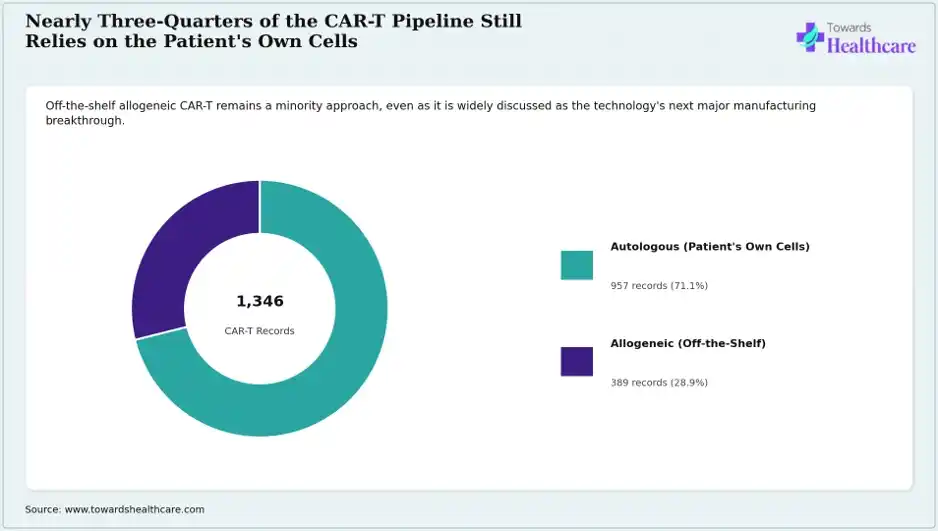
The respective chart shows a comparison across autologous, i.e. patient-derived & allogeneic, i.e. off-the-shelf, donor-derived CAR-T pipeline records throughout the worldwide competitive landscape.
Key Insight: From the chart, across the total 1,346 CAR-T records, autologous captures 957 (71.1%) records, while allogeneic holds 389 (28.9%) records. This indicates that autologous approaches still have more than seven in ten pipeline programs, regardless of surging discussion about allogeneic. Alongside, the manufacturing & immunological risks of allogeneic cell therapy have shown more durability than early guided confidence.
Source: PatSnap Eureka, “CAR-T Cell Therapy Competitive Landscape Analysis 2026,” June 10, 2026.
Companies' Involvement: Ten Players Hold Most of Cell and Gene Therapy Revenue
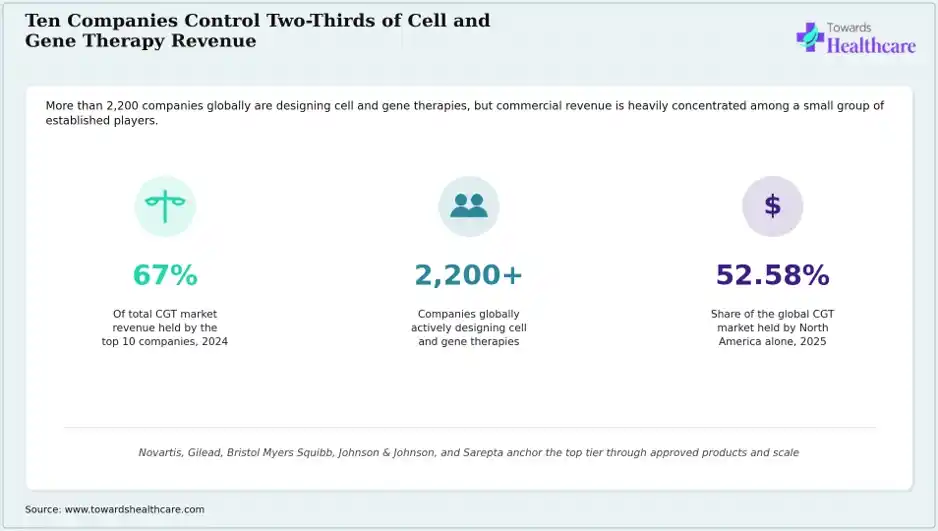
These statistics indicate company-level revenue concentration in the cell and gene therapy market, along with the total number of companies competing in this area around the world.
Key Insight: Specific focus on the difference between 2,200-plus active companies and just 10 companies is stating 67% of revenue, which describes a classic long-tail market framework. Meanwhile, North America accounted for nearly 52.58% of the global CGT market share in 2025. Moreover, a small cluster of commercially authenticated firms with approved products registers the intense majority of value and a huge population of earlier-stage companies rivals for the rest.
Source: Norfolk Daily News (GlobeNewswire), “Cell And Gene Therapy Market Competitive Analysis 2026,” March 16, 2026; Top 50 Cell and Gene Therapy Companies report, 2026.
Progression of the Access Infrastructure at the Same Time as the Hindering Revenue Growth of Market Players
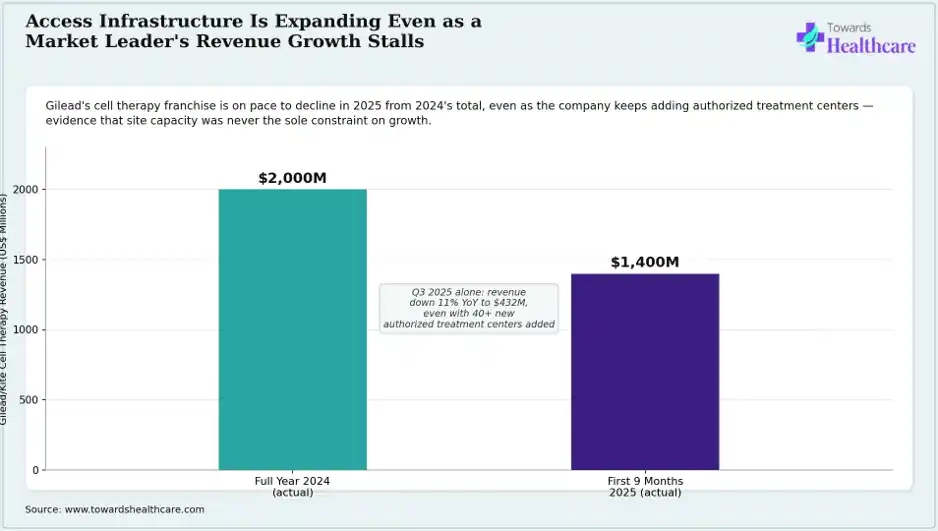
This illustrates a comparison across Gilead/Kite’s full-year 2024 cell therapy revenue against its first-nine-months 2025 total and also presents the setting on treatment-center growth simultaneously.
Key Insight: The graph represents $2,000M for full-year 2024 and $1,400M for the first 9 months of 2025, which further adds more than 40 new proven treatment centers. Meanwhile, the revenue growth barriers directly depict that regulatory approval & manufacturing capacity are not the only limitations on cell therapy adoption. This also emphasizes importance of physician referral patterns, competitive dynamics, and patient-selection criteria.
Source: Towards Healthcare Key Insights, “50 cell and gene therapy leaders to watch in 2026,” August 11, 2026.
Instead of the Core, Unveiling Gene Therapy as a Small Portion of the Expensive Rare Disease Pipeline
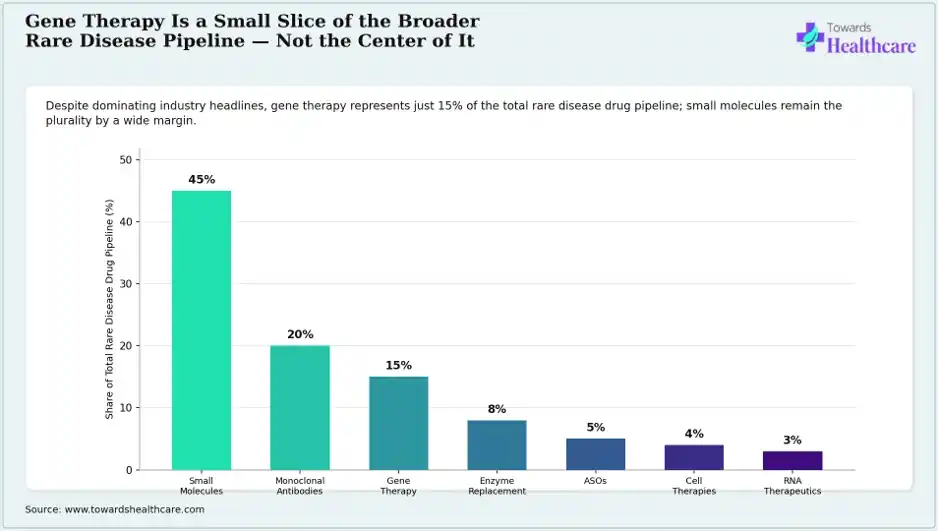
This graph dictates comprehensive rare disease drug development pipeline by therapeutic modality, where gene therapy’s actual share is compared to small molecules, antibodies, & other approaches.
Key Insight: The bar chart reflects small molecules (45%) as the highest holder and RNA therapeutics as the lowest holder, while gene therapy captured a 15% share of the overall rare disease pipeline. This gene therapy share is lower than small molecules' (45%) and monoclonal antibodies' (20%) share. This results in the industry’s substantial correction to gene therapy being executed as the fastest-growing segment rather than the dominant modality across the rare disease drug development sector.
Source: PatSnap Eureka, “Rare Diseases Competitive Landscape Analysis 2026,” May 25, 2026.
Brief Listing of Rare Disease Mirrors its Dominance In Non-Oncology Gene Therapy Development
Globally, the emerging CGT pipeline presents well-described single-gene defects with advanced biology that consistently appeal the most to non-oncology gene therapy programs, with consideration of the expense of widespread rare disease diversity. This significantly highlights:
- Beta Thalassemia
- Duchenne Muscular Dystrophy
- Hemophilia A
- Retinitis Pigmentosa
- Amyotrophic Lateral Sclerosis
- Scleroderma
- Lupus
- Myasthenia Gravis
These listed indications explain that they often focus on gene therapy pipeline reviews and company pipeline disclosures, including hematologic, muscular, ophthalmic, neurological, and autoimmune conditions. Along with a logical sequencing strategy, sponsors are now seeking diseases where the causal biology is lucid & regulatory precedent already exists. Also, ignoring numerous less-characterized rare diseases still omits an active gene therapy program.
Source: Pfizer Rare Disease pipeline disclosures; Vaczine Analytics, “Gene Therapies R&D Targets Review,” 2026.
Executive Presence of China’s CAR-T Group Leads as a Key Risk of Its Own, Paired With Limited Cross-Border Deals
Primarily, the five Chinese biotechs host an unequal share of next-generation CAR-T innovation, but approximately all depend on licensing deals currently disclosed to transitioning US biosecurity policy. However, the major biotech players mentioned across China are:
- JW Therapeutics
- IASO Bio
- CARsgen Therapeutics
- Hrain Biotechnology
- Juventas Cell Therapy
Key Insight: This respective small China-based group develops a definitive systemic risk, i.e. proposed BIOSECURE-style legislation that limits US biotech relationships with Chinese companies, which could disturb the deal pipeline of five separate firms at the same time. This disruption results from their commercialization paths sharing a similar structure dependency.
Source: PatSnap Eureka, “CAR-T Cell Therapy Competitive Landscape Analysis 2026,” June 10, 2026.
Ongoing Steps: Big Pharma Moving Towards Next-Generation Cell Therapy Platforms at Own Pace
Despite the development in-house, well-nurtured players are stepping into the acquisition of small platform firms to access in vivo & next-generation manufacturing technology. Including:
| In February 2026, Gilead agreed to acquire Arcellx, which covers anito-cel CAR-T for myeloma. |
| In January 2026, Galapagos initiated wind-down of its own cell therapy activities. |
| In August 2025, Kite (Gilead) announced strategies to acquire Interius, an in vivo cell-engineering platform. |
This description shows how access to next-generation cell therapy is merging even though some present companies retreat. Exploration of simultaneous active acquisition, like Gilead pursuing both Arcellx & Interius within a nearly six-month window, and voluntary exit, such as Galapagos winding down its cell therapy unit. This further ensures that consolidation, instead of broad-based novel entry, is the leading structural trend transforming who controls next-generation cell therapy technology.
Differentiation Across the CAR-T Landscape with an Emphasis on Safest & Highest-Upside
Specifically, the competitive analysis of the CAR-T framework describes a fine comparison between crowded, de-risked growth opportunities and genuine white space that necessitates real platform innovation.
| Crowded & De-Risked | Genuine White Space |
| Second-line & earlier-line CD19 + BCMA expansion | CNS lymphoma |
| Encompasses fast-turnaround manufacturing, including Novartis T-Charge, decentralized cleanroom programs. |
|
This simplified comparison between safe bets & high-upside bets forces investors & corporate development teams to have a clear map of where incremental capital. This capital is looking to create incremental, defensible return vs. where it is establishing a genuine bet on unauthenticated biology.
Source: PatSnap Eureka, “CAR-T Cell Therapy Competitive Landscape Analysis 2026,” June 10, 2026.
Uncovering a Blend of Western Majors & Chinese Biotechs that Fosters the Global CAR-T Landscape
Specifically, eleven players register the massive majority of approved & late-stage CAR-T programs globally, which range across four nations & every key antigen.
- Gilead/Kite Pharma: US - CD19 franchise leader (Yescarta, Tecartus)
- Bristol Myers Squibb: US - BCMA franchise (Abecma)
- Janssen/Legend Biotech: US/China – BCMA franchise (Carvykti)
- Novartis: Switzerland – First CD19 approval (Kymariah), T-Charge Platform
- Autolus Therapeutics: UK – CD19 franchise (Aucatzyl)
- JW Theraputics/IASO/CARsgen/Hrain/Juventus: China – Domestic approvals & cross-border licensing
This genuine international framework covers the US, Switzerland, the UK, & a China-based group of five companies, which ensures that CAR-T innovation is not only a Western enterprise, but also commercial revenue & market capitalization sustained as focused among the US & European incumbents.
Source: PatSnap Eureka, “CAR-T Cell Therapy Competitive Landscape Analysis 2026,” June 10, 2026.
Across Just Two Targets, the Last 18 Months Showed a Signal of New Approvals
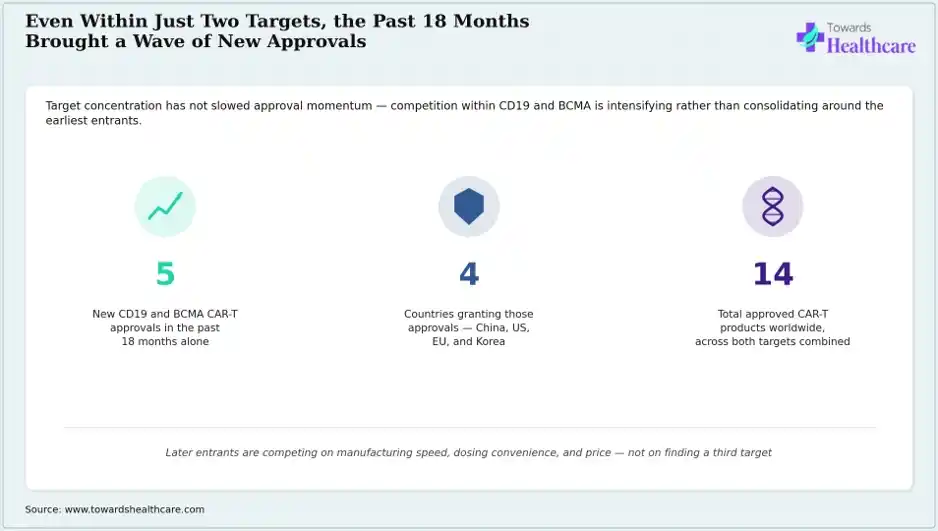
This panel reflects recent approval pace within the CD19 & BCMA target sector, which indicates that target penetration has not moderated the acceleration of novel product approvals.
Key Insight: In the recent 18 months, five new approvals have been made across four countries within a two-target area, showing that consequent entrants are still seeking commercially viable trajectories to market. This significantly competes on manufacturing turnaround time, dosing convenience, and price instead of requiring the discovery of a completely innovative biological target.
Source: PatSnap Eureka, “CAR-T Cell Therapy Competitive Landscape Analysis 2026,” June 10, 2026.
Prospective Efforts: Upcoming Any Firm Developing Cell & Gene Therapy Should Consider Three Forces in 2027
This panel executes three practical implications, such as target diversification as the real remaining opportunity, manufacturing and access as an independent growth constraint, and geopolitical risk as a genuine pipeline-level variable.
Key Insight: Current intense competition & by exclusion it indicates where the field’s most crucial unmet opportunities and unrecognized risks are systematically situated coming into 2027.
Source: Synthesis of evidence presented in Sections 1-12 of this briefing.
Ongoing Developments Across the Advanced CGT Pipeline
In July 2026, Sail Biomedicines collaborated with Johnson & Johnson to bolster innovative In Vivo Chimeric Antigen Receptor T-cell (CAR-T) therapies for immune-mediated diseases. This unifies Sail’s pioneering AI-powered product design utilizing its proprietary eRNA and targeted nanoparticle platform with Johnson & Johnson’s supreme capabilities in drug development, manufacturing, & commercialization.
Source- https://www.businesswire.com/news/home/20260728202837/en/Sail-Biomedicines-Announces-Strategic-Collaboration-to-Develop-New-Class-of-Medicines-for-In-Vivo-CAR-T
In July 2026, Immuneel Therapeutics partnered with Arogya Finance to roll out India’s first Zero Cost EMI programme of up to ₹25 lakh for eligible patients receiving Qartemi (varnimcabtagene autoleucel), the company’s CD19-directed autologous CAR-T cell therapy for relapsed or refractory B‑cell malignancies.
Source- https://indiamedtoday.com/immuneel-and-arogya-finance-launch-indias-first-zero-cost-emi-programme-for-qartemi-car-t-therapy/
In June 2026, Pfizer introduced Elranatamab, a BCMA (B-Cell Maturation Antigen)-directed bispecific antibody, in India to treat adult patients with relapsed or refractory multiple myeloma (RRMM).
Source- https://www.expresspharma.in/pfizer-launches-elranatamab-in-india-for-relapsed-or-refractory-multiple-myeloma/
In June 2026, a team of UCLA researchers led by Lili Yang received a US$7.49 million grant from the California Institute for Regenerative Medicine to evolve a universal chimeric antigen receptor natural killer T (CAR-NKT) cell immunotherapy for multiple sclerosis (MS).
Source- https://www.regmednet.com/us7-49-grant-awarded-to-develop-off-the-shelf-car-nkt-cell-therapy-for-multiple-sclerosis/
In June 2026, Syntax Bio joined Mayo Clinic to explore & followed by the development of an allogeneic pancreatic beta cell therapy based on patient needs.
Source- https://www.contractpharma.com/breaking-news/syntax-bio-pairs-with-mayo-clinic-on-stem-cell-pancreatic-cell-therapies-for-type-1-diabetes/
In May 2026, CREATE Medicines, Inc. closed its $122 million Series B funding round, co-powered by existing investors Newpath Partners, ARCH Venture Partners, and Hatteras Venture Partners, to strengthen the breakthrough of CREATE's clinical pipeline across autoimmune disease and oncology.
Source- https://www.prnewswire.com/news-releases/create-medicines-announces-122-million-series-b-financing-to-advance-in-vivo-car-pipeline-in-autoimmune-disease-and-oncology-302771778.html
In April 2026, GSK’s Blenrep unveiling gives the first BCMA-targeting antibody-drug conjugate approved in South Korea for adult patients with relapsed or refractory multiple myeloma.
Source- https://www.koreabiomed.com/news/articleView.html?idxno=31487
In March 2026, Eurofins Viracor launched the ExPeCT anti-CD19 (obe-cel) CAR T-cell assay, a cutting-edge solution to assist clinicians in monitoring CAR T-cell therapy performance with validated precision and a faster turnaround time for results.
Source- https://www.prnewswire.com/news-releases/eurofins-viracor-launches-expect-anti-cd19-obe-cel-car-t-cell-assay-to-advance-proactive-monitoring-in-next-generation-immunotherapy-302725812.html
Future Pipelines of CD19 and BCMA CAR-T Approaches in 2027
Based on Dual-Targeting CD19/BCMA Pipelines
- Tempest Therapeutics’s TPST-2003, an autologous, dual-targeting CD19/BCMA clinical asset. Its registrational Phase IIb trial is moving toward interim data updates in 2027, with long-term plans for a BLA submission in China.
- AZD0120, next-generation dual BCMA/CD19 CAR-T candidate of AstraZeneca, presented a 100% overall response rate in evaluable patients with deep in vivo growth. Thus, expansion through Phase 1/2 cohorts places it on track for key effectiveness updates by 2027.
- Imviva Bio’s CTA313, an ideal dual-targeted CD19/BCMA allogeneic (off-the-shelf) CAR-T cell therapy derived from healthy donors, is under Phase 1/2 open-label trials in B-cell-mediated autoimmune diseases with active clinical readouts anticipated through 2027.
Next-Gen CD19 Pipelines for Oncology & Autoimmune
- Lyell Immunopharma is expecting a 2027 Biologics License Application (BLA) FDA filing date for Ronde-cel/LYL314, a next-generation CAR-T targeting CD19/CD20 to resist T-cell exhaustion.
- In 2027, Allogene Therapeutics’ ALLO-329, a dual-targeting CD19/CD70 allogeneic CAR-T using ‘Dagger’ technology to lower or remove the need for harsh patient lymphodepletion, will push the multi-indication proof-of-concept readouts of its allogeneic pipeline.
Next-Gen BCMA Pipelines, Including Multiple Myeloma & Many More
- CARsgen Therapeutics has been impelling its CT0596, an allogeneic, off-the-shelf BCMA-targeted CAR-T leveraging proprietary THANK-u Plus technology, with its IND clearance; its Phase 1 registrational trials in relapsed/refractory multiple myeloma and plasma cell leukemia are heavily scaling up for data delivery by 2027.
- Descartes-08, an autologous mRNA-based anti-BCMA CAR-T developed by Cartesian Therapeutics, is massively tracking milestones for generalized B-cell autoimmune conditions, such as Myasthenia Gravis through 2027.
Breakthroughs Covered Across In Vivo CAR-T
- By 2027, TPST-4003 of Tempest Therapeutics is paving the path for broadened multi-dose Phase 1 trials and considering initial clinical data from its first nervous system autoimmune cohorts (MS and MG) that are scheduled for early readouts.
- CARsgen Therapeutics has its KJ-C2633, a part of the proprietary CARvivo in vivo platform, that hits both CD19 and BCMA directly in vivo for multiple myeloma and autoimmune conditions, performing side by side to early investigator-initiated clinical solutions emerging into 2027.
Key Companies & Organizations
| Company | Category | Related to Pipeline Concentration |
| Gilead Sciences/Kite Pharma | CD19 CAR-T Leader | Their franchise revenue decline, regardless of treatment-center growth, reflects manufacturing/access as a distinct progression constraint. Also, they are promoting KITE-753 and KITE-363 targeting both CD19 and CD20 to mitigate tumor relapse. |
| Bristol Myers Squibb | BCMA CAR-T Leader | Along with its Abecma, the firm is spurring next-generation non-BCMA and dual-targeting constructs, including arlocabtagene autoleucel (GPRC5D-targeted) & the dual BCMA/GPRC5D-targeting BMS-986453 to control resistance & earlier-line relapsed/refractory multiple myeloma (RRMM). |
| Janssen/Legend Biotech | BCMA CAR-T Leader | A prominent catalyst is the US-China alliance for Carvykti, and also impelling scale-up of commercial adoption, shifting into frontline treatment via trials, such as CARTITUDE-6, with expansion of manufacturing capacity to elevate profitability. |
| Novartis | CD19 CAR-T Pioneer | This company received approval for the first CD19 CAR-T, i.e., Kymriah and is seeking major activities for rapcabtagene autoleucel (YTB323/rap-cel), using its rapid T-Charge manufacturing platform for both oncology & autoimmune indications. |
| Autolus Therapeutics | CD19 CAR-T Competitor | It is the UK-based innovator of Aucatzyl, a later entrant challenging within the crowded CD19 space. |
| JW Therapeutics, IASO Bio, CARsgen, Hrain Biotechnology, Juventas Cell Therapy | China CAR-T Cluster | They host China's disproportionate share of CAR-T innovation, massively relying on cross-border licensing deals. |
| Arcellx | CAR-T Platform (Acquisition Target) | Along with its acquisition by Gilead, consolidating anitocabtagene autoleucel (anito-cel), an investigational BCMA-directed therapy for relapsed or refractory multiple myeloma. |
| Interius BioTherapeutics | In Vivo Cell Engineering | With a target of Kite, demonstrating big pharma’s buy-not-build approach to next-gen platforms. |
| Galapagos | Cell Therapy (Exiting) | This leader implemented wind-down of cell therapy activities in January 2026, showcasing consolidation pressure. |
| Sarepta Therapeutics | Gene Therapy Leader | This is a well-known player among the top 10 companies in the gene therapy industry that focuses on clinical-stage gene therapy candidates, such as SRP-9003 for limb-girdle muscular dystrophy type 2E/R4. |
Strategic Business & Research Questions
- Which specific CAR-T programs targeting antigens beyond CD19 and BCMA have the strongest early clinical data, and what is the realistic timeline for a third antigen to reach approval?
- How does the actual manufacturing cost differential between autologous and allogeneic CAR-T compare today, and at what point does allogeneic become commercially competitive rather than just theoretically advantageous?
- What specific factors explain Gilead's cell therapy revenue stall despite treatment-center expansion: is it competitive share loss, patient-selection bottlenecks, or physician referral pattern changes?
- Which of the 2,200-plus companies globally developing cell and gene therapies have the strongest paths to breaking into the top 10 revenue tier within the next five years?
- How exposed is each of the five major China-based CAR-T companies specifically to different scenarios of BIOSECURE-style legislation, and which have diversified licensing partners outside the US?
- What proportion of the 45% small-molecule share of the rare disease pipeline targets diseases that could theoretically also be addressed by gene therapy, representing a potential future modality-share shift?
- Which specific autoimmune indications beyond lupus and scleroderma have the strongest mechanistic rationale for CD19 CAR-T intervention, based on current B-cell depletion clinical data?
- What is the realistic addressable market size for CNS lymphoma CAR-T, genuinely white-space territory, compared to the already-crowded systemic lymphoma CAR-T market?
- How does treatment-center authorization capacity vary by country and health system, and which markets have the greatest unmet infrastructure investment need to support cell therapy scale-up?
- Which specific companies hold the strongest patent positions in allogeneic and iPSC-derived CAR-T platforms, and how does that patent landscape affect competitive entry timelines?
- What is the realistic probability that dual-target logic-gated CAR-T chemistry reaches clinical proof-of-concept within the next three years, and which companies are furthest along?
- How concentrated is the rare disease gene therapy pipeline specifically among the eight indications identified in this briefing, versus the thousands of rare diseases without any active program?
- Which specific structural or regulatory changes would be required to make solid-tumor CAR-T commercially viable at a scale comparable to hematologic malignancy CAR-T today?
- What is the realistic timeline and probability that in vivo CAR-T (bypassing ex vivo manufacturing entirely) reaches clinical proof-of-concept, based on Interius and comparable platform companies' current data?
- How does target concentration in CAR-T compare to target concentration in other advanced modalities such as bispecific antibodies or ADCs, and does CAR-T represent an outlier level of concentration?
- Which specific investors have the largest concentrated exposure to China-based CAR-T companies, and how are they hedging against cross-border policy risk?
- What is the realistic revenue impact on Gilead, Bristol Myers Squibb, Janssen, and Novartis if a genuinely differentiated third-antigen CAR-T reaches approval and captures meaningful market share?
- How does the actual clinical trial enrollment rate differ between crowded CD19/BCMA expansion trials and genuine white-space trials (CNS lymphoma, solid tumor), and what does that reveal about real-world development risk?
- Which specific manufacturing innovations (beyond Novartis's T-Charge) are most likely to compress CAR-T production timelines meaningfully over the next three years?
- What is the probability-adjusted risk that continued consolidation (acquisitions plus exits like Galapagos) reduces the number of independent cell therapy platform companies below a level needed to sustain genuine innovation diversity by 2028?
Data & Intelligence Pointers
- All 14 globally approved CAR-T therapies target one of just two antigens: 10 target CD19 and 4 target BCMA; no third antigen has reached approval anywhere in the world.
- The CAR-T pipeline consists of 957 autologous and 389 allogeneic records (1,346 total); autologous approaches still reflect 71.1% of the pipeline despite years of allogeneic platform investment.
- The top 10 companies in cell and gene therapy registered 67% of total market revenue in 2024, even though more than 2,200 companies globally are actively designing cell and gene therapies.
- North America captured 52.58% of the global cell and gene therapy market in 2025, the largest single-region share.
- Gilead/Kite's cell therapy revenue was on pace to decline from 2024's nearly $2 billion total to roughly $1.4 billion through the first nine months of 2025, even after adding more than 40 new authorized treatment centers across the globe.
- Gene therapy indicates just 15% of the total rare disease drug development pipeline, behind small molecules (45%) and monoclonal antibodies (20%), regardless of being the fastest-growing modality segment.
- Five Chinese biotechs, including JW Therapeutics, IASO Bio, CARsgen Therapeutics, Hrain Biotechnology, and Juventas Cell Therapy, anchor a disproportionate share of next-generation CAR-T innovation, largely dependent on cross-border licensing deals now exposed to BIOSECURE-style legislative risk.
- In the 18 months before mid-2026, five novel CD19 and BCMA CAR-T approvals were granted across four countries: China, the United States, the European Union, and South Korea.
- Gilead agreed to acquire Arcellx in February 2026 and announced plans to acquire Interius BioTherapeutics in August 2025; both moves emphasized accessing next-generation cell therapy technology through acquisition rather than internal development.
- Galapagos announced the wind-down of its cell therapy activities in January 2026, affecting hundreds of employees across multiple sites.
- Eight rare disease indications, like beta thalassemia, Duchenne muscular dystrophy, hemophilia A, retinitis pigmentosa, ALS, scleroderma, lupus, and myasthenia gravis, recur most frequently across non-oncology gene therapy pipeline disclosures.
- The global cell and gene therapy market was estimated at roughly $26-27 billion in 2025-2026, with projections reaching $80.1 billion to $232.22 billion by 2035 depending on the forecasting methodology used.
References
- PatSnap Eureka. “CAR-T Cell Therapy Competitive Landscape Analysis 2026.” June 10, 2026, presented at ASCO 2026. Used for: target antigen concentration, autologous/allogeneic split, anchor companies, white-space mapping, recent approval wave.
- PatSnap Eureka. “Rare Diseases Competitive Landscape Analysis 2026.” May 25, 2026. Used for: rare disease pipeline modality composition and gene therapy program count.
- PatSnap Eureka. “Gene Therapy - Global Competitive Landscape (2026).” April 28, 2026. Used for: gene therapy pipeline scale and commercial-phase context.
- Norfolk Daily News (GlobeNewswire). “Cell And Gene Therapy Market Competitive Analysis 2026: Strategies Shaping Industry Growth.” March 16, 2026. Used for: top 10 company revenue concentration statistic.
- Towards Healthare. “50 cell and gene therapy leaders to watch in 2026.” August 11, 2026. Used for: Gilead/Kite revenue figures, Galapagos wind-down.
- Towards Healthcare. “Top 50 Cell and Gene Therapy Companies in 2026.” Used for: total global company count actively designing cell and gene therapies.
- Pfizer. “Rare Disease Drug Pipeline and Clinical Trials.” Used for: common rare disease indication targeting rationale.
- Vaczine Analytics. “Gene Therapies R&D Targets Review.” Used for: list of common non-oncology rare disease gene therapy indications.