


Scientists have created a blood test aimed at the early detection of pancreatic cancer, at which time the condition can progress without presenting any signs. This test is called the PANXEON and was presented by scientists in the journal Nature Medicine. It showed high sensitivity in detecting pancreatic cancer in Stages 1 and 2 while keeping the number of false results relatively low. Furthermore, it successfully detected high-grade dysplasia a precursor to pancreatic cancer.
Since pancreatic cancer usually shows no symptoms or produces similar signs that mimic common illnesses, it usually goes unnoticed for months or years. "Pancreatic cancer is a very lethal disease because it is usually diagnosed once the time period for treating it has started closing down," explains senior author Dr. Ajay Goel, Chairman, Department of Molecular Diagnostics & Experimental Therapeutics, Beckman Research Institute of City of Hope.
According to Dr. Goel, the new discovery will lead scientists one step closer to detecting the disease before symptoms appear, which will give people the chance to treat it. The new test could be used as another way of detecting individuals who need further testing.
PANXEON measures three markers of pancreatic cancer in a blood sample: circulating miRNA, exosomal miRNA, and CA19-9 protein. AI technology is then utilized to calculate one risk score based on all three measurements. As claimed by the developers of the study, PANXEON is the first-ever liquid biopsy that combines these three biomarkers.
The test was assessed in almost 1,800 patients from the United States, Italy, Japan, and South Korea to prove whether the findings of the earlier research can be repeated in different clinical environments. The blood test correctly detects Stage 1 and Stage 2 pancreatic cancer in 87 percent of cases.
False positives are recorded in 3 percent of low-risk patients and in 16 percent of high-risk individuals. It should be noted that PANXEON is not meant to replace other diagnostic procedures, it can assist in the identification of high-risk patients.
It was also seen that the test had the capability to identify high-grade dysplasia in patients with high-risk pancreatic cysts with 64.3% accuracy. This can be helpful for physicians in determining which pancreatic cysts need to be kept under surveillance before the onset of any cancer. According to the researchers, "PANXEON might be used to complement existing approaches for early diagnosis of pancreatic ductal adenocarcinoma."
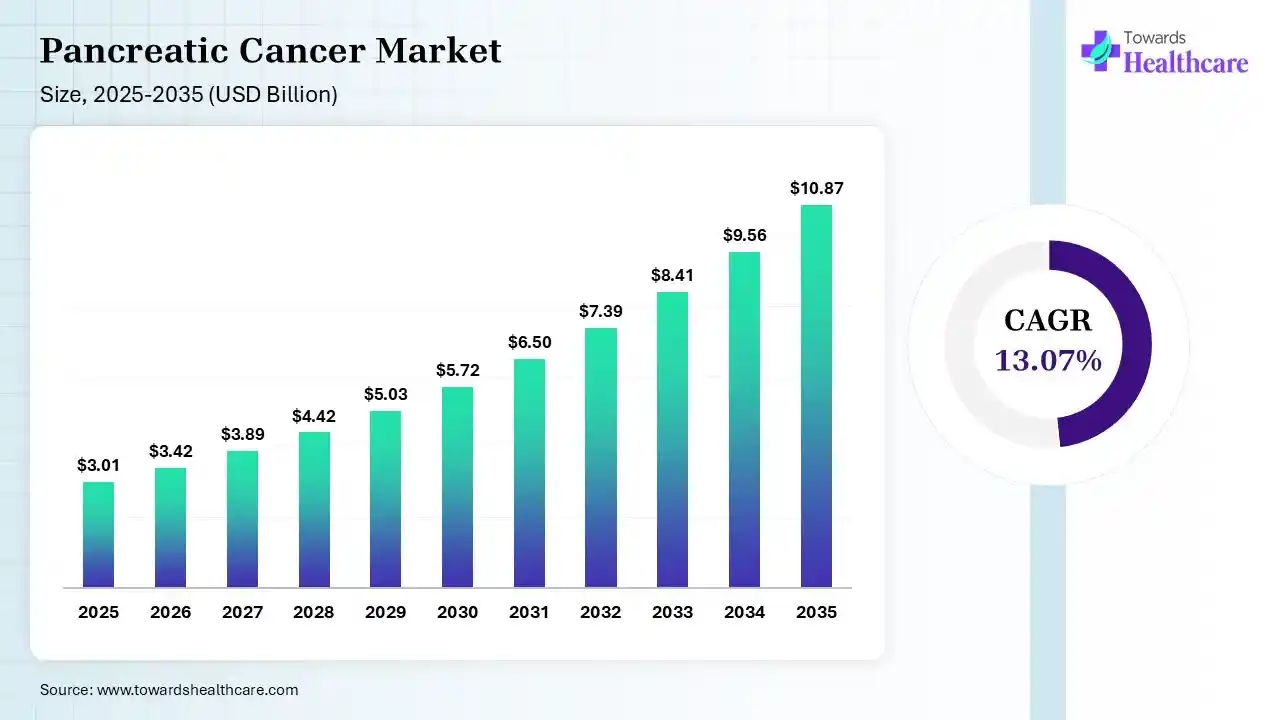
According to Towards Healthcare, the pancreatic cancer market is projected to grow significantly, with estimates indicating the market size will increase from USD 3.42 billion in 2026 to approximately USD 10.87 billion by 2035, expanding at a CAGR of 13.07% from 2026 to 2035. Enabled by the continued development of technology that is aimed at detecting pancreatic cancer in earlier stages. Liquid biopsy, biomarker testing, and artificial intelligence have emerged as some of the key technologies for the detection of cancer signals in blood as well as risk-based diagnostics. Technologies like PANXEON represent a promising approach towards utilizing several biomarkers together with AI technology.
The research institute affiliated with the senior author, Ajay Goel, Chair of the Department of Molecular Diagnostics and Experimental Therapeutics, is the Beckman Research Institute of City of Hope. The researchers from the above-mentioned research institute have been involved in developing and testing PANXEON, an experimental liquid biopsy that helps in the early diagnosis of pancreatic cancer.


