


The China pharmaceutical market size accounted for USD 86.34 billion in 2025 and is predicted to increase from USD 93.11 billion in 2026 to approximately USD 183.66 billion by 2035, expanding at a CAGR of 7.84% from 2026 to 2035. A rigorous focus on oncology pipelines, expansion of domestic production of generic drugs, and strong government support drive the market growth.
The China pharmaceutical market mainly covers the research, development, manufacturing, & distribution of medicinal drugs, active pharmaceutical ingredients (APIs), biologics, & medical devices in China. Prominently, China is known as the world's giant producer of APIs, which supplies nearly 70% of India's raw pharmaceutical inputs & up to 90% for critical antibiotics across the globe. The market is highly emphasizing rapid advances from a generic-drug manufacturer to an R&D powerhouse, coupled with massive efforts in oncology, targeted therapies, & tailored medicine.
China’s numerous research pipelines are pushing massive innovations in Antibody-Drug Conjugates (ADCs) & cell therapies, and promoting Chinese researchers at the frontline of global cancer & immunology pipelines. Moreover, the China pharmaceutical market will expand with substantial integration of AI modeling & Text and Data Mining (TDM) to speed up the R&D of new medicines, ultimately lowering discovery timelines & propelling efficiency across R&D labs.
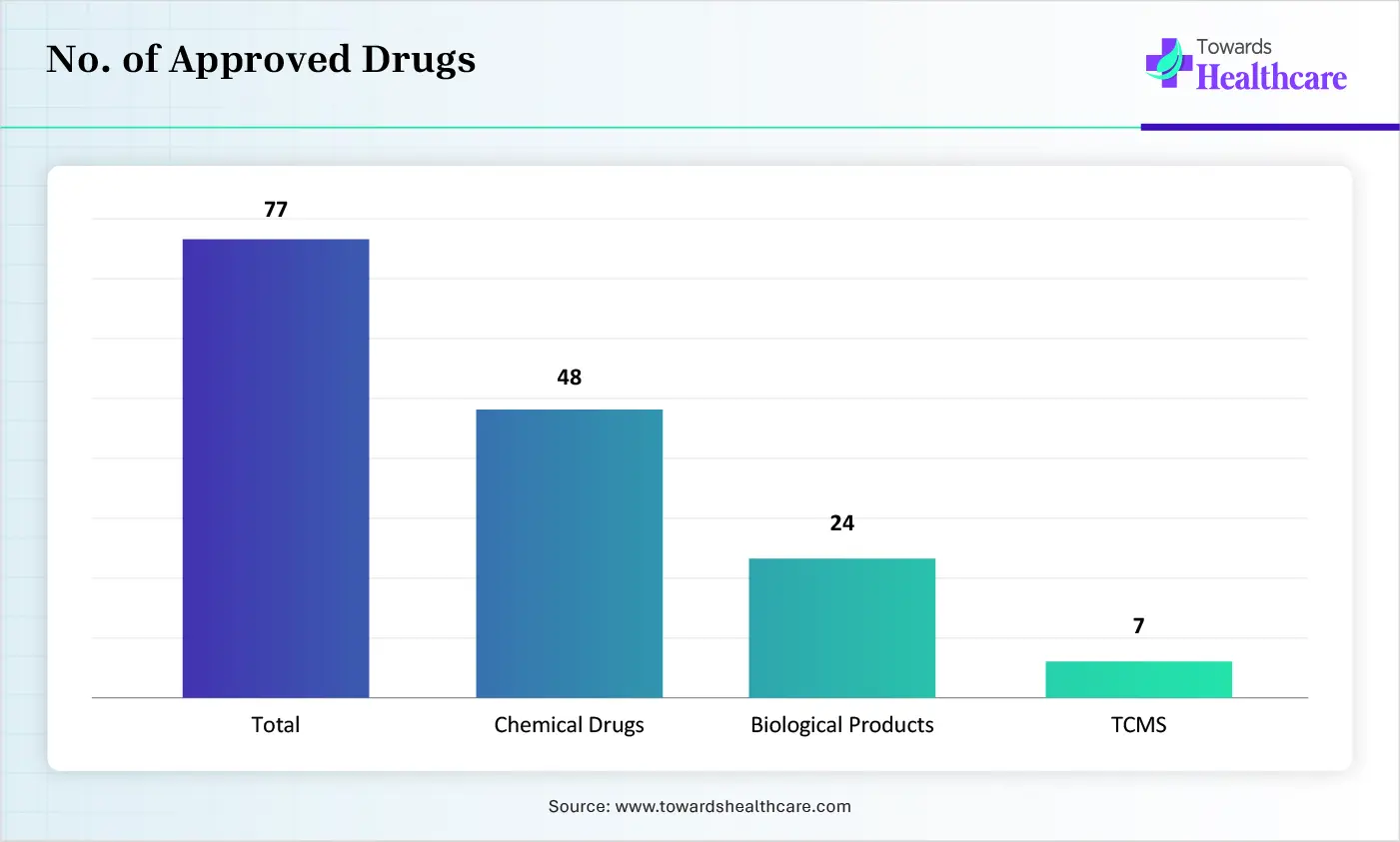
From the above counts, China's locally produced therapies held 81% of chemical drug approvals & nearly 91% of biologic approvals. This shows a movement towards a self-sufficient, localized biotech ecosystem across the China pharmaceutical market. Exploration of the National Reimbursement Drug List (NRDL) & a complementary commercial insurance drug list are highly aimed at enhancing patient access & minimizing financial obstacles for expensive, high-value innovative therapies.
By drug type, the generic drugs segment held a dominant share of 38.0% of the market in 2025. Dominance is propelled by the emergence of volume-based procurement programs, which raise generic adoption across hospitals. Alongside, the cost-sensitive patient population is broadly dependent on affordable medicines. However, the government reimbursement policies are increasingly supporting domestic generic manufacturers.
By molecule type, the small molecules segment led with a 68.0% share of the China pharmaceutical market in 2025. Well-developed production infrastructures are fostering high-volume small molecule manufacturing. Additionally, the ongoing expansion of generic drugs is driving demand for synthetic APIs. Another driver is the wider prescription of oral solid dosage forms across healthcare facilities, which impacts small molecule demand and adoption.
By therapeutic area, the oncology segment captured the largest share of a 24.0% of the market in 2025. Escalating cancer cases are fueling higher demand for targeted therapies, coupled with the immersive progression of immune-oncology pipelines, which are reinforcing the overall segmental innovation. Robust government support for oncoloy reimbursement is boosting treatment accessibility.
By formulation, the tablets segment dominated with a 34.0% share of the China pharmaceutical market in 2025. This formulation is the highly preferred one, particularly in chronic concerns treatments. Also, patient familiarity with tablets empowers the long-term consumption patterns. In addition, tablets' greater manufacturing efficiency assists in industrial-scale production economics.
By end user, the hospitals segment registered dominance with a 54.0% share of the market in 2025. They are known as the primary centers for prescription drug dispensing. Continuous revolution of the tertiary healthcare infrastructure is rising pharmaceutical procurement. Various specialty treatments are continuing to concentrate in institutional settings.
The top leading firms of the market are Sinopharm, Shanghai Pharmaceuticals Holding, Jiangsu Hengrui Medicine, & Fosun Pharma, which are dominating their position around drug manufacturing, research, & national healthcare distribution. Whereas Jiangsu Hengrui Pharmaceuticals is considered the King of Oncology in China, which widely offers a vast pipeline of investigational drugs, consisting of high-end cancer research, tumor immunity, & autoimmune diseases.
By Drug Type
By Product type
By Molecule Type
By Therapeutic Area
By Route of Administration
By Distribution Channel
By Manufacturing Type
By Formulation
By End User


