


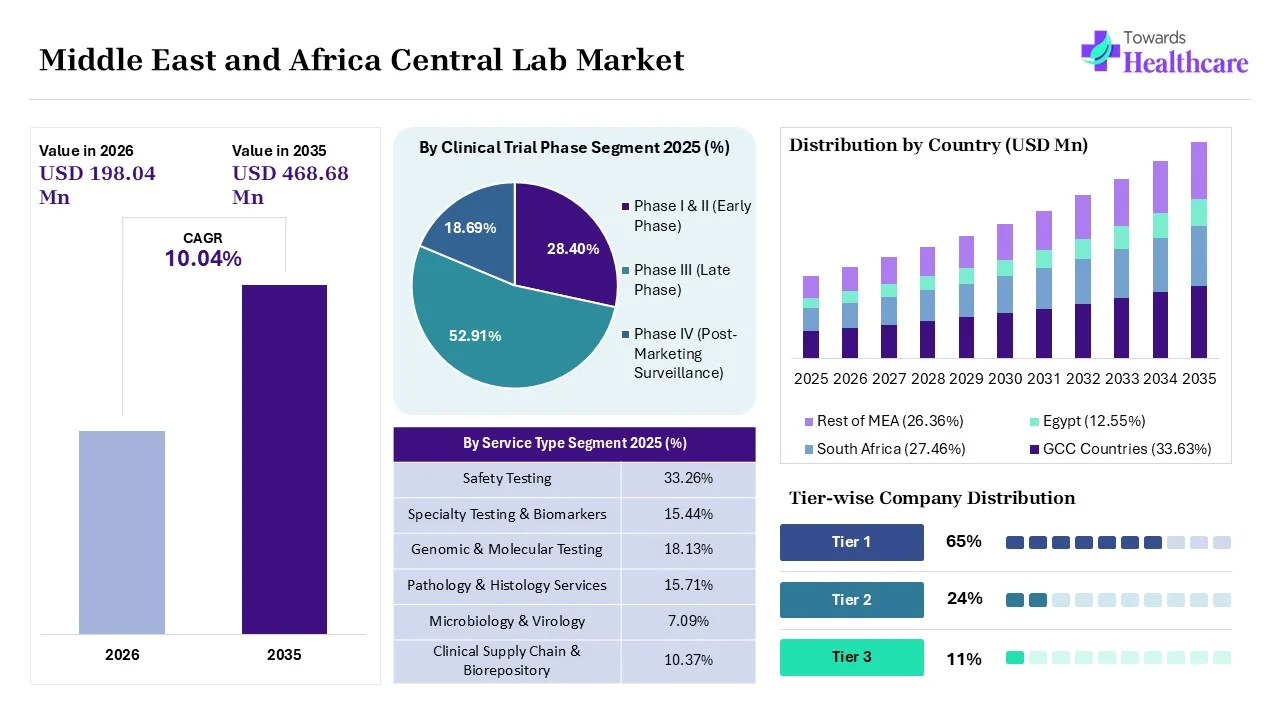
The Middle East and Africa central lab market size was valued at US$ 178.29 million in 2025 and is projected to grow to 198.04 million in 2026. Forecasts suggest it will reach approximately US$ 468.68 million by 2035, registering a CAGR of 10.04% during the period. The market is experiencing steady growth, driven by increasing trial activities, rising pharmaceutical and biotechnology investments, and expanding demand for standardized laboratory testing services. Growing adoption of biomarker analysis, molecular diagnostics, and advanced laboratory technologies is further supporting market expansion across the region.
A Central laboratory is specialized facility that providers standardized facility that provides standardized testing, sample analysis, and data management services for clinical trials and healthcare research, ensuring consistent and accurate results across multiple study sites. The Middle East and Africa central lab market is growing due to increasing clinical trial activities, rising pharmaceutical and biotechnology investments, and expanding healthcare infrastructure. The growing demand for standardized laboratory testing, biomarker analysis, and molecular diagnostics is further driving market expansion. Additionally, a greater focus on precision medicine, regulatory compliance, and high-quality clinical research data is strengthening the adoption of central laboratory services across the region.
The Middle East and Africa central lab market presents significant growth opportunities driven by expanding clinical trial activities and rising demand for precision medicine. Increasing pharmaceutical investments and the development of advanced diagnostic capabilities. Growing healthcare infrastructure and research collaborations are further creating opportunities for central laboratories to support complex clinical studies and specialized testing services.
| Indicator | Verified Data |
| Clinical trials registered in Africa | 861 trials |
| Total clinical trials registered in PACTE (Africa) | 1400 |
| African CDC membership coverage | 55 countries |
| Regional research coordination hubs in Africa | 4 regional centers of excellence |
| WHO African regional coverage | 47 countries |
| Ethical compliance in African trials | 90% of trials with ethics approval recorded |
| Prospective registration rate in Africa | 55^ trials registered prospectively |
This table presents verified government and WHO-backed indicators that reflect the clinical research and regulatory environments across the Middle East and Africa region. It highlights the scale of clinical trial activity in Africa, the role of standardized trial registries such as PACTR and WHO ICTRP, and the strengthening of regional research governance through Africa CDC and WHO frameworks. These factors collectively demonstrate the foundation of clinical research infrastructure that directly supports and drives demand for central laboratory services in the region.
The safety testing segment held a dominant share of 33.26% in 2025 due to its essential role in ensuring patient safety and monitoring adverse events. and supporting regulatory compliance trials. The increasing complexity of drug development, rising clinical research activities, and strict safety monitoring requirements have made it a mandatory component across most studies. Its continuous need across all trial phases reinforced its leading market position.
The oncology segment dominated the Middle East and Africa central lab market with a share of 32.78% in 2025 due to the high burden of cancer and the growing number of oncology-focused clinical trials in the region. Increasing investment in cancer drug development, demand for biomarker-driven therapies, and complex diagnostic requirements strengthened reliance on central laboratory services. The need for precise standardized testing across trial phases further reinforced the oncology leading position.
The phase III (large phase) segment held a dominant share of 52.91% in 2025 due to its large patient populations, extensive testing requirements, and critical role in confirming drug safety and efficacy before approval. These trials involve multi-site studies requiring standardized laboratory services, high sample volumes, and strict regulatory compliance, making central laboratories essential for reliable data generation and trial success.
The biologics (Large Molecules) segment led the Middle East and Africa central lab market with a share of 39.17% in 2025 due to increasing development of monoclonal antibodies, vaccines, and protein-based therapeutics. These treatments require complex laboratory testing, biomarker analysis, and continuous safety monitoring during clinical trials. Rising investments in biotechnology and the shift towards targeted therapy further strengthened demand for specialized central laboratory services, reinforcing biologics as the dominant modality segment in 2025.
The pharmaceutical & biotechnology companies segment held a dominant share of 59.21% in 2025 due to extensive investments in drug discovery, clinical trials, and biologics development. These organizations rely heavily on central laboratories for standardized testing, biomarker analysis, safety assessment, and regulatory compliance. The expanding pipeline of innovative therapies and increased outsourcing of laboratory services further strengthened their leading position in the market.
The Middle East and Africa central lab market is leading due to rapid growth in clinical research programs, increasing multinational trial participation, and stronger healthcare infrastructure development. Expanding demand for standardized testing, advanced diagnostics, and high-quality management is further supporting adoption. Growing pharmaceutical collaboration and greater focus on efficient trial execution across diverse patient populations are strengthening the role of central laboratories in the region.
Leading companies in the market include Lancet Laboratories, Ampath Laboratories, PathCare, Al Borg Diagnostics, and National Reference Laboratory. These players are driving market growth through expanding clinical diagnostics capabilities, strengthening pathology and molecular testing services, and supporting clinical trial laboratory requirements. Continuous investments in advanced laboratory infrastructure, biomarker testing, and regional healthcare expansion across GCC and African countries are further reinforcing their market presence and competitiveness in the region.
By Service Type
By Therapeutic Area
By Clinical Trial Phase
By Modality
By End User
By Region


