


Ocugen Announces that the U.S. Food and Drug Administration Has Granted OCU410 Regenerative Medicine Advanced Therapy (RMAT) Designation for Management of Geographic Atrophy, Secondary to Dry Age-Related Macular Degeneration
Ocugen, Inc., a pioneering biotechnology leader in gene therapies for blindness diseases, announced that the U.S. Food and Drug Administration (FDA) has granted RMAT designation to Ocugen's investigational product OCU410 for the management of geographic atrophy (GA), secondary to dry age-related macular degeneration (dAMD).
"RMAT designation for OCU410 is a significant accomplishment that recognizes both the potential of our 'one treatment for life' novel gene therapy platform and the substantial unmet medical need for geographic atrophy," said Dr. Shankar Musunuri, Chairman, Chief Executive Officer, and Co-Founder of Ocugen. "With an estimated 2 to 3 million people in the U.S. and Europe affected, a number expected to grow as the population ages, geographic atrophy is a leading cause of irreversible blindness in older adults, highlighting the urgent need for new treatment options. We look forward to continuing to work closely with the FDA to responsibly and efficiently advance the development program for patients suffering from this devastating disease."
The RMAT designation for OCU410 was supported by Phase 2 clinical data demonstrating healthcare-meaningful effectiveness and a favorable safety profile, with no reported severe adverse events associated with the drug. Based on these data, the FDA determined that OCU410 met the criteria for RMAT designation by offering preliminary clinical evidence that the therapy has the strength to address a severe condition with significant unmet medical need. This designation recognizes the promise of OCU410 as a regenerative medicine therapy and supports an expedited development pathway.
In early July 2026, Ocugen reached a position with the FDA on the design of the OCU410 Phase 3 registrational trial, with study initiation expected in the third quarter of 2026, and a Biologics License Application (BLA) filing anticipated in 2028.
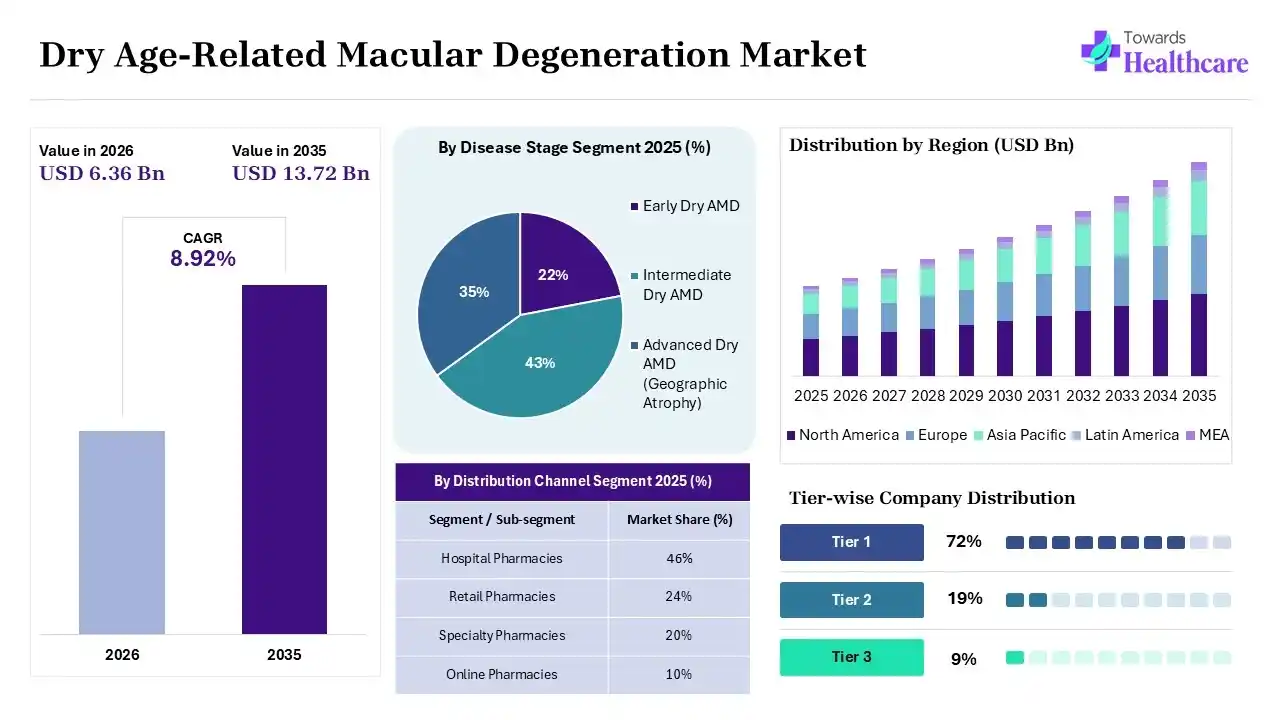
According to Towards Healthcare, the dry age-related macular degeneration market is projected to experience significant growth, with estimates suggesting the market size will increase from USD 6.36 billion in 2026 to approximately USD 13.72 billion by 2035. Growth is expected at a steady CAGR of 8.92% in between 2026 to 2035the significant treatments for dry age-related macular degeneration (AMD) focus on decelerating disease progression and managing well-developed stages, relying potentially on AREDS2 nutritional supplements, targeted eye-injections for late-stage geographic atrophy, and healthy lifestyle transformation. While there is no complete cure, these choices support protecting remaining sight.
The FDA established the RMAT designation to accelerate the advancement and review of regenerative medicine therapies planned to treat, adapt, reverse, or cure severe or life-threatening diseases or conditions. RMAT designation is granted to investigational regenerative medicine therapies supported by preliminary healthcare evidence indicating the strength to address unmet medical needs. Products get RMAT designation are qualified for all the advantages of the Fast Track and Breakthrough Therapy programs, involving increased interactions with the FDA to support effective development, suitability for rolling BLA review, and the strength for expedited approval and Priority Review, where suitable.
Geographic atrophy is a well-developed form of dAMD considered progressive degeneration of the macula, leading to irreversible central vision loss. Millions of patients globally are affected by GA, with a specifically increasing challenges in aging populations in the United States and Europe. Despite recent approvals, management options remain limited and require chronic intravitreal injections, underscoring the requirement for innovative, tough therapies that tackle multiple disease mechanisms. dAMD affects around 10 million Americans and more than 266 million patients worldwide. It is characterized by the thinning of the macula, the region of the retina responsible for clear vision in one's direct line of sight. dAMD includes the slow deterioration of the retina with submacular drusen, atrophy, loss of macular function, and central vision damage. dAMD accounts for 85-90% of all AMD cases.
OCU410 is an investigational, subretinal injection, AAV5-driven gene therapy that delivers RORA (retinoid-related orphan receptor alpha), a nuclear receptor that regulates significant pathways involved in retinal homeostasis, involving oxidative stress response, complement regulation, inflammation, and lipid metabolism. OCU410 is being advanced as a one-time gene therapy for patients with GA secondary to dAMD. OCU410 received Advanced Therapy Medicinal Product (ATMP) classification from the European Medicines Agency.
Ocugen, Inc. is a ground-breaking biotechnology company developing gene therapies for blindness. The Company's breakthrough transformer gene therapy platform has the strength to tackle significant unmet healthcare needs across large patient populations via a gene-agnostic strategy. Unlike traditional gene therapies and gene-editing solutions, which target a single gene mutation, Ocugen's modifier gene therapies are intended to address the underlying disease biology by restoring balance in multiple gene networks. The organization is presently developing programs for inherited retinal diseases and other causes of blindness that affect millions worldwide, involving retinitis pigmentosa, Stargardt disease, and geographic atrophy, an advanced form of dry age-related macular degeneration.
A recent report by Towards Healthcare highlights that the dry age-related macular degeneration market is growing, as the management of early dry AMD is usually nutritional therapy, with a healthy diet high in antioxidants to support the cells of the macula. The dry variant of age-associated macular degeneration shows an earlier stage of the disease, throughout which vision loss tends to be slower. Dry AMD management focuses on slowing the transition to wet AMD and the increased likelihood of vision loss. The significant treatment for dry AMD is nutritional therapy.


