


Vertex Announces US FDA Approval for Expanded Use of CASGEVY® for the Treatment of People Ages 2 Years and Older With Sickle Cell Disease or Transfusion-Dependent Beta Thalassemia
Vertex Pharmaceuticals Incorporated announced that the U.S. Food and Drug Administration (FDA) has approved expanded use of CASGEVY for the management of patients ages 2 years and older with either sickle cell disease (SCD) with recurrent Vaso-occlusive crises (VOCs) or transfusion-dependent beta thalassemia (TDT). CASGEVY is the first approved genetic therapy designated for children as young as 2 years for both SCD and TDT.
"Just as we redefined what is possible in cystic fibrosis, our ambition is to transform the future for people living with sickle cell disease and transfusion-dependent beta thalassemia. The remarkable consistency of results across age groups reinforces the potential of CASGEVY to deliver durable, transformative benefits to those who have historically had limited options," said Reshma Kewalramani, M.D., Chief Executive Officer and President, Vertex. "We're deeply grateful to the patients, families and investigators who participated in the clinical trials that led to this historic approval, and we are ready to bring CASGEVY to children and their families across the U.S."
"Today's approval offers renewed hope for children living with sickle cell disease or transfusion‑dependent beta thalassemia," said Haydar Frangoul, M.D., M.S., Medical Director of HCA Healthcare's Sarah Cannon Transplant and Cellular Therapy Program at TriStar Centennial Children's Hospital, investigator with Sarah Cannon Research Institute (SCRI) and Member of Vertex's SCD Program Steering Committee. "Earlier access to the transformative potential of this therapy will allow clinicians and families to consider treatment before years of cumulative damage from these life-shortening diseases take hold."
Vertex has established a network of autonomously operated, authorized treatment centers (ATCs) throughout the U.S. to provide CASGEVY to eligible patients via presenting access and reimbursement pathways. There are more than 75 activated ATCs in the U.S. The full list can be accessed at CASGEVY.com.
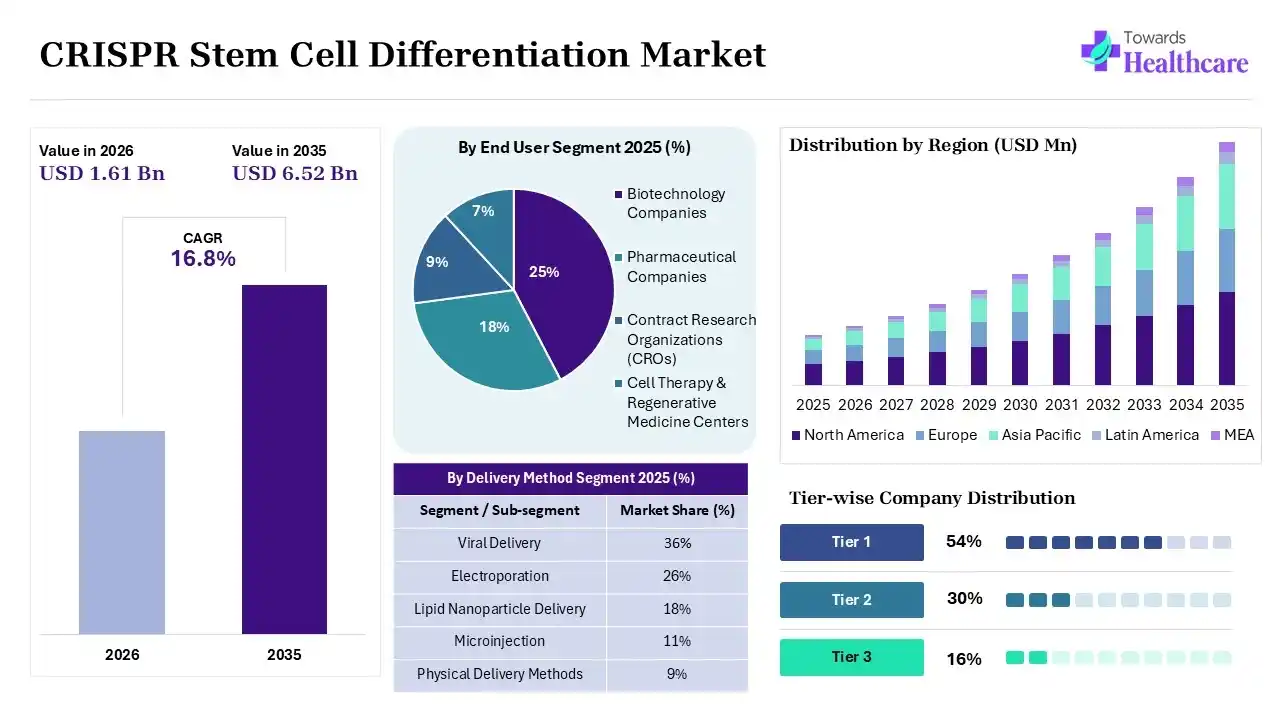
According to Towards Healthcare, the CRISPR stem cell differentiation market is projected to experience significant growth, with estimates suggesting the market size will increase from USD 1.61 billion in 2026 to approximately USD 6.52 billion by 2035, representing a compound annual growth rate (CAGR) of 16.8% from 2026 to 2035, driven by CRISPR/Cas9 provides ease and effectiveness in genome editing, allowing rapid gene modifications directly in embryos as compared to traditional embryonic stem (ES) cell-driven methods. Upcoming applications include using CRISPR/Cas9 in ES cells rather than embryos to enhance precision, lessen mosaicism, and modernize the generation of genetically engineered mouse models. CRISPR enables easy gene editing in stem cells, thus presenting promising potential in therapy advancement.
Sickle cell disease (SCD) is a rare, severe, inherited blood disease which is progressive and life‑shortening. The disease causes red blood cells to become rigid and misshapen, constricting blood flow and oxygen delivery to vital organs. Recurrent vaso‑occlusive crises (VOCs), unpredictable episodes of serious pain caused by blocked blood vessels, are a defining characteristic of SCD and frequently require hospitalization. Many patients experience these difficulties early in life, and over time, repeated VOCs and chronic anemia lead to irreversible and progressive organ damage, involving damage to the brain, lungs, kidneys, and heart. SCD places a substantial load on patients and their families, who must manage frequent healthcare visits, hospitalizations, school and work disruptions, and the emotional toll of chronic pain and life‑threatening complications. Despite lifelong treatment, people with SCD and recurrent VOCs in the U.S. face shortened life expectancy, with a median age of death of around 45 years; report quality‑of‑life scores far below the general population, and the projected lifetime medical care expenses of managing the disease are $4-6 million.
Transfusion‑dependent beta thalassemia (TDT) is a rare, severe, inherited blood disease that is progressive and life‑shortening. The disease impairs the body's capability to produce adequate hemoglobin, restraining oxygen delivery to tissues and organs. Patients with TDT do not have sufficient functional hemoglobin in their red blood cells and need regular, enduring blood transfusions, often beginning early in childhood, along with continuing iron chelation therapy. While transfusions are needed for survival, many of the long‑term challenges of TDT are exacerbated by chronic transfusion therapy and iron overload and cumulative harm to the liver, heart and endocrine system, as well as bone abnormalities and delayed growth and adolescence. TDT places significant and continuing challenges on patients and their families, needing frequent medical visits and complex lifelong treatment. Despite lifelong treatment, patients with TDT in the U.S. face shortened life expectancy, with a median age of death of approximately 37 years, reduced quality of life and efficiency, and the estimated lifetime healthcare expenses of managing the disease are $5-5.7 million.
CASGEVY is a non-viral, ex vivo CRISPR/Cas9 gene-edited cell therapy for eligible patients with SCD or TDT, in which a patient's own hematopoietic stem and progenitor cells are edited at the erythroid-specific enhancer region of the BCL11A gene via a precise double-strand break. This edit results in the manufacturing of high levels of fetal hemoglobin in red blood cells. HbF is the form of the oxygen-carrying hemoglobin that is naturally present throughout fetal development, which then switches to the adult form of hemoglobin after birth. CASGEVY has been shown in clinical trials to lower or remove VOCs for patients with SCD and transfusion needs for patients with TDT.
In the United States, CASGEVY was accepted using the Commissioner's National Priority Voucher. Vertex has recently completed regulatory submissions in the Kingdom of Saudi Arabia and the United Kingdom to increase the application of CASGEVY to children as young as five.
The completed Phase 1/2/3 open-label studies, CLIMB-111 and CLIMB-121, were intended to assess the safety and effectiveness of a single dose of CASGEVY in patients ages 12-35 years with TDT or with SCD and recurrent VOCs. Patients were followed for around two years after CASGEVY infusion in these studies. CLIMB-141 and CLIMB-151 are continuing Phase 3 open-label research, intended to assess the safety and efficacy of a single dose of exagamglogene autotemcel in patients ages 2-11 years with TDT or with SCD and recurrent VOCs. Enrollment and dosing are comprehensive for the 5-11-year-old cohort in both studies.
A recent report by Towards Healthcare highlights that the CRISPR stem cell differentiation market is growing, as CRISPR has enabled advancements in stem cell research, enabling accurate modifications in these cells. This has implications for regenerative therapeutics, where modified stem cells could be used to repair or replace injured tissues. CRISPR has created new opportunities for the advancement of gene therapies. Scientists are discovering its applications in modifying genetic defects and introducing therapeutic genes to manage a variety of healthcare conditions. CRISPR has allowed scientists to research the functional consequences of genetic changes over generations. This has implications for understanding evolutionary processes and the impact of genetic alterations on species.


