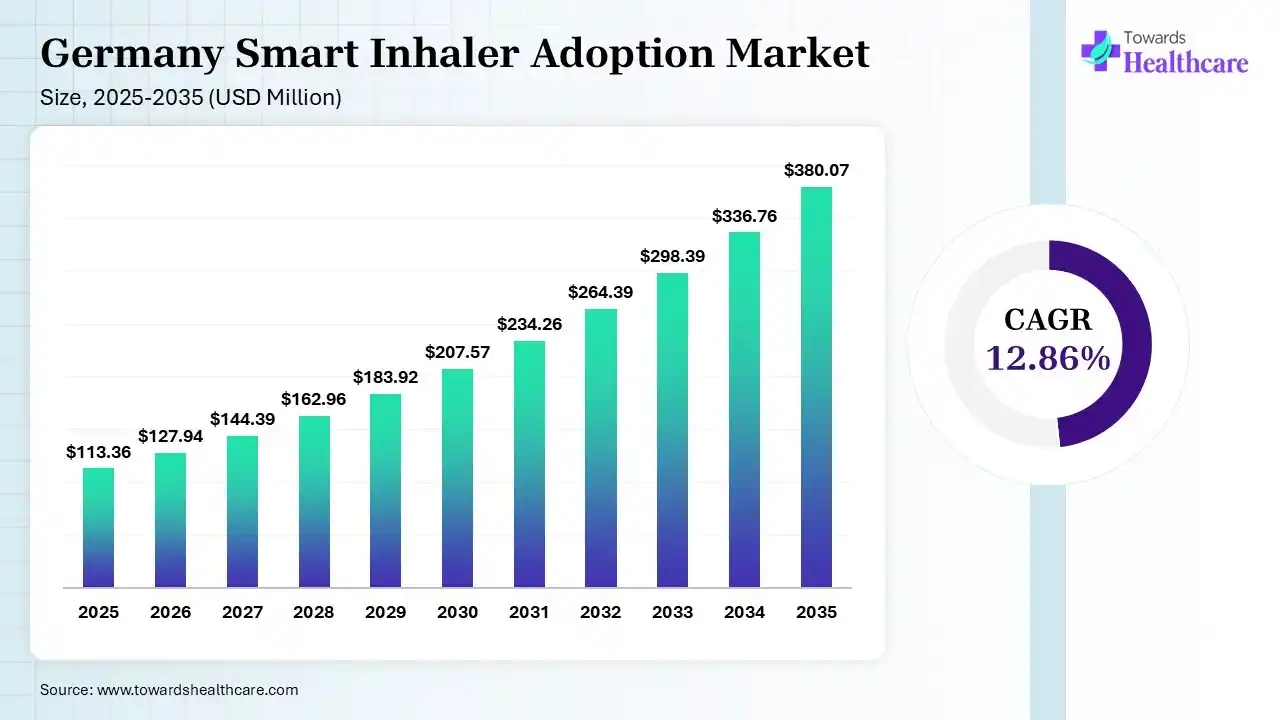
The Germany smart inhaler adoption market is projected to grow from USD 127.94 million in 2026 to USD 380.07 million by 2035, at a CAGR of 12.86% over the forecast period. The report distinguishes between the total addressable market (TAM), patients eligible for smart inhalers, current users, and revenue-generating adopters. This approach avoids overstating the market by treating all patients with respiratory conditions as potential smart-inhaler users.
Germany's combined asthma and COPD population represents a large potential user base. However, only a portion of these patients currently use connected inhaler solutions. The market forecast therefore follows a step-by-step adoption model, covering diagnosed patients, inhaler users, digitally eligible patients, smart-inhaler candidates, active users, and retained users.
In the base-case scenario, smart-inhaler adoption is expected to increase significantly between 2025 and 2030. By 2030, penetration could reach 2-4% of the addressable population of chronic inhaler users. Faster reimbursement adoption could raise penetration to 5-7%, while limited reimbursement may keep it below 2%.
Market revenue is expected to come from both device sales and recurring income from software subscriptions and remote monitoring services. These revenue streams could support subscription-based and enterprise business models as adoption expands.
Germany is becoming one of the most appealing markets in Europe for the early adoption of smart inhalers due to the presence of numerous factors, including the large population with chronic respiratory diseases, high healthcare spending, extensive use of smartphones, development of the e-health infrastructure, and the mounting necessity to show quantifiable outcomes from treatment.
The target patient population is quite significant. It includes 8.0% of adults have asthma, while COPD affects 3.18 million people above 40 years old - 6.7% of the corresponding population in 2024. The prevalence of COPD amounts to 8.5% in people above 45 years old and exceeds 10% in the older age groups.
The current size of the commercial smart inhaler market is much smaller than that of the overall respiratory treatment market, showing that Germany is in the early stages of penetration.
This is due to the key trend of evolving from a hardware-only solution to a connected respiratory care platform.
Market segmentation will be done on the basis of device architecture, inhaler technology, indications, connectivity technology, customer, channel, and business model.
Add-on sensors should continue to be an important part of the category since they enable established inhalers to become connected without compelling patients and physicians to switch brands. Smart inhalers provide better value by directly capturing usage information and, in certain architectures, the quality of the inhalation, yet at a higher level of regulatory, production, and pharma development risk.
MDI-compatible products will stay commercially important due to the large installed base of pressurized inhalers, and DPI compatibility will be of strategic importance for companies aiming at comprehensive maintenance coverage.
In terms of indications, asthma would become the largest adoption segment in the near term, due to the obvious use of digital adherence and self-management in that indication. COPD should be a great mid-term opportunity, due to the older age of the patients and higher morbidity level.
Connected respiratory management is needed in Germany due to the prevalence of approximately 8.0% of asthmatic adults, along with 3.18 million adults aged 40 and above suffering from COPD in 2024.
From our analysis, it becomes clear that the German market is thus more limited by reimbursement than by clinical applicability. From the available data, it appears that monitoring of connectivity and adherence cannot alone support adoption unless the usage of smart inhalers correlates to some tangible increase in adherence, proper usage, fewer exacerbations, health resource use, or cost. Reimbursement-readiness will thus likely be more crucial in determining market uptake than clinical need for the near future.
This is how we see it as creating a strategic dichotomy between proof-of-concept efforts and commercially scalable respiratory health care. Applications that have the ability to create actionable data and integrate into physicians’ workflow will have more chances of making the transition from pilots, whereas those whose main competitive advantage is related to their connectivity capabilities might be met with lower WTPs.
The complete report analyzes the economics of adherence and inhalation techniques, physician workflow impact, patient engagement, reimbursement models for digital health applications, data interoperability, security concerns, evidence requirements, and barriers to mass adoption, as well as scenarios related to market uptake and revenues until 2030.
There are major differences in smart-inhalers economics based on the architecture being considered. The simple add-ons with sensors will likely be priced as a modest premium for a conventional inhaler accessory, while the connected systems and clinical monitoring tools enable significantly higher revenue per user.
The report includes ASP of the devices, annualized patient revenue, cost of the software subscription, enterprise-level pricing and combined economics of pharma-device solutions. Price ceiling is modeled considering the pricing in Germany, where reimbursement is available, and the doctors' readiness to prescribe.
The most sustainable business model is increasingly seen as a combination of the relatively low cost of hardware per user and recurring revenues from software, monitoring, or partnerships with pharmaceuticals.
Demand comes from patients, pulmonologists, primary‑care physicians, hospitals, payers, and clinical research organizations.
The supply chain is spread among inhaler makers, sensor vendors, digital health experts, electronic component suppliers, and custom medical device design firms. Compatibility and clinical integration, not production, are the limiting factors on the supply side. An inhaler that is compatible with one inhaler technology type has less addressable market potential than an inhaler that can integrate with many MDI and DPI technologies.
Therefore, this report looks at supply in terms of inhaler families, manufacturing capabilities, regulatory compliance, and partnerships for commercialization and not just smart device SKUs.
Value chains go all the way from sensors, microelectronics, and inhaler components to device assembly, pharmaceutical formulations, software, connectivity, clinical platforms, and reimbursement.
Hardware generates less strategic value than the more repetitive data and software value layer. The best platforms will be able to commercialize patient monitoring, clinical decision support, adherence analytics, and clinical trial applications.
The report quantifies the sources of value for hardware, software, pharmaceutical integration, distribution, and clinical services, and the most important interoperability barriers.
Commercial smart-inhaler technology is moving beyond basic actuation recording to include time-stamped adherence tracking, remaining-dose calculations, inhalation flow measurement, environmental monitoring, location-linked exposure data, and clinician dashboards. These features provide more detailed information than simple confirmation of inhaler use. They help healthcare professionals understand when and how patients use their inhalers and identify environmental factors that may affect treatment.
Based on our research, it becomes clear that inhalation intelligence becomes the more strategically valuable level of smart-inhalers' technology. The focus on inhalation quality measurement, adherence prediction using artificial intelligence, personalized reminder systems, and electronic patient records integration shows that the future of smart-inhalers will be more focused on converting sensor data into clinically meaningful insight. We believe that technologies which will have capabilities to combine sensors and analytics, and integrate them with clinical workflows will become strategically more relevant than just dose tracking technologies.
The key takeaway from our perspective is that the maturity level of technology would increasingly rely on factors such as clinical usefulness, interoperability and evidence rather than on the number of interconnectivity options offered by the devices. The introduction of intelligence and predictive analytics would make it possible for problems related to patient adherence and inhalation to be detected sooner, while the integration of data from smart inhaler devices into electronic health records would significantly increase the usefulness of this data for clinicians.
However, the German regulatory framework also presents opportunities and conflict. There are certain requirements for the safety, functionality, quality, data protection, cybersecurity, and evidence of healthcare benefits in order to obtain reimbursement for digital health solutions.
As a secondary, yet more and more relevant issue, the sustainability factor is being considered due to the increased amount of electronics and batteries as well as complexities in life-cycle management of connected inhalers. Therefore, reusable sensor architecture presents an additional advantage compared to disposable connected devices.
The best early adopters will be individuals suffering from poorly-controlled asthma, poor adherence records, regular exacerbations, complicated management plans, or high utilization of health care resources. The economic justification for these patients is better than that for low-risk patients with controlled disease.
The provider value proposition is in lowering manual adherence checks and treatment choices. The pharma value proposition is in treatment differentiation, real-world evidence, and patient engagement. The payer value proposition is in avoiding exacerbations, hospitalization, or wastage through additional digital spending.
Germany’s competitive dynamics are much more complicated than the traditional medical-device market since ownership of the patient relationship could fall to the pharmaceutical company, inhaler company, digital health solution provider, or health care provider.
The top competitive segments are integrated pharmaceutical-inhaler platforms, sensor technologies, inhaler component manufacturers, digital adherence solutions, and respiratory monitoring firms. Competitive advantage will increasingly be determined by range of compatibility and evidence, not hardware alone.
Clinical evidence will become a true source of differentiation. The German real world digital companion trial in 163 patients with 90-day data showed ≥80% adherence in 82.8% of patients in month one and 72.4% of patients in month three. On the other hand, a much larger German non-interventional study in 222 digitally supported patients versus 203 traditionally treated patients demonstrated similar improvement in asthma control between both groups, emphasizing the difficulties of turning digital engagement into additional clinical value.
Thus, there is a critical competitive differentiation opportunity for those who can show their impact on reducing exacerbations, improving technique, lowering total cost of care, or generating payback on investment from payers.
| # | Company | Headquarters | Market Position | Core Strength | Major Applications/Segments |
| 1 | AstraZeneca | UK | Pharmaceutical/device leader | Respiratory medicines and connected-care ecosystem | Asthma, COPD |
| 2 | GSK | UK | Pharmaceutical leader | Respiratory portfolio and patient support | Asthma, COPD |
| 3 | Teva Pharmaceutical Industries | Israel | Digital-inhaler pioneer | Integrated connected inhalers | Asthma, respiratory |
| 4 | Novartis | Switzerland | Integrated respiratory player | Digital companion and inhaler platforms | Asthma, COPD |
| 5 | Boehringer Ingelheim | Germany | Major respiratory manufacturer | Inhaler platforms and respiratory medicines | COPD, asthma |
| 6 | AptarGroup | US | Device/component leader | Drug-delivery and connected-device technology | Inhalers |
| 7 | Adherium | Australia | Smart-sensor specialist | Medication adherence monitoring | Asthma, COPD |
| 8 | FindAir | Poland | Connected-inhaler specialist | Add-on sensors and respiratory software | Asthma, COPD |
| 9 | H&T Presspart | UK | Inhaler-component specialist | pMDI/DPI components | Inhaler systems |
| 10 | Sensirion | Switzerland | Sensor technology provider | Flow and pressure sensing | Smart inhalers |
| 11 | BreatheSuite | Canada | Digital respiratory specialist | Adherence and respiratory monitoring | Asthma, COPD |
| 12 | Cognita Labs | US | Smart-inhaler specialist | Inhalation monitoring | Asthma, COPD |
| 13 | AireHealth | US | Connected respiratory platform | Smart inhalation systems | Asthma, COPD |
| 14 | Pneuma Respiratory | US | Digital drug-delivery challenger | Smart inhaler architecture | Respiratory |
| 15 | Chiesi | Italy | Respiratory pharmaceutical player | Inhaled therapies and digital initiatives | Asthma, COPD |
| 16 | Philips | Netherlands | Respiratory technology player | Connected respiratory care | Respiratory |
| 17 | PARI | Germany | Respiratory-device specialist | Inhalation devices and nebulization | Respiratory |
| 18 | Omron Healthcare | Japan | Connected monitoring specialist | Digital respiratory monitoring | Home care |
Germany's smart inhaler market does not yet have a single supplier with a clearly dominant share. Competition remains spread across different technology platforms and business models, including connected devices, sensor systems, and integrated pharmaceutical solutions.
The competitive analysis assesses market share using several measures: smart-inhaler revenue, number of connected patients, installed device base, and number of compatible inhalers. These measures provide a broader view of market positioning. For example, a company with a large connected patient base may not generate the highest revenue, while an integrated pharmaceutical platform may earn significant revenue from bundled therapy solutions without operating primarily as a sensor supplier.
The full report estimates the combined market shares of the top five and top ten companies, evaluates changes in their competitive positions, and examines different market concentration scenarios.
Leaders are characterized in terms of revenue size, exposure of respiratory systems, the size of smart device installation base, level of compatibility, software, evidence base, regulatory experience, partnerships, geographic reach, and reimbursement.
For patient access and integration into therapy, pharmaceutical companies are expected to be leaders, whereas digital health specialists are going to be flexible in technology, and device makers will have strong engineering and manufacturing capabilities.
The difference is related to technology capabilities and reimbursement reach. Hence, the report categorizes leader companies into Scale Leaders, Technology Leaders, Respiratory Portfolio Leaders, Platform Specialists, Regional Specialists, and Emerging Challengers.
Comparative company analysis is performed on the basis of pMDI sensors, DPI sensors, integrated smart inhalers, inhalation-flow measurements, adherence software, patient apps, and clinician dashboards.
Multi-device compatibility becomes critically important in Germany, because doctors tend to prescribe across several families of inhalers. A platform limited to a proprietary inhaler will be structurally challenged by a smaller total addressable market than a multi-device platform.
Technology assessment is made based on patents, R&D activity, sensor architecture, connectivity, algorithms, artificial intelligence capability, battery life, data architecture, APIs, and clinical validation.
Most interesting technologies evolve from the question “Did he use the inhaler?” to “Did he use it correctly, did he use it consistently, and at the right clinical time?” It opens opportunities for differentiation in terms of flow measurement, technique detection, personalized interventions, and predictive adherence analytics.
Application Competitive Benchmarking: Asthma Leads Initial Adoption, COPD Offers a Larger Long-Term Monitoring Opportunity
Asthma is currently the most clear-cut case for digital self-management, especially for patients who lack control. COPD represents an interesting longer-term opportunity because of exacerbations, hospitalization risk, and polypharmacy.
The competitive analysis highlights which vendors are most exposed to asthma, COPD, pediatric respiratory disease, home monitoring, specialty clinics, and sponsored patient programs by pharmaceutical companies.
Developing smart inhalers offers a significant opportunity; the key elements are the realization of such solutions via sensors and the appropriate medical device ecosystem to ensure that the software in the inhaler has been validated and that it has been cleared by the relevant regulatory bodies.
The report assesses the production sites, their dependence on contract manufacturers, their reliance on components, and their local and scalable manufacturing footprint to identify the key elements for smart inhalers: the ability to manufacture thousands of devices without altering the design.
Doctors specializing in pulmonary care, general physicians, lung clinics, pharmacies, hospitals, home healthcare, and pharmaceutical care programs are the key distribution channels for the patient care data solution.
The customer’s lifetime value is increased through the ability to provide data captured by the device directly to the doctor in a manner that is seamlessly incorporated into the clinical workflow; the study evaluates the sales pathway options, including distributorships selling in the territory under a pharmaceutical agreement with the supplier, utilizing providers, assessing reimbursement and access solutions, and patient recruitment strategies.
The recent activities suggest a move towards integrated platforms, which will comprise the inhaler hardware, sensors, software, and clinical data. The focus of developments is more on APIs, remote monitoring, pharmaceutical real-world evidence, and use cases for clinical trials.
This report analyses the launches of products, collaborations, distribution deals, clinical trials, manufacturing capacity, and German commercialisation activity in the last 24-36 months.
In M&A analysis, the deals that take place related to connected inhalers, respiratory software, inhalation technology, sensors, and drug delivery platforms are taken into account.
Some potential themes for future transactions are expected to be acquisition of sensor technology, digital health platform consolidation, vertical integration into drug delivery, and pharmaceutical acquisition of differentiated adherence technology.
The report identifies several priority white spaces:
The largest opportunity is not simply converting all inhaler users to connected devices. It is targeting the highest-cost and highest-risk patient cohorts first, where a relatively small penetration rate can generate disproportionately high clinical-economic value.
| Force | Assessment | Strategic Interpretation |
| Supplier power | Medium | Specialized sensors and inhaler components can create dependency |
| Buyer power | High | Payers and pharmaceutical customers demand clinical-economic evidence |
| Threat of new entrants | Medium | Software entry is relatively easy; medical-device validation is harder |
| Threat of substitutes | Medium | Conventional inhalers and smartphone-based adherence tools remain alternatives. |
| Competitive rivalry | High | Pharmaceutical, device, and digital-health models increasingly overlap |
Attractive is the rating for Germany, and this may be increased to Highly Attractive should reimbursement improve.
The positive aspects include millions of patients with respiratory diseases, a strong health care system, favorable policies on digital health, highly valued exacerbation economics, and a well-developed pharmaceutical industry.
The negative aspects include low penetration levels, fragmented reimbursement, evidentiary needs, physicians’ work process integration, and need to support multiple inhaler platforms.
By 2030, the German smart-inhaler market should move beyond the connected-device niche market into a digital ecosystem for respiratory disease management.
The base case assumes high-teens to mid-20s annual revenue growth rates along with 2-4% of penetration for smart devices among the addressable population with chronic inhalers. The upside case achieves 5-7% penetration on the basis of reimbursement, integration with patient record management systems, and sound clinical-economic data. For the downside case, penetration is less than 2% if reimbursement is still fragmented and there is no demonstrated incremental value from digital interventions.
Profit pools of the future will probably be found in software, clinical monitoring, pharmaceutical partnerships, and outcome-oriented service offerings instead of sensors.
Winners in the future are likely to be those companies that can simultaneously provide all three capabilities: patient access, interoperable technology, and clinical-economic data.
By Inhaler/Device Type
By Device Architecture
By Disease/Indication
By Technology/Connectivity
By Customer Type
By Commercial/Business Model
By Channel
By Application
By Patient/Adoption Stage
By Revenue Model


Principal Consultant
Payal Rabde is a Healthcare Market Research Analyst at Towards Healthcare Research & Consulting with 4+ years of experience in pharmaceuticals, biotechnology, medical devices, and life sciences.
Learn more about Payal Rabde

Reviewed By
Aditi Shivarkar is a seasoned professional with over 14 years of experience in healthcare market research. As a content reviewer, Aditi ensures the quality and accuracy of all market insights and data presented by the research team.
Learn more about Aditi Shivarkar