


The global intelligent mental health management market size was estimated at USD 5.54 billion in 2025 and is predicted to increase from USD 6.13 billion in 2026 to approximately USD 15.24 billion by 2035, expanding at a CAGR of 10.64% from 2026 to 2035.
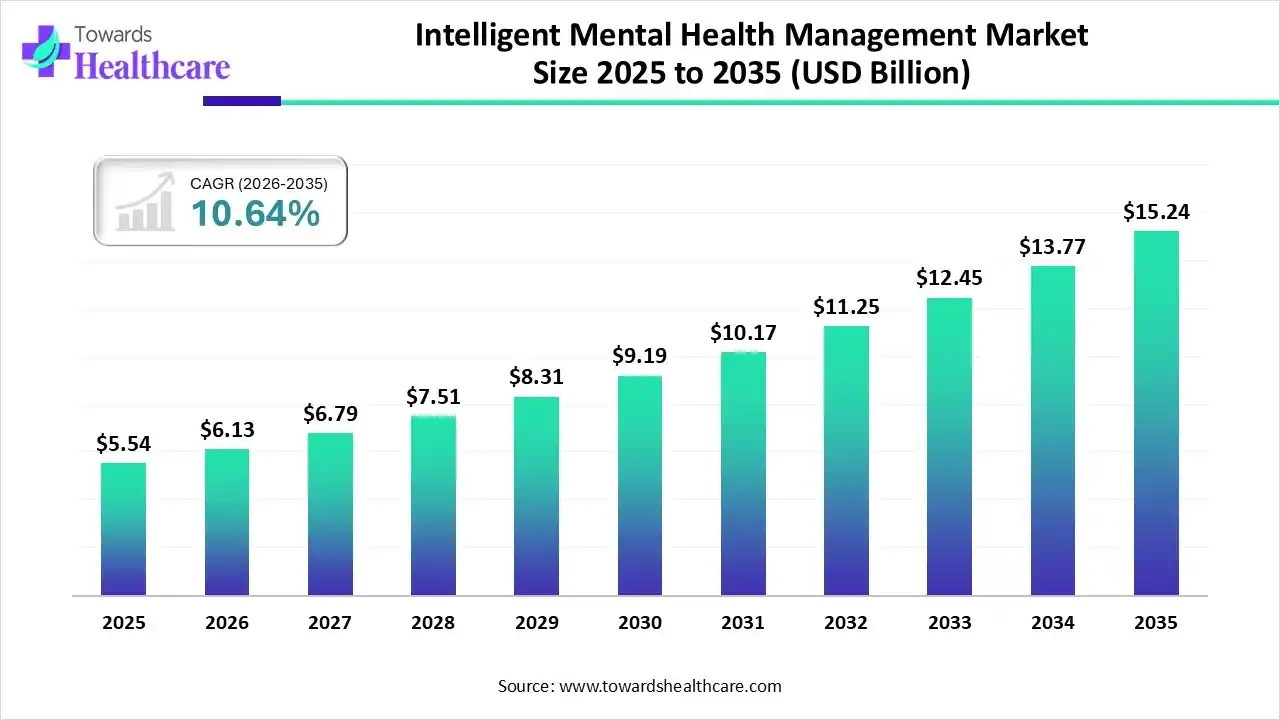
Across the globe, the leading companies are fostering the transformation of cloud-based & edge-enabled solutions to explore seamless, affordable, scalable, and advanced solutions in mental health care. Moreover, healthcare providers are also widely leveraging telepsychiatry and virtual care to reach underserved or low-income areas and to conduct rapid screening of mental health concerns. However, numerous governments are promoting AI research activities, resulting in the progression of AI-enabled tools and platforms for mental health care.
| Key Elements | Scope |
| Market Size in 2026 | USD 126.38 Billion |
| Projected Market Size in 2035 | USD 182.07 Billion |
| CAGR (2026 - 2035) | 4.14% |
| Leading Region | North America by 45% |
| Historical Data | 2020 - 2023 |
| Base Year | 2025 |
| Forecast Period | 2026 - 2035 |
| Measurable Values | USD Millions/Units/Volume |
| Market Segmentation | By Component, By Technology, By Deployment Mode, By End User, By Application, By Region |
| Top Key Players | Ginger, Talkspace, Pear Therapeutics, SilverCloud Health, Lyra Health, Mindstrong Health, Spring Health, BioBeats, Calm |
The intelligent mental health management market refers to the ecosystem of software, platforms, and services that utilize digital technologies such as artificial intelligence (AI), machine learning (ML), natural language processing (NLP), analytics, and sensor data to assist in the assessment, monitoring, diagnosis, treatment, and ongoing management of mental health conditions. Adoption is driven by rising mental health burden, clinician shortages, telehealth expansion, and payer reimbursement support.
These solutions aim to improve access, personalization, and outcomes in mental healthcare by offering predictive risk scoring, automated therapy delivery, symptom tracking, digital cognitive behavioral therapy (CBT), tele-psychiatry, wearable integrations, and clinician decision support.
Intelligent mental health management refers to the use of artificial intelligence, machine learning, digital therapeutics, and data analytics to assess, monitor, diagnose, and manage mental health conditions through personalized and technology-driven care. The intelligent mental health management market is expanding due to the increasing prevalence of anxiety, depression, and stress-related disorders, coupled with rising adoption of digital healthcare disorders, coupled with rising adoption of digital healthcare platforms. Key trends include AI-powered virtual therapies, wearable devices for real -time mental health monitoring, and integration of mental health advancements with telemedicine services. Technological advancements in natural language processing, predictive analytics, and emotion recognition are improving early intervention and personalized treatment strategies. Future opportunities include predictive analytics and emotion recognition, which are improving early intervention and personalized treatment strategies. Future opportunities are driven by expanding digital health infrastructure, growing investments in behavioral health technologies, increasing acceptance of mental healthcare, and continuous innovation in AI-enabled clinical decision support systems that enhance accessibility and patient outcomes.
Nowadays, leading companies are increasingly advancing customized AI chatbots and virtual assistants, predictive analytics by using multimodal data, and AI-assisted diagnostic and treatment support for clinicians. Recent breakthroughs include "Ambient" AI scribes, such as those from Sunoh.ai, which are employed in therapy sessions to transcribe conversations and automatically draft clinical notes. This substantially lowers the administrative burden for clinicians, enabling them to emphasize patient interaction.
The world is witnessing an emphasis on the integration of physical health, including exercise and nutrition, with mental wellness, with an understanding of their connection.
Persistent research activities are utilizing VR for exposure therapy for issues, such as PTSD and phobias, which demonstrates how AI-enabled VR can facilitate controlled, tailored therapeutic environments and integrate with brain-computer interfaces.
In the coming era, the market will explore a perfect blend of automated and human-led care. Whereas AI tools will be used as robust adjuncts, supporting therapists with administrative tasks, data analysis, and continuous patient monitoring.
Which Component Led the Intelligent Mental Health Management Market in 2025?
In 2025, the software platforms segment captured nearly 52% share of the market. This is mainly fueled by a rise in the need for accessible, scalable, and personalized mental health assistance. However, AI-enabled chatbots & virtual therapists, like Wysa, Woebot Health, & Youper, are providing 24/7, stigma-free emotional support using NLP and CBT techniques. Key leaders are fostering the integration of smartwatches and other IoMT devices for passive monitoring of physiological properties, especially heart rate variability, sleep patterns, and physical activity.
Mobile Apps & Digital Therapeutics
Moreover, the mobile apps & digital therapeutics segment will expand rapidly. They prominently offer a scalable, 24/7 alternative to reach underserved populations, specifically in rural or low-income areas. Also, the FDA in the U.S. and the DiGA program in Germany are developing definite pathways for the approval and reimbursement of clinically validated DTx products. The latest examples comprise Somryst, a prescription digital therapeutic to treat chronic insomnia in adults.
Which Technology Dominated the Intelligent Mental Health Management Market in 2025?
The artificial intelligence & machine learning segment held approximately 46% share of the market in 2025. A major driver is continuous advances in deep learning, NLP, & predictive analytics, which allow more accurate detection of symptoms, real-time patient tracking, and the progression of advanced diagnostic and therapeutic tools. Immersive developments include more precise predictive models, like 89% for schizophrenia relapse using multimodal data, AI-powered virtual reality (VR) for skill-building, and initiatives from bodies, particularly the NIMH, which are encouraging AI research.
Telepsychiatry & Virtual Care
The telepsychiatry & virtual care segment is anticipated to witness rapid growth. These solutions primarily provide for resolving the geographical obstacles, with raised patient comfort and convenience, & also offer flexible scheduling choices. Telepsychiatry is widely integrated within primary care settings, which enables primary care physicians to consult with psychiatric specialists during routine appointments for early detection and united treatment of mental and physical health issues.
How did the Cloud-Based Segment Lead the Market in 2025?
In 2025, the cloud-based segment dominated with nearly 63% share of the intelligent mental health management market. The widespread adoption of Software as a Service (SaaS) models is led by lowering the initial higher spending on hardware and infrastructure, which bolsters advanced solutions more accessible to smaller clinics and solo practitioners. Recently, Blue Cloud Softech Solutions Ltd. unveiled BluHealth Platform v2.0, which combines AI tools and non-invasive diagnostic technologies, also dependent on a cloud infrastructure for data management & scalability.
Edge-Enabled Solutions
In the future, the edge-enabled solutions segment is predicted to expand rapidly. These solutions specifically lower the latency connected with cloud-based processing, allowing quicker decision-making and timely interventions. However, researchers are implementing landscapes for mental health monitoring in 5G edge-enabled Cognitive IoT frameworks. Alongside, they are exploring intelligent edge-fog interplay systems, where simple tasks are tackled on the edge device, & more resource-intensive tasks are dispatched to nearby fog nodes, which ensures both real-time response for emergencies and sufficient power for complex analysis.
Why did the Healthcare Providers Segment Dominate the Market in 2025?
The healthcare providers segment captured nearly 48% share of the intelligent mental health management market in 2025. Extensive solutions offer expanded clinical decision-making, boosted operational effectiveness, and the ability to facilitate tailored, continuous patient care. Additionally, they leverage Upheal and Supanote to transcribe and summarize therapy sessions, & automatically evolves compliant clinical notes by uniting with existing Electronic Health Record (EHR) systems.
Individuals/Consumers
The individuals/consumers segment is estimated to witness rapid expansion. The market has been transforming sophisticated solutions & making them accessible 24/7 through apps and chatbots, mainly in underserved or remote areas. Specifically, younger generations, like Gen Z & Millennials, are highly using tools, such as personal journaling, mood tracking, and fitness monitoring apps to support their well-being. Clare&Me & Limbic Care is a UK- and Germany-based platform that facilitates always-on AI "therapy companions" for tracking moods and suggesting related resources.
Which Application Led the Intelligent Mental Health Management Market in 2025?
In 2025, the assessment & screening segment captured nearly 40% share of the market. This is mainly involved in primary care, workplaces, and educational institutions, with a shift towards preventive and patient-centered care models, which support early detection of concerns and minimise long-term healthcare expenditures. Many models are used in the analysis of clean facial expressions, voice patterns, and digital interactions to address emotional distress or declining mental states.
Preventive Mental Health Solutions
Although the preventive mental health solutions segment is anticipated to witness the fastest growth. This is primarily driven by a rise in public education campaigns, media coverage, and celebrity advocacy, which are resolving historical hurdles and supporting people, ultimately accelerating preventive solutions. Researchers studied the integration of biometric and acoustic data to estimate symptom intensity in schizophrenia patients with high accuracy, enabling preventive interventions.
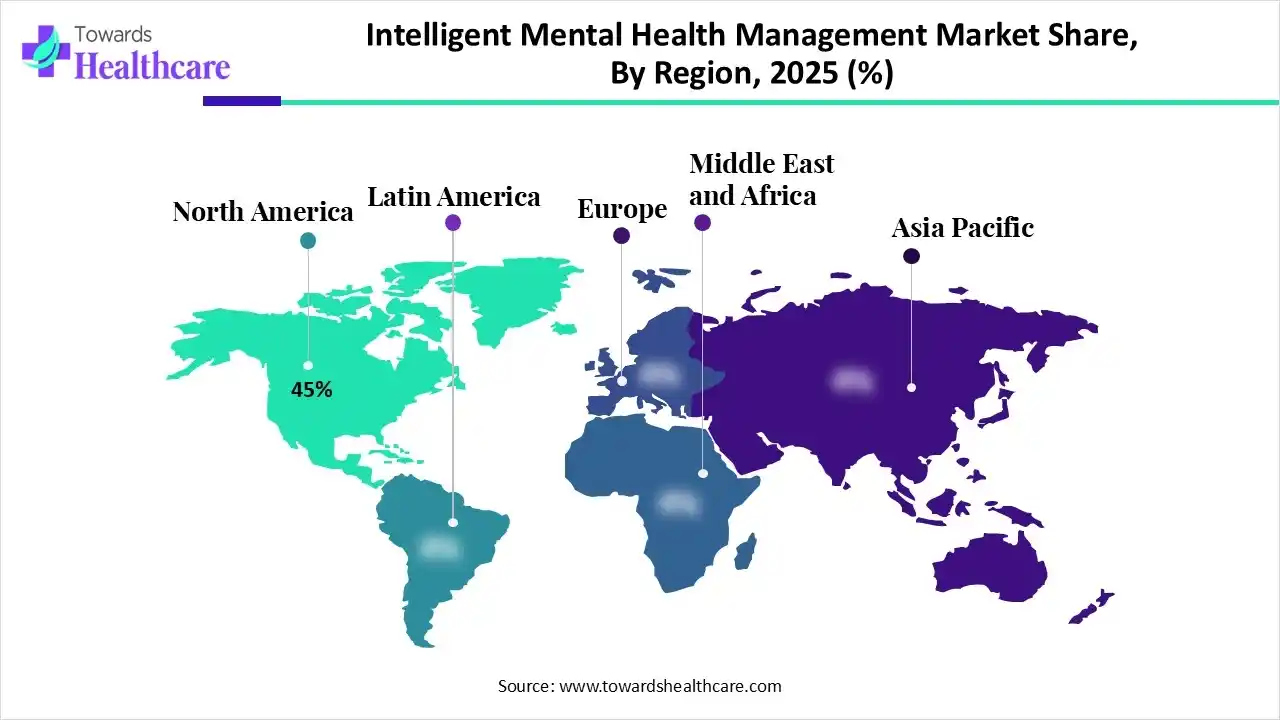
By capturing approximately 45% share, North America dominated the market in 2025. This is propelled by greater internet and smartphone use, also integrated with an advanced healthcare infrastructure, which encourages the application of digital mental health solutions. In the last few days, the NHS forced a new partnership to explore how AI could revolutionize mental health services, with expanded access to care and lower pressure on clinicians.
U.S. Market Trends
However, numerous leading firms in the U.S. are putting efforts into establishing advanced measures and tools in the intelligent mental health management market.
For instance,
Canada Accelerates Intelligent Mental Health Management Adoption
Canada is witnessing significant growth in the intelligent mental health management market due to increasing awareness of mental health disorders, rising adoption of digital healthcare solutions, and strong government support for mental health initiatives. Expanding telehealth services, growing integration of AI-powered mental health platforms, and increasing investments in digital health technologies are further driving market growth.
In the coming era, the Asia Pacific will expand rapidly, as various governments are empowering their healthcare system through substantial initiatives. Like, the Boao initiative advises a "Four-in-One" action plan by encompassing key digital innovations to reinforce smart health systems across the region. Whereas Alpha Global joined with LIO to launch an all-in-one platform for inpatient mental health care in Australia.
China Market Trends
Recently, China's National Health Commission (NHC) elected 2025–2027 as the "Years of Pediatric and Mental Health Services". This initiative fosters targeted screening, early intervention, and the use of technology-enabled services for children, adolescents, and other vulnerable groups.
India Gains Significant Share in the Intelligent Mental Health Management Market
India holds a significant share in the intelligent mental health management market due to its large population, rising prevalence of mental health disorders, expanding digital healthcare ecosystem, and increasing smartphone penetration. Government initiatives promoting digital health, growing adoption of AI-powered mental health platforms, improving internet accessibility, and increasing investments in health technology startups are further supporting market growth.
With a lucrative growth, Europe is transforming the intelligent mental health management market through the progression of integrated care solutions. This specifically comprises combining digital tools, like AI, apps, with traditional, united care pathways, which increase patient engagement and results. WHO/Europe introduced the Pan-European Mental Health Coalition, which integrates stakeholders to mainstream mental health and advocate for investment in quality mental health services, & also focuses on digital health.
UK Market Trends
Alongside, Innovate UK made an investment of over £3.6 million and £3.2 million through separate funding calls to speed up business-led projects evolving therapeutic XR solutions for mental health.
Germany Strengthens Its Intelligent Mental Health Management Market
Germany is witnessing notable growth in the intelligent mental health management market due to its advanced healthcare infrastructure, increasing adoption of digital health technologies, and growing awareness of mental health disorders. Strong government support for digital healthcare, rising investments in AI-based mental health solutions, expanding telepsychiatry services, and continuous innovation in digital therapeutics are further driving market growth.
| Company | Description |
| Ginger | This explores Headspace Care, a comprehensive, on-demand digital platform for mental health management. |
| Talkspace | It specializes in AI to create tailored "Talkcast" mini-podcasts for members, based on their therapy objectives, to empower insights between sessions. |
| Pear Therapeutics | A company unveiled prescription digital therapeutics (PDTs) for intelligent mental health management. |
| SilverCloud Health | This facilitates a comprehensive set of evidence-based, interactive programs embedded in Cognitive Behavioral Therapy (CBT). |
| Lyra Health | It specifically provides an AI-driven platform called Lyra Empower |
| Mindstrong Health | This implements a virtual mental health platform by integrating AI-enabled data analysis with personalized clinical care. |
| Spring Health | It mainly offers a global mental health solution for employers and health plans, using intelligent technology and AI to deliver "Precision Mental Healthcare." |
| AbleTo | It facilitates an intelligent, data-driven set of virtual mental health management solutions. |
| BioBeats | This specializes in combining wearable technology and an AI-driven mobile application to offer a preventative and tailored approach to mental well-being. |
| Calm | This company offers through the Calm Health platform by using evidence-based programs, data-driven personalization, and unification with healthcare systems. |
The rising requirement of collecting patients' sensitive data may raise crucial privacy issues and challenges of data breaches or misuse, as regulatory guidelines for these technologies are still evolving.
The use of AI may lead companies to legal risks if the tools are seen as offering medical advice without proper regulation or professional oversight.
By Component
By Technology
By Deployment Mode
By End User
By Application
By Region





Reviewed By
Aditi Shivarkar is a seasoned professional with over 14 years of experience in healthcare market research. As a content reviewer, Aditi ensures the quality and accuracy of all market insights and data presented by the research team.
Learn more about Aditi Shivarkar









