Pipeline Programs

CGT Companies Tracked

Manufacturing Facilities


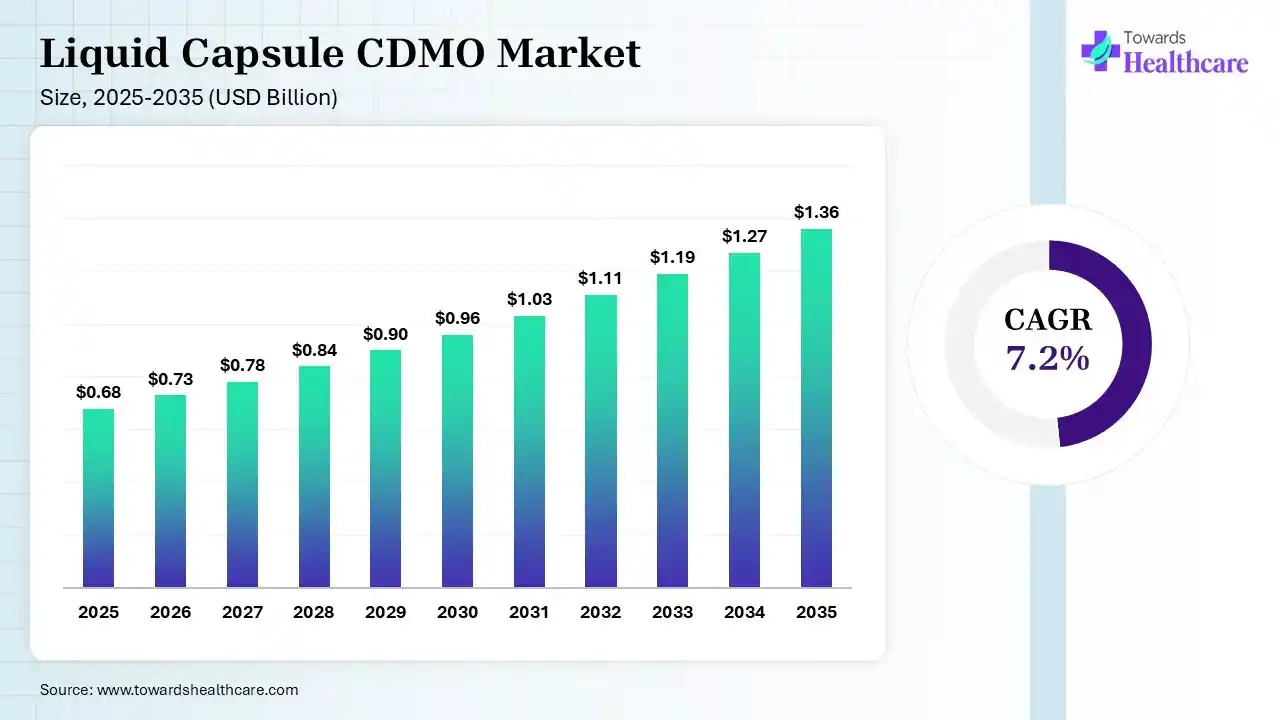
The liquid capsule CDMO market was valued at USD 0.68 billion in 2025 and is projected to reach USD 1.36 billion by 2035, growing at a CAGR of 7.2% during the 2026-2035 forecast period. Liquid-filled capsules are used to deliver poorly water-soluble drugs, oils, and lipid-based formulations. Pharmaceutical companies are increasingly considering these formats to improve solubility, absorption, and formulation stability where appropriate.
Liquid-filled capsules offer contract development and manufacturing organizations (CDMOs) opportunities to address several formulation challenges. These include delivering poorly water-soluble active pharmaceutical ingredients (APIs), handling lipid-based formulations for oxygen-sensitive compounds, manufacturing low-dose and high-potency products, and encapsulating complex nutraceutical ingredients. Some HPMC liquid-fill technologies support fill viscosities of approximately 100–2,000 centipoise (cP), with certain systems allowing fill temperatures of up to around 70°C. These capabilities depend on the specific capsule technology and formulation requirements.
North America currently holds a leading position in the capsule CDMO market, while Asia Pacific is experiencing faster growth in manufacturing capacity and outsourcing activity. Pharmaceuticals remain the primary application segment, supported by demand for specialized drug formulations. Nutraceutical outsourcing is also expanding as brands focus on premium products, clean-label formulations, and differentiated delivery formats. Prescription pharmaceutical products account for an estimated 62% of the liquid-filled hard capsule market, while nutraceutical applications are growing at a faster rate.
The study focuses specifically on liquid capsule CDMO services rather than the broader capsule market. It evaluates revenue across key service stages, including formulation development, clinical manufacturing, and commercial-scale production. This distinction provides a clearer view of outsourcing demand and the revenue opportunities available to specialized CDMOs.
Market segmentation is done on the basis of consumer type, formulation type, shell material, filling type, sealing technology, drug release profile, development phase, manufacturing capacity, and geography.
Gelatin continues to be the biggest shell material segment, holding 73.1% of the overall liquid-filled hard capsule market in 2025; however, HPMC will be experiencing significant growth due to vegetarian and vegan needs, low moisture content, and improved compatibility with moisture-sensitive formulations.
Oil fill accounts for 45.2% of the overall market; however, self-emulsifying systems, such as SEDDS/SMEDDS, are gaining significance as an increasingly fast-growing specialty use because of bioavailability limitations associated with poorly soluble compounds. Immediate-release products account for approximately half of the total demand, while modified-release products are growing faster. Mordor Intelligence
Thus, the CDMO market is splitting between high-volume nutraceutical manufacturing and high-value pharmaceutical formulation/technology development.
A key market driver is the growing number of poorly water-soluble drug molecules. Liquid-filled capsules can help keep these drugs dissolved or dispersed in lipid-based formulations, improving absorption and bioavailability where suitable.
Another driver is the development of oral alternatives to injectable drugs. Peptides, metabolic drugs, and other new formulations are increasing demand for specialized CDMOs with expertise in advanced drug delivery. These formulations can improve the feasibility of oral administration for certain challenging molecules.
However, manufacturers face challenges related to formulation stability, fill viscosity, capsule compatibility, leakage, oxygen sensitivity, process validation, and production limitations.
Liquid capsule CDMO pricing depends on more than the cost per capsule. It includes formulation development, testing, batch production, minimum order requirements, technology transfer, validation, packaging, and project management.
Costs are higher for complex projects involving poorly soluble or oxygen-sensitive ingredients, specialized delivery technologies, and extensive testing. Large production volumes can reduce the cost per unit by spreading fixed costs across more capsules.
The report therefore evaluates pricing at the project, batch, and per-unit levels rather than applying a single price per capsule across all projects.
Capsule filling involves special equipment, formulation control, sealing, and process validation. Capsule machinery can now operate at about 210,000 capsules per hour in very high-volume processes, the theoretical speed of the machinery doesn't equal the effective production capacity since viscosity, formulation preparation, and changeover limitations affect the process efficiency. Mordor Intelligence
The market supply is divided into two categories: high volume nutraceutical manufacturers and competent pharmaceutical contract manufacturers.
The value chain runs from API/active ingredient → excipients and lipid systems → capsule shell → formulation development → liquid preparation → filling → sealing → inspection → stability testing → packaging → regulatory release → commercial distribution.
The physical capsule does not necessarily capture the highest strategic value. It increasingly sits in formulation know-how, bioavailability enhancement, process robustness, regulatory documentation, and validated commercial supply.
Liquid-capsule technology is leaving filling technologies behind and entering the era of fusion sealing, oxygen-controlled filling, lipid-based technologies for enhanced biopharmaceutical performance, hot-melt and semi-solid fills, and capsules-in-capsules and beads-in-liquid delivery. Advanced HPMC technologies can handle fill temperatures of up to 70 degrees Celsius, and the burgeoning field of SEDDS/SMEDDS is forecast to grow at a 10 percent CAGR, compared to 5.6 percent of the overall market for liquid-filled hard capsules. Our research shows that this gap is even bigger for complex dosage form technologies.
We believe that complexity in formulation is becoming a more important differentiator than the speed of the filling technology. SEDDS/SMEDDS and other lipid-based technologies can surmount solubility challenges for hydrophilic APIs, while fusion sealing and oxygen-controlled filling can offer a robust solution to the vexing problem of leaking, thus enabling more sensitive formulations. At the same time, multi-compartment and modified-release technologies can offer discontinuous API-output profiles, which are not available from conventional liquid-filled capsules.
In our opinion, the most important strategic implication is the creation of a premium layer for technology among the liquid capsule CDMO service providers. Companies specializing in filling with HPMC compatibility, advanced seals, high-temperature fills, lipids, modified release, and multi-phase delivery will be able to work on more complex and lucrative projects and retain their clients via unique process know-how and technology transfer demands.
This research report offers a benchmarking of such technologies based on technology maturity, commercial adoption, application relevance, compatibility with formulations, development complexity, patents, manufacturing needs, and growth potential of the technology. The research also considers SEDDS/SMEDDS, hot melt fills, fusion and band sealing, multi-phase delivery, modified release, and formulation development technologies and analyzes them in the context of pharmaceutical and nutraceutical applications.
Pharmaceutical liquid-capsule CDMOs operate under strict regulatory requirements covering GMP compliance, process and analytical validation, stability testing, and change control. Nutraceutical manufacturing follows a separate regulatory framework, with growing demand for globally recognized quality certifications to support market access.
Sustainability is becoming an important consideration, driving interest in plant-based capsule materials such as HPMC and pullulan, reduced excipient use, and packaging solutions that minimize material consumption.
Pharmaceutical customers are highly interested in the aspects of bioavailability, ensuring proper functioning of the drug, and reproducibility, ensuring that the effects would be identical each time. Customers should also adhere to regulations, transfer technologies, and ensure the availability of the drug. Nutraceutical customers are primarily interested in product commercialization, visual attractiveness of their products, use of clean-label ingredients, dosage options, and quality consumer experience.
The most promising areas for the pharmaceutical industry are associated with poorly soluble medicines, low-dose medicines that are extremely potent, and programs ensuring longevity of products. In this area, the greatest opportunities include oils, herbal extracts, vitamins, minerals, sportsmen's products and weight management products.
There are four types of manufacturers in the industry, including integrated pharmaceutical CDMOs, capsule-technology specialists, nutraceutical formulation and manufacturing specialists, and regional contract manufacturers. Integrated pharmaceutical CDMOs can be defined by linking clinical development to commercial manufacturing. The latter is the main competitive advantage of this type of manufacturer. In turn, capsule-technology specialists specialize in creating the most relevant technologies for filling liquids and providing formulations appropriate for this. Additionally, these specialists are known for being able to give the most rapid development to the programs of development. Nutraceutical specialists provide turnkey formulation services and private-label manufacturing services.
The important structural transformation in the industry is linked to Lonza's decision to spin off the business into a standalone firm. The deal is expected to be completed by the end of 2026, and its total value is expected to reach 2.3 billion Swiss Francs. Based on the press release, Lonza is expected to get 1.7 billion Swiss Francs in cash compensation for selling the business, and 40% of the compensation will be in company stock. This shows the value of the technology and dosage form capabilities for capsule manufacturing, which is widely demanded in the industry.
| Company | Headquarters | Market Position | Core Strength | Major Applications/Segments | |
| 1 | ACG / Vantage Nutrition | India | Global specialist | Liquid-fill technology | Nutraceuticals, pharma |
| 2 | Lonza Capsules & Health Ingredients | Switzerland | Global leader | Capsule technology/CDMO | Pharma, nutraceutical |
| 3 | Catalent | US | Global CDMO | Liquid-in-hard-shell | Pharmaceuticals |
| 4 | Thermo Fisher Scientific | US | Global CDMO | Oral-dose development | Pharmaceuticals |
| 5 | Altasciences | Canada/US | Specialist CDMO | Clinical manufacturing | Pharma, biotech |
| 6 | Sirio Pharma | China | Global nutraceutical CDMO | Complex delivery formats | Nutraceuticals |
| 7 | Bright Pharma Caps | US | Specialist | Liquid hard capsules | Nutraceuticals |
| 8 | CPG Fusion Bioscience | US | Specialist | Liquid encapsulation | Nutraceuticals |
| 9 | LiquidCapsule Manufacturing | US | Specialist | Liquid hard-shell filling | OTC, nutraceutical |
| 10 | INNERCAP Technologies | US | Technology specialist | Multi-compartment capsules | Nutraceuticals |
| 11 | Healthcaps India | India | Regional specialist | Capsule manufacturing | Pharma, nutraceutical |
| 12 | Zeon Lifesciences | India | Regional CDMO | Nutraceutical manufacturing | Nutraceuticals |
| 13 | Fermentis Life Sciences | India | Regional specialist | Capsule formulations | Nutraceuticals |
| 14 | Suheung | South Korea | Capsule specialist | Capsule manufacturing | Pharma, nutraceutical |
| 15 | Sunil Healthcare | India | Capsule specialist | Hard capsules | Pharma, nutraceutical |
| 16 | Farmacapsulas | Colombia | Regional specialist | Capsule manufacturing | Pharma, nutraceutical |
| 17 | Lefancaps | US | Capsule specialist | Hard-shell technology | Pharma, nutraceutical |
| 18 | Nectar Lifesciences | India | Integrated pharma manufacturer | Oral dosage | Pharmaceuticals |
| 19 | PLX Pharma | US | Specialty pharma | Liquid-capsule products | Pharmaceuticals |
| 20 | Roxlor | US | Specialist | Contract manufacturing | Nutraceuticals/OTC |
The market for capsules filled with liquids is characterized as fragmented, involving many small local and specialized players. This means that a standard top five market share analysis underestimates the concentration level of premium pharmaceutical CDMOs.
The study provides market share estimates for the total service market for liquid capsules, pharmaceutical CDMO services, and nutraceutical CDMO services without distortions due to the combination of sales of capsule shells and outsourcing.
Benchmarking concentrates on market-specific KPIs such as liquid-fill capabilities, clinical manufacturing, commercial manufacturing, formulation capability, HPMC capability, high potency capabilities, modified release, geographical footprint, customer qualifications, technology platform, and manufacturing footprints.
The best integrated platforms include development and commercial manufacturing, while specialists usually perform better in terms of agility and custom formulation. This benchmarking does not create an internal index for each company, but classifies each one as Leader/Strong/Moderate/Emerging.
Portfolios include gelatin and HPMC capsules, oil-filled capsules, suspensions, semisolids, hot melts, beadlets, capsule-in-capsule technology, dual-release systems and delivery platforms.
The broad-based suppliers will gain from cross-selling, while specialized suppliers can gain from high value added in terms of complexity of formulations.
Technology benchmarking includes patents, proprietary sealing technologies, formulation platforms, bioavailability technologies, research and development spending, product launches, and commercialization.
One example of a technology platform is that of a company that has liquid-filled hard capsules, beadlets, dual-release systems, and multiparticulate delivery.
The map illustrates the mapping of suppliers to Rx products, OTC products, vitamins, sports nutrition, plants, fats, poorly soluble ingredients, and special release formulations.
Typically, individuals dealing with pharmaceuticals have an understanding of regulation and development of new drugs; individuals involved in vitamins and supplements have good skills regarding customized formulation, production, and market launch.
North America accounts for 35% of the demand for larger liquid-filled hard capsules, whereas Asia Pacific is anticipated to expand more than 9% per annum according to some forecasts.
The report features manufacturing locations, regulations, and compliance understanding in each region, proximity to customers, and opportunities to distribute products outside the U.S., Canada, Europe, India, China, Japan, South Korea, and Southeast Asia.
Requirements include liquid filler machines, formula development laboratories, sealing machines, scale-up testing, manufacturing at large scale, usage volumes, and growth plans.
The report highlights the discrepancy between the machine capacity and the real capacity after testing, which is important due to the fact that formulating changes, formula developing, quality control and stabilization may reduce significantly the capacity.
A direct competitor relationship analysis looks at how different pharmaceutical companies connect with each other. It also looks at how nutraceutical brands connect. This includes things like distributor networks, the help that is available, how formulas are supported, how packaging is put together, and where the main customers are located.
For customers, relationships can last for many years because it costs a lot to qualify a new supplier and move technology. For customers, the time to develop a new product can be shorter. These customers are also more sensitive to how fast things happen, the minimum order quantities, and the price.
Now there is a trend toward vertical integration. ACG has increased its ability to fill liquids by buying AquaCap. This has added another contract manufacturing position in North America. ACG already had a platform there. Vantage Nutrition has factories in India and North America. It has also started making complex liquid capsule forms.
The broader strategic direction is clear: companies are attempting to own more of the formulation → capsule technology → manufacturing → packaging → commercialization chain.
The most recent significant development is the proposed CHF 2.3 billion divestiture of the Capsules & Health Ingredients division, showcasing investor awareness of the independent value of capsule technology, production capabilities, and customer relationships.
This study analyzes acquisitions involving liquid-fill manufacturers, capsule technology developers, nutraceutical CDMOs, and oral-dose production facilities, looking at potential private equity consolidation and vertical strategic integration possibilities.
All profiles balance corporate size with liquid-capable relevance, including metrics such as revenues, markets, manufacturing locations, product offerings, liquid-fill capabilities, HPMC/gelatin capabilities, applications, geography, R&D, partnerships, M&A, capacity, and strategic weaknesses.
In cases of diversified organizations, the financial data provided distinguishes between total corporate revenue and the economically relevant revenue associated with liquid-capsule CDMO services.
The market is expected to develop around:
The key opportunities in the market of liquid capsule CDMO are the ones related to getting beyond the oil-based products. The most interesting white spots are those related to poorly soluble pharmaceutical APIs in SEDDS/SMEDDS in low-dose/high-potency formulations, in modified-release formulations, in oral peptide delivery in vegan HPMC capsules, and in multi-compartment delivery. According to the industry's viewpoint, SEDDS/SMEDDS is the fastest-growing technology area, where the growth is close to ten percent annually. HPMC-based liquid capsules market is also growing faster than the market itself. Our analysis proves that these segments of the liquid capsule CDMO market are of key importance since they combine formulating complexity with technical and qualification barriers, which allow skilled CDMOs to compete in terms of formulation development skills.
We believe that this has strategic implications in terms of how CDMOs should prioritize white spaces. We believe that building capabilities in platforms such as lipid-based formulations, HPMC, high-potency containment, advanced sealing, modified release, and clinical-to-commercial scale-up would provide greater differentiation than just adding conventional filling capacity. This is an especially interesting opportunity for companies wishing to shift upstream into formulation development and downstream into commercial manufacturing.
The complete report provides estimates of the opportunities in terms of incremental revenue pools, application-level compound annual growth rate, technology penetration rates, formulating challenges, capacity shortfalls, geographic demand-supply gaps, and customer adoptability. The report provides a ranking of the white spaces in terms of pharmaceutical vs nutraceutical applications, development stage, geography, and manufacturing need, thus identifying those areas in which the unmet capacity and capability create a commercially viable CDMO opportunity. The report also segregates high growth opportunities from those with strong technical merit but smaller revenue pool potential.
This foundational analysis can further be carried out in the form of a white space opportunity database, encompassing technology/application, formulation, customer, geography, market size estimates, CAGR, penetration, manufacturing requirements, capacity availability, technical difficulty, and opportunity category. Users are able to screen and benchmark opportunities according to application, technology, geography, and growth characteristics, providing an additional dimension to the strategic report on how future investments into CDMOs must be made.
The highest-value white spaces include poorly soluble pharmaceutical APIs, SEDDS/SMEDDS, low-dose/high-potency compounds, oral peptide delivery, modified-release liquid capsules, vegan HPMC formats, multi-compartment delivery, and regionalized manufacturing.
The analysis quantifies opportunities using incremental revenue pools, penetration gaps, application CAGR, and capacity shortages rather than simply identifying qualitative “growth areas.”
| Force | Intensity | Strategic Evidence |
| Supplier power | Medium | Specialized shell materials and formulation ingredients create dependency |
| Buyer power | Medium–High | Large pharma buyers negotiate aggressively but face switching costs |
| New entrants | Medium | Equipment is accessible, but GMP qualification and customer validation are barriers. |
| Substitutes | Medium–High | Softgels, tablets, powders, and liquid dosage forms compete directly |
| Rivalry | High | Specialists and integrated CDMOs compete for premium projects |
The market is assessed as Attractive, with the highest attractiveness concentrated in specialized pharmaceutical formulation and high-value nutraceutical applications.
The combination of approximately 6–8% market growth, formulation complexity, qualification barriers, recurring commercial supply, and increasing demand for bioavailability enhancement supports above-average strategic attractiveness. Commodity capsule manufacturing is less attractive because of price competition and lower differentiation.
In 2030-2035, the industry will move towards integrated formulation and manufacturing platforms, with HPMC/cellulose systems increasing their share, increased lipid delivery, and more modified-release products in the premium revenue segment.
The base scenario is based on mid-high single-digit CDMO growth, pharmaceutical outsourcing continuation, and nutraceuticals growth.
Up scenario includes faster oralization of complex molecules, stronger GLP-1/weight management oral development, fast SEDDS development, and outsourcing from emerging pharmaceutical companies.
Down scenario implies slow oral drug development, high regulatory costs, overcapacity, and substitution by softgels, tablets, or other delivery systems.
Winners of the future will be those companies that will be able to integrate formulation science + capsules + manufacturing validation + geographical redundancy + technology transfer, not unit manufacturing cost competition providers.
By Customer Type
By Shell Material
By Formulation / Fill Type
By Sealing Technology
By Release Profile
By Delivery Technology
By Development / Manufacturing Stage
By Manufacturing Scale
By Application
By CDMO Service
By Competitive Positioning
By Region


Principal Consultant
Payal Rabde is a Healthcare Market Research Analyst at Towards Healthcare Research & Consulting with 4+ years of experience in pharmaceuticals, biotechnology, medical devices, and life sciences.
Learn more about Payal Rabde

Reviewed By
Aditi Shivarkar is a seasoned professional with over 14 years of experience in healthcare market research. As a content reviewer, Aditi ensures the quality and accuracy of all market insights and data presented by the research team.
Learn more about Aditi Shivarkar