The global rapid sterility testing for cell and gene therapies market size is estimated at USD 495 million in 2025, driven by the increasing adoption of cell and gene therapies and the need for faster sterility testing. The market is expected to reach USD 573.71 million in 2026 due to rising regulatory compliance requirements, growing use of rapid microbiological methods, and expanding biopharmaceutical manufacturing. It is projected to reach USD 2164.91 million by 2035 as automation, advanced molecular testing technologies, and increasing investments in advanced therapies support market growth. The market is expected to grow at a CAGR of 15.9% during the forecast period (2026–2035). North America accounted for 42% of the market in 2025, supported by a strong biotechnology industry, stringent regulatory standards, and increasing cell and gene therapy development.
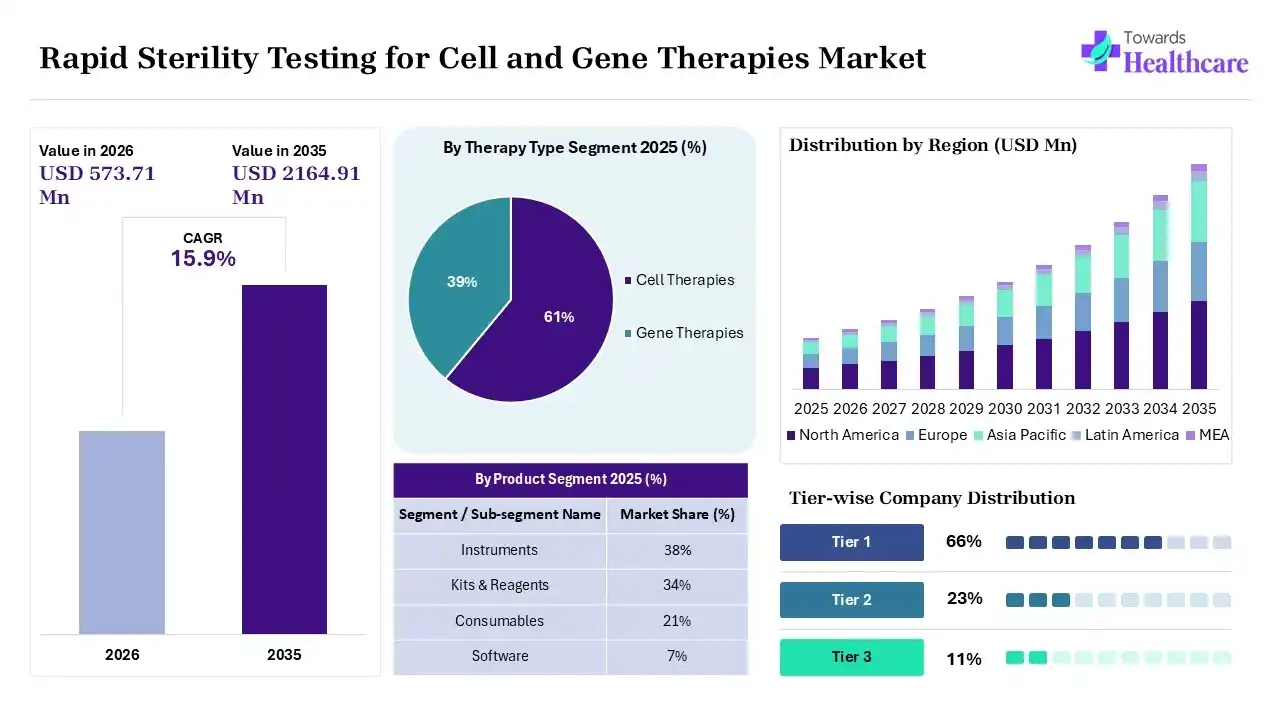
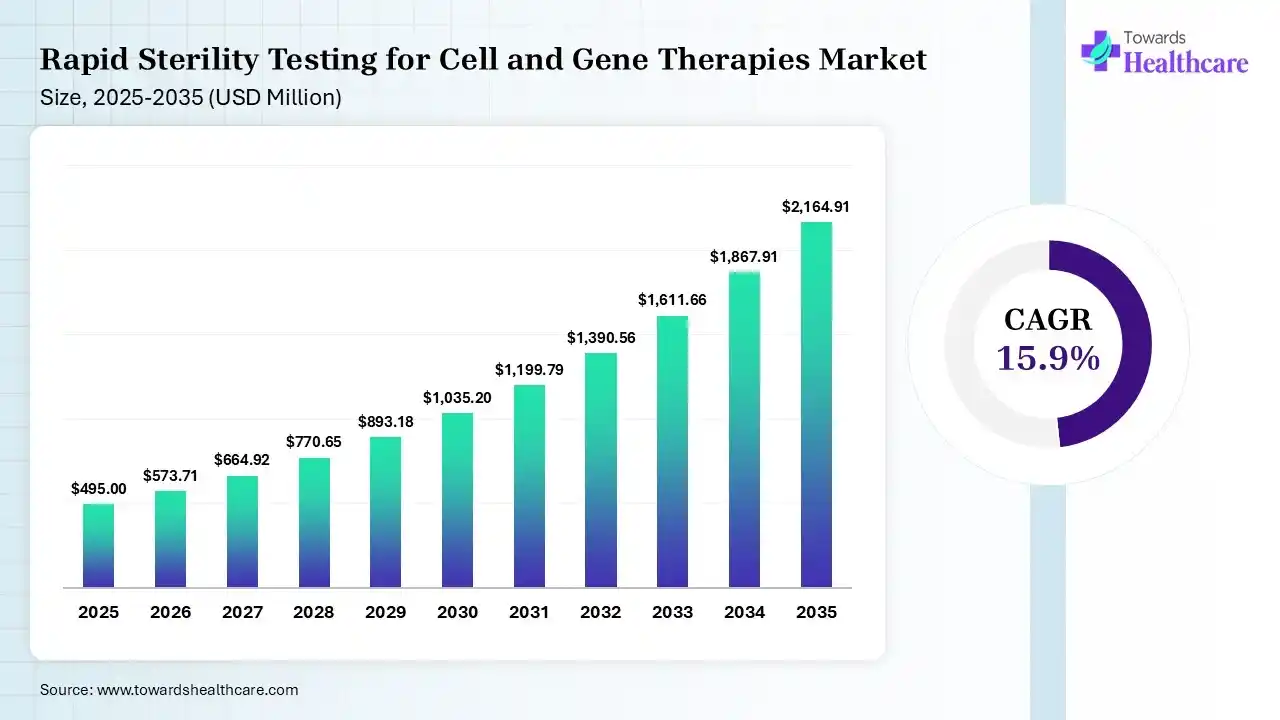
The rapid sterility testing for cell and gene therapies market focuses on technologies that rapidly detect microbial contamination in advanced therapy products, enabling faster product release than conventional sterility methods. These solutions support efficient manufacturing, strengthen quality assurance, ensure regulatory compliance, and enhance patient safety, making it a critical component of modern cell and gene therapy production.
Understanding Rapid Sterility in Cell and Gene Therapy Manufacturing
Rapid sterility testing supports cell and gene therapy manufacturing by detecting microbial contamination within hours instead of days, enabling faster product release. It enhances quality assurance through early contamination detection, reduces manufacturing delays and product loss, supports compliance with stringent regulatory requirements, and improves production efficiency. These capabilities are especially critical for time-sensitive, short shelf-life cell and gene therapy products.
Industry Evolution and Commercial Development
The shift from conventional sterility testing to rapid microbial detection technologies is being driven by the increasing need for faster and more efficient quality testing in cell and gene therapy manufacturing. Traditional methods often require several days to confirm sterility, whereas rapid techniques provide results in a much shorter time. Rising production of advanced therapies, greater focus on process efficiency, evolving regulatory expectations, and ongoing technological innovations are encouraging wider adoption of rapid sterility testing solutions.
Scope of the Market
The scope of this study covers rapid sterility testing solutions for cell and gene therapies, including products such as instruments, kits, and reagents, technologies including PCR-based testing and nucleic acid amplification technologies, applications across commercial manufacturing and research & development, end users such as biopharmaceutical companies and therapy developers, and regional analysis across the global market.
The market is evolving with the adoption of automated testing platforms, molecular detection technologies, and real-time microbial monitoring. Increasing demand for faster product release, growing advanced therapy manufacturing, regulatory focus on quality standards, and integration of artificial intelligence are driving innovation and reshaping testing workflows.
The increasing demand for rapid product release is driven by short shelf-life therapies, requiring faster sterility testing to minimize delays, maintain product quality, ensure patient safety, and improve manufacturing efficiency.
Growing implementation of automated testing platforms enhances scalability by streamlining workflows, reducing manual intervention, improving testing accuracy, and enabling efficient handling of increasing cell and gene therapy manufacturing volumes.
Manufacturing scale-up in cell and gene therapies is increasing demand for rapid microbial testing by requiring efficient contamination monitoring, faster quality checks, consistent production processes, and reliable sterility assurance at larger volumes.
Increasing integration of digital quality management systems, laboratory automation, and compliance software is improving data integrity, workflow efficiency, regulatory adherence, and real-time monitoring while reducing manual errors in rapid sterility testing operations.
Growing use of PCR, NAT, microfluidics, and advanced microbial detection technologies is improving rapid contamination detection, enhancing testing accuracy, reducing turnaround time, and supporting efficient cell and gene therapy manufacturing.
Technology Developers
Companies developing rapid sterility testing systems provide advanced instruments and platforms that enable faster microbial detection and improved quality control in cell and gene therapy manufacturing.
Reagent and Consumable Suppliers
Reagent and consumable suppliers support testing operations by providing essential materials required for accurate, reliable, and continuous sterility testing workflows.
Cell and Gene Therapy Manufacturers
Cell and gene therapy manufacturers generate market demand by adopting rapid sterility testing solutions to ensure product safety, regulatory compliance, and efficient production.
CDMOs and CROs
CDMOs and CROs strengthen the outsourcing ecosystem by offering specialized manufacturing, testing, and development services that require advanced sterility testing capabilities.
Regulatory Authorities
Regulatory authorities influence technology adoption by establishing quality standards, validation requirements, and compliance guidelines for sterility testing in advanced therapies.
This stage involves innovation and development of rapid sterility testing technologies, focusing on improving detection speed, accuracy, and reliability for advanced therapies.
Manufacturers produce rapid sterility testing instruments, kits, and reagents while ensuring product quality, scalability, and compliance with industry standards.
Distribution channels enable the availability of rapid sterility testing solutions to biopharmaceutical companies, research facilities, and contract service providers.
Laboratories integrate rapid sterility testing platforms into workflows to enhance contamination monitoring, testing efficiency, and operational performance.
Quality teams ensure testing processes meet regulatory guidelines, validation requirements, and safety standards throughout therapy manufacturing.
Biopharmaceutical companies and research organizations adopt these technologies to improve product safety, accelerate release timelines, and optimize manufacturing processes.
Molecular Detection Technologies: Advanced molecular detection technologies enable faster, highly sensitive microbial identification, improving sterility testing efficiency and supporting timely product release.
ATP Bioluminescence Platforms: ATP bioluminescence platforms provide rapid contamination detection by measuring microbial metabolic activity, reducing testing time and improving laboratory productivity.
Flow Cytometry Innovations: Advanced flow cytometry technologies enable rapid microbial analysis with greater accuracy, supporting efficient sterility testing and process monitoring.
Microfluidics-Based Testing: Microfluidics-based platforms use small sample volumes to deliver rapid, high-throughput microbial detection with improved operational efficiency.
Digital Laboratory Automation: Digital automation enhances laboratory workflows by improving data accuracy, reducing manual errors, and supporting regulatory compliance.
Future Technology Pipeline: Future innovations, including AI-powered analytics, smart automation, and next-generation molecular diagnostics, are expected to further strengthen rapid sterility testing capabilities.
The regulatory requirement environment significantly influences the adoption of rapid sterility technologies for cell and gene therapies. FDA expectations encourage the use of scientifically validated rapid microbial detection methods, while EMA requirements emphasize product quality, safety, and manufacturing consistency. USP <71> provides the benchmark for sterility testing and supports the adoption of alternative rapid methods when appropriately validated. GMP compliance standards require robust quality systems and controlled manufacturing processes, whereas validating and qualification requirements ensure that testing platforms consistently deliver accurate, reliable, and reproducible results before routine commercial implementation.
Raw Material Supply: A reliable supply of high-quality raw materials and critical components is essential for uninterrupted production of rapid sterility testing products.
Instrument Manufacturing Landscape: Manufacturers are expanding production capacity and adopting advanced manufacturing technologies to meet the growing demand for rapid sterility testing systems.
Distribution Channels: Well-established distribution networks ensure the efficient delivery of instruments, reagents, and consumables to end users across global markets.
Supply Chain Risks: Raw material shortages, logistics disruptions, and supplier dependency can affect production continuity and timely product availability.
Localization Trends: Companies are increasingly localizing manufacturing and supply networks to improve supply chain resilience, reduce delivery times, and strengthen regional market access.
Instrument pricing is influenced by automation capabilities, detection technology, system throughput, and overall performance requirements.
Prices of reagents and consumables vary based on test complexity, product quality, usage volume, and supplier agreements.
Service and validation costs depend on installation, system qualification, maintenance, training, and regulatory validation requirements.
Pricing is affected by technological advancements, manufacturing costs, regulatory compliance, product customization, and supply chain dynamics.
Key Purchasing Criteria: Purchasing decisions are primarily influenced by technology compatibility, scalability, validation support, ease of integration, and regulatory acceptance.
Vendor Selection Process: End users assess vendors based on manufacturing capabilities, product consistency, implementation expertise, supply reliability, and customer support.
Cost versus Performance Evaluation: Organizations compare overall ownership costs with operational benefits, testing efficiency, system scalability, and long-term productivity before procurement.
Long-Term Service Considerations: Customers prioritize vendors offering dependable technical assistance, preventive maintenance, software upgrades, user training, and lifecycle support to maximize system performance.
Biopharmaceutical Companies:
Biopharmaceutical companies are the primary adopters, selecting rapid sterility testing solutions to support large-scale manufacturing, regulatory compliance, and faster product release.
Cell Therapy Developers:
Cell therapy developers adopt rapid sterility testing to enable timely contamination detection during product development and manufacturing.
Gene Therapy Developers:
Gene therapy developers increasingly implement rapid sterility testing to support complex manufacturing workflows and accelerate clinical and commercial production.
CDMOs:
CDMOs invest in rapid sterility testing platforms to provide flexible, compliant, and high-quality manufacturing services for multiple clients.
CROs:
CROs utilize rapid sterility testing technologies to deliver efficient analytical testing and support research and clinical development programs.
Academic Institutions:
Academic institutions adopt rapid sterility testing systems to strengthen translational research, process development, and advanced therapy innovation.
Hospital-Based Manufacturing Centers:
Hospital-based manufacturing centers implement rapid sterility testing to support point-of-care production and ensure the safe release of personalized cell and gene therapies.
Venture Capital Trends: Venture capital funding is supporting the development and commercialization of innovative rapid sterility testing technologies for advanced therapies.
Strategic Investments: Companies are making strategic investments to expand manufacturing capacity, strengthen technology portfolios, and accelerate product innovation.
Government Funding: Government funding is encouraging research, infrastructure development, and adoption of advanced sterility testing solutions in the life sciences sector.
Mergers and Acquisitions: Mergers and acquisitions are enabling companies to enhance technological capabilities, broaden product offerings, and strengthen their market presence.
Partnership Activity: Strategic partnerships between technology providers, biopharmaceutical companies, and research organizations are accelerating innovation and expanding the adoption of rapid sterility testing solutions.
Patent filings indicate the pace of technological advancement and ongoing research in rapid sterility testing solutions for advanced therapies.
Intellectual property ownership highlights organizations with exclusive rights to key testing technologies, methods, and platform designs.
Innovation is expanding toward integrated digital platforms, miniaturized testing systems, and novel microbial detection approaches.
The patent landscape reflects the level of competition, technology differentiation, and strategic positioning among industry participants.
Clinical Manufacturing Trends:
Clinical manufacturing is expanding with increasing production of investigational cell and gene therapies, driving demand for rapid sterility testing throughout development.
Commercial Manufacturing Expansion
Commercial manufacturing growth is increasing the adoption of rapid sterility testing to support larger production volumes and faster product release.
Facility Capacity Growth
Manufacturers are expanding production facilities and laboratory capacity to meet the rising demand for advanced therapy manufacturing.
Manufacturing Bottlenecks
Production challenges such as complex workflows, limited processing capacity, and quality control requirements can affect manufacturing efficiency and product availability.
| Table | Scope |
| Market Size in 2026 | USD 573.71 Million |
| Projected Market Size in 2035 | USD 2164.91 Million |
| CAGR (2026 - 2035) | 15.9% |
| Leading Region | North America by 42% |
| Historical Data | 2020 - 2023 |
| Base Year | 2025 |
| Forecast Period | 2026 - 2035 |
| Measurable Values | USD Millions/Units/Volume |
| Market Segmentation | By Product, By Technology, By Test Type, By Therapy, By Application, By End User, By Region |
| Top Key Players | bioMérieux, Rapid Micro Biosystems, Charles River Laboratories, Merck KGaA, Sartorius AG |
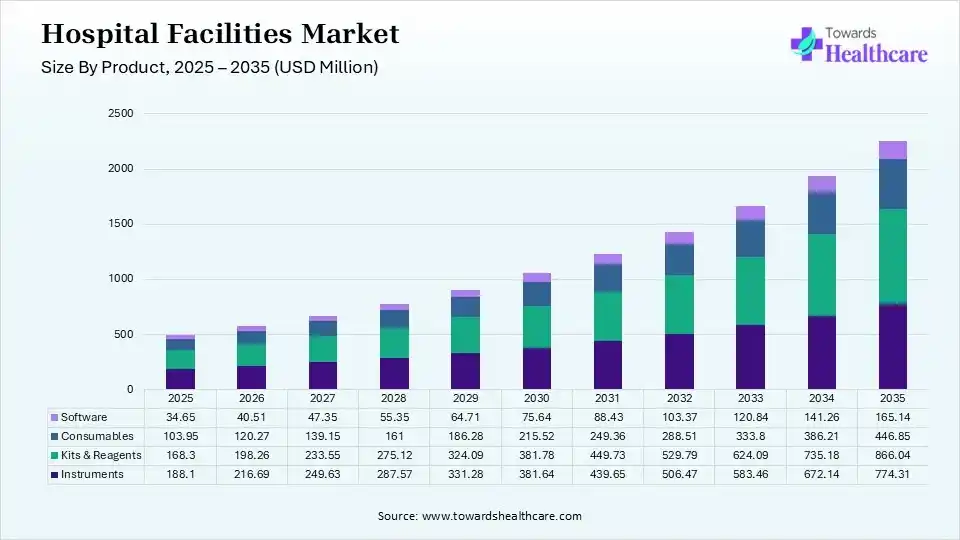
| Segments | Shares % |
| Instruments | 38% |
| Kits & Reagents | 34% |
| Consumables | 21% |
| Software | 7% |
Instruments Segment Leads Through Advanced Automation
The instruments segment dominated the market with a share of 38% in 2025, due to increasing adoption of automated sterility testing systems, high demand for accurate and rapid microbial detection, and expanding biopharmaceutical manufacturing. Their ability to improve workflow efficiency, reduce turnaround time, and support regulatory compliance strengthened segment leadership.
The kits & reagents segment held the second-largest share of 34% in 2025 and is expected to grow at the fastest CAGR in the market during the forecast period, due to increasing demand for consumables in routine sterility testing. Growing adoption of rapid microbiological methods, expanding cell and gene therapy manufacturing, and the need for consistent, high-throughput testing are driving segment growth.
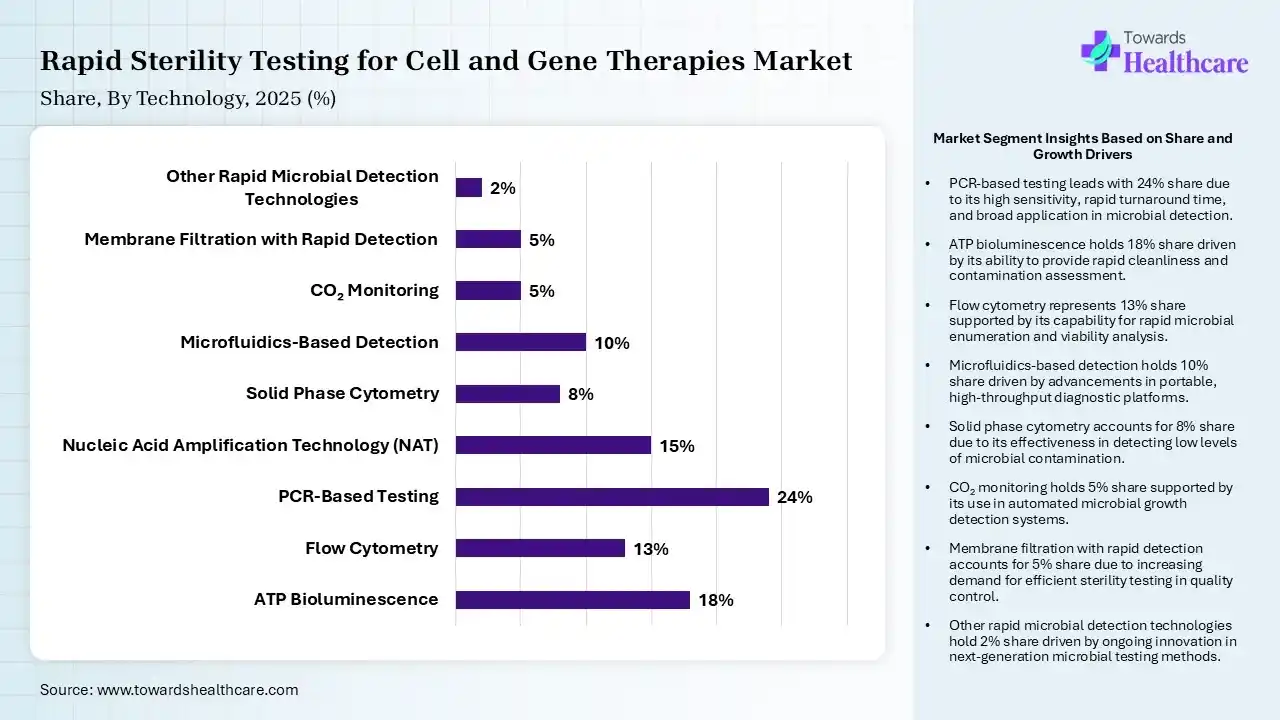
| Segments | Shares % |
| ATP Bioluminescence | 18% |
| Flow Cytometry | 13% |
| PCR-Based Testing | 24% |
| Nucleic Acid Amplification Technology (NAT) | 15% |
| Solid Phase Cytometry | 8% |
| Microfluidics-Based Detection | 10% |
| CO₂ Monitoring | 5% |
| Membrane Filtration with Rapid Detection | 5% |
| Other Rapid Microbial Detection Technologies | 2% |
PCR-based Testing Leads Through Speed and Accuracy
The PCR-based testing segment held a dominant share of 24% of rapid sterility testing for cell and gene therapies market in 2025, due to its high sensitivity, rapid detection of microbial contamination, and accurate results. Its widespread adoption in biopharmaceutical manufacturing, ability to reduce product release time, and support for regulatory compliance strengthened its position as the leading technology segment.
The nucleic acid amplification technology (NAT) segment held a 15% share in 2025 and is expected to grow at the fastest CAGR in the market during the forecast period due to its high sensitivity, rapid pathogen detection, and ability to identify low levels of microbial contamination. Increasing adoption in cell and gene therapy manufacturing, growing regulatory focus on product safety, and advances in molecular diagnostics are driving segment growth.
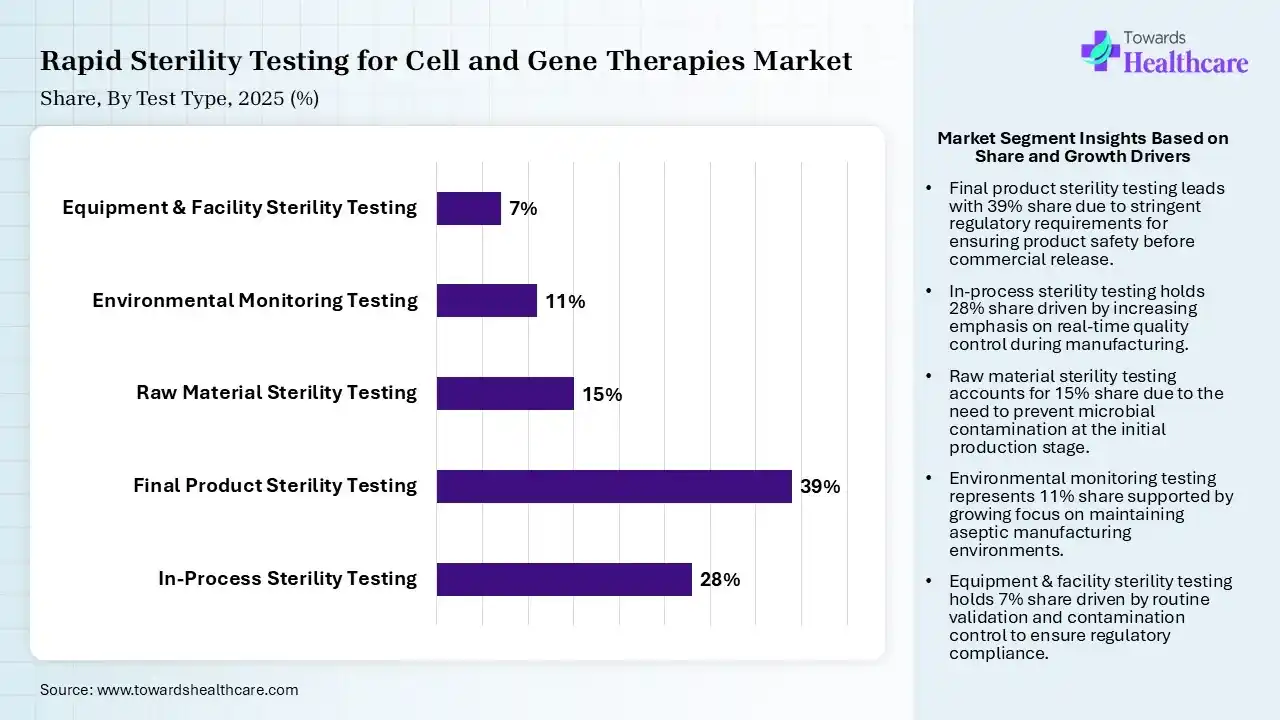
| Segments | Shares % |
| In-Process Sterility Testing | 28% |
| Final Product Sterility Testing | 39% |
| Raw Material Sterility Testing | 15% |
| Environmental Monitoring Testing | 11% |
| Equipment & Facility Sterility Testing | 7% |
In-Process Sterility Leads Through Early Quality Control
The in-process sterility testing segment led the market with a share of 28% in 2025, due to its ability to detect microbial contamination during manufacturing, reducing product loss and production delays. Increasing emphasis on quality assurance, regulatory compliance, and real-time process monitoring has driven its widespread adoption across biopharmaceutical manufacturing facilities.
The final product sterility testing segment held the second-largest share of 39% in 2025 and is expected to grow at the fastest CAGR in the market during the forecast period, due to increasing regulatory requirements for product release and patient safety. Growing commercialization of cell and gene therapies, rising demand fir rapid batch release, and wide adoption of advanced sterility testing technologies are driving segment growth.
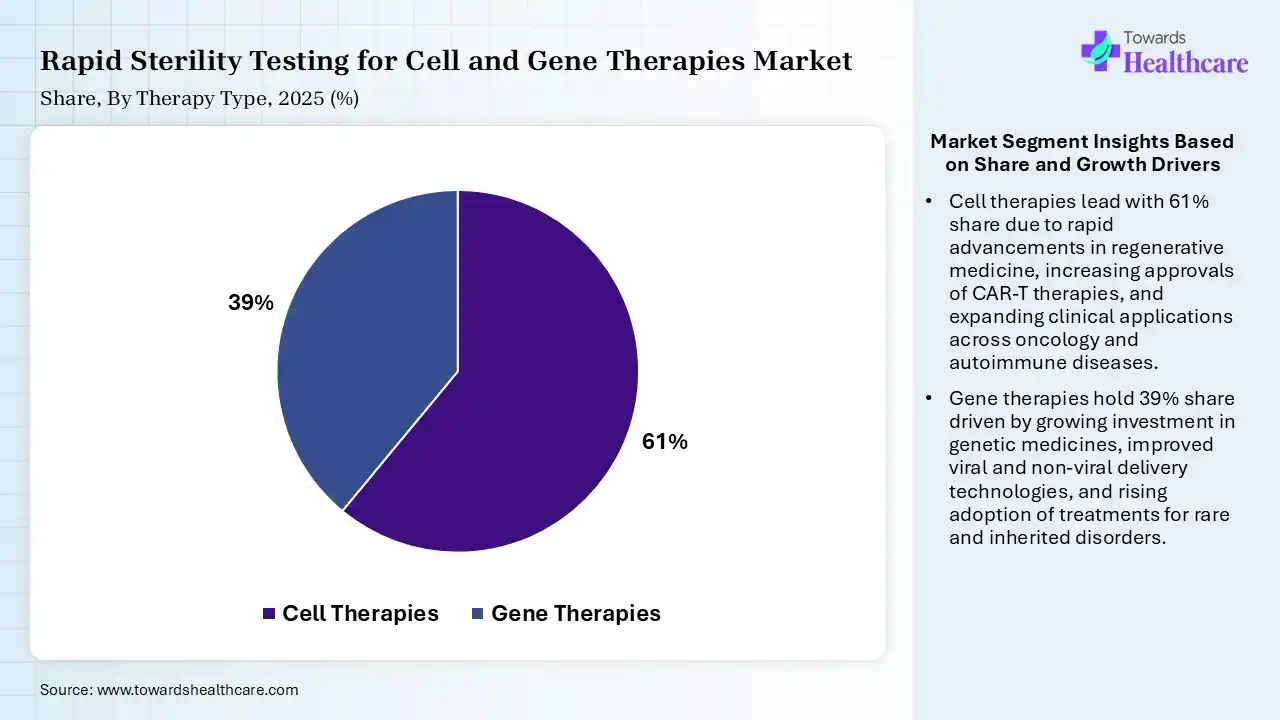
| Segments | Shares % |
| Cell Therapies | 61% |
| Gene Therapies | 39% |
Cell Therapies Lead Through Expanding Clinical Adoption
The cell therapies segment dominated the rapid sterility testing for cell and gene therapies market with a share of 61% in 2025, due to increasing commercialization of cell-based therapies, growing clinical trial activity, and rising demand for stringent quality control. Clinical trial activity and rising demand for stringent quality control. High manufacturing complexities, greater contamination risks, and the need for rapid product release have accelerated the adoption of advanced sterility testing solutions.
The gene therapies segment held the second-largest share of 39% in 2025 and is expected to grow at the fastest CAGR in the market during the forecast period, due to increasing approvals of gene-based treatments, growing clinical trial activity, and rising investments in advanced therapeutics. Higher demand for rapid product release, stringent sterility requirements, and expanding manufacturing capabilities are further driving the adoption of rapid sterility testing solutions.
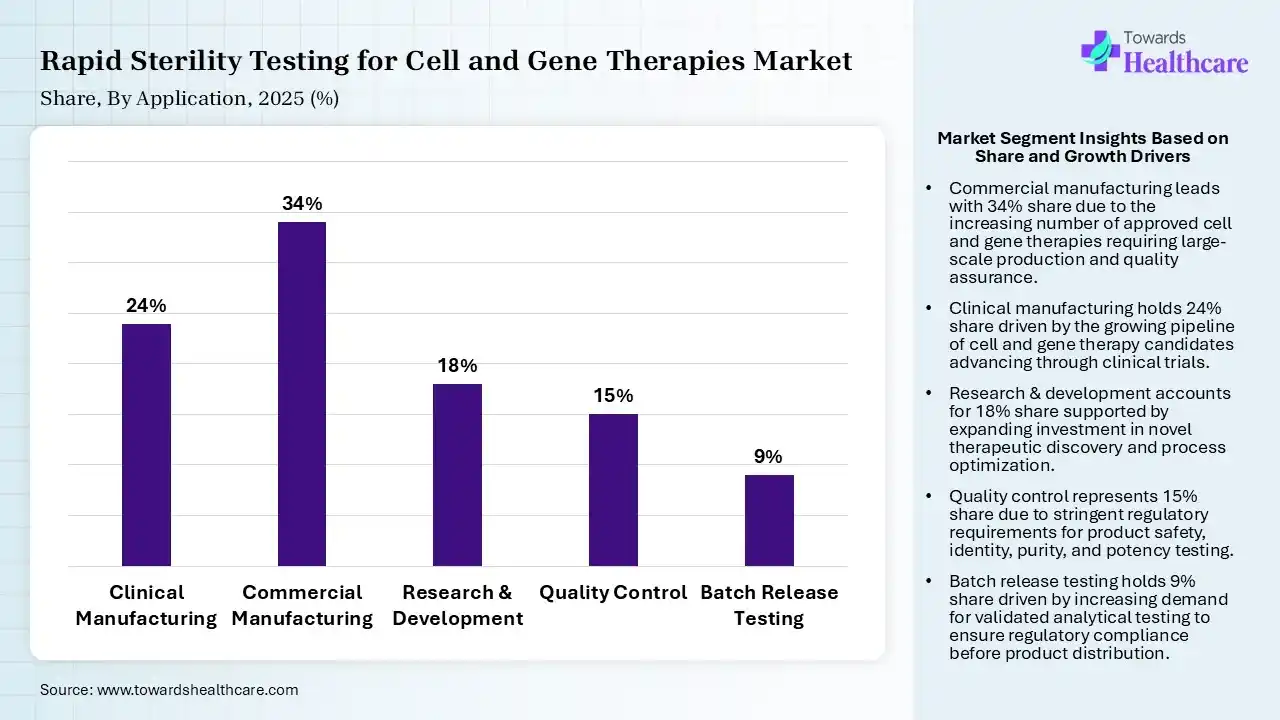
| Segments | Shares % |
| Clinical Manufacturing | 24% |
| Commercial Manufacturing | 34% |
| Research & Development | 18% |
| Quality Control | 15% |
| Batch Release Testing | 9% |
Commercial Manufacturing Leads Through Rising Product Commercialization
The commercial manufacturing segment held a dominant share of 34% in 2025, due to increasing commercialization of approved cell and gene therapies, rising production volumes, and stringent regulatory requirements. Growing demand for rapid batch release, efficient quality control, and reliable sterility testing to ensure product safety and manufacturing efficiency strengthened the segment’s market leadership.
The research & development held a 18% share in 2025 and is expected to grow at the fastest CAGR in the market during the forecast period, due to increasing investment in cell and gene therapy research, rising preclinical and clinical studies, and expanding biotechnology innovation. Growing demand for rapid sterility during product development, factor validation processes, and continuous advancements in testing technologies are driving segment growth.
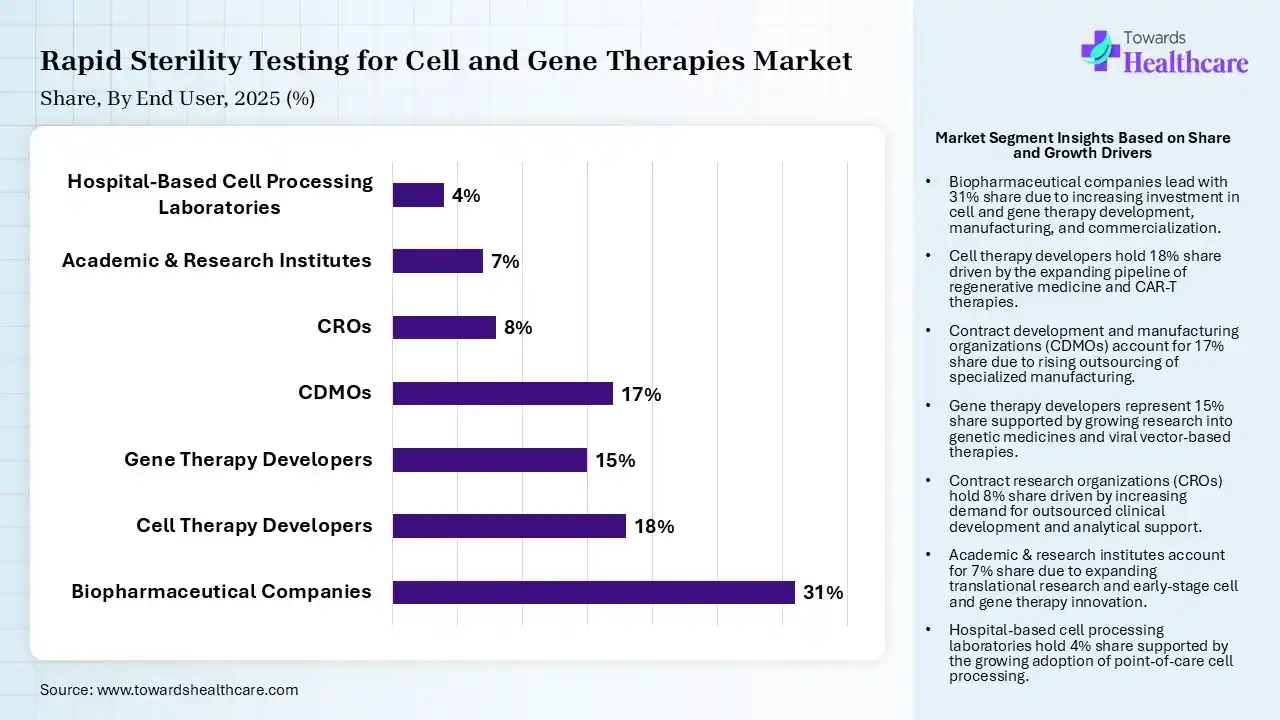
| Segments | Shares % |
| Biopharmaceutical Companies | 31% |
| Cell Therapy Developers | 18% |
| Gene Therapy Developers | 15% |
| CDMOs | 17% |
| CROs | 8% |
| Academic & Research Institutes | 7% |
| Hospital-Based Cell Processing Laboratories | 4% |
Biopharmaceutical Companies Drive Market Leadership
The biopharmaceutical companies segment led the market with a share of 31% in 2025, due to increasing production of advanced therapies, stringent sterility and regulatory requirements, and rising investment in biopharmaceutical manufacturing. Growing demand for rapid product release, enhanced quality control, and adoption of advanced sterility testing technologies further strengthened the segment’s dominant position.
The gene therapy developers segment held a 15% share in 2025 and is expected to grow at the fastest CAGR in the market during the forecast period, due to increasing investment in gene therapy pipelines, rising clinical trials activity, and expanding product development programs. Growing demand for rapid sterility testing to ensure product safety, accelerate regulatory approvals, and support faster commercialization is expected to drive segment growth.
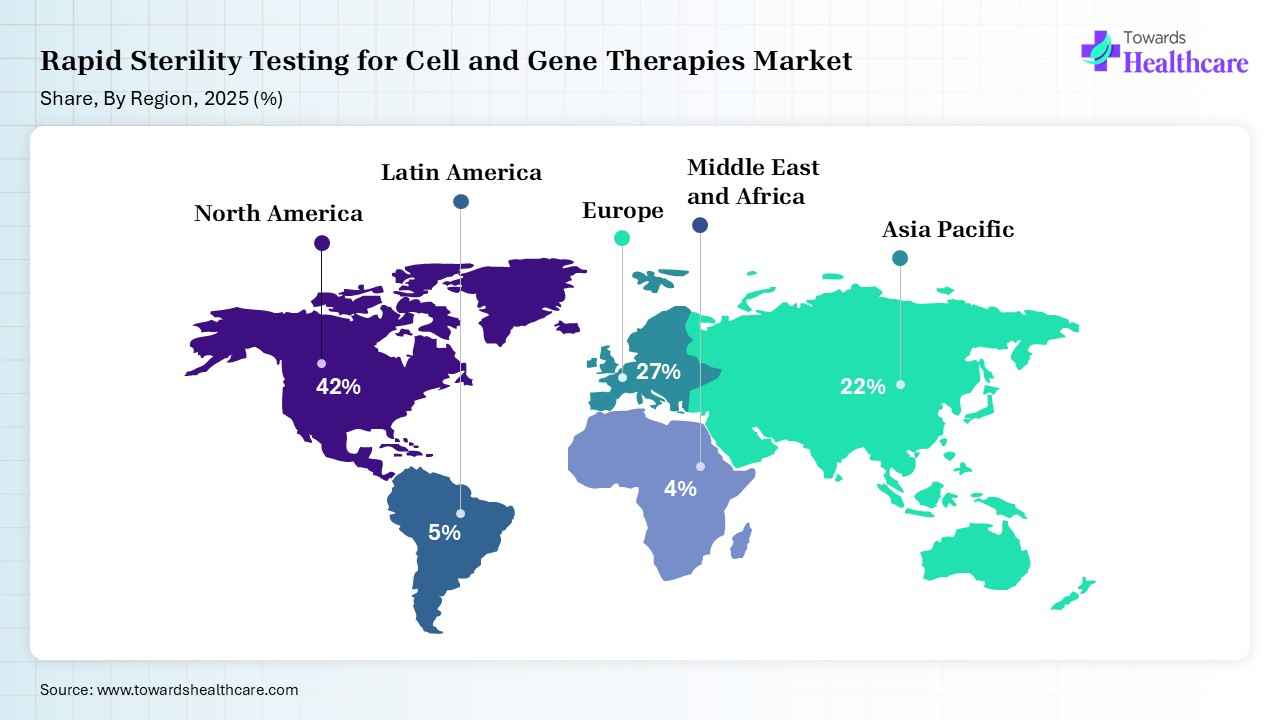
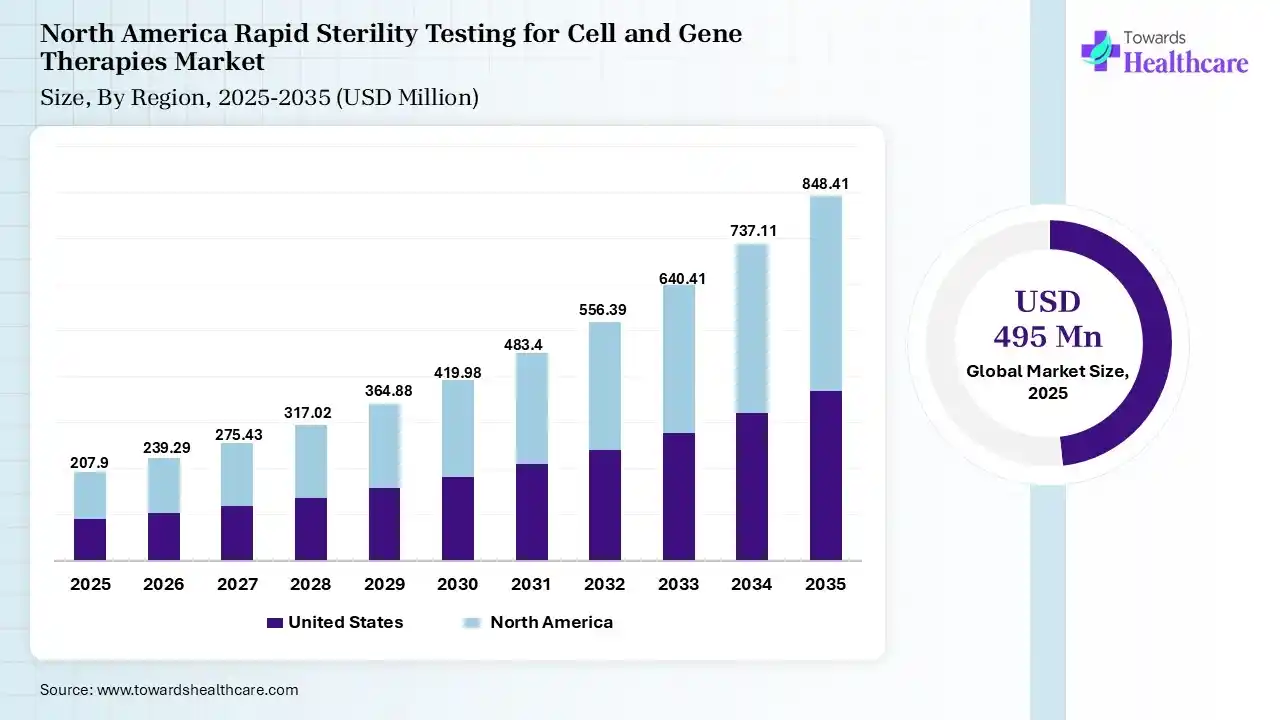
North America dominates the rapid sterility testing for cell and gene therapies market with a share of 42% in 2025, due to its strong biotechnology and biopharmaceutical ecosystems, high number of clinical trials, and increasing commercialization of advanced therapies. Stringent regulatory standards for sterility assurance, widespread adoption of rapid microbiological methods, substantial R&D investments, and the presence of leading cell and gene therapy developers and CDMOs continue to strengthen the region’s market leadership.
U.S. Market Trends
U.S. held a 86% share of the rapid sterility testing for cell and gene therapies market in 2025. The country accounts for over 50% of global cell and gene therapy clinical trials and has more than 2000 active regenerative medicine clinical studies, driving demand for rapid sterility testing. Strong FDA regulatory oversight, substantial biopharmaceutical R&D investment, advanced manufacturing facilities, and the presence of leading biotechnology companies and CDMOs continue to reinforce the country’s market leadership.
Canada Market Trends
Canada held a 210% share in the market in 2025 and is expected to grow with the highest CAGR during the studied years, due to expanding investments in regenerative medicine and biomanufacturing. The country has invested over CAD 2 billion in life sciences and biomanufacturing initiatives in recent years, strengthening domestic manufacturing capabilities. Growing clinical trial activity, increasing collaboration between academia and biotechnology companies, supportive government funding, and rising adoption of rapid microbiological testing technologies are expected to accelerate market growth.
Europe held a 27% share of the rapid sterility testing for cell and gene therapies market and is expected to grow significantly during the forecast period, driven by increasing investments in advanced therapy medicinal products (ATMPs), expanding biopharmaceutical manufacturing, and stringent regulatory standards. The region has over 500 active ATMP clinical trials, while the European Medicines Agency (EMA) continues to support innovation through accelerated regulatory pathways. Rising adoption of rapid microbiological methods and growing CDMO capabilities are expected to further fuel market growth.
Germany Market Trends
Germany held a 28% share in the rapid sterility testing for cell and gene therapies market in 2025, due to its well-established biopharmaceutical manufacturing sector, strong biotechnology research, and expanding advanced therapy pipelines. The country accounts for over 25% of Europe’s biotechnology industry revenue and hosts numerous GMP-certified manufacturing facilities for ATMPs. Increasing investments in regenerative medicines, stringent quality standards, growing adoption of rapid microbiological methods, and collaborations between research institutes and industry continue to strengthen Germany’s market leadership.
UK Market Trends
The UK held 24% share in the market in 2025 and is expected to witness the fastest growth with a CAGR over the forecast period, due to expanding cell and gene therapy research, increasing investments in biopharmaceutical manufacturing, and supportive regulatory initiatives. Growing adoption of rapid microbiological testing methods, rising collaborations between biotechnology companies and research institutions, and increasing demand for faster product release and high-quality sterility assurance are expected to accelerate market growth.
Asia Pacific held a 22% share in 2025 and is expected to grow at the fastest CAGR in the market during the forecast period, due to expanding biopharmaceutical manufacturing, increasing investments in cell and gene therapy research, and growing clinical trials activity. Rising government support for biotechnology, improving healthcare infrastructure, increasing adoption of rapid microbiological testing methods, and the expansion of CDMO capabilities are expected to accelerate regional market growth
China Market Trends
China held a 35% share of the rapid sterility testing for cell and gene therapies market in 2025, due to its rapidly expanding biopharmaceutical manufacturing sectors, increasing cell and gene therapy research, and strong government support for biotechnology innovation. Growing investments in advanced therapy production, rising clinical trial activity, expanding CDMO capabilities, and increasing adoption of rapid microbiological testing technologies are driving market growth. The country’s improving regulatory framework and large biotechnology ecosystems further strengthen its regional leadership.
India Market Trends
India held a 15% share in the market in 2025 and is expected to expand rapidly with a CAGR in the coming years, due to expanding biopharmaceutical manufacturing, rising biotechnology investments, and increasing cell and gene therapy research. Growing clinical trials activity, improving regulatory support, wider adoption of rapid microbiological testing technologies, and expanding CDMO capabilities are strengthening the country’s position as a key destination for advanced therapy development and manufacturing.
Latin America held a 5% share in the rapid sterility testing for cell and gene therapies market in 2025 and is expected to show lucrative growth during the forecast period, due to expanding biotechnology research, increasing investments in biopharmaceutical manufacturing, and growing clinical trial activity. Rising adoption of advanced quality control technologies, improving healthcare infrastructure, supportive regulatory initiatives, and increasing collaborations between global biopharmaceutical companies and regional manufacturers are expected to drive market growth during the forecast period.
Brazil Market Trends
Brazil held a 48% share of the rapid sterility testing for cell and gene therapies market in 2025, due to its well-established biopharmaceutical industry, growing biotechnology research, and expanding clinical trials activity. Increasing investment in advanced therapy manufacturing, rising adoption of rapid microbiological testing methods, supportive regulatory initiatives, and strengthening partnerships between healthcare institutions and biotechnology companies continue to drive demand for rapid sterility testing solutions across the country.
Argentina Market Trends
Argentina held a 22% share in the market in 2025, due to its well-established biopharmaceutical industry, growing biotechnology research, and expanding clinical trials activity. Increasing investments in advanced therapy manufacturing, rising adoption of rapid microbiological testing methods, supportive regulatory initiatives, and strengthening partnerships between healthcare institutions and biotechnology companies continue to drive demand for rapid sterility testing solutions across the country.
The Middle East & Africa held a 4% share in the regulatory consulting outsourcing services market in 2025 and is expected to show notable growth during the forecast period, due to increasing investments in biotechnology, expanding healthcare infrastructure, and rising clinical research activities. Growing adoption of advanced biopharmaceutical manufacturing, supportive government initiatives, and increasing demand for rapid sterility testing solutions are expected to accelerate regional market growth during the forecast period.
Saudi Arabia Market Trends
Saudi Arabia held a 36% share of the rapid sterility testing for cell and gene therapies market in 2025, due to substantial investments in biotechnology, expanding biopharmaceutical manufacturing, and ongoing healthcare modernization. Increasing adoption of advanced laboratory technologies, growing clinical research activities, supportive government initiatives, and rising demand for high-quality sterility testing in advanced therapies continue to strengthen the country’s leading position in the regional market.
UAE Market Trends
The UAE held a 30% share in the market in 2025, due to increasing investments in biotechnology, expanding biopharmaceutical research, and strong government support for healthcare innovation. Growing adoption of advanced laboratory technologies, rising clinical research activities, improving regulatory frameworks, and expanding partnerships with global life science companies are expected to accelerate market growth during the forecast period.
The market structure is characterized by the presence of established global companies alongside emerging technology innovators competing across advanced sterility testing solutions.
Companies are evaluated based on technology capabilities, product performance, innovation, regulatory expertise, and global presence.
Market participants strengthen their position by expanding technology capabilities, application expertise, and customer reach.
Companies differentiate themselves through diverse product portfolios covering instruments, reagents, software, and integrated sterility testing solutions.
Market players are implementing growth strategies focused on innovation, geographic expansion, manufacturing enhancements, and digital transformation.
Recent developments highlight continuous advancements in rapid sterility testing technologies, automation, and product enhancement.
Mergers and acquisitions are enhancing companies to strengthen technological expertise, expand capabilities, and improve competitive positioning.
Strategic collaborations are accelerating technology development, expanding commercial reach, and supporting integrated testing solutions.
New product launches are introducing advanced sterility testing platforms with improved speed, accuracy, automation, and workflow efficiency.
Company Overview- Develops rapid microbiological testing solutions and automated sterility testing technologies for pharmaceutical and cell and gene therapy manufacturing.
Product Portfolio- BacT/ALERT® 3D, BacT/ALERT® VIRTUO®, culture media, microbial identification systems, and quality control solutions.
Geographic Presence- Operates across North America, Europe, Asia-Pacific, Latin America, and the Middle East & Africa.
Manufacturing Capabilities- Produces automated microbial detection instruments, culture media, reagents, and laboratory automation systems through global manufacturing facilities.
Recent Strategic Developments- Continued expanding rapid microbiology capabilities with product enhancements and investments supporting advanced therapy manufacturing.
SWOT Analysis-
Strengths
Weaknesses
Opportunities
Threats
Company Overview- Specializes in automated rapid microbial detection systems designed for pharmaceutical, biologics, and cell and gene therapy manufacturing.
Product Portfolio-Growth Direct® Rapid Sterility System, automated microbial detection platforms, software, consumables, and validation services.
Financial Performance- Generates revenue primarily from automated microbial detection systems, consumables, and service contracts for regulated life science industries.
Geographic Presence- Serves customers across North America, Europe, and Asia-Pacific through direct operations and distribution partners.
Manufacturing Capabilities- Manufactures automated rapid microbial detection platforms, consumables, and integrated software solutions for GMP-compliant laboratories.
Recent Strategic Developments- Expanded commercial partnerships and strengthened adoption of the Growth Direct® platform within biopharmaceutical and advanced therapy manufacturing.
SWOT Analysis
Strengths
Weaknesses
Opportunities
Threats
Leading companies in the rapid sterility testing for cell and gene therapies market are benchmarked based on their technology capabilities in rapid microbial detection, geographic reach across global life science markets, innovation strength reflected through product development and R&D investments, manufacturing capacity for scalable production, regulatory expertise in meeting global compliance standards, and commercialization strategies focused on partnerships, product expansion, and market penetration.
High-Growth Segments: Cell and gene therapy manufacturing, automated sterility testing, and rapid microbial detection represent the highest-growth commercial opportunities.
Emerging Technologies: AI-enabled analytics, microfluidics, molecular diagnostics, and digital laboratory automation are creating new opportunities for technology adoption.
Untapped Geographic Markets: Emerging biopharmaceutical markets in Asia-Pacific, Latin America, and the Middle East offer significant expansion opportunities due to increasing healthcare investments.
Investment Opportunities: Investments in advanced manufacturing facilities, rapid testing platforms, and laboratory automation are expected to support long-term market growth.
White Space Analysis: Opportunities remain in cost-effective rapid sterility testing solutions, decentralized manufacturing, and integrated digital quality management systems for advanced therapies.
The rapid sterility testing for cell and gene therapies market is expected to witness sustained growth through 2035, driven by continuous technological advancements, evolving regulatory requirements, increasing competition, expanding commercial manufacturing, and rising demand for faster, more reliable sterility testing solutions.
Recommendations for Established Companies: Focus on expanding rapid testing portfolios, strengthening regulatory compliance, and investing in automation to maintain long-term competitiveness.
Recommendations for New Entrants: Prioritize cost-effective, innovative technologies and build strategic partnerships to establish a strong market presence.
Investment Priorities: Invest in advanced microbial detection technologies, scalable manufacturing capabilities, and digital laboratory infrastructure to capture future growth opportunities.
Innovation Priorities: Accelerate the development of AI-enabled, automated, and high-sensitivity sterility testing solutions to address evolving industry and regulatory requirements.
| Company | Technology Focus | Product Offering | Geographical Presence |
| bioMérieux | Automated microbial detection and rapid sterility testing | BacT/ALERT® systems, culture media, microbial identification solutions | North America, Europe, Asia-Pacific, Latin America, Middle East & Africa |
| Rapid Micro Biosystems | Automated rapid microbial detection | Growth Direct® platform, consumables, software, validation services | North America, Europe, Asia-Pacific |
| Charles River Laboratories | Rapid microbiology testing and quality control services | Rapid sterility testing, microbial identification, endotoxin testing, analytical services | North America, Europe, Asia-Pacific |
| Merck KGaA | Rapid microbiology and sterility assurance technologies | Sterility testing systems, culture media, membrane filtration products, reagents | North America, Europe, Asia-Pacific, Latin America, Middle East & Africa |
| Sartorius AG | Bioprocessing and rapid sterility testing technologies | Sterility testing systems, filtration solutions, microbiology products, laboratory instruments | North America, Europe, Asia-Pacific, Latin America, Middle East & Africa |
By Product
By Technology
By Test Type
By Therapy Type
By Application
By End User
By Region











Principal Consultant
Payal Rabde is a Healthcare Market Research Analyst at Towards Healthcare Research & Consulting with 4+ years of experience in pharmaceuticals, biotechnology, medical devices, and life sciences.
Learn more about Payal Rabde

Reviewed By
Aditi Shivarkar is a seasoned professional with over 14 years of experience in healthcare market research. As a content reviewer, Aditi ensures the quality and accuracy of all market insights and data presented by the research team.
Learn more about Aditi Shivarkar