


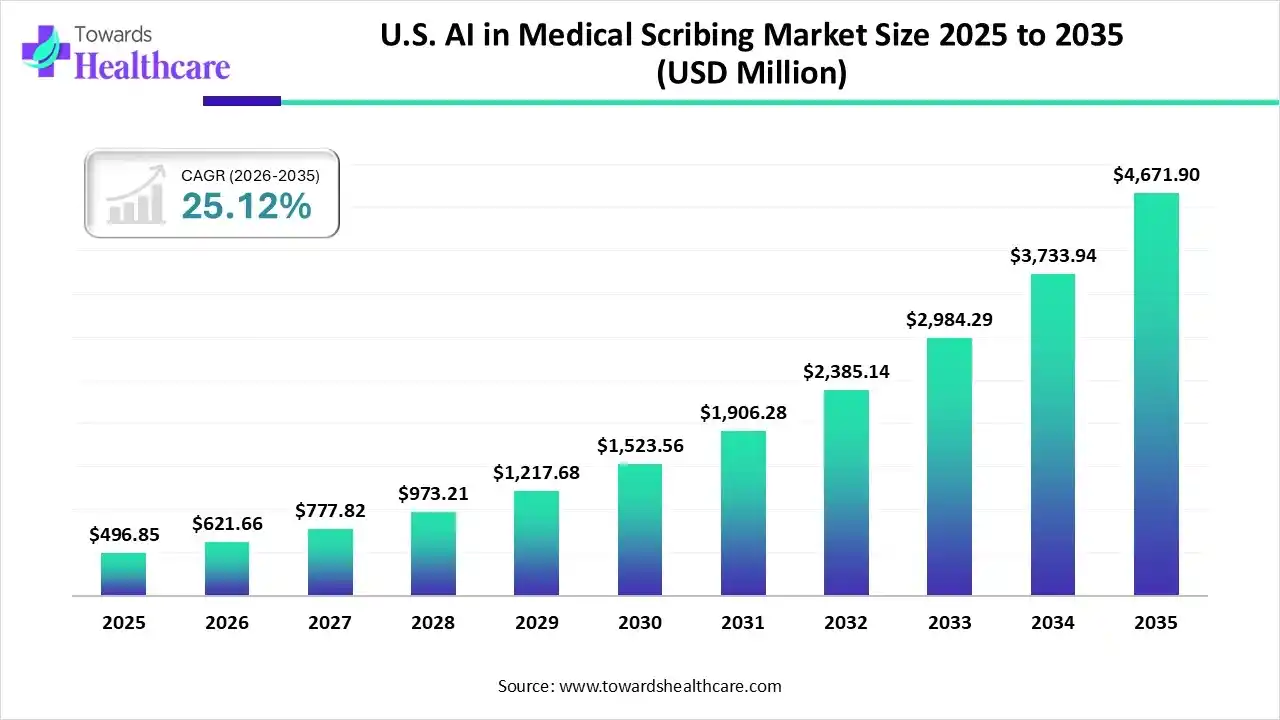
The U.S. AI in medical scribing market size was estimated at USD 496.85 million in 2025 and is predicted to increase from USD 621.66 million in 2026 to approximately USD 4671.9 million by 2035, expanding at a CAGR of 25.12% from 2026 to 2035. The growing digital transformation in the U.S. healthcare sector is increasing the adoption of AI medical scribing tools. The growing remote healthcare, technological innovations, and launches are promoting the market growth.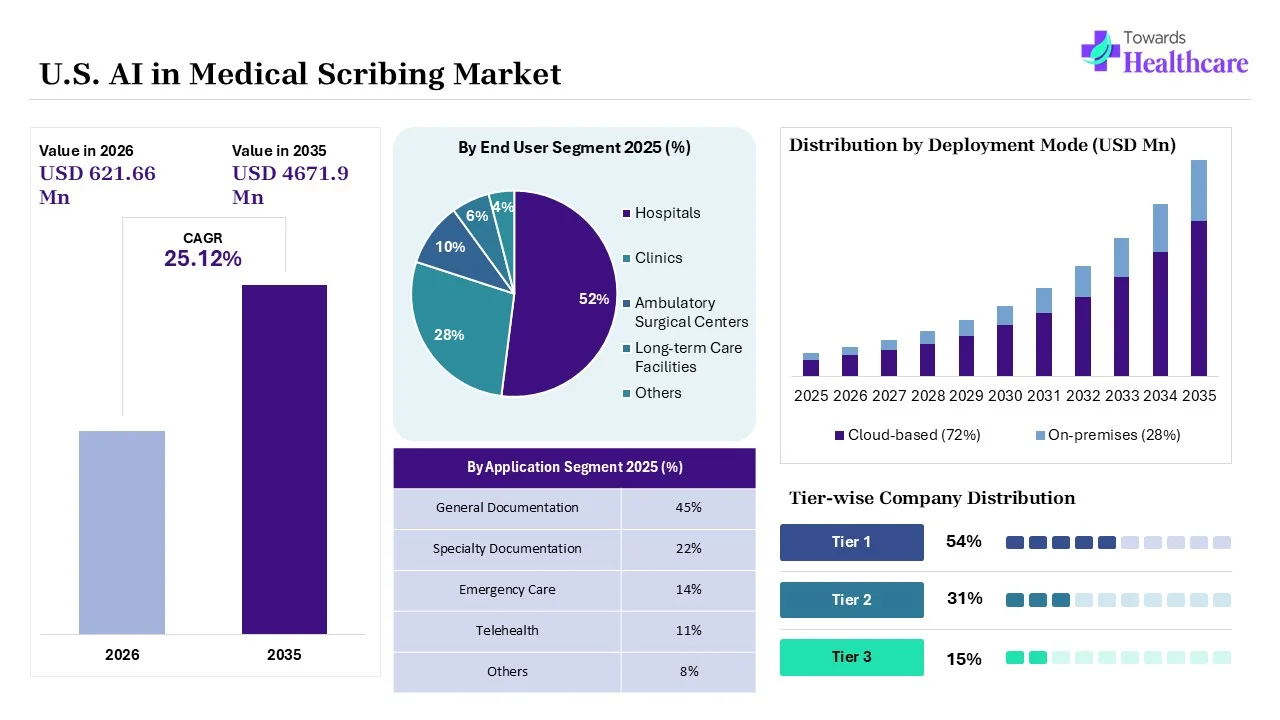
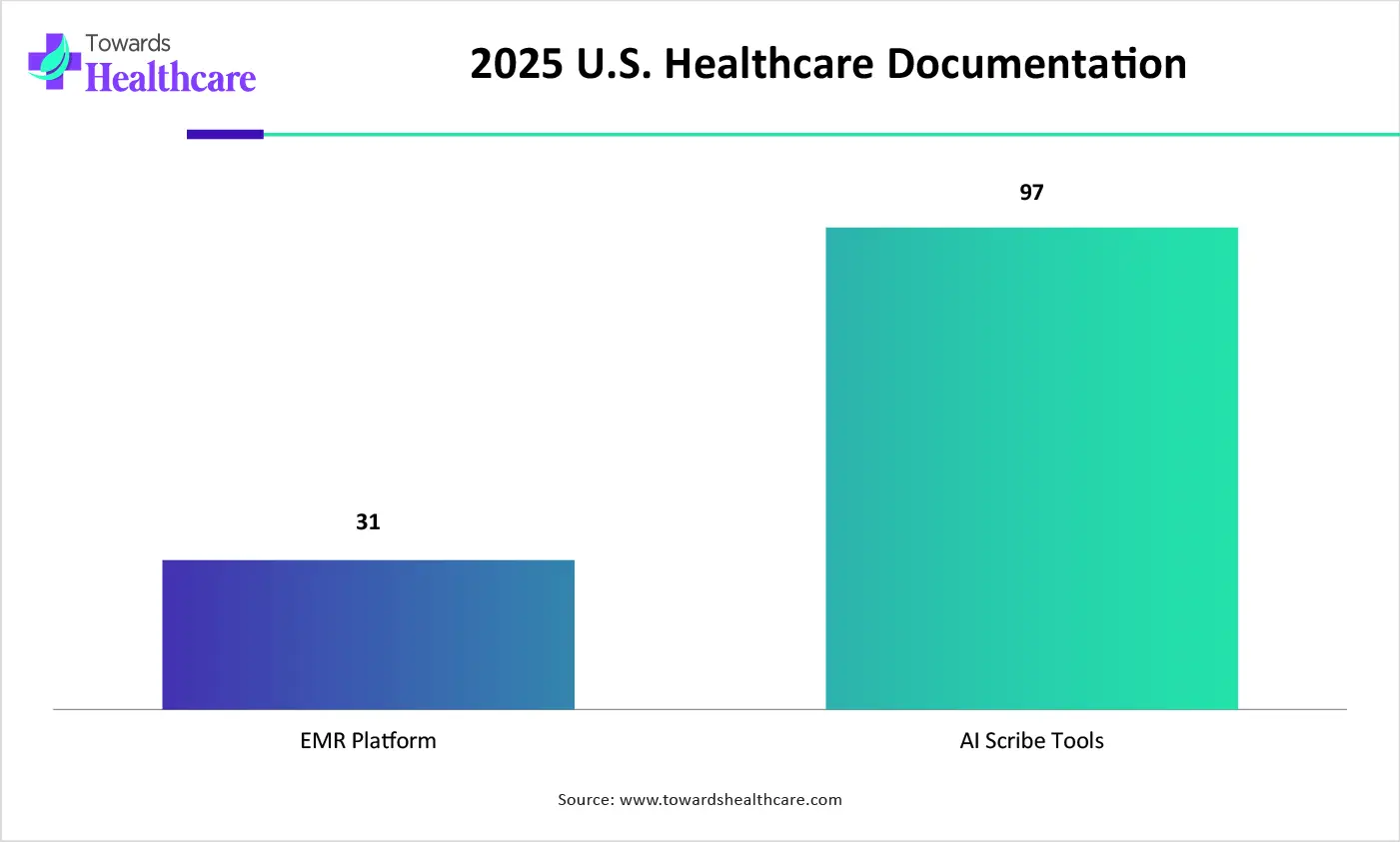
The U.S. AI in medical scribing market is driven by the urgent need to reduce clinical burnout and automate “pajama time” (the hours spent on documentation after shift by the doctors). The U.S. AI in medical scribing encompasses the artificial intelligence technologies utilized to develop, optimize, and manage clinical documentation automatically, across the U.S. These technologies interpret the doctor-patient interactions and help in the generation of accurate and structured medical notes.
High clinical Documentation Burden
The expanding healthcare, growing diseases, and patient volume across the U.S. are increasing the clinical documentation burden. Moreover, these procedures are time-consuming and are increasing the physician burnout, which is driving the demand for automation. This is increasing the use of AI in medical scribing, which offers high accuracy, faster documentation, and reduces the administrative overload by transcribing and organizing clinical information automatically.
Reliability Issues
The AI in medical scribing often misinterprets the accents, speech, and complicated clinical context. This decreases the accuracy of the documentation, increasing the workload of the physician for their correction, where their inaccurate documentation can reduce compliance with regulatory standards, and decrease physicians' trust, limiting their use.
Growing AI Medical Scribing Models
To offer various applications and enhance the features of the AI in medical scribing, the companies in the U.S. are increasing the development of new AI medical scribing models. These models are offering automated documentation, improved efficiency, enhanced accuracy, easy deployment, and data-driven insights. Furthermore, the specialty-specific solutions and hybrid human-AI models are also being developed.
Telehealth Proliferation
The growing shift towards remote care is increasing the use of telehealth platforms, which is promoting the use of AI medical scribing solutions for capturing consultations and seamless documentation.
Flourishing Technological Advancements
In order to enhance the applications of the AI medical scribing systems, they are being integrated with other digital health tools, which will enhance the interpretation of the conversation, documentation accuracy, reduce manual errors, with improved data security.
Expanding Specialty Clinics
The U.S. AI in medical scribing market is experiencing a rapid growth in specialty clinics such as oncology, cardiovascular, psychiatry, and orthopedics, which is increasing the specialty-specific AI medical scribing models to deal with the growing, intricate documentation burden.
| Table | Scope |
| Market Size in 2026 | USD 621.66 Million |
| Projected Market Size in 2035 | USD 4671.9 Million |
| CAGR (2026 - 2035) | 25.12% |
| Key Applications | Ambient clinical documentation, automated SOAP notes, EHR integration, physician workflow automation, specialty-specific documentation, coding assistance, clinical decision support workflows |
| Primary End Users | Hospitals, health systems, physician groups, outpatient clinics, specialty practices, emergency departments, independent clinicians |
| Key Growth Drivers | Physician burnout reduction, shortage of clinical staff, adoption of generative AI, EHR workflow optimization, demand for value-based care, healthcare automation investments |
| Measurable Values | USD Millions/Units/Volume |
| Market Segmentation | By Deployment Mode, By Application, By End-use |
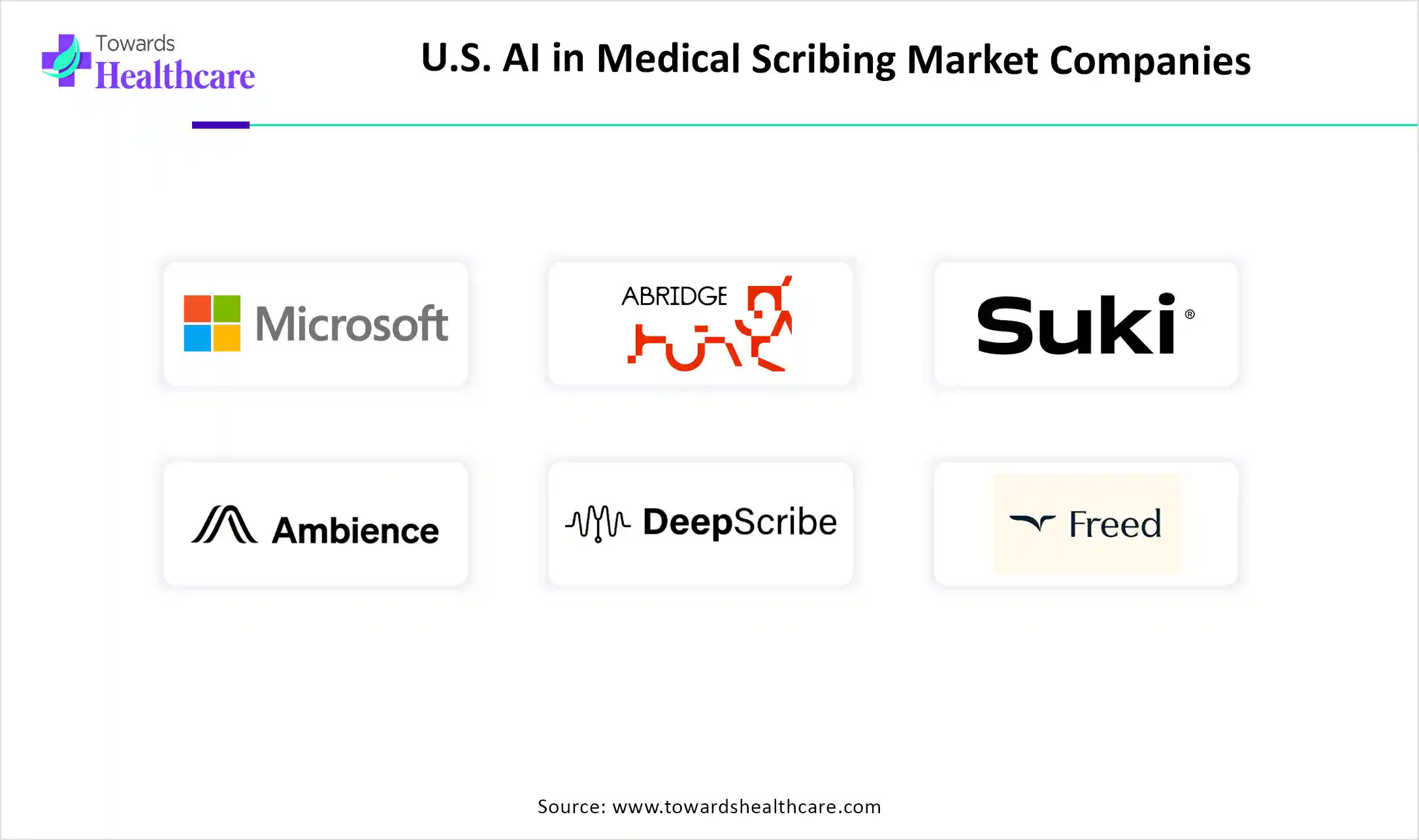
| Top Key Players | Microsoft (Nuance), Abridge, Suki AI, Ambience Healthcare, DeepScribe, Freed AI, ScribeAmerica, Augmedix, Sunoh.ai, Nabla |
| Segments | Shares % |
| Cloud-based | 72% |
| On-premises | 28% |
Why Did the Cloud-based Segment Dominate in the Market in 2025?
The cloud-based segment registered its dominance in the U.S. AI in medical scribing market by 72% share in 2025 and is expected to show the fastest growth rate during the predicted time, due to its faster implementation. It also offered automated updates and real-time speech recognition, which increased their use. Beyond rapid deployment, these platforms offered automated updates, real-time speech recognition, and seamless integration with Electronic Health Records (EHRs), significantly streamlining clinical workflows.
The shift was further fueled by the high accessibility and scalability provided by major hyperscalers like AWS, Google Cloud, and Microsoft Azure, which allow healthcare providers to bypass substantial upfront investments in hardware and IT infrastructure. Additionally, these solutions were increasingly leveraged for remote healthcare applications and secure, interoperable data sharing across hospitals and research institutions.
| Segments | Shares % |
| General Documentation | 45% |
| Specialty Documentation | 22% |
| Emergency Care | 14% |
| Telehealth | 11% |
| Others | 8% |
Which Application Type Segment Held the Dominating Share of the Market in 2025?
The general documentation segment held the dominating share of 45% in the U.S. AI in medical scribing market in 2025, due to growth in clinical documentation. This increased the time required to summarize the documents, as well as the physicians' burnout. This promoted the use of AI in medical scribbling in the U.S. healthcare, where it offered accurate, fast, and standardized documentation.
Specialty Documentation
The specialty documentation segment is expected to show the highest growth during the upcoming year, due to growing demand for detailed and structured documents. Furthermore, the expanding specialty clinics and healthcare investments are also increasing the use of AI medical scribing solutions for customized and precise documentation.
| Segments | Shares % |
| Hospitals | 52% |
| Clinics | 28% |
| Ambulatory Surgical Centers | 10% |
| Long-term Care Facilities | 6% |
| Others | 4% |
What Made Hospitals the Dominant Segment in the Market in 2025?
The hospitals segment contributed the biggest revenue share of 52% in the U.S. AI in medical scribing market in 2025, due to growth in the patient volume, which increased the documentation burden. Moreover, the reimbursement policies and multiple departments also increased the demand for AI medical scribing platforms. They were also integrated with other digital health care systems, which enhanced their applications.
Clinics
The clinics segment is expected to show the fastest growth rate during the forthcoming year, due to growing outpatient visits and a skilled personnel shortage. This is driving the adoption of various affordable AI medical scribing tools to reduce the documentation burden and make faster clinical decisions. The expanding remote healthcare is also increasing its use.
The U.S. AI in medical scribing market is expected to grow significantly during the forecast period, due to the growing clinical documentation burden, which is increasing the physician workload and encouraging the use of various AI medical scribing tools. The growing focus on physician burden reduction and growing healthcare innovations are also increasing their adoption rates. Similarly, the rapid expansion of specialty clinics and remote healthcare is also increasing their use and driving their innovations, which is promoting the market growth.
As a major tech hub, California accelerates AI scribing through rapid adoption by tech-forward health systems and startups in Silicon Valley. Dense, innovative healthcare providers integrate these AI tools to reduce clinician documentation burden, enhancing efficiency and patient care.
In the Midwest, regional growth is driven by major, strategic partnerships between healthcare systems and technology providers, such as the deployment of Nabla ambient AI across Illinois-based Carle Health. This adoption spans 1,500+ providers in emergency departments and specialized care, highlighting how regional hospital networks are proactively integrating AI tools to streamline documentation in traditionally high-volume settings.
In the Northeast, AI medical scribing growth is fueled by a high concentration of academic medical centers and tech-forward institutions, which are quick to adopt solutions like DAX Copilot. This region focuses on integrating these systems directly into electronic health records (EHR) to automate, summarize, and enhance documentation, reducing the 25% extra time spent on paperwork, per Microsoft.
California Market Trends
California is a strong player in the market. The presence of UCLA Health, Kaiser Permanente, and UCSF increases the development of AI in medical scribing. The strong biomedical research universities and high patient volume increase adoption of AI in medical scribing. The increasing EHR integration and the requirements for audio processing drive the overall growth of the market.
Texas Market Trends
Texas is rapidly growing in the market. The focus on handling documentation tasks and the deployment of UT Dell Medical Center increase adoption of AI in medical scribing. The presence of institutions like UT Health East Texas and UTMB helps with expansion. The rise in ambient listening tools and the surge in AI-generated medical datasets support the overall growth.
New York Market Trends
New York is robustly expanding in the market. The established academic medical centers and the presence of large physician groups increase adoption of AI in medical scribing. The high burnout burdens and the rise in packed facilities help with expansion. Burgeoning clinical intelligence platforms support the overall growth of the market.
Florida Market Trends
Florida is growing in the U.S. AI in medical scribing market. The increased rates of burnout and the focus on taking notes automatically increase the use of AI scribes. The high use of telehealth after the pandemic and the increasing use of AI documentation help with expansion. The presence of multilingual patients and AI integration by major health systems drives the growth.
Washington Market Trends
Washington is expanding in the market. The strong tech-reach environments and the integration of AI in ambulatory spaces help with expansion. The availability of AI note options and huge physician workloads increases use of AI scribes. The heavy administrative documentation and the need to enhance the doctor-patient experience boost the overall growth.
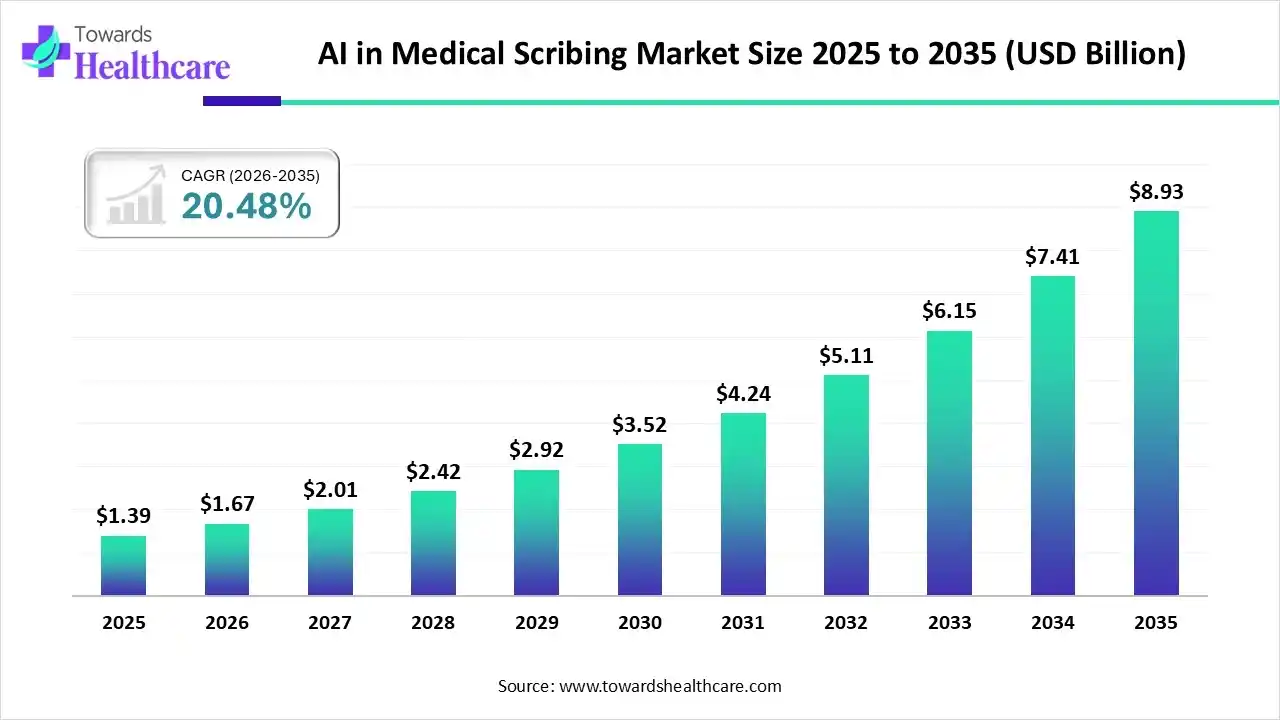
The global AI in medical scribing market size was estimated at USD 1.39 billion in 2025 and is predicted to increase from USD 1.67 billion in 2026 to approximately USD 8.93 billion by 2035, expanding at a CAGR of 20.48% from 2026 to 2035.
| Ecosystem Category | Key Players / Description |
| AI Medical Scribing Technology Providers | Companies developing AI models, NLP engines, ambient listening technology, and clinical documentation automation platforms. |
| Clinical Documentation Platforms | Vendors providing end-to-end AI scribe solutions integrated with physician workflows and EHR systems. |
| Healthcare IT & EHR Vendors | Large healthcare software companies integrating AI documentation capabilities into electronic health record platforms. |
| Digital Health Companies | AI-first healthcare companies focused on workflow automation and clinician productivity. |
| Cloud & AI Infrastructure Providers | Technology providers supporting healthcare AI deployment, data processing, and machine learning infrastructure. |
| Healthcare Service Providers | Health systems and physician networks adopting AI scribing tools to improve operational efficiency. |
| Research & AI Innovation Ecosystem | Universities, healthcare AI labs, and research organizations advancing clinical NLP and healthcare automation. |
| Tier 1 | Tier 2 | Tier 3 | |
| Typical Market Influence | 54% | 31% | 15% |
| Tier 1 | ||||
| Company Name | Headquarters | Country | Why Relevant to This Market | Key Products/Services |
| Microsoft | Redmond, Washington, USA | USA | Major healthcare AI player through clinical AI solutions and strategic healthcare partnerships. Strong enterprise healthcare presence. | Dragon Copilot, Nuance AI clinical documentation solutions |
| Nuance Communications | Burlington, Massachusetts, USA | USA | One of the earliest and largest providers of AI-powered clinical documentation and speech recognition technology. | Dragon Medical One, ambient clinical intelligence, AI medical documentation |
| Epic Systems | Verona, Wisconsin, USA | USA | Dominant U.S. EHR provider integrating AI documentation capabilities across hospitals and health systems. | AI-powered clinical documentation workflows, EHR-integrated AI tools |
| Tier 2 | ||||
| Company Name | Headquarters | Country | Why Relevant to This Market | Key Products/Services |
| Suki | Redwood City, California, USA | USA | AI healthcare assistant company focused heavily on physician documentation automation. | Suki AI Assistant, AI medical notes |
| Augmedix | San Francisco, California, USA | USA | Specialized provider of AI-enabled medical documentation solutions used by clinicians. | Augmedix Go, ambient AI documentation |
| Corti | Copenhagen, Denmark | Denmark | AI healthcare company applying speech intelligence and clinical AI automation. | AI clinical assistant technology |
| Tier 3 | ||||
| Company Name | Headquarters | Country | Why Relevant to This Market | Key Products/Services |
| Heidi Health | Melbourne, Australia | Australia | Fast-growing AI medical scribe platform expanding internationally. | AI clinical documentation assistant |
| Freed AI | United States | USA | Consumer-facing AI medical scribe startup gaining adoption among clinicians. | AI medical note generation |
| Tali AI | Toronto, Ontario, Canada | Canada | Healthcare AI assistant focused on physician productivity and documentation. | AI clinical assistant |
Strengths
Weaknesses
Opportunities
Threats
By Deployment Mode
By Application
By End-use






Principal Consultant
Rohan Patil is a seasoned market research professional with over 5+ years of focused experience in the healthcare sector, bringing deep domain expertise, strategic foresight, and analytical precision to every project he undertakes.
Learn more about Rohan Patil

Reviewed By
Aditi Shivarkar is a seasoned professional with over 14 years of experience in healthcare market research. As a content reviewer, Aditi ensures the quality and accuracy of all market insights and data presented by the research team.
Learn more about Aditi Shivarkar









