


 Request Consultation
Despite early-year progression, the global cell and gene therapy pipeline in 2026 is revolutionizing. In 2025, the total number of active gene, cell, and RNA therapy programs contracted, even as commercial market-size projects for the sector keep surging. This shows that the field is merging around certain, well-resourced programs instead of broadening unselectively. Within a single year, massive transitions, such as newly begun gene therapy trials, shifted from an oncology majority to a rare-disease majority. Meanwhile, CAR_T sustains dominance as gene-modified cell therapy technology but is advancing into autoimmune disease, and clinical trial activity in Asia-Pacific has resolved most of the gap with North America.
The overall glimpse was developed completely from the quarterly Gene, Cell & RNA Therapy Landscape Reports published by the American Society of Gene & Cell Therapy (ASGCT) in alliance with Citeline. Alongside, the field's most authoritative, primary-source pipeline tracker is complemented by regional deep-dive data from PackGene Biotech and cross-referenced trade coverage. Whereas quarterly figures vary by data-collection methodology, that differentiation is shared explicitly rather than mixed into a single misleading number. The respective CGT pipeline is heavily re-sorting itself by modality, by disease area, and by geography dynamics that are invisible in a single market-size headline number but become subtle the moment the pipeline is assessed program by program.
Spanning the Global Cell and Gene Therapy Pipeline into Four Different Modality Families
- CAR-T & Gene-Modified Cell Therapy: Possess 52% of the genetically modified cell therapy pipeline.
- Viral Vector Gene Therapy: This represents AAV, lentiviral delivery, & 45 assets are now in Phase III.
- Non-Genetically Modified Cell Therapy: This has 962 assets, including stem cell, NK cell, and other platforms.
- Gene Editing & Next-Gen Platforms: This consists of CRISPR, base & prime editing, with significant in vivo momentum.
In Q4 2025, 2,041 gene, cell and RNA therapy programs were tracked. Moreover, every modality family has a fundamentally diverse manufacturing model, regulatory landscape, & cost structure. Hence, ‘cell and gene therapy’ is not one sector with one expansion path, but four adjacent industries whose prospects are only broadly correlated with each other.
Source: ASGCT-Citeline, Gene, Cell & RNA Therapy Landscape Report, Q4 2025 and Q1 2026.
Along With the Market Expansion, the Pipeline is Experiencing Attrition
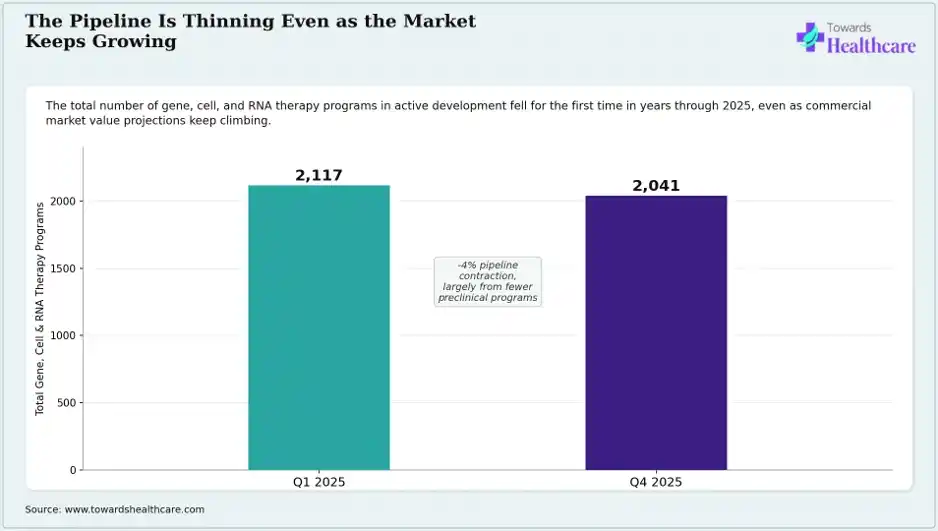
The above graph displays a comparison of the total number of active gene, cell, and RNA therapy programs tracked by ASGCT and Citeline between Q1 2025 and Q4 2025.
Key Insight: From Q1 2025 (2,117) & Q4 2025 (2,041) data, there is a 4% reduction in total pipeline programs. This is mainly fueled by certain preclinical-stage programs being started or sustained, which does not deny increasing market-value projections. This shows a field where capital & scientific focus are emphasizing minimal, more clinically de-risked assets instead of an expansive base of early-stage speculation.
Source: ASGCT-Citeline, Gene, Cell & RNA Therapy Landscape Report, Q4 2025.
Unlocking Gene Therapy Assets Surpass Non-Genetically Modified Cell Therapy Assets More Than 2-to-1
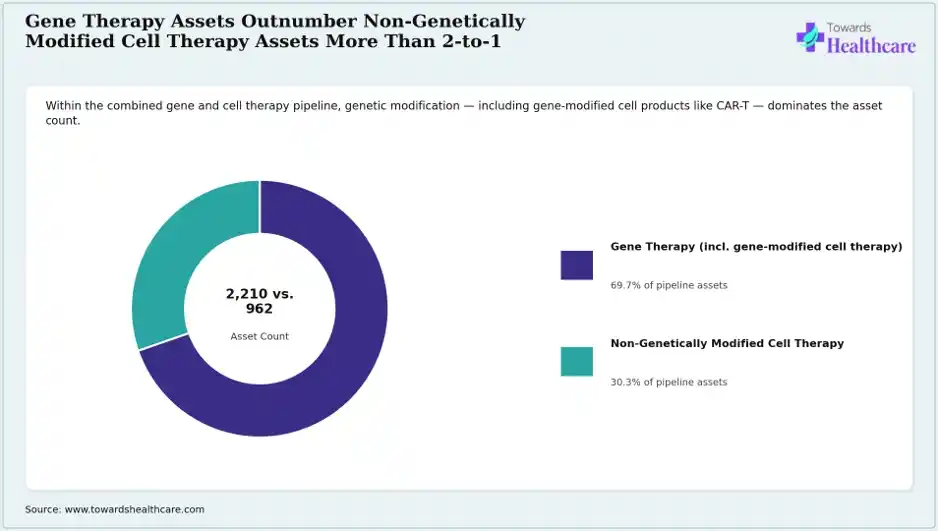
From my analysis, the above infographic represents a comparison of the number of gene therapy assets, such as gene-modified cell therapies like CAR-T and non-genetically modified cell therapy assets throughout the integrated pipeline. Specifically, gene therapy holds 69.7%, i.e. 2,210 assets, while non-genetically modified cell therapy accounts for 30.3%, i.e., an asset count of 962 across the pipeline assets.
Key Insight: From the given counts, one can interpret that an approximate 70/30 dominance of gene modifications in asset count shows how rigorously gene-editing & gene-delivery tools have been unified into cell therapy development. Although a major focus of the industry has inclined towards engineered, despite unmodified, cellular products.
Source: PackGene Biotech, citing ASGCT-Citeline data, “Advances in Cell and Gene Therapy and the Evolving AAV Landscape in 2025 H1.”
CAR-T Impacts as the Only Well-Known Technology in the Gene-Modified Cell Therapy Pipeline
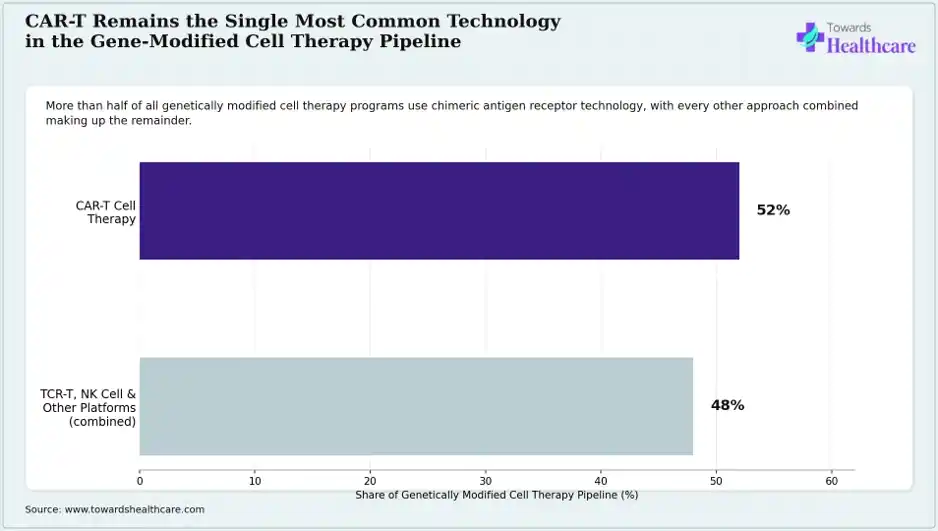
The graph compares CAR-T’s share of the genetically modified cell therapy pipeline against every other approach combined, such as TCR-T & NK cell platforms. This mainly accounts for 52% of CAR-T cell therapy share, while TCR-T, NK cell & other platforms in combined form hold 48% share.
Key Insight: Specifically, the bar chart shows that more than half of all gene-modified cell therapy programs are still developed on CAR-T architecture, roughly a decade after the first approvals. Meanwhile, the dominance of the technology indicates both its validated manufacturing trajectory & the sheer difficulty of novel platforms, including TCR-T, NK cell, & allogeneic, which experience challenges in meeting their clinical track record.
Source: ASGCT-Citeline, Gene, Cell & RNA Therapy Landscape Report, Q1 2026.
Inclusion of CAR-T in an Oncology Narration, But Autoimmune Disease Underlined as the Developing Leading Edge
Across the globe, CAR-T approaches play a pivotal role in targeting cancer as a prominent solution, but minor solutions are testing the technology in lupus, scleroderma, & other autoimmune diseases. This primarily covers:
- 81% of CAR-T cell therapies in development for cancer indications.
- 19% developed for non-oncology indications, such as autoimmune conditions.
- 795 CAR-T candidates tracked across the global therapeutic pipeline in 2024.
This significantly highlights that 19% of CAR-T programs are currently seeking to target non-oncology concerns, especially autoimmune disease, such as lupus & scleroderma. This showcases a true platform-extension shift, where early data describing drug-free remission in autoimmune patients demands a technology verified in cancer be extended into an extensively varied & much larger disease class.
Source: ASGCT-Citeline, Gene, Cell & RNA Therapy Landscape Report, Q1 2026; Pharmacy Times, “CAR T and Beyond: The Expanding Pipeline and Promise of Cell Therapies,” May 2026.
Latest Transition: Innovative Gene Therapy Moved From Oncology-Led to Rare-Disease-Majority Within a Year
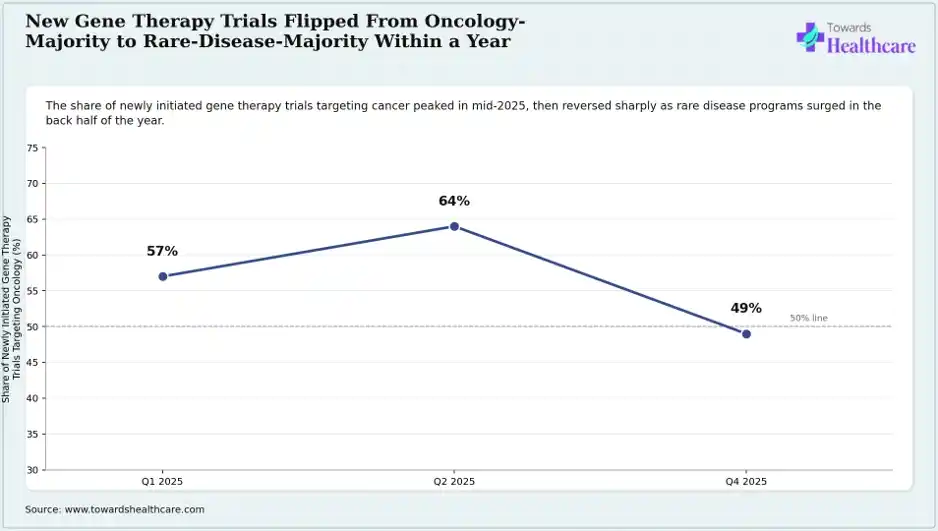
The graph reflects the share of newly started gene therapy clinical trials that target oncology across three quarters of 2025. However, 2025’s Q1 registered 57%, with a peak share of 64% in Q2 2025, and the lowest share of 49% in Q4 2025.
Key Insight: From the recent pipeline data, a technology invested in speeding toward cancer indications in early 2025, while the second half of the year spent its efforts across rare disease. Alongside, this pipeline data depicts both diversified regulatory incentives & an efficient recognition of where gene therapy’s durability advantage impacts most clinically.
Source: ASGCT-Citeline, Gene, Cell & RNA Therapy Landscape Report, Q1, Q2, and Q4 2025 editions.
Leading Area: Rare Disease Programs Command the Gene Therapy Pipeline’s Massive Advanced Stage
From research activities,
- In Q1 2026, 8 gene therapies advanced to Phase III trials.
- Whereas 7 of 8 were for rare diseases, such as hereditary spastic paraplegia & haemophilia A.
- However, 87.5% of Q1 2026’s Phase III advancements were rare-disease programs.
These statistics finally show that rare disease indications hold the substantial majority of new late-stage expansions. Based on 7 rare disease programs, the pipeline’s frontier currently seems systematically diverse from its expansive composition, while rare disease assets are broadening through clinical progression at an inordinately rapid rate as compared to their overall pipeline share.
Source: ASGCT-Citeline, Gene, Cell & RNA Therapy Landscape Report, Q1 2026.
Clinical Trials Reach: Less Than 3% of Gene Therapy Programs Have Attained Late-Stage Trials.
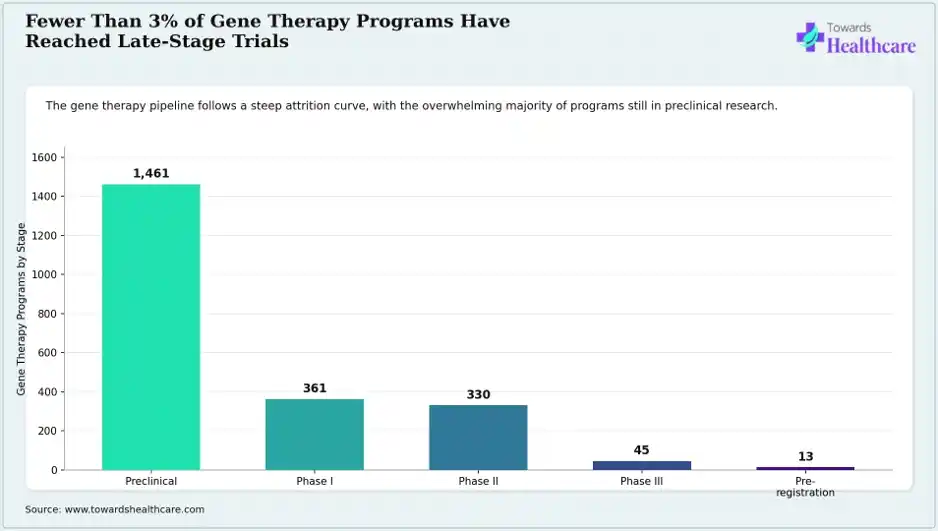
The graph displays the comprehensive distribution of gene therapy programs across development stages. This unveils 1,461 programs at the preclinical stage, i.e., the highest, while 361 are at Phase I, 330 are at Phase II, and 45 are at Phase III, i.e. hugely fewer than overall stages. Subsidiary, 13 programs are involved in the pre-registration stage.
Key Insight: This depletion graph shows the breadth of general biopharma development, but specifically manifested in gene therapy, uncovering its manufacturing & regulatory intricacy. Furthermore, the current preclinical pipeline is a poor predictor of which particular programs will reach patients. Meanwhile, the prospective era of this field’s transformations will be found by which of the 1,461 preclinical assets sustain the upcoming many years of development, regardless of the assets themselves.
Source: PackGene Biotech, citing ASGCT-Citeline data, “Advances in Cell and Gene Therapy and the Evolving AAV Landscape in 2025 H1."
Regional Spotlight: Asia-Pacific Trial Activity is Competing with North America
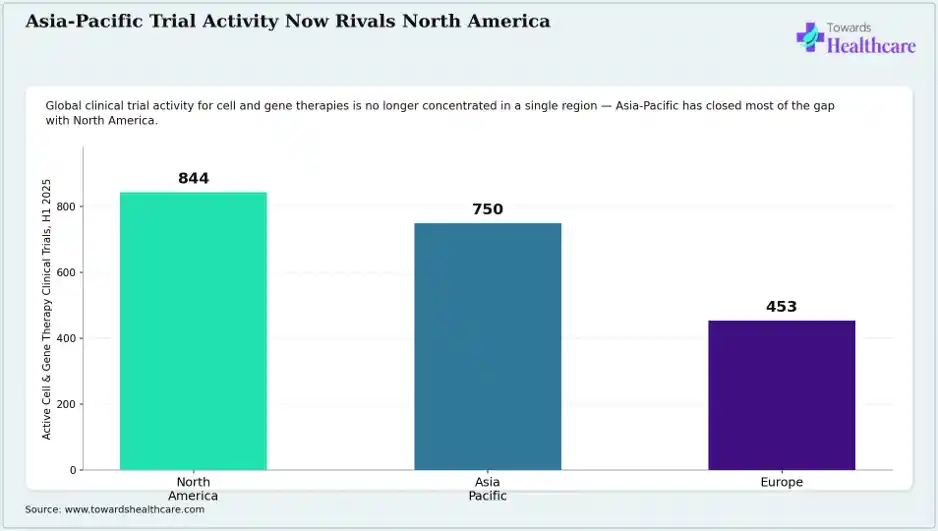
This represents a regional comparison across active cell & gene therapy clinical trials, especially across North America, Asia-Pacific, & Europe as of the first half of 2025.
Key Insight: This shows that North America registers 844, APAC accounts for 750, & Europe holds 453 trials. Hence, the Asia-Pacific trial volume accounts for 89% of North America’s total, whereas China is especially approving locally created CAR-T therapies at expediting pace. However, the geographic hub of cell and gene therapy clinical trial expansion has truly differentiated beyond its historic focus on the United States and Western Europe.
Source: PackGene Biotech, citing ARM/ASGCT-Citeline data, “Advances in Cell and Gene Therapy and the Evolving AAV Landscape in 2025 H1.”
Beyond a Focus on One Region, Approvals are Broadening Across Modalities & Geographies
| Q2 2025 | Zevaskyn (US), a cell-based gene therapy for RDEB and China's first haemophilia B gene therapy |
| Q3 2025 | Hicara (China), a CAR-T for large B-cell lymphoma, and Papzimeos (US) approved. |
| Q4 2025 | Pulidekai (China), a CAR-T for refractory B-cell acute lymphoblastic leukemia (ALL) and Waskyra (US) for Wiskott-Aldrich syndrome (WAS). |
| Q1 2026 | Raguneprocel (Japan), a stem cell-based therapy for Parkinson’s and ReHeart (Japan), an iPS cell-based regenerative therapy for heart failure. |
This panel depicts the range of global cell and gene therapy approvals across gene therapy, CAR-T, & non-genetically modified cell therapy across four different regulatory bodies.
Key Insight: This respective framework of approvals, i.e. gene therapy in the US and Canada, CAR-T in China, and cell therapy in Japan, ensures that no single regulator or country has recorded a durable first-mover advantage throughout all modalities, whereas diverse landscapes are dominating in various technology classifications concurrently.
Source: ASGCT-Citeline, Gene, Cell & RNA Therapy Landscape Report, Q2 2025 through Q1 2026 editions.
Global Launches: 152 Advanced Therapies Have Secured the Market Across the World
Today, the global market has revealed that non-genetically modified cell therapies register the largest share of all approved therapies, coupled with gene therapy and RNA therapy products combined.
- Total Approved: 152
- Non-Genetically Modified Cell Therapy: 75 products approved
- Gene Therapy: 40 products approved
- RNA Therapy: 37 products approved
Along with a dominance of non-genetically modified cell therapy approved, this also shows its comparatively simpler regulatory & manufacturing landscape. This also covers the leading pipeline of gene therapy and gene-modified cell therapy by program count, while the candidates exactly reaching patients currently still slant toward less intricate cell-based solutions.
Source: ASGCT-Citeline, Gene, Cell & RNA Therapy Landscape Report, Q1 2026.
Briefing on Start-Up Financing Recovered Exactly as the Comprehensive Pipeline Contracted
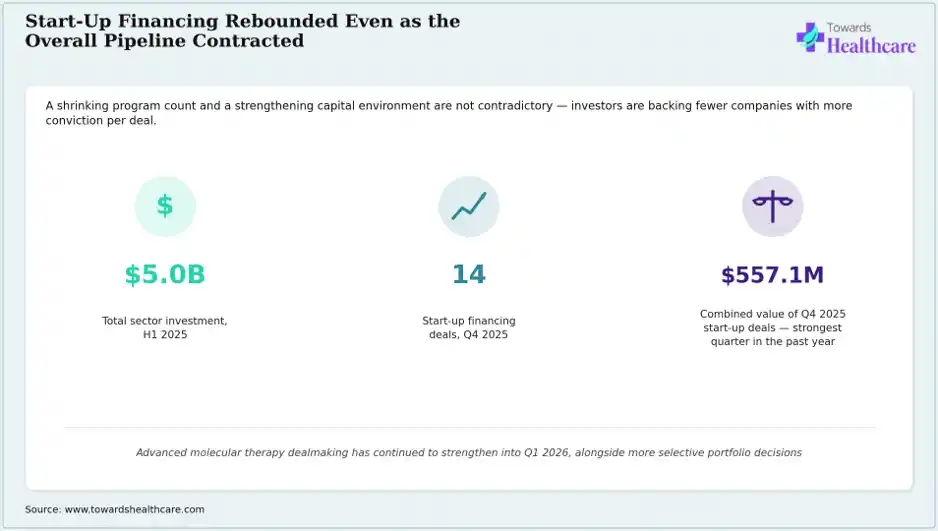
The above panel reflects sector investment figures, such as total H1 2025 capital deployed ($5.0B) and the value and volume of Q4 2025 start-up financing deals.
Key Insight: an explanation covers a rebounding financing circumstance, i.e. Q4 2025’s $557.1 million across 14 deals noted the robust quarter of the past year. This appears simultaneously with a contracting overall program count, which is the finest quantitative proof that capital is merging around fewer, more varied firms instead of widely re-expanding across the sector.
Source: ASGCT-Citeline, Gene, Cell & RNA Therapy Landscape Report, H1 2025 and Q4 2025 editions.
Emerging Steps: Three Shifts Will Explore the Cell and Gene Therapy Pipeline Through 2027
- Quality Over Quantity: A notable reduction in the preclinical pool and rebounding late-stage financing signal selectivity.
- Beyond Oncology: The CGT pipeline aims at rare disease & this currently dominates new trial initiates & Phase III advancement in gene therapy.
- Genuine Globalization: Specifically, Asia-Pacific volume now rivals North America, while China is approving CAR-T at scale.
This closing structural execution indicates that no shifts from these three exist as a single aggregate market-size or program-count headline. These shifts are present only at the time when the pipeline is disaggregated by modality, therapeutic areas, and geography, which is specifically why quarter-by-quarter, program-level tracking which sustains necessity for anyone making capital deployment or alliance decisions in this area.
Source: Synthesis of evidence presented in Sections 1-12 of this briefing.
Ongoing Technological Trends Across CGT Pipeline by Modality in 2026
Gene Therapy & Editing Modalities:
- The emergence of in vivo CRISPR and base editing approaches is inclining from rare liver diseases toward cardiovascular targets & immunology with boosted precision & lowered off-target risks.
- In this era, the widespread use of prime editing is advancing into complex genetic insertions & corrections past initial laboratory leads.
- Among AAV & non-viral vectors, leaders are going through certain delivery challenges, which has elevated an emphasis on lipid nanoparticle (LNP) engineering & targeted capsids to broaden tissue tropism outside the liver.
Cell Therapy Modalities
- Immersive progression of CAR-T includes expansion of clinical footprints beyond hematological cancers into severe autoimmune diseases.
- Exploration of allogeneic platforms forces hypoimmune and healthy donor-derived cellular pipelines, though navigating rigorous long-term safety & consistent assessments.
- However, robust & latest mRNA-encoded CAR-T expedites clinical registration to briefly express receptors & lower constant toxicity concerns.
| Modality | Major AI Application | Key Constraints Resolved |
| Cell Therapy (Like, CAR-T/TCR-T) | Leaders heavily leveraged in silico receptor design & manufacturing supply chain algorithms. | These applications eliminated cell culture depletion & manufacturing failures. |
| Viral Vector (Including AAV/Lentivirus) | The global CGT industry incorporated generative capsid design & automated bioreactor scaling in 2026. | This supported enhancing tissue specificity & overcoming expensive scale-up limits. |
| Non-Viral (Such as mRNA/Gene Editing) | To raise development across this modality, firms employed LNP formulation modeling & off-target cut simulators. | This technology assists in studying in vivo delivery mechanics & genomic toxicity. |
Recent Developments Across CGT Pipeline in 2026
In August 2026, Ultragenyx Pharmaceutical Inc. received the granted accelerated approval from the U.S. FDA for GENGLYCOS (pariglasgene brecaparvovec-opnr), also referred to as DTX401, & used in adult and pediatric patients eight years and older with glycogen storage disease type Ia (GSDIa).
Source- https://ir.ultragenyx.com/news-releases/news-release-details/ultragenyx-announces-us-fda-approval-genglycostm-gene-therapy
In July 2026, Allotera Therapeutics, Inc. (formerly Wugen, Inc.) closed a $35 million financing round consisting of equity and venture debt to foster pivotal-stage development of Soficabtagene Geleucel, an off-the-shelf CAR-T cell therapy being assessed in relapsed or refractory T-cell acute lymphoblastic leukemia (T-ALL) & T-cell lymphoblastic lymphoma (T-LBL).
Source- https://www.businesswire.com/news/home/20260708371243/en/Allotera-Therapeutics-Formerly-Wugen-Closes-%2435-Million-Financing-to-Advance-Off-the-Shelf-CAR-T-Therapies-for-T-Cell-Cancers
In July 2026, Vanda Pharmaceuticals Inc. (Vanda) announced that the U.S. Food and Drug Administration (FDA) granted Rare Pediatric Disease Designation to VCA-894A, Vanda's investigational antisense oligonucleotide therapy for the treatment of Charcot-Marie-Tooth disease, axonal, type 2S (CMT2S), a rare, serious, and progressive inherited neurological disorder.
Source- https://www.prnewswire.com/news-releases/vanda-pharmaceuticals-announces-fda-rare-pediatric-disease-designation-for-investigational-therapy-for-charcot-marie-tooth-disease-type-2s-302819555.html
In May 2026, CREATE Medicines raised $122 million in Series B financing to strengthen its in vivo chimeric antigen receptor T-cell (CAR-T) therapy pipeline across autoimmune disease and oncology indications.
Source- https://www.biopharminternational.com/view/create-medicines-secures-122-million-advance-in-vivo-car-t-pipeline
Briefing on Upcoming Cell and Gene Therapy Pipelines in 2027
| Ocugen is moving towards 2027 BLA filings for its OCU400 retinitis pigmentosa and OCU410ST Stargardt disease gene therapies, with potential rollouts as early as 2028 if development stays on track. |
| Immatics is planning to submit regulatory filings for its PRAME-targeting autologous cell therapy, i.e. Anzu-Cel (IMA203), in 2027. |
| From Johnson & Johnson, MeiraGTx acquired botaretigene sparoparvovec (bota-vec), a gene therapy for X-linked retinitis pigmentosa (XLRP) in April 2026 and is seeking filing for regulatory approval in the U.S., Europe, & Japan as fast as possible, with the potential for a commercial launch in 2027. |
| Intellia's CRISPR-based in vivo gene editing candidate, i.e. lonvoguran ziclumeran (NTLA-2002) for hereditary angioedema, shifts toward an earliest expected approval window in 2027. |
Key Companies & Organizations
| Company | Category | Offerings in 2026 CGT Pipeline |
| ASGCT (American Society of Gene & Cell Therapy) | Industry Association | This entity publishes the quarterly Gene, Cell & RNA Therapy Landscape Report in alliance with Citeline, the primary source for this briefing. |
| Citeline (Norstella) | Data & Intelligence Provider | This firm provides tracking of global pipeline programs, trial initiations, and approvals across gene, cell, and RNA therapy modalities. |
| Chongqing Precision Biotech | China CAR-T Developer | Along with an NMPA approval for Pulidekai, they unveil clinical applications for leukemia, lymphoma, and multiple myeloma, like newer in vivo CAR-T biological interventions. |
| GSK | Gene Therapy Developer | Mainly, this company received FDA approval for Waskyra and is also expanding assets, including risvutatug rezetecan (ris-rez, B7-H3 ADC) & mocertatug rezetecan (B7-H4 ADC), with broadening of indications for Jemperli (dostarlimab). |
| Hrain Biotechnology | China Gene Therapy Developer | In Q3 2025, NMPA approved its Hicara and specializes in tumor immunotherapy and precision CAR-T/TCR-T cell therapies. |
| Sumitomo Pharma | Cell Therapy Developer | They achieved Japanese marketing authorization for raguneprocel and secured U.S. FDA Orphan Drug Designation in March 2026 for DSP-3077 used to treat retinitis pigmentosa (RP). |
| Arrowhead Pharmaceuticals | RNA Therapeutics Developer | This leader received FDA approval for Redemplo (RNAi) to treat familial chylomicronemia syndrome in Q4 2025. |
| Vertex Pharmaceuticals/CRISPR Therapeutics | Gene Editing | This is a commercial firm in CRISPR/Cas9 gene editing therapy, coupled with Novartis/AveXis in AAV gene transfer. |
| Innovative Genomics Institute (UC Berkeley) | Gene Editing Research | An institute advances foundational CRISPR platform technology basic much of the in vivo gene editing pipeline. |
| Prime Therapeutics | Payer/Pipeline Intelligence | They publish the Cell & Gene Pipeline Outlook tracking pending FDA approvals related to health plan formulary planning. |
Strategic Business & Research Questions
- Which specific preclinical-stage gene therapy programs are most likely to survive the current pipeline contraction and advance to Phase I within the next 18 months, based on sponsor funding runway and modality?
- How does the actual clinical trial success rate differ between rare-disease-focused and oncology-focused gene therapy programs at each phase transition, and does that explain the late-2025 pivot toward rare disease?
- Which autoimmune indications beyond lupus and scleroderma show the strongest early CAR-T efficacy signals, and which companies have the deepest non-oncology CAR-T pipelines?
- What proportion of Asia-Pacific's cell and gene therapy trial volume represents genuinely novel domestic innovation versus multinational companies running regional trial sites?
- Which non-CAR-T gene-modified cell therapy platforms (TCR-T, NK cell, allogeneic) have the strongest late-stage data to potentially erode CAR-T's 52% pipeline share over the next five years?
- How does the manufacturing cost and timeline differential between autologous CAR-T and allogeneic off-the-shelf cell therapy affect which companies can realistically compete on price as the field matures?
- What is the realistic probability that China's approved CAR-T therapies (Hicara, Pulidekai) receive subsequent Western regulatory approval, and what would that mean for global pricing benchmarks?
- Which specific investors and financing structures accounted for the rebound in Q4 2025 start-up financing, and does that capital show sector-wide or company-specific concentration?
- How does the actual real-world durability of response data for approved gene therapies compare to the clinical trial data that supported their original approval, across the 40 approved products tracked?
- What is the addressable patient population gap between rare disease indications currently in gene therapy trials and the total rare disease patient population that could theoretically benefit from a curative gene therapy approach?
- Which companies hold the broadest cross-modality pipelines (spanning CAR-T, viral vector gene therapy, and gene editing simultaneously), and does that breadth correlate with survival through the current consolidation period?
- What is the realistic timeline for in vivo CAR-T (avoiding ex vivo cell manufacturing entirely) to reach clinical proof-of-concept, and which companies are furthest along in that specific approach?
- How does the regulatory review timeline for cell and gene therapies differ meaningfully between the FDA, China's NMPA, and Japan's PMDA, and which jurisdiction is fastest for which modality specifically?
- Which rare disease patient advocacy organizations have been most effective at accelerating specific gene therapy programs through orphan drug and other expedited regulatory designations?
- What is the probability-adjusted risk that isotope, viral vector, or other critical manufacturing input shortages constrain the gene therapy pipeline's ability to convert current Phase III programs into commercial launches on schedule?
- How concentrated is the non-genetically modified cell therapy approval landscape (75 products) among a small number of leading developers, versus gene therapy's approval landscape?
- Which specific companies are best positioned to benefit from the pipeline's continued shift toward rare disease, based on current preclinical and Phase I portfolio composition?
- What is the realistic differential in payer reimbursement willingness between oncology and rare-disease gene therapies, and how does that affect commercial viability projections for pipeline assets?
- How does clinical trial enrollment speed differ between North America, Europe, and Asia-Pacific for comparable cell and gene therapy indications, and what does that imply for global development timeline strategy?
- Which specific next-generation gene editing modalities, like base editing and prime editing, have the strongest near-term path to their first regulatory approval, based on current pipeline stage and sponsor resources?
Data & Intelligence Pointers
- The total gene, cell, and RNA therapy pipeline contracted 4% from 2,117 programs in Q1 2025 to 2,041 programs in Q4 2025, propelled primarily by fewer preclinical-stage programs.
- Gene therapy assets, such as gene-modified cell therapies, represent roughly 69.7% of the combined gene and cell therapy pipeline, versus 30.3% for non-genetically modified cell therapy.
- CAR-T cell therapies remain the most common technology in the genetically modified cell therapy pipeline at a 52% share, with all other platforms, like TCR-T, NK cell, and others, combined making up the remaining 48%.
- Whereas 81% of CAR-T cell therapies in development target cancer indications, while a surging 19% target non-oncology indications, such as autoimmune diseases, like lupus & scleroderma.
- The share of newly initiated gene therapy trials targeting oncology swung from 57% in Q1 2025 to a peak of 64% in Q2 2025, then reversed to 49% by Q4 2025, a rare-disease-majority flip within a single year.
- In Q1 2026, eight gene therapies advanced to Phase III trials, and seven of the eight (87.5%) were for rare diseases, especially hereditary spastic paraplegia and haemophilia A.
- Of the gene therapy pipeline as tracked in H1 2025, 1,461 programs were preclinical, 361 were in Phase I, 330 in Phase II, 45 in Phase III, and just 13 in pre-registration.
- Global cell and gene therapy clinical trial activity in H1 2025 totalled 844 trials in North America, 750 in Asia-Pacific, and 453 in Europe, where Asia-Pacific trial volume now reaches 89% of North America's total.
- As of Q1 2026, global cumulative approvals stand at 40 gene therapies, 75 non-genetically modified cell therapies, and 37 RNA therapies, as 152 advanced therapies total.
- Total sector investment reached $5 billion in H1 2025; Q4 2025 start-up financing rebounded to 14 deals worth a combined $557.1 million, the strongest quarter of the prior year.
- China approved at least two domestically designed CAR-T therapies in the second half of 2025 alone (Hrain Biotechnology's Hicara and Chongqing Precision Biotech's Pulidekai), coupled with its first gene therapy for haemophilia B in Q2 2025.
- CAR-T cell therapies ranked 10th among all therapeutic technology categories tracked in 2024, with 795 candidates, while broader gene therapy, such as gene-modified cell therapy, ranked 3rd with 2,151 compounds in development.
References
- ASGCT (American Society of Gene & Cell Therapy) and Citeline. “Gene, Cell & RNA Therapy Landscape Report, Q1 2026.” April 2, 2026. Used for: CAR-T modality share, Phase III rare disease advancement, Q1 2026 approvals, cumulative approval totals.
- ASGCT and Citeline. “Gene, Cell & RNA Therapy Landscape Report, Q4 2025.” February 24, 2026. Used for: total pipeline size and contraction, Q4 2025 approvals, non-oncology gene therapy trial share, start-up financing figures.
- ASGCT and Citeline. “Gene, Cell & RNA Therapy Landscape Report, Q3 2025.” November 18, 2025. Used for: Q3 2025 approvals and total pipeline trial count context.
- ASGCT and Citeline. “Gene, Cell & RNA Therapy Landscape Report, Q2 2025.” August 1, 2025. Used for: Q2 2025 approvals and gene therapy trial oncology share peak.
- ASGCT and Citeline. “Gene, Cell & RNA Therapy Landscape Report, Q1 2025.” April 25, 2025. Used for: Q1 2025 gene therapy trial oncology share and financing baseline.
- PackGene Biotech. “Advances in Cell and Gene Therapy and the Evolving AAV Landscape in 2025 H1.” September 20, 2025. Used for: gene vs. non-genetically modified cell therapy asset split, phase distribution, geographic trial distribution.
- Pharmacy Times. “CAR T and Beyond: The Expanding Pipeline and Promise of Cell Therapies.” May 15, 2026. Used for: CAR-T and gene therapy candidate counts, 2024 pipeline rankings.
- Prime Therapeutics. “Cell & Gene Pipeline Outlook, June 2026.” Used for: payer-side pipeline tracking context and pending FDA approval landscape.
- Tufts Medical Center NEWDIGS/Paying for Cures Consortium. “Cell and Gene Therapy (CGT) Pipeline Deep Dive.” Used for: therapeutic area distribution context (oncology vs. orphan vs. broader indications) and long-term approval projections.