


 Request Consultation
Glimpse:
Producing an intricate small-molecule active pharmaceutical ingredient (API) is a more complex engineering challenge than many people expect. This mainly includes multi-step synthesis, cryogenic reactions, high-pressure hydrogenation, and containment for compounds active at nanogram concentrations. These all demand capital infrastructure that few firms can embrace building in-house. Hence, under such conditions, Contract Development and Manufacturing Organizations (CDMOs), supported by their presence and a different tier of specialists, have been fostering the management of the industry's most chemically demanding molecules.
Meanwhile, Towards Healthcare identifies 15 eminent global CDMOS for small-molecule API manufacturing, ranging from Lonza, a unified platform with three decades of high-potency API experience, to WuXi STA's specialized oligonucleotide & peptide production network. Alongside, a bunch of mid-scale and geographically emphasized specialists are competing on specific chemistries instead of widespread capability. According to Towards Healthcare, the market indicates a $27.6 billion specialized innovator CDMO segment placed within a much larger $206.9 billion total small-molecule API market, and the two are surging at significantly diverse velocities. Based on Towards Healthcare's strong analysis of this market, cross-referenced against independent industry research and company financial disclosures, to describe not just who the major leaders are, but why complex molecule manufacturing has become its own distinct competitive class across pharmaceutical outsourcing.
Earlier to Reach Patients, A Complex Molecule Goes Through Five Different Manufacturing Stages
Specifically, every stage of the clinical-to-commercial process requires diverse process controls, batch documentation, and stricter regulatory requirements from a CDMO partner. Prominent stages are:
- Preclinical Development
- Phase I Manufacturing
- Phase II Manufacturing
- Phase III Manufacturing
- Commercial Manufacturing
Each stage demands steadily more stringent process documentation & control, especially from initial catalyst and solvent screening in preclinical work to full Pre-Approval Inspections at the commercial phase. This reflects that a CDMO's real value sits in handling that rising complexity feasibly, not easily having capacity at any single stage.
Source: Towards Healthcare Database.
Prospective Mission: By 2035, the Small Molecule Innovator Market Is Projected to Reach Approximately Double.
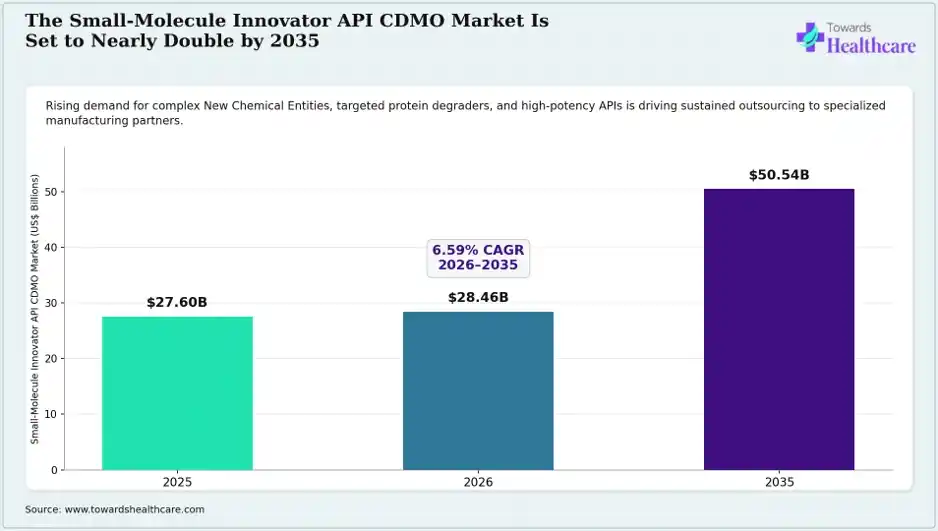
This graph represents the anticipated growth of the specialized small-molecule innovator API CDMO market from 2025 through 2035.
Key Insight: Along with a $27.60 B in 2025, $28.46B, and $50.54B in 2035, the market will witness a 6.59% CAGR expansion during 2026-2035. This ensures that outsourced complex molecule manufacturing has shifted well past its early-adoption phase into a promising, structurally surging segment of the expansive pharmaceutical supply chain.
Source: Towards Healthcare Database
Presence of Lonza & WuXi STA Host the Leading Complex Molecule CDMO League Table
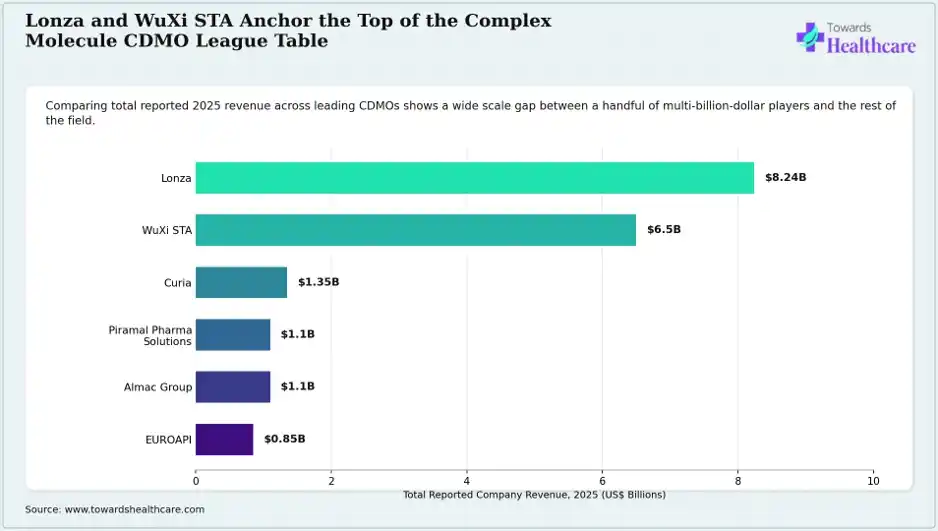
This shows a comparison of total reported 2025 company revenue across six top CDMOs active in complex molecule manufacturing.
Key Insight: The above nearly six-fold revenue gap between the two prominent companies and the next tier down indicates truly diverse competitive positions. Alongside, Lonza and WuXi STA offer unified, multi-modality platforms ranging across biologics and advanced therapies, coupled with small molecules. Meanwhile, the mid-tier players remain more narrowly aimed at specialists.
Source: Towards Healthcare Database.
High-Potency API Manufacturing Has Executed a Distinct, Oncology-Driven Specialty
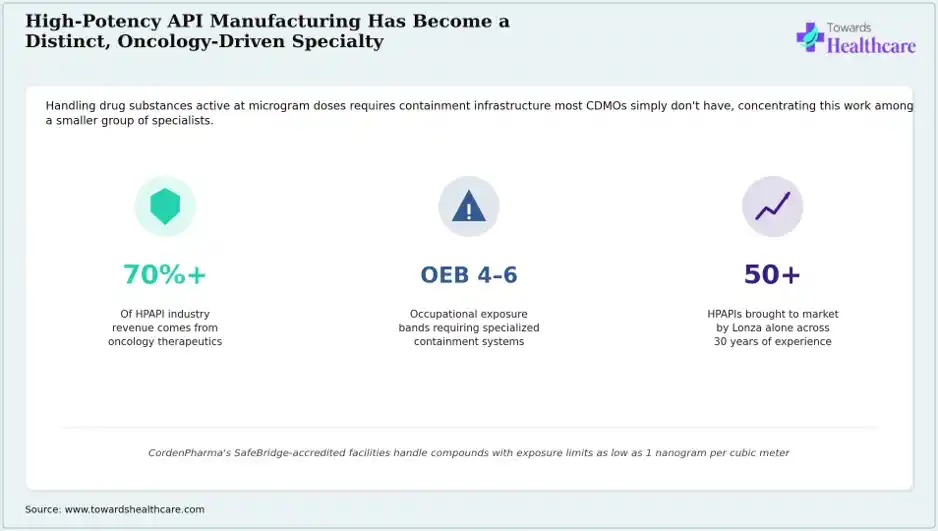
These statistics uncover the scale of oncology's dominance within HPAPI revenue, the occupational exposure band classifications necessitating specialized containment, and Lonza's specific HPAPI track record.
Key Insight: As oncology therapeutics fuel more than 70% of HPAPI industry revenue, the containment infrastructure demand to safely handle all these compounds. It is considered an original niche investment. This results in the price of entry for any CDMO expecting to compete for the fastest-growing segment of complex molecule work.
Source: Towards Healthcare Database.
The Widespread Small-Molecule API Market Midgets the Outsourced CDMO Segment Throughout It
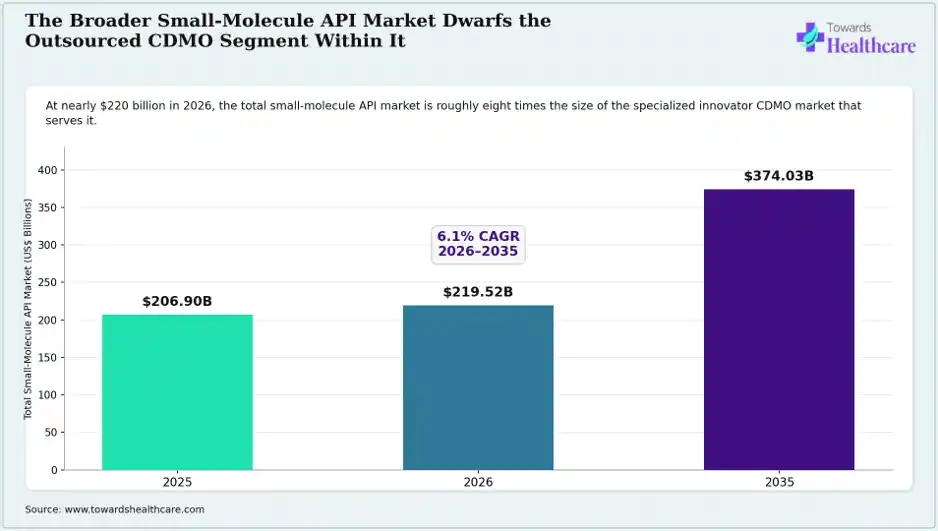
The graph discloses the total global small-molecule API market, which covers both in-house pharmaceutical manufacturing and outsourced CDMO production, from 2025 through 2035.
Key Insight: The approximate eight-to-one size gap between the total small-molecule API market and the specialized CDMO segment within it explains significant headroom for consistent outsourcing expansion. Whereas most small-molecule API production still appears in-house at pharmaceutical companies, not via contract manufacturers.
Source: Towards Healthcare Database.
Regional Spotlight: North America Registers Dominance in the Comprehensive API Manufacturing, While Asia Pacific Witnesses Rapid Growth in the Market
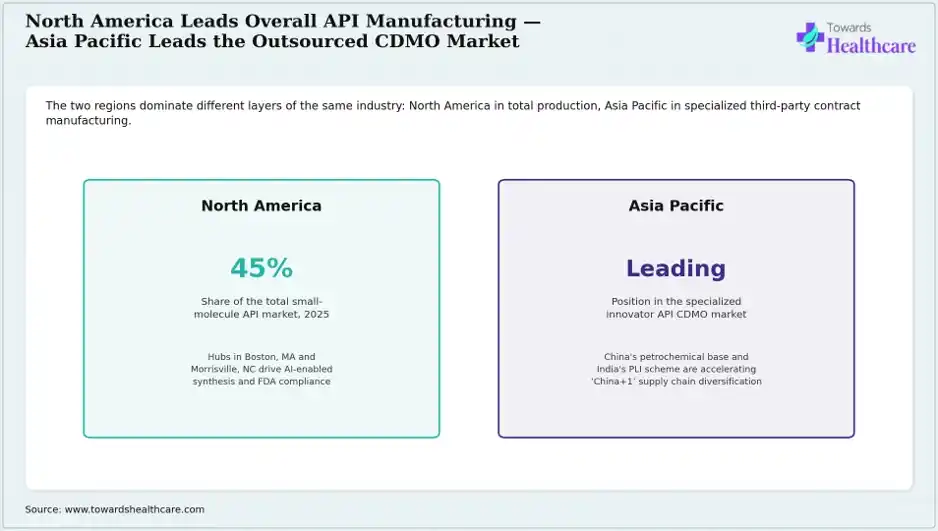
This panel compares North America's largest share of the total small-molecule API market vs. Asia Pacific's leading position, particularly within the outsourced CDMO segment.
Key Insight: Differences across the regions reflect that North America's advantage lies in domestic pharmaceutical R&D intensity and onshoring policy. In addition, Asia Pacific's CDMO leadership is driven by cost-competitive infrastructure and government-led localization programs, such as India's Production-Linked Incentive scheme.
Source: Towards Healthcare Database.
Capital Surges Into Complex Molecule Capacity Across the First Half of 2026
| March 2026 | Axplora invests $60M in HPAPI manufacturing at its Farmabios site. |
| March 2026 | SK pharmteco invests $100M in viral vector capabilities throughout two sites. |
| June 2026 | Siegrifed opens 100 cm square reactor capacity with Industry 4.0 in Germany. |
| June 2026 | Lonza expands drug-linker & ADC payload-linker capacity at Visp, Switzerland. |
This explains that CDMOs are establishing capacity close to where their sponsor customers and regulatory jurisdictions genuinely exist. An intentional hedge against the same supply chain concentration risk that is now propelling US reshoring pressure.
Source: DCAT Value Chain Insights, “CDMOs/CMOs: The Key Moves in 2026,” July 2026; Towards Healthcare, July 27, 2026.
Globally, Fifteen CDMOs Discover the Complex Molecule Manufacturing Landscape
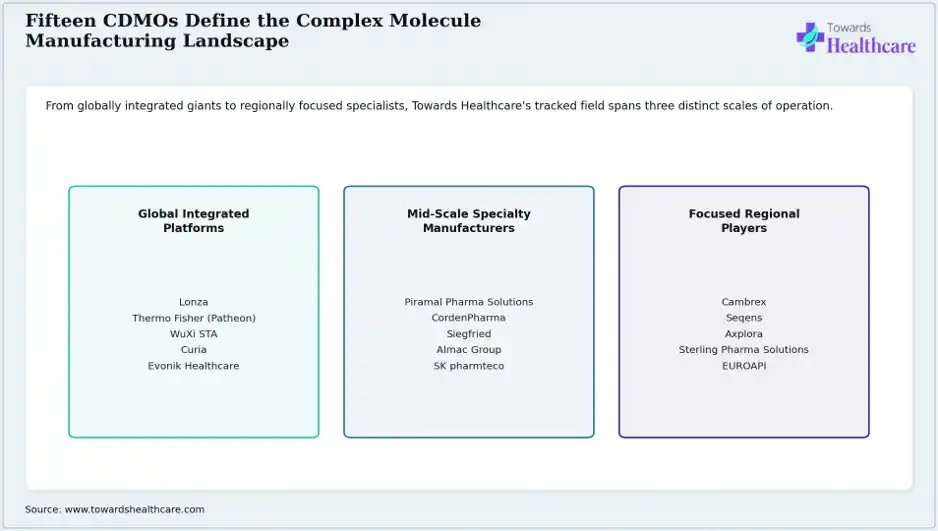
These three diagrams unveil Towards Healthcare's tracked field of 15 leading CDMOs into global combined platforms, mid-scale specialty manufacturers, and focused regional leaders.
Key Insight: Diversity across scale from Thermo Fisher's $44 billion parent company to regionally focused specialists, including Seqens and Axplora, guarantees that complex molecule manufacturing rewards both widespread platform breadth & narrow chemistry-specific expertise, instead of preferring one operating model exclusively.
Source: Towards Healthcare Database.
Selection of a CDMO Partner Comprises Four Questions Beyond Price
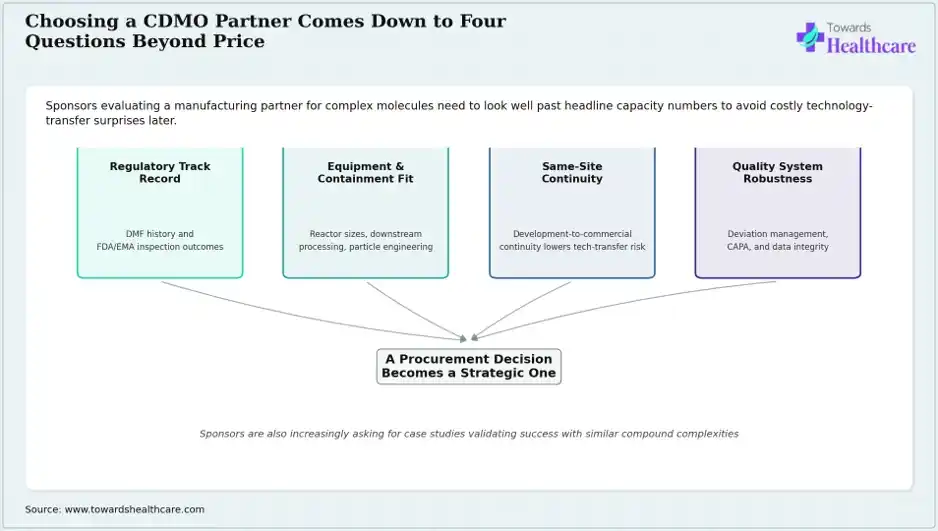
This panel describes four evaluation criteria sponsors should consider when choosing a complex molecule CDMO partner, especially regulatory track record, equipment & containment fit, same-site development-to-commercial continuity, and quality system robustness.
Key Insight: This shows transitioning a process between various facilities for clinical and commercial manufacturing rollouts is the kind of tech-transfer risk, which are well-known derails a complex molecule's trajectory from Phase III into commercial launch.
Source: Towards Healthcare Database.
US Localization Is Hitting With a 32-Month Wait to Develop An Innovative GMP Capacity
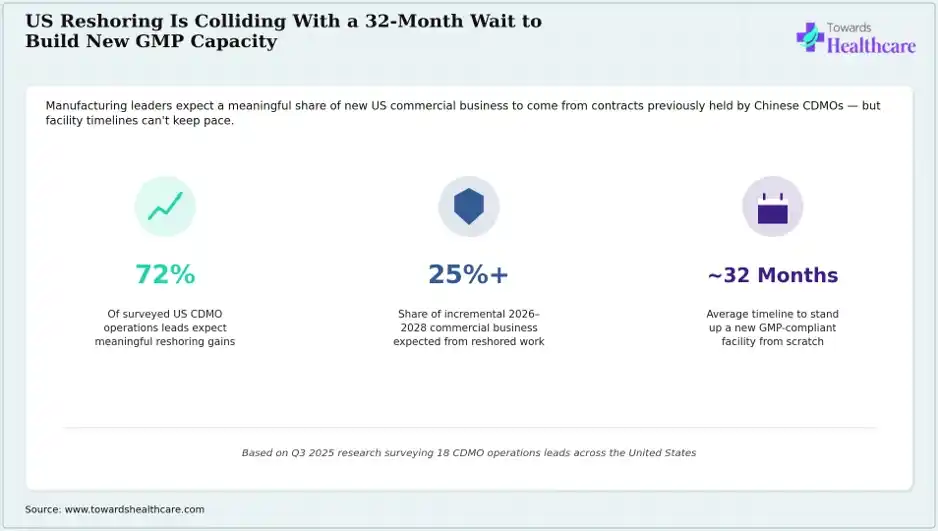
The above statistical survey represents findings on US CDMO operations leaders' reshoring projections, along with the average timeline required to evolve new GMP-compliant manufacturing capacity from scratch.
Key Insight: The gap between near-term reshoring demand, i.e. 72% of operations leaders anticipating substantial gains within two years, and the multi-year facility construction timeline means the reshoring trend will similarly be capacity-constrained well into the late 2020s, prioritizing CDMOs that already have existing US GMP capacity over those still establishing it.
Stepping From Gram-Scale to Commercial-Scale Evolves Five Different Failure Points
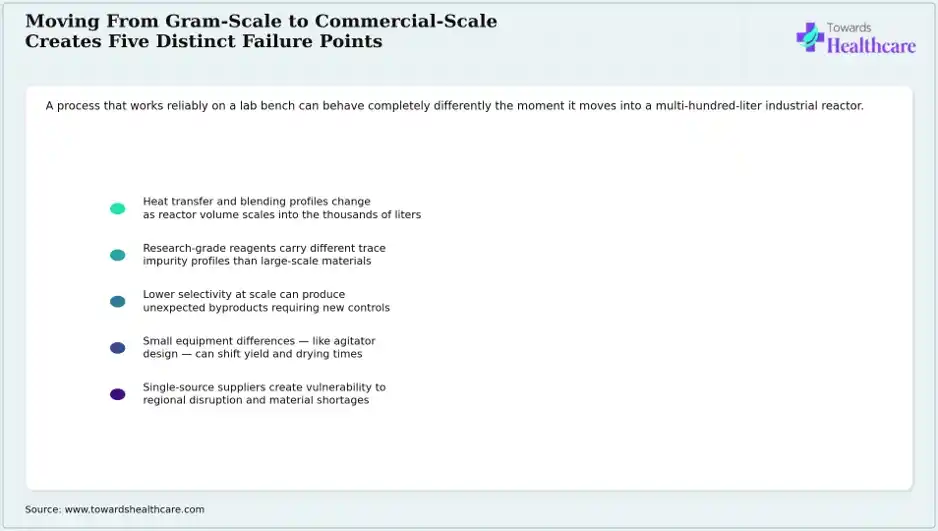
This list explains five specific technical challenges that majorly appear when a complex molecule synthesis process transitions from laboratory-scale to industrial commercial-scale production.
Key Insight: Any of these five failure points are not visible during early-phase clinical manufacturing at small scale. Furthermore, they only consolidate during the move to commercial volumes, which is exactly why a CDMO's presented experience with similar-complexity molecules at commercial scale is more important than its capabilities on paper.
Source: Towards Healthcare Database.
A Launch of Green Chemistry Is Leading a Selection Criterion, Not Just a Sustainability Emerging Point
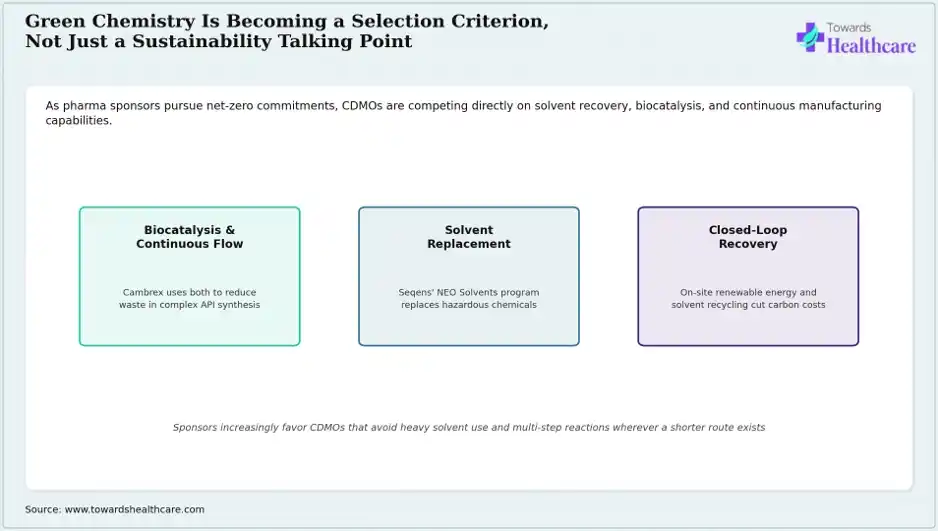
The above landscape describes three specific green chemistry approaches CDMOs are leveraging, specifically biocatalysis and continuous flow chemistry, solvent replacement programs, and closed-loop solvent recovery systems.
Key Insight: Along with pharmaceutical sponsors formalising their own net-zero commitments, a CDMO's solvent recovery and green chemistry credentials are stepping from a nice-to-have differentiator into a genuine procurement requirement. Meanwhile, sponsors widely require their manufacturing partners' environmental performance to avoid as their own compliance liability.
Source: Towards Healthcare Database.
Projecting Three Forces Will Decide Complex Molecule CDMO Leadership Through 2027
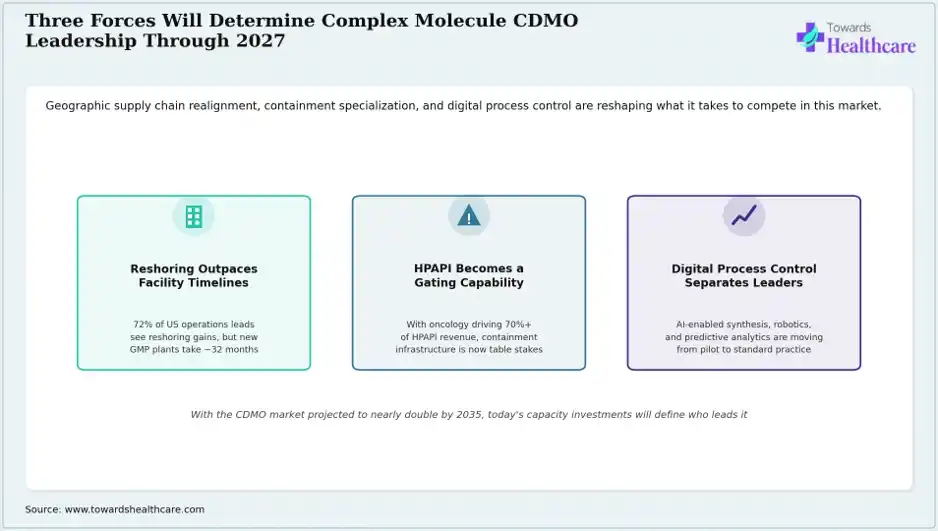
A closure of this panel creates the briefing's evidence into three forces anticipated to transform competitive leadership in complex molecule CDMO manufacturing through 2027, especially reshoring-driven capacity constraints, HPAPI containment as a gating capability, and digital process control as a differentiator.
Key Insight: These forces support incumbents with present infrastructure over new entrants, with available GMP capacity, developed containment systems, and mature digital process control. These all take years to establish; thus, CDMOs best reached for 2027 are largely those already investing now, as this briefing's own recent-developments timeline representations.
Source: Synthesis of evidence presented in Sections 1-12 of this briefing
Key Companies & Organizations
| Company | Revenue of 2025 | Specialization |
| Lonza | CHF 6.5B (roughly $8.24B) | They provide an integrated biologics platform & having 30 years of HPAPI experience, with 50+ HPAPIs launched to market. |
| WuXi STA | RMB 45.46B (nearly $6.5B) | Their WuXi TIDES platform specializes in oligonucleotides, peptides, and complex conjugates. |
| Thermo Fisher Scientific (Patheon) | $44.56B (total company) | A firm evolved 14% of all small molecules approved by the FDA; assists small molecules through cell therapies. |
| Evonik Healthcare | €5.49B (Custom Solutions segment) | They unveiled AI-powered process development joined with green chemistry manufacturing solutions. |
| Curia | $1.3B–$1.4B | They have 150+ scientists across the globe; scales from gram quantities to multi-ton commercial batches. |
| Piramal Pharma Solutions | ₹9,151 crore (~$1.1B) | A leader with 15+ sites throughout North America, UK, and Asia with HPAPI expertise. |
| Almac Group | £1.1B | They offer small molecules, peptides, and HPAPIs, with bioinformatics and genomic profiling for oncology. |
| Siegfried | CHF 1,327.8M | A company that has 16 global facilities across 4 continents; recently broadened US small-molecule API capacity. |
| CordenPharma | €960M | It has SafeBridge-accredited facilities handling exposure limits as low as 1 ng/m³. |
| EUROAPI | €848.2M | They have explored a unified industrial platform across France, Germany, Hungary, and Italy. |
| SK pharmteco | KRW 932B (approximately $695M) | A leader unveils custom ADC payload and linker development; strengthening viral vector capabilities |
| Cambrex | $500M–$717M | They offer biocatalysis and continuous flow chemistry for innovator and generic small-molecule APIs |
Strategic Business & Research Questions
- Which specific CDMOs have the strongest track record of successful clinical-to-commercial technology transfer at the same site, and how does that correlate with sponsor retention rates?
- How does the actual realized cost per kilogram for HPAPI manufacturing compare across Lonza, CordenPharma, and Axplora for compounds of comparable potency and complexity?
- What proportion of the projected reshoring-driven US commercial business will actually materialize by 2028, given the 32-month average facility construction timeline?
- Which specific antibody-drug conjugate payload-linker technologies are most differentiated among Lonza, CordenPharma, and other ADC-focused CDMOs?
- How does India's Production-Linked Incentive scheme compare in effectiveness to China's petrochemical infrastructure advantage in attracting new CDMO capacity investment?
- What is the realistic timeline for continuous manufacturing to become the default approach for complex small-molecule synthesis, versus remaining a specialized capability?
- Which mid-scale CDMOs (Cambrex, Seqens, Sterling Pharma Solutions) are most likely acquisition targets for larger integrated platforms seeking specific chemistry capabilities?
- How does green chemistry adoption (biocatalysis, solvent recovery) actually affect total manufacturing cost compared to traditional synthesis routes, once capital investment is amortized?
- What is the addressable market opportunity for targeted protein degrader manufacturing specifically, as this modality moves from early pipeline into later-stage development?
- Which specific CDMOs have the deepest bench of process chemists with demonstrated experience in cryogenic reactions and high-pressure hydrogenation for genuinely novel chemical entities?
- How does WuXi STA's TIDES platform for oligonucleotides and peptides compare competitively to SK pharmteco's peptide manufacturing expansion in South Korea?
- What is the realistic probability that a major CDMO experiences a significant supply chain disruption event given current single-source supplier dependencies across the industry?
- Which specific companies are best positioned to benefit from the shift toward smaller, patient-centric, personalized medicine batch manufacturing?
- How do quality system robustness metrics (deviation rates, CAPA closure times, FDA inspection outcomes) actually vary across the 15 CDMOs profiled in this briefing?
- What is the realistic capital expenditure required for a mid-tier CDMO to add genuine OEB 5-6 HPAPI containment capability, and what is the payback period given current demand?
- Which specific CDMOs have made the most substantive investments in generative AI for reaction pathway discovery, versus using it primarily for marketing positioning?
- How does the total addressable market for CDMO services in Europe compare to North America and Asia Pacific when adjusted for regulatory complexity and sponsor preference?
- What proportion of new chemical entities entering Phase I trials in 2026 require genuinely novel synthetic routes that existing CDMO capabilities cannot readily support?
- Which specific companies have the strongest combined capability across both small-molecule API and biologics drug substance manufacturing, and does that combination provide a genuine competitive advantage?
- How does customer concentration risk vary across the 15 profiled CDMOs, and which companies are most dependent on a small number of large pharmaceutical sponsor relationships?
Data & Intelligence Pointer
- The global small-molecule innovator API CDMO market was estimated at $27.6 billion in 2025, growing to $28.46 billion in 2026, and projected to reach approximately $50.54 billion by 2035, a 6.59% CAGR.
- The broader total small-molecule API market was valued at $206.9 billion in 2025, growing to $219.52 billion in 2026, and projected to reach $374.03 billion by 2035, a 6.1% CAGR.
- North America held approximately 45% of the total small-molecule API market in 2025, the largest regional share, while Asia Pacific holds the leading position specifically within the outsourced innovator CDMO segment.
- Oncology therapeutics account for over 70% of high-potency API (HPAPI) industry revenue, requiring specialized containment at Occupational Exposure Bands (OEB) 4 through 6.
- Lonza reported total 2025 revenue of approximately CHF 6.5 billion (nearly $8.24 billion), built on 30 years of HPAPI manufacturing experience and more than 50 HPAPIs brought to market.
- WuXi STA reported total 2025 revenue of approximately RMB 45.46 billion (roughly $6.5 billion), anchored by its WuXi TIDES platform for oligonucleotides, peptides, and complex conjugates.
- In Q3 2025 research surveying 18 US CDMO operations leads, 72% expected more than a quarter of their incremental 2026-2028 commercial manufacturing business to originate from reshoring contracts previously held by Chinese CDMOs.
- The average timeline to stand up a new GMP-compliant manufacturing facility from scratch is approximately 32 months, creating a structural constraint on how quickly US reshoring demand can be met.
- CordenPharma's SafeBridge-accredited facilities can safely handle compounds with Occupational Exposure Limits as low as 1 nanogram per cubic meter.
- South Korea's SK pharmteco announced a $260 million investment in September 2024 to build a new 135,800-square-foot small-molecule and peptide manufacturing facility in Sejong, South Korea, scheduled for late-2026 operations.
- Samsung Biologics announced a pending $1.8 billion acquisition of PolyPeptide Group, a CDMO focused on peptide-based APIs, one of the largest CDMO acquisitions announced in 2026.
- Thermo Fisher Scientific's Patheon business has developed 14% of all small molecules approved by the FDA, according to company disclosures.
References
- Towards Healthcare. “Best CDMOs For Small-Molecule API Manufacturing Clinical to Commercial.” July 27, 2026. Used for: company profiles and revenue figures, market sizing (both CDMO-specific and total API market), clinical-to-commercial manufacturing journey, regional landscape, CDMO selection criteria, scale-up challenges, sustainability trends. https://www.towardshealthcare.com/key-insights/best-cdmos-small-molecule-api-manufacturing-clinical-to-commercial
- DCAT Value Chain Insights. “CDMOs/CMOs: The Key Moves in 2026.” July 2026. Used for: Evonik Tippecanoe Labs investment, PolyPeptide Group acquisition by Samsung Biologics, peptide manufacturing investment trends.
- Neuland Labs. “CDMO API Manufacturing for Complex Molecules: A Practical Guide.” April 28, 2026. Used for: complex molecule manufacturing capability requirements context.
- PharmaSource. “What Is a CDMO? The Complete 2026 Guide to Pharma.” Used for: CDMO service category definitions and industry structure context.