




 Request Consultation
An expansive domain of Active Pharmaceutical Ingredient (API) covers a prominent, biologically active component of a medication that shows the necessary therapeutic efficacy. Whereas the development of a small-molecule API is defined as an active ingredient with low molecular weight, i.e. less than 900 Daltons & generally designed through chemical approaches in labs or industries. These tiny APIs have a pivotal role in the pharma sector & serve as a key entity in diagnosis, cure, prevention, treatment, or mitigation of diseases.
Why Small Molecules Dominate the Pharmaceutical Market?
Primarily, small molecules are considered the backbone of modern medicine & are further seeking massive, significant novel drug approvals. These small molecules are highly beneficial due to their compact size & chemical characteristics, which support easy diffusion across cell membranes & sustain in the acidic environments of the GIT. Along with their oral bioavailability, they can be manufactured by employing advanced, scalable chemical synthesis, which is more cost-effective & less intricate than the production of large-molecule biologics.
Besides this, the dominance of small molecules includes well-established regulatory frameworks, such as the U.S. FDA, which has decades of historical actions & a subtle regulatory landscape for small molecules, streamlining the clinical trial & approval pathway. These molecules also have effectiveness across many therapeutic areas, i.e. from chronic diseases to acute bacterial infections and oncology indications, resulting in a dominant market share.
What are the Major Challenges of Complex Small-Molecule Manufacturing?
Multi-Step Synthesis: Generally, intricate small molecules need complex, sequential chemical transformations, like condensations and reductions, to develop the essential carbon skeleton. Here, engineers must safely and effectively separate stable intermediates at each stage without degradation of the product.
Reaction Optimization: One of the key limitations is the optimisation of fine-tuning reaction parameters, like temperature, pressure, catalysts, and stoichiometry, to boost yield, reduce byproducts, & ensure the process is feasible at industrial scales.
Purification Techniques: Specifically, crude APIs should be purified to less than 99.9% purity by using techniques such as preparative chromatography, fractional distillation, and fractional crystallization to remove unreacted materials, reagents, & solvents.
Process Chemistry: This involves process chemists and engineers resolving the gap between laboratory-scale beakers & huge manufacturing plants. Also, they recognize mass and heat transfer bottlenecks, designing safe, affordable routes.
Particle Engineering: To enhance API’s solubility & bioavailability, their physical form plays a vital role. However, the emergence of controlled crystallization, milling, & micronization is engineered to bring specific crystal shapes & particle size distributions (PSD).
Solid-State Delineation: Many small molecules can exist in polymorphs or amorphous states, while the use of techniques like X-ray powder diffraction confirms the API remains in its most bioavailable and stable form.
Impurity Profiling: Arising impurities from raw materials, byproducts, or degradation demand profiling, which emphasises identification & quantification of these trace contaminants to meet rigorous regulatory guidelines, especially the ICH guidelines for genotoxic and elemental impurities.
Analytical Validation: The need for analytical validation is pushing analytical teams to establish and validate testing methods, like HPLC, LC-MS, and NMR, to verify that the API continuously complies with stringent identity, strength, & purity specifications across various manufacturing batches.
To overcome all these scientific & engineering limitations across the small molecules industry, there should be specialized expertise participating to resolve emerging issues, like rising structural complexity, traditional batch-processing approaches, & unsatisfactory conventional chemistry. Specialized expertise broadly focuses on the management of chirality and control over hazardous conditions, like cryogenic reactions or high-pressure hydrogenations. In this era, the production of small molecules is facing solubility issues, which need sophisticated particle engineering to improve drug absorption by the human body. Alongside, professionals are supporting to follow rigorous regulations, as they demand highly advanced analytical methods & stronger Quality-by-Design (QbD) strategies to handle risks.
The Growing Importance of CDMOs in Pharmaceutical Manufacturing
The evolution of Contract Development and Manufacturing Organizations (CDMOs) refers to outsourced partners in the pharmaceutical area that manage both drug development & large-scale production of drugs on behalf of pharma & biotech leaders. Globally, the development of a novel drug is highly expensive, which may exceed $2.5 billion, whereas CDMOs lower financial burnout by shifting fixed capital expenditures into manageable operational expenses. Moreover, the era is experiencing a broader need for biologics, cell therapies, & targeted APIs, which demands advanced infrastructure & technical professionals to overcome biotech limitations in-house. Rising adoption of ready-to-use production platforms & integrated services by CDMOs supports biopharma companies in fast-track progression timelines & enables a fluid move from clinical trials to commercial scaling. Additionally, CDMOs enable firms to sustain asset-light operations, freeing resources to emphasise research & clinical studies instead of developing & validating expensive manufacturing facilities. The globe is facing increasingly rigorous FDA, EMA, or PMDA regulations, in which CDMOs offer well-developed quality systems, standardized equipment, & regulatory personnel to ensure drug compliance and bolster global distribution.
Clinical-to-Commercial API Manufacturing Journey
Preclinical Development
This phase mainly covers evaluation & identification of optional synthetic pathways for robust & scalable production. Further, this stage follows laboratory-scale synthesis by finding catalysts, bases, & solvents to enhance yields. Also, this stage includes impurity detection, analytical method development, smoother assessment, & toxicology batch manufacturing.
Phase I Clinical Manufacturing
A phase focuses on batch reproducibility via process consistency, control of critical process parameters (CPPs) & critical quality attributes (CQAs). This proceeds with stability testing leveraging analytical techniques, coupled with a documentation process, including comprehensive batch records, & highlight any deviations from the process, production concerns, or necessary process changes. With an expanded quality assurance (QA) department, executives enable independent formal supervision, batch release on review of batch records, and investigate errors. Further, Corrective and Preventive Action (CAPA) procedures must be developed to examine mistakes & mitigate their recurrence.
Phase II Clinical Manufacturing
It is a mid-stage of production, which prominently focuses on process optimization, yield enhancement via screening for optimal solid-state forms & utilizing solvents/surfactants to elevate product recovery & solubility. Impurity production is sustained with an emphasis on process-related impurities, degradants, and by-products. Producers are fostering analytical assays to assess potency, purity, and impurities, coupled with forced degradation studies. This phase transfers technology to Phase III to bolster lab-scale production to commercial-scale.
Phase III Clinical Manufacturing
Upon large-scale production and batch validation, this phase allows the establishment of qualified vendor networks, ensures cold-chain logistics for drug stability, & evolving stronger inventory strategies that prevent challenges during launch. Moreover, companies proceed with submission of the New Drug Application (NDA) or Biologics License Application (BLA), passing Pre-Approval Inspections (PAIs), & emerging continued process verification.
Commercial API Manufacturing
Process of lab-scale to industrial scale further comprises inspection by regulatory bodies, like the US FDA, EMA, or PMDA. Alongside, Pre-Approval Inspections (PAIs) and routine cGMP inspections prove that accurate manufacturing operations, process controls, & quality systems match the submitted Drug Master File (DMF) or New Drug Application (NDA).
Services Offered by Modern Small-Molecule API CDMOs
Gradually, the global CDMOs are broadening their services across the different leading pharmaceutical & biotech companies to escalate small-molecule API manufacturing. A key service is process development, in which CDMOs offer Route scouting, process improvement, & scale-up engineering. Alongside, this service ranges from lab-scale synthesis through pilot plants to commercial manufacturing, such as handling highly potent APIs (HPAPIs) & specialized chemistries.
Moreover, CDMOs provide diversity in analytical development, including method development, validation, & release testing. Also, their majority focuses on impurity profiling, polymorph screening, and stability testing to ensure structural integrity & quality. On method validation, leaders are highly emphasizing Current Good Manufacturing Practice (cGMP) production of active pharmaceutical ingredients (APIs) & intermediates for clinical phases and commercial entry, while ensuring stricter quality control & batch consistency.
Manufacturing processes are moving towards regulatory assistance, as CDMOs foster drafting & maintenance of Drug Master Files (DMFs), help with Investigational New Drug (IND) and New Drug Application (NDA) filings, & confirm global compliance with the FDA, EMA, & PMDA. CDMOs' supply chain enforces end-to-end management of raw material sourcing, vendor qualification, inventory tracking, & global distribution to prevent supply risks.
Key Trends Shaping the Small-Molecule API CDMO Industry
An expansion & emergence of a proprietary API manufacturing facility necessitates millions of dollars in capital expenditure, highly specialized equipment & consistent maintenance. For these facilities, emerging players are depending on CDMOs that use an asset-light model, deploying their limited capital into core drug discovery & clinical trials. CDMOs are widely offering this kind of specialized infrastructure and modular facilities to startups, to move from small-batch clinical trials to commercial demands. CDMOs’ regulatory and compliance expertise supports quality assurance, process validation, & documentation, coupled with developed supply chains for startups to accelerate market launch.
Day by day, thousands of companies are shifting towards integrated service providers, which manage discovery, scale-up, & industrial-scale production. In 2026, advanced CDMOs are pairing process chemists & engineers for smoother technology transfer, & also shortening development periods. These facilities also consist of a single, global quality management system to ensure consistent compliance.
A trend of high potency API (HPAPI) requires substantial capital investment in air-handling systems, restricted access barriers (isolators), & consistent particulate monitoring to mitigate cross-contamination & ensure worker safety. Developing biotech leaders are highly outsourcing their HPAPI production to CDMOs. Specifically, oncology therapeutics possess over 70% of HPAPI industry revenue, & to secure degradation of the product, they demand rigorous occupational exposure limits (OEB 4-6) to protect operators.
In CDMO, manufacturing of small-molecule API is leveraging digital solutions, such as the adoption of robotics & automated control systems, which ensures stricter process control, safer management of hazardous intermediates, & continuous batch repeatability. On the other hand, modern AI platforms promote the evaluation of chemical reaction databases to demonstrate innovative synthetic pathways, estimate reaction yields, & find impurity formation before lab synthesis begins. The utilization of predictive analytics in API facilities reinforces predictive maintenance & rollout of soft sensors to support estimation of hard-to-measure quality attributes. Exploration of cloud-based software landscapes serves as a digital backbone, which links laboratory data, Manufacturing Execution Systems (MES), & Enterprise Resource Planning (ERP).
Top Global CDMOs for Small-Molecule API Manufacturing
| Company | Description |
| Lonza |
Its Integrated Biologics platform unifies drug substance (DS) & drug product (DP) manufacturing. They have 30 years of experience in HPAPI manufacturing & over 50 HPAPIs unveiled to market. Their platform has been promoting contained particle engineering, continuous manufacturing, & specialized low-dose handling.Total Revenue: CHF 6.5 billion (nearly USD 8.24 billion) in 2025. |
| WuXi STA | A company’s WuXi TIDES platform specializing in oligonucleotides, peptides, & complex conjugates. It operates a global network of R&D & production campuses across Asia, North America, & Europe. Also, focusing on the expansive use of advanced, continuous manufacturing lines for oral solids & commercial-scale continuous purification systems for peptides. Total Revenue: RMB 45.46 billion (roughly US $6.5 billion) in 2025. |
| Cambrex | This player is widely providing both innovator and generic small-molecule APIs by leveraging biocatalysis & continuous flow chemistry. They have been exploring solid-state chemistry, analytical expertise, along with commercial API manufacturing, especially in the US & Europe. Total Revenue: $500 million to $717 million range in 2025. |
| Piramal Pharma Solutions | Their footprint of over 15 sites across North America, the UK, & Asia is facilitating end-to-end services, including manufacturing & specialized expertise in highly potent active pharmaceutical ingredients (HPAPIs).Total Revenue: ₹9,151 crore (nearly $1.1 billion USD) in 2025. |
| CordenPharma | A firm specializes in complex chemistry, peptide synthesis, HPAPI production, & extensively unified large-scale manufacturing. Their prominent strength is SafeBridge accredited facilities that offer safe handling of compounds with Occupational Exposure Limits (OEL) as low as picogram levels (1 ng/m³). Total Revenue: €960 million in 2025. |
| Evonik Healthcare | A player globally providing specialized APIs, complex drug delivery systems, and sustainable manufacturing solutions. Also unveiling integration of AI-enabled process development with green chemistry to speed up the commercialization of safe, efficient, & sustainably responsible therapeutics. Total Revenue: €5.49 billion in 2025. (Custom Solutions Segment) |
| Siegfried | This company’s fully unified services span 16 global facilities across 4 continents, with commercial alliances. Their commercial partners employ Siegfried for custom production of high-value innovations. Recently, Siegfried acquired additional high-quality small molecule API capacity in the U.S., further advancing its North American footprint. Total Revenue: CHF 1,327.8 million in 2025. |
| Curia | A global CDMO that includes more than 150 scientists across the world, bolstering the development of drugs from preclinical trials to IND applications & commercial launch API Manufacturing. They highly focus on small molecules, biologics, & high-potency APIs, scaling production from gram quantities to multi-ton commercial batches. Total Revenue: $1.3 billion to $1.4 billion in 2025. |
| Almac Group | A player specializes in small molecules, peptides, and HPAPIs, coupled with extensive Phase I to Phase III manufacturing, blinding, & primary/secondary packaging. Their comprehensive bioinformatics expertise & genomic profiling solutions for oncology, like next-generation sequencing (NGS) panels, strengthen their global reach. Total Revenue: £1.1 billion (recorded in September 2025). |
| Seqens | It offers a powerful European manufacturing and R&D network, along with four promising plants across France & the UK & also facilitates additional specialized API facilities in Germany. Its green chemistry initiatives have unveiled NEO Solvents to replace hazardous chemicals with safer options. |
| Axplora | It has over 30 years of experience in high-potency drug manufacturing & has executed Center of Excellence in Leverkusen, Germany, which operates flexible cGMP pilot flow units to assist extreme reaction conditions, extending from -50°C to 200°C & up to 40 bar. It specializes in evolving & producing intricate, multi-step oncology APIs, linker-payloads, and Antibody-Drug Conjugates (ADCs). |
| Thermo Fisher Scientific (Patheon) | Their facilities assist small molecules, biologics, viral vectors, mRNA, & cell therapies; they also developed 14% of all small molecules approved by the FDA. Their program called Quick to Clinic and Quick to Care supports innovators in streamlining early-stage projects, balancing pace & risk, & expediting IND filing. Total Revenue: $44.56 billion in 2025. |
| SK pharmteco | Along with scaling production for oncology Active Pharmaceutical Ingredients (APIs) & advanced chemistry modalities, they raised a $260 million peptide and small-molecule API growth in Sejong, South Korea, with a $6.1 million peptide manufacturing scale-up in Rancho Cordova, California. They are supporting custom ADC Payload & Linker Development Services, with a mid-2026 unveiling slated for a new kilo-scale payload facility to fulfil increasing demand. Total Revenue: KRW 932 billion (nearly $695 million USD) in 2025. |
| Sterling Pharma Solutions | A global CDMO executing complex medicinal chemistry, parallel synthesis, & the synthesis of reference standards. Moreover, they operate over 835 m³ of reactor capacity across US, UK, & EU locations, with assistance in High Potency API (HPAPI) manufacturing up to OEB 5 containment & accommodating batch sizes spanning from <1 kg to >300 metric tonnes per year. |
| EUROAPI | It is a major European-based producer of active pharmaceutical ingredients (APIs) & offers extensive API portfolios and CDMO services. Their operational capacity spans over 2,000 m³ for cGMP organic synthesis & 6,000 m³ for microbial fermentation, with industrial-scale output ranging from 200 kg to 200 M. They have reinforced their integrated industrial platform across France, Germany, Hungary, & Italy. Total Revenue: €848.2 million in 2025. |
Latest Unveilings by Leading CDMOs in 2026
- In June 2026, Lonza expanded its drug-linker center of excellence and strengthened payload-linker manufacturing capacity at its Visp site. Also, they will launch new commercial-scale capabilities for the manufacture of highly complex and highly potent active pharmaceutical ingredients (HPAPI) & ADC payload-linkers.
- In June 2026, Siegfried opened a key progression at its Minden, Germany site. This facilitated 100 m³ of large-scale reactor capacity & unifies advanced Industry 4.0 technologies, such as gravity-flow processing, high-containment functionality, & RFID-enabled recipe control to bolster capacity for complex APIs.
- In June 2026, AustinPx joined with Thermo Fisher Scientific’s Patheon pharma services to install AustinPx’s KinetiSol Technology equipment at Thermo Fisher’s Bend, Oregon, and Cincinnati, Ohio, oral solid drug manufacturing sites, broadening KinetiSol capabilities from development & scale-up through commercial production.
- In March 2026, Axplora announced its $60 million investment programme in highly potent API (HPAPI) manufacturing at its Farmabios site in Gropello Cairoli. This mainly covers the construction of a new 4,500 m², three-storey R&D & laboratory hub to speed up development, broaden execution capacity & deliver affordable high-potency manufacturing at scale.
- In March 2026, SK pharmteco invested $100 million to empower & advance capabilities across its viral vector business & focuses on the company’s centers of excellence in King of Prussia, Pa., and Corbeil-Essones, France.
- In March 2026, Wilmington PharmaTech announced a $50 million expansion of its Delaware campus to more than double its current API reactor capacity, assisting in rising demand for high-quality, U.S.-based manufacturing.
According to Towards Healthcare, the global small molecule API market size is calculated at US$ 206.9 billion in 2025, grew to US$ 219.52 billion in 2026, and is projected to reach around US$ 374.03 billion by 2035. The market is expanding at a CAGR of 6.1% between 2026 and 2035.
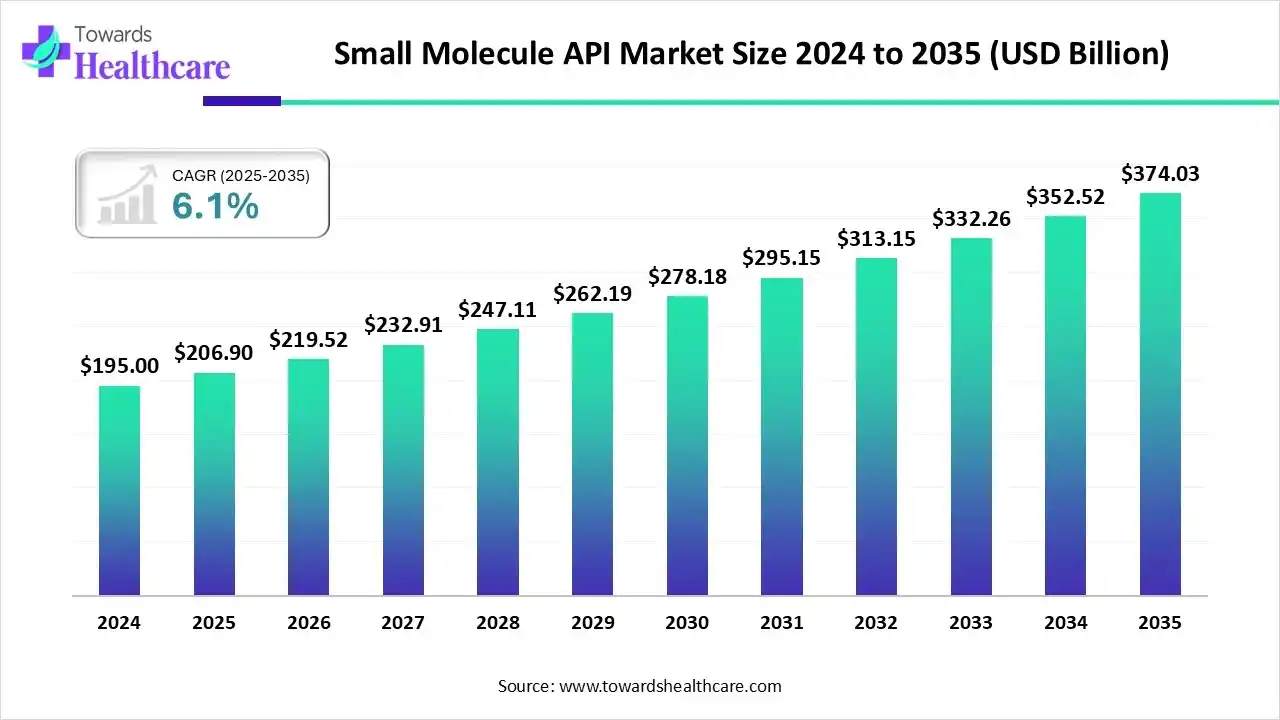
The overall market development is specifically fueled by a rise in demand for small-molecule medications across different therapeutic areas, especially in oncology, cardiovascular diseases, & diabetes management. Alongside, many of the largest pharmaceutical firms are accelerating investments to enhance internal production capabilities and lower reliance on external API suppliers. In 2025, North America dominated the small molecule API market with a revenue of roughly 45%. Asia Pacific is predicted to expand rapidly in the market in the coming years.
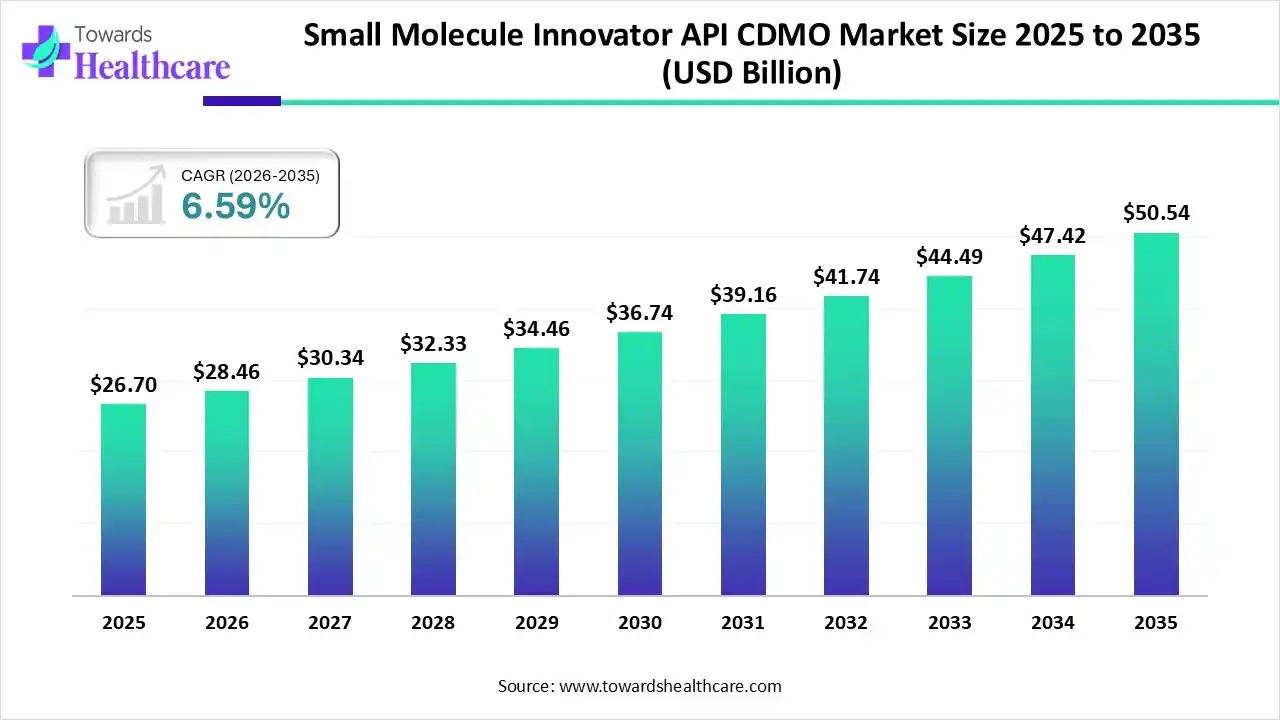
According to Towards Healthcare, the global small molecule innovator API CDMO market size was estimated at USD 27.6 billion in 2025 and is predicted to increase from USD 28.46 billion in 2026 to approximately USD 50.54 billion by 2035, expanding at a CAGR of 6.59% from 2026 to 2035. Asia Pacific registered dominance in the market due to the robust presence of developed CDMOs, expansion of pharmaceutical R&D activities, favourable government initiatives, & growing outsourcing from global pharma companies, especially to India and China. North America is estimated to expand at a rapid CAGR, with strong pharmaceutical and biotechnology innovation, surging clinical activity, & accelerating demand for complex small-molecule APIs.
Regional Landscape of Small-Molecule API Manufacturing
North America
This region dominated small-molecule API manufacturing due to supply-chain onshoring, sophisticated continuous manufacturing, & specialized CDMOs. It has major hubs across Boston, MA, and Morrisville, NC, which widely facilitate the unification of AI-enabled synthesis & stricter FDA compliance to secure domestic drug pipelines. Nowadays, regional firms are transitioning from traditional batch processing to continuous flow chemistry, drastically lowering waste, enhancing yields, & compressing lead times. The U.S. FDA is increasingly publishing rigorous guidelines, like alterations to Current Good Manufacturing Practices (CGMP) under 21 CFR Part 211, to ensure the highest levels of safety and impurity control.
Asia Pacific
Along with a major share, APAC is anticipated to expand rapidly in the small-molecule API market. Whereas, with vast petrochemical and fine chemical infrastructure, China is rapidly shifting towards complex, high-potency APIs (HPAPIs) & innovative CDMO services. Moreover, the Indian government’s Production-Linked Incentive (PLI) scheme is providing funds for bulk drug localization. Additionally, Indian companies are heavily investing in regulatory-compliant sites. Including upstream raw materials & fermentation of APIs, both nations are facilitating significant affordability advantages & accelerating the ‘China+1’ supply chain diversification strategy.
Europe
A notable growth of Europe in the small-molecule Api manufacturing industry, expanding leadership, which is propelled by innovating complex chemistry, leveraging sustainable green manufacturing practices, reinforcing highly potent API (HPAPI) containment technologies, & maintaining the gold standard for regulatory excellence. Participation of thorough R&D expertise enables European facilities to master limiting impurity control & successfully scale up complex laboratory-synthesized molecules. European facilities are implementing micronization and spray drying to ensure precise control over crystal morphology and particle size, which are pivotal for bioavailability.
How to Choose the Right CDMO?
To choose the right CDMO, companies must go through different kinds of assessments, such as investigating the CDMO used Quality by Design (QbD) and Design of Experiments (DoE) to improve chemical synthesis & estimate processing variables. This will support leaders seeking united teams professional in route scouting, process development, & scale-up.
The developer should review the CDMO’s audit report/history & Drug Master File (DMF) track record. Also, confirm their facilities comply with the requirements of the company's target markets and meet global standards, such as the U.S. FDA & EMA. Furthermore, companies should examine the CDMO’s equipment train, i.e. do they have the reactor sizes, downstream processing, & particle engineering capabilities necessary for the player's expected batch sizes & volume demands.
Moreover, the company can file for case studies validating their success with similar compound complexities to reduce early-stage development challenges. One can look for assessing robustness of CDMO’s quality systems, especially about deviation management, change control, Corrective and Preventive Actions (CAPA), & data integrity.
The player must seek supply chain resilience, regional barriers, & proximity for technology transfers, with on-site supervision. CDMOs have a wide range of supplier networks that ensure consistency if logistics are disrupted. Apart from this, growing demand is pushing for visible reporting & dedicated project managers who proactively address project issues instead of just answering them. Also, verify their governance structures & joint steering committee landscapes.
Common Challenges During Clinical-to-Commercial Scale-Up
During the scaling up of small-molecule API, leaders are facing concerns in shifting from gram-scale lab reactions to 2,000-litre commercial reactors, which may change heat transfer & blending profiles. This further impacts the API’s polymorph, particle size distribution, & powder flowability, which directly affects downstream drug product formulation.
Certainly, research-grade reagents possess diverse trace impurity profiles & reactivities as compared to large-scale materials. Emerging minor changes in starting materials or catalysts can result in significant yield reductions & quality deviations.
Commercial-scale-up reactions may lower selectivity, which leads to the development of unexpected byproducts. So, here producers must highlight process limits to match rigorous regulatory guidelines.
Besides this, the emergence of small differences in production equipment, like agitator design in filter dryers, can result in major variations in isolated product yields & drying times.
Higher reliance on single-source suppliers can make commercial APIs vulnerable to regional interruption, cold-chain breaches, & material shortages. To prevent this, firms need secondary sourcing, strict vendor audits, & inventory projection.
Future Outlook for the Small-Molecule API CDMO Market
The prospective era will impel robust biotech pipelines via complex New Chemical Entities (NCEs), Targeted Protein Degraders (TPDs), and High-Potency APIs (HPAPIs). But many start-ups are facing a shortage of specialized capital infrastructure, containment facilities, & expertise to control these safely in-house. Hence, these companies will foster demand for outsourcing by CDMOs. Furthermore, the worldwide advancing digital approaches are spurring the use of virtual models in the developing biotech players. These models will majorly emphasize core R&D & discovery, necessitating end-to-end (E2E) CDMO partners to handle the comprehensive Chemistry, Manufacturing, and Controls (CMC) lifecycle. Along with accelerating market timelines, CDMOs are promoting geographically different, compliant, & vertically unified production footprints. To raise innovation in advanced technology integration, CDMOs are massively investing in these technologies to make them accessible for smaller companies & across the world.
In terms of personalized medicine, global facilities are targeting to offer smaller, patient-centric batches, along with inclining towards modular, miniaturized process equipment that can adjust to various molecules by omitting key capital investments. CDMOs will also strengthen continuous manufacturing, which is vital to produce smaller quantities on-demand, reduce waste, & enable real-time batch adaptations. The launch of novel molecular modalities often demands complex, multi-step synthesis using specialized catalysts, cryogenic reactions, & advanced chromatography.
To empower global supply chains, CDMOs are broadly advancing strong manufacturing networks, especially across North America, Europe, & major nations in Asia. Alongside, CDMOs are transitioning towards final markets to lower transfer times & logistical limitations. This will significantly ensure that crucial API intermediates are procured from regionally stable, allied nations to prevent trade embargoes, tariffs, and potential supply blockages. At the same time, emerging supply chain resilience initiatives are confirming business continuity, with just-in-case models to maintain strategic stockpiles & safety stock of needed chemical 7 early-stage raw materials.
Ongoing & upcoming investments in advanced manufacturing technologies are spurring us to step into intelligent, interconnected production settings, which will decrease batch failures, reduce variability, & ensure stringent real-time quality control. Moreover, stronger CDMOs are uncovering their investments in generative AI to assess historical reaction data & improve critical metrics. According to investigations, it seems that CDMOs are pushing their investments in unifying multiple unit operations into simplified processes that hugely minimize operational expenses, energy use, & waste. The worldwide impressive breakthroughs are promoting the latest collaborative robots, Automated Guided Vehicles (AGVs), and articulated robotic arms to manage precision-critical, repetitive, & highly vulnerable tasks. In the future, advanced entities will use IoT sensors & cloud-based systems to combine data perfectly from the shop floor to the enterprise level.
To elevate eco-friendliness, pharma giants & biotech firms announced intensive public commitments to achieve net-zero greenhouse gas emissions. This is drastically beneficial for CDMOs, which will enable investment in energy-efficient facilities, on-site renewable energy, & solvent recycling to overcome the carbon penalties that sponsors would otherwise incur. To bypass a heavy dependency on harmful solvents & multi-step reactions during small-molecule API manufacturing, sponsors are seeking CDMOs with green-by-design measures. In addition, these CDMOs are offering modern wastewater treatment, closed-loop solvent recovery, & rigorous compliance frameworks over non-compliant facilities.
Frequently Asked Questions (FAQs)
What core services do API CDMOs offer?
API CDMOs widely provide route scouting, process development, analytical method validation, Good Manufacturing Practice (GMP) clinical and commercial-scale manufacturing, with regulatory assistance.
Why are pharma leaders highly outsourcing API production?
During the production of intricate small-molecule API, firms need heavy investment, so to lower these capital investments in infrastructure, acquire access to specialized technologies, like continuous-flow chemistry and cryogenic reactions, and gain supply chain flexibility without heavy fixed expenses, companies are outsourcing API production.
What are HPAPIs, and why do they necessitate specialized production?
Primarily, Highly Potent Active Pharmaceutical Ingredients (HPAPIs) are leveraged increasingly in targeted oncology. These products massively need specialized, highly controlled containment settings to secure both the drug's integrity & the safety of operating personnel.
How does a CDMO ensure regulatory compliance?
CDMOs must stick to cGMP benchmarks, maintain strong Quality Management Systems (QMS), &help the sponsor's Drug Master File (DMF) or CMC submissions for global markets.
What criteria are necessary when choosing an API CDMO?
One should seek powerful technical capability, i.e. handling the company’s specific chemistry, an authorised regulatory track record, like the number of successful FDA/EMA inspections, development-to-commercial continuity at the same site to lower tech-transfer risks, & robust quality management systems.
Which regions are the dominant hubs for small-molecule API production?
Particularly, North America, Europe, & Asia-Pacific are key regions. Whereas India and China are globally prime for API production due to their extensive technical expertise, skilled talent, & cost-competitive cGMP infrastructure.
Conclusion
A growing demand & need for complex small-molecules API across the globe is encouraging leading CDMOs, like Lonza, WuXi STA, to explore their extensive end-to-end services in the emerging biotech companies. CDMOs act as a backbone for manufacturing complex entities, as they offer affordability, technical support, skilled expertise, & innovative continuous manufacturing ideas. To boost product yield, quality, & purity, major leaders are demanding outsourcing by advanced CDMOs, who possess scientific expertise, regulatory compliance, scalable manufacturing, innovations, & digital revolution. Specifically, digital transformation is bolstering the use of AI solutions, robotics, and predictive analytics to optimize process development, continuous manufacturing, & real-time data analytics to lower cycle times. Companies are stepping into long-term strategic alliances with experienced CDMOs to speed up their product’s development timelines, ensure supply chain resilience, support global commercialization, & maintain their competitive position in the emerging pharmaceutical framework. Subsidiary, sustainability across the API production facilities is allowing the use of green chemistry, eco-friendly solvents, & biocatalytic processes to comply with environmental guidelines & synchronise with ESG goals.