

Pipeline Programs

CGT Companies Tracked

Manufacturing Facilities


The global small molecule innovator API CDMO market size was estimated at USD 27.6 billion in 2025 and is predicted to increase from USD 28.46 billion in 2026 to approximately USD 50.54 billion by 2035, expanding at a CAGR of 6.59% from 2026 to 2035.
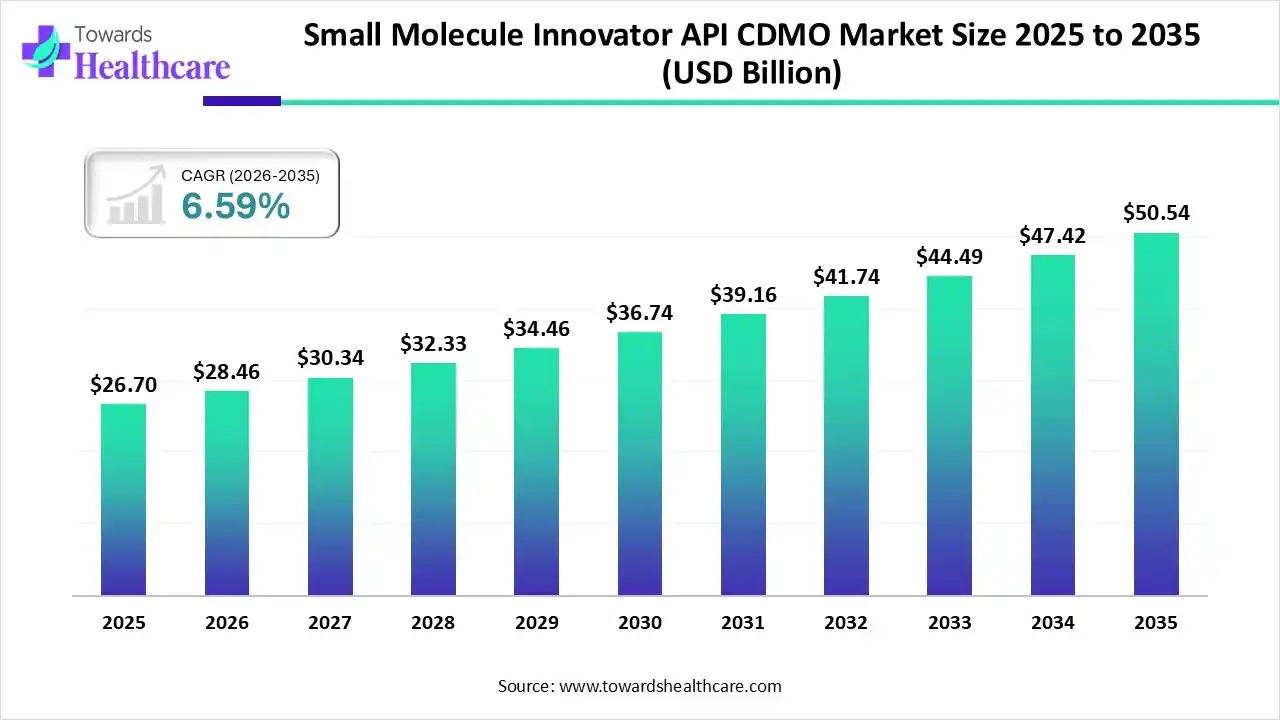
The market is growing as drug development increasingly outsources specialized synthesis and manufacturing to reduce costs, improve scalability, and focus on core research, driven by rising demand for complex APIs and global clinical expansion.
A small molecule innovator API CDMO is a contract development and manufacturing organization that specializes in producing active pharmaceutical ingredients (APIs) for novel small-molecule drugs, offering expertise in synthesis scale-up and regulatory-compliant manufacturing. The small molecule innovator API CDMO market is growing as pharmaceutical companies increasingly outsource API development and manufacturing to reduce costs, shorten drug development timelines, and access specialized expertise. Rising global demand for novel therapies, complex small-molecule drugs, and efficient scale-up capabilities are driving CDMOs adoption. Regulatory support and the need for flexible, high-quality production further accelerate market expansion worldwide.
The growing reliance on small molecule innovator API CDMOs is fundamentally reshaping how life-saving treatments reach the public. By handling the highly technical chemistry and strict regulatory compliance, these specialized manufacturing partners allow pharmaceutical companies to focus entirely on discovery and patient care. This collaborative model is especially crucial for smaller biotech startups that possess brilliant therapeutic ideas but lack the massive infrastructure required for complex chemical synthesis. Ultimately, this seamless integration of outsourced expertise means that breakthroughs move from a laboratory setting to clinical trials much faster. As medical needs become more precise and personalized, these flexible manufacturing facilities ensure that supply chains remain resilient, giving patients around the world quicker access to innovative, high-quality, and dependable therapies.
AI is set to revolutionize the market by optimizing drug design, predicting reaction outcomes, and accelerating process development. It enables faster synthesis route selection, improves yield and quality, and reduces development costs. By integrating AI-driven analytics, CDMOs can enhance efficiency, minimize risks, and deliver APIs more rapidly, strengthening their role in supporting innovative pharmaceutical pipelines.
| Table | Scope |
| Market Size in 2026 | USD 28.46 Billion |
| Projected Market Size in 2035 | USD 50.54 Billion |
| CAGR (2026 - 2035) | 6.59% |
| Leading Region | Asia Pacific by 43% |
| Historical Data | 2020 - 2023 |
| Base Year | 2025 |
| Forecast Period | 2026 - 2035 |
| Measurable Values | USD Millions/Units/Volume |
| Market Segmentation | By Stage Type, By Customer Type, By Therapeutic Area, By Region |
| Top Key Players | Lonza Group Ltd., Catalent, Inc. (Novo Holdings), Thermo Fisher Scientific, Inc., Siegfried Holding AG, Recipharm AB, CordenPharma International |
Why Did the Clinical Segment Dominate in the Small Molecule Innovator API CDMO Market in 2025?
The clinical segment dominated the market in 2025 as pharmaceutical companies increasingly outsourced early-stage API development for preclinical and clinical trials. CDMOs provided specialized expertise, flexible production, and rapid scale-up, ensuring efficient testing, regulatory compliance, and faster scale-up for novel small-molecule drugs, driving higher demand in clinical-stage manufacturing services.
Commercial
The commercial segment is expected to grow at the fastest CAGR during the forecast period as more small-molecule drugs successfully progress from clinical to commercial stages. Rising drug approvals, increasing demand for large-scale API manufacturing, and long-term outsourcing partnerships drive growth. CDMOs offer cost-efficient production, regulatory compliance, and scalable capacity, making them preferred partners for sustained commercial manufacturing.
What Made the Pharmaceutical Segment Dominant in the Small Molecule Innovator API CDMO Market in 2025?
The pharmaceutical segment dominated the market as large and mid-sized pharma companies increasingly relied on CDMOs to support their expanding small-molecule innovation pipelines. High R&D activity, strong financial resources, and the need to accelerate development timelines drove outsourcing. Additionally, pharma companies preferred CDMOs for regulatory expertise, relied on quality standards, and scalable manufacturing across clinical and commercial stages.
Biotechnology
The biotechnology segment is expected to grow at the fastest CAGR as biotech companies increasingly focus on innovative small-molecule therapies while lacking in-house manufacturing infrastructure. Heavily relance in CDMOs for end-to-end API development, cost efficiency, and faster scale-up supports growth. Rising venture funding, expanding biotech pipelines, and increased clinical activity accelerate outsourcing demand throughout the forecast period.
How did the Oncology Segment Dominate the Small Molecule Innovator API CDMO Market in 2025?
The oncology segment dominated the market due to the strong pipeline of cancer therapies requiring complex and high-potency APIs. Rising cancer prevalence, increased R&D investment, and accelerated regulatory approvals drive demand. CDMOs offered specialized capabilities in potent compound synthesis, scale-up, and compliance, making them essential partners for oncology drug development and manufacturing.
| Year | Oncology Approval (Drug/API) |
| 2024 | Osimertinib with chemotherapy (Tagrisso) |
| Lifileucel (Amtagvi) | |
| Tepotinib (Tepmetko) | |
| Irinotecan liposome (Onivyde combo) | |
| Erdafitinib (Balversa) | |
| Nivolumab + hyaluronidasenvhy (Opdivo Qvantig) | |
| Encorafenib + cetuximab + mFOLFOX6 | |
| 2025 | Acalabrutinib + bendamustine + rituximab (Calquence combo) |
| Brentuximab vedotin + lenalidomide & rituximab (Adcetris combo) | |
| Vimseltinib (Romvimza) | |
| Pembrolizumab + chemo (Keytruda combos) |
Infectious Diseases
The infectious diseases segment is expected to grow at the fastest CAGR during the forecast period due to rising global infection rates and the continued threat of emerging and drug-resistant pathogens. Increased investment in antiviral and antibacterial drug development, along with faster regulatory pathways, drives demand for rapid, scalable API manufacturing. CDMOs play a critical role by supporting accelerated development timelines and flexible production needs.
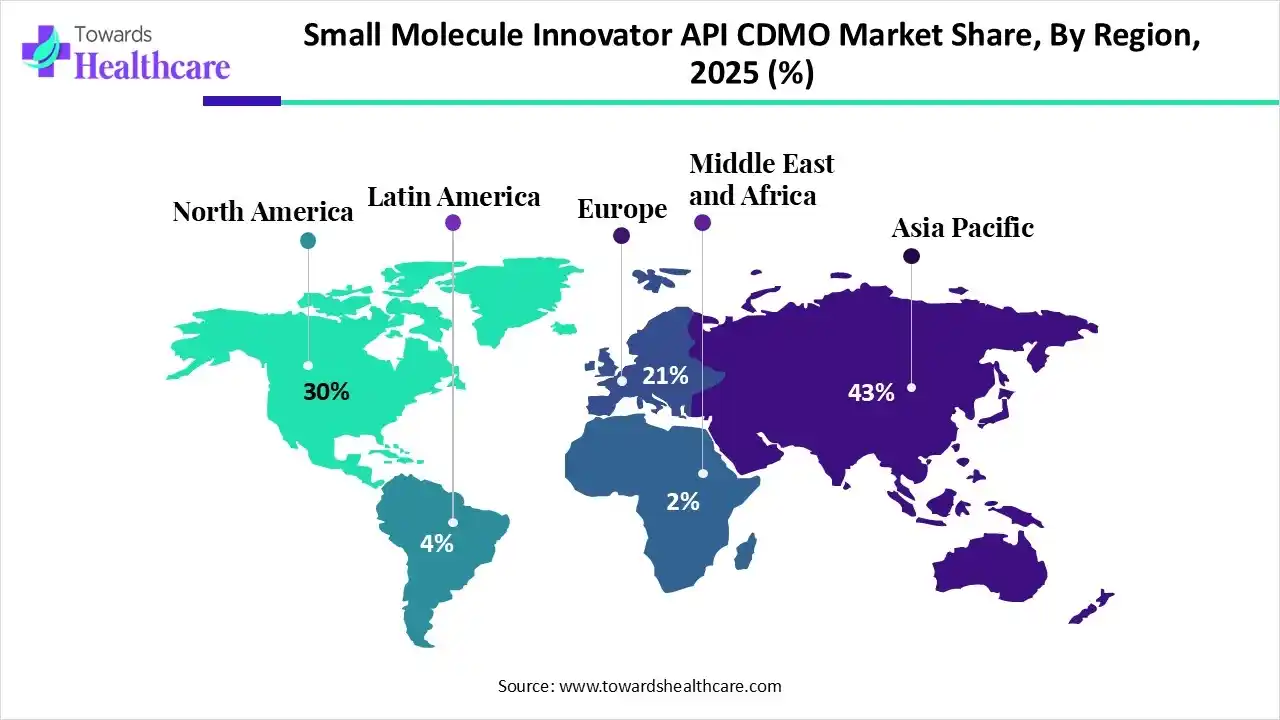
Asia Pacific dominated the market by 43% share in 2025 due to its robust manufacturing ecosystem, cost advantages, and availability of skilled chemists. Strong presence of established CDMOs, expanding pharmaceutical R&D activities, supportive government initiatives, and increasing outsourcing from global pharma companies, particularly to India and China, further reinforced the region’s market leadership and production scalability.
India Rise as a Global API CDMO Revenue Leader
India led the market in2025 by capturing the largest revenue share due to its strong expertise in small-molecule synthesis, cost-competitive manufacturing, and a large, skilled workforce. A robust network of established CDMIs, regulatory-compliant facilities, and growing trust from global pharmaceutical innovators accelerates outsourcing, long-term contracts, and high-volume API production, strengthening India’s revenue dominance.
China Market Trends
The market in China is expanding rapidly because local drug discovery efforts are increasing. Many domestic pharmaceutical firms now focus heavily on finding new treatments for cancer and heart conditions. To save money and move faster, these firms outsource their complex chemistry needs to local manufacturing partners. This shift allows companies to avoid building costly facilities while quickly turning scientific ideas into real medicines for patients.
North America is expected to grow by 30% share at the fastest CAGR during the forecast period due to strong pharmaceutical and biotechnology innovation, increasing clinical activity, and rising demand for complex small-molecule APIs. Growing outsourcing to specialized CDMOs, early adoption of advanced manufacturing technologies, and supportive regulatory pathways further accelerate development and commercialization, positioning the region for sustained high growth momentum.
U.S. Accelerates as a High-Growth Hub for API CDMOs
The U.S. is anticipated to grow at a rapid CAGR during the forecast period due to strong innovation in small-molecule drug development and a robust biotech ecosystem. Rising clinical trial activity, increasing demand for complex and high-potency APIs, and growing reliance on outsourcing drive growth. Advanced manufacturing technologies, favorable regulatory support, and faster commercialization timelines further strengthened the U.S. market outlook.
Canada Market Trends
The market in Canada is growing due to rising investments in medical research and development. Local drug companies are launching a steady stream of new projects that require outside assistance. Instead of doing everything inside their own labs, they team up with specialized manufacturing partners. These partners provide flexible factory space, unique production technologies, and faster setup times to help get new therapies ready.
Europe is anticipated to grow by 21% share at a notable CAGR during the forecast period due to increasing investments in pharmaceutical innovation and expanding clinical pipelines. Strong regulatory standards, growing demand for complex and high-value APIs, and rising outsourcing by pharma and biotech companies support growth. Additionally, focusing on sustainable manufacturing practices and advanced process technologies enhances Europe’s competitiveness and long-term market expansion.
UK Emerges as a Fast-Growing Hub in the Small Molecule Innovator API CDMO Market
The UK is anticipated to grow at a rapid CAGR during the forecast period due to strong pharmaceutical and biotechnology research, expanding clinical trials activity, and rising demand for innovative small-molecule drugs. Increased outsourcing to specialized CDMOs, supportive regulatory frameworks, and government initiatives promoting life science investment further accelerate market growth and strengthen the UK’s position in advanced API development and manufacturing.
Germany Market Trends
The market in Germany is advancing as European drug creators seek highly advanced manufacturing solutions. The country serves as a major hub for specialized production, especially for complex and highly potent ingredients. Local partners are spending heavily to upgrade their factories with automated systems and continuous production methods. These advanced technologies ensure reliable quality, strict safety standards, and efficient operations across the region.
R&D
Clinical Trials
Regulatory Approvals
| Companies | Headquarters | Offerings |
| Lonza Group Ltd. | Basel, Switzerland | End-to-end small-molecule API services including route scouting, process development, scale-up, HPAPI manufacturing, and commercial GMP production. |
| Catalent, Inc. (Novo Holdings) | New Jersey, USA | Integrated API development, clinical and commercial manufacturing, formulation support, and supply solutions for innovator small-molecule programs. |
| Thermo Fisher Scientific, Inc. | Massachusetts, USA | Small-molecule API process development, cGMP manufacturing, analytical services, and global clinical-to-commercial supply through its CDMO network |
| Siegfried Holding AG | Zofingen, Switzerland | Custom API synthesis, process optimization, scale-up, and commercial manufacturing for innovative small-molecule drugs. |
| Recipharm AB | Stockholm, Sweden | Small-molecule API development, clinical manufacturing, oral solid dosage production, and integrated drug development services. |
| CordenPharma International | Basel, Switzerland | Specialized API development, high-potency compound manufacturing, process scale-up, and commercial GMP production. |
| Samsung Biologics | Incheon, South Korea | Primarily biologics-focused, with limited small-molecule and integrated biopharma development support for innovator pipelines. |
| Labcorp | North Carolina, USA | Early-stage API development support, analytical services, formulation, and clinical trial supply enabling accelerated small-molecule development. |
Strengths
Weaknesses
Opportunities
Threats
In May 2025, Jan Vertommen, vice president of commercial development, Advanced Synthesis, Lonza, said: “Lonza is transforming the development of small molecule APIs by advancing innovative offerings targeting faster development and optimisation of synthetic API manufacturing processes. With the rising complexity of APIs in mind, these new offerings aim to reduce the time it takes to move from early candidate selection to first-in-human materials.”
By Stage Type
By Customer Type
By Therapeutic Area
By Region



Principal Consultant
Rohan Patil is a seasoned market research professional with over 5+ years of focused experience in the healthcare sector, bringing deep domain expertise, strategic foresight, and analytical precision to every project he undertakes.
Learn more about Rohan Patil

Reviewed By
Aditi Shivarkar is a seasoned professional with over 14 years of experience in healthcare market research. As a content reviewer, Aditi ensures the quality and accuracy of all market insights and data presented by the research team.
Learn more about Aditi Shivarkar









