


Bausch + Lomb Corporation, an important worldwide eye health organization intended to support patients to see better to live better, announced that two of its pharmaceutical pipeline assets both first-in-class treatments, will advance to novel trials based on recent clinical outputs.
"Helping people see better to live better starts with tackling the challenges patients still face every day," said Bausch + Lomb CEO Brent Saunders. "These results support our approach to developing differentiated therapies that have the potential to address significant unmet needs and change the standard of care in eye health."
Dry eye disorder is a challenging, multifactorial condition affecting millions of patients globally. While present prescription therapies can efficiently tackle individual causes of dry eye disease, no approved management addresses both the inflammatory and evaporative drivers of the disease in a single therapy. Patients often continue to experience persistent symptoms despite management, highlighting the requirement for novel strategies that more widely address the condition.
Bausch + Lomb has developed a first-in-class dual-action eye drop that integrates 5% lifitegrast (the active ingredient in XIIDRA) and perfluorohexyl octane (PFHO; the active ingredient in MIEBO) in the single twice-daily management designed to address both eyes surface inflammation and tear evaporation two of the significant underlying causes of dry eye disorder.
A four-week, randomized, double-masked, parallel-group, active-controlled Phase 2 study enrolled 443 patients with dry eye disorder in the six arms: the dual-action eye drop, lifitegrast alone, PFHO, and three vehicle masking controls. This was the first clinical study of the integration, and Day 29 was selected as the significant endpoint time point in the absence of prior human information on the timing of the integrated management effect.
The research did not meet its primary endpoint of superiority over lifitegrast alone in reducing total corneal fluorescein staining (tCFS) from baseline at Day 29, although results statistically favored the dual-action eye drop. A pre-specified secondary analysis at Day 15 - a timepoint accepted by the Food and Drug Administration as a registrational significant endpoint for tCFS presented a potentially reducing in mean transformation from baseline tCFS for the dual-action eye drop versus lifitegrast alone. At Day greater reduction, 41.6% of patients managed with the dual-action eye drop achieved a ≥3-unit advancement in tCFS, as compared with 18.8% of patients treated with lifters alone and 31.6% managed with PFHO alone.
The safety profile in all three management groups was consistent with the established profiles of XIIDRA and MIEBO, with no new safety signals identified.
The data provide a clear path forward, and Bausch + Lomb will advance the dual-action eye drop into Phase 3 development with a primary endpoint at Day 15.
Significantly, the dual-action eye drop achieved this output with more than 50% less lifitegrast volume than XIIDRA and half the dosing frequency of MIEBO. The organization believes this profile a rapid management efficiency at a reduce drug load and simplified dosing regimen supports the design of Phase 3 research to demonstrate advantage to both patients' therapies. Details of the Phase 3 program will be shared in the coming months.
"This was the first time this combination has been studied in humans, and it did exactly what a Phase 2 should do: demonstrated a rapid, robust treatment effect and told us precisely when to measure it," said Yehia Hashad, MD, executive vice president, R&D and chief medical officer, Bausch + Lomb. "With a pre-specified result of this strength at a registrationally accepted timepoint achieved with less drug than the individual therapies, and the ability to increase the dose based on an acceptable safety profile, we're advancing to Phase 3 with a clear design and high conviction."
Ocular Surface Pain Program: Positive Phase 1b Results Confirm TRPV1 Mechanism in Humans and Support Continued Development of BL1332; Phase 2 Results Expected Within Next Few Months
Ocular surface pain is the leading reason patients seek care from eye care professionals and affect patients with dry eye disease, corneal disease, and post-surgical challenges. Despite its prevalence and impact on quality of life, there are currently no approved therapies particularly intended to specific the underlying neurosensory pathways responsible for ocular surface pain, leaving major patients with incomplete treatment choices.
Bausch + Lomb has advanced BL1332, a first-in-class topical TRPV1 antagonist intended to target a significant receptor involved in ocular pain signaling. Different therapies that significantly tackle related signs or symptoms, BL1332 is designed to directly modulate the biological pathways that drive ocular surface pain. The new therapy is being assessed as a significant management for multiple forms of ocular surface pain, involving post-surgical, acute, and chronic conditions. Depends on its mechanism and clinical experience to date, the organization believes BL1332 helps advancement in the multiple ocular surface pain patient populations.
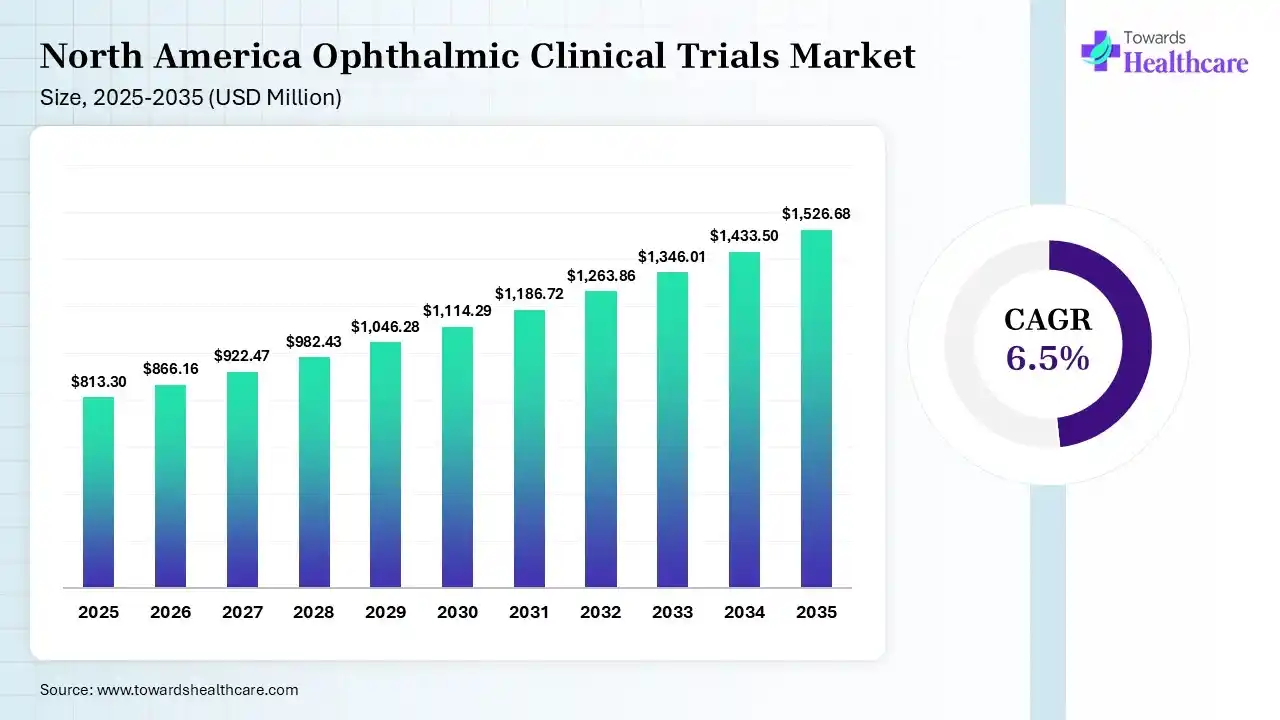
According to Towards Healthcare, the North America ophthalmic clinical trials market is projected to grow significantly, with estimates indicating the market size will increase from USD 866.16 million in 2026 to approximately USD 1526.68 million by 2035, expanding at a CAGR of 6.5% from 2026 to 2035. Ophthalmology clinical trials are the significant of solution in vision care, playing a significant role in the advancement of novel treatments, diagnostics, and therapies for eye disease.
As conditions such as glaucoma, macular degeneration, and diabetic retinopathy continue to affect millions of patients global, these trials show one of the most significant pathways to protecting and restoring sight. Ophthalmology clinical trials are research research that test novel treatments, drugs, or devices aimed at avoiding, diagnosing, or managing eye diseases and conditions. These trials are significant for determining the safety and efficiency of novel interventions before they reach extensive use. They generate the healthcare data required to develop better therapeutic strategies, significantly transforming the lives of lots living with vision losses.
These companies goal is simple, they supports patients to see advance to live better, all over the world. For nearly two centuries, companies emerging with the changing requirement of patients and customers, and commitment to innovation and enhancing the standard of care in eye health has never been stronger. From contact lenses to prescription products, over-the-counter options, surgical tools and more, turning bold standard into better results via passion, perseverance, and purpose.
A recent report by Towards Healthcare highlights that the North America ophthalmic clinical trials market is growing, as ophthalmology research trials are planned research intended to assess the safety and efficiency of novel interventions for eye conditions. These trials includes therapeutics, surgical processes, diagnostic tools, or even lifestyle intervention's goal at preserving or enhancing vision. Ophthalmology has witnessed amazing progress over the past some decades. This technology is significantly driven by precious research and clinical trials that test novel treatments, equipment, and therapeutics. These trials are important for enhancing patient results and expanding understanding of eye diseases. Ophthalmology research trials are structured studies intended to evaluate the safety and efficiency of novel interventions for eye conditions. These trials includes therapeutics, surgical procedures, diagnostic devices, or even lifestyle interventions aimed at preserving or enhancing vision.


