


Chemists at Northwestern University effectively repurposed flexible DNA strands as a programmable "molecular glue" to guide proteins into accurate crystal structures.
Researchers have massively relied on conscientious trial and error to coax proteins into crystalline forms. Crystallization allows researchers to regulate the molecular structures of proteins, which offers a blueprint for designing medicine, engineering enzymes, and treating disease.
Recently, Northwestern University chemists have advanced a novel strategy that substitutes a tedious, unpredictable technology with intentional design.
In a novel study, Northwestern scientists repurposed flexible DNA strands as a blueprint and programmable molecular glue. With application DNA, the team directed proteins to assemble into diffraction-quality, intentionally intended crystal structures with atomic-level order. The approaches allowed the researchers to precisely control how proteins connect, making generally soft, elastic crystals while attaining the high structural order required to identify protein structures.
Not only does the work streamline one of structural biology's most problematic challenges, but it also overturns a long-held statement that flexible building blocks cannot produce crystals with atomic-level order. The strategy also could allow a novel generation of flexible, customizable biomaterials for biosensing, drug delivery, bioelectronics and robotics.
"The implications of this research are profound," said Northwestern's Chad A. Mirkin, who led the study. "Proteins are the building blocks of life, and their structure determines their function. When we intentionally determine those structures, we gain powerful new insights into how proteins recognize other molecules, catalyze chemical reactions and interact with living systems. That knowledge ultimately helps us identify new drug targets, design new medicines and engineer new materials."
A nanotechnology innovator, Mirkin is the George B. Rathmann Professor of Chemistry, a professor of medicine (including hematology and oncology) and a lecturer of chemical and biological engineering, biomedical engineering and materials science and engineering at Northwestern, where he has appointments at the Weinberg College of Arts and Sciences, Northwestern University Feinberg School of Medicine and McCormick School of Engineering. He is the founding director of the International Institute for Nanotechnology. Zhenyu Han, who was an ex-student in Mirkin's laboratory at the time of the research, is the paper's first author.
From aggressive infections to processing food, proteins carry out nearly every significant task inside living cells. To appreciate how these molecular machines work and design medicine to target them, researchers need to regulate their three-dimensional structures.
X-ray crystallography is the gold standard for revealing these structures. In this method, researchers first coax billions of identical proteins to collect into a crystal. Then, they shine X-rays through the crystal and analyze the output diffraction patterns to rebuild the protein's atomic structure. But persuading proteins to form appropriate crystals is often one of the most problematic and unpredictable steps in the technology.
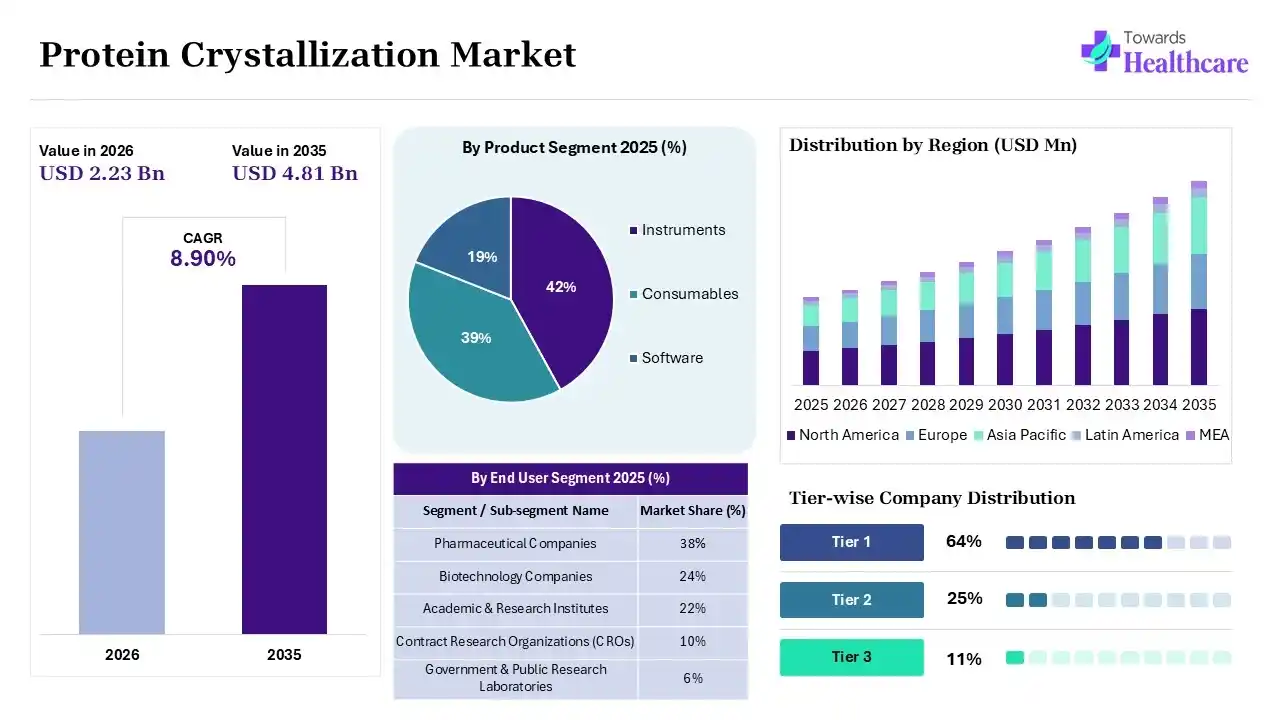
According to Towards Healthcare, the protein crystallization market is projected to experience significant growth, with estimates suggesting the market size will increase from USD 2.23 billion in 2026 to approximately USD 4.81 billion by 2035.Estimated to grow at a CAGR of 8.90% starting from 2026 to 2035. Protein crystallization plays a significant role in the food and biopharmaceutical industry, improving product quality and effectiveness by enhancing purity. Protein crystals offer major benefits as biopharmaceutical medicine carriers, involving intrinsic biocompatibility and biodegradability, improving stability, controlled release, and effective endosomal escape abilities. As the demand for life-saving biopharmaceutical medicines continues to rise.
Generally, proteins crystallize as parts of their surfaces happen to stick together via multiple, weak chemical interactions. By contrast, Mirkin's team exploited DNA's natural tendency to seek out its seamless match. Every DNA strand is made up of four chemical letters A, T, C, and G, which pair in foreseeable ways. For instance, A always pairs with T, and C always pairs with G. When two complementary DNA strands meet one another, they impulsively snap together to form the familiar double helix.
To more validate the strategies, the team grew more than 1,000 protein crystals and resolved the atomic structures of 28 distinct protein-DNA designs. Despite systematically transforming DNA length and position, the output crystals consistently assembled in the designed architectures. That reproducibility, together with the direct visualization of DNA double helices connecting neighboring proteins in the crystals, gave the scientists confidence that DNA, not chance, focused the assembly.
A recent report by Towards Healthcare highlights that the protein crystallization market is growing as protein crystallization is a significant step in identifying the structure of proteins, which is important for understanding their work and advancing novel therapeutics. Furthermore, the technology of crystallization is especially challenging and takes a long time to attain success. Protein crystallization has significant advantages in developing a stable, safe, and efficient drug product.


