Pipeline Programs

CGT Companies Tracked

Manufacturing Facilities


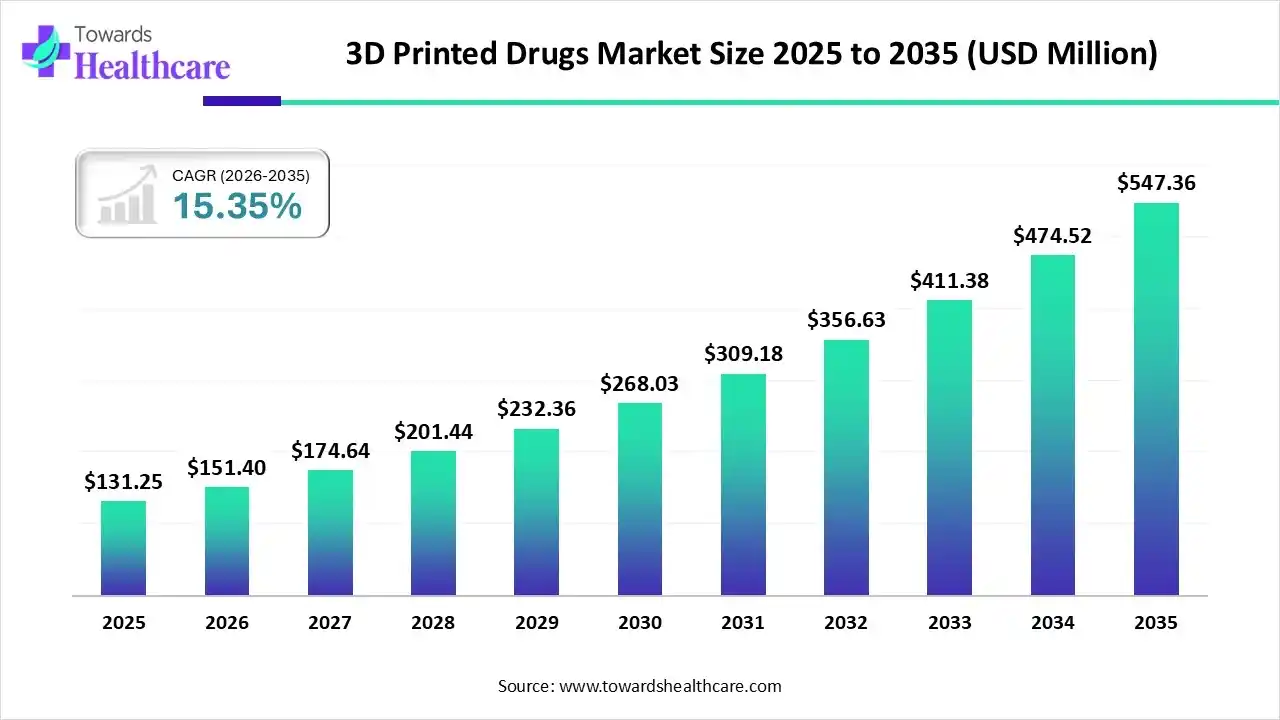
The global 3D printed drugs market size is calculated at US$ 131.25 million in 2025, grew to US$ 151.4 million in 2026, and is projected to reach around US$ 547.36 million by 2035. The market is expanding at a CAGR of 15.35% between 2026 and 2035. 3D printing technology is experiencing a global boom in the pharmaceutical sector. It has been showing various advantages compared to traditional technologies, such as fast manufacturing, accurate control of drug release, modification of drug doses and combinations, formulation of personalized pharmaceuticals, and many more.
Additive manufacturing technology is another name for 3D printing technology. In the pharmaceutical sector, the use of 3D printing technology has become more sophisticated in recent years. It holds several advantages compared to the traditional manufacturing process of drugs, such as personalized medications, easy and fast manufacturing, etc. It also develops complex 3D structures with precision, which provides advanced medicines. Immediate-release tablets, controlled-release tablets, dispersible films, microneedles, implants, and transdermal patches are the different types of products that can be manufactured by using 3D printing technology.
Precision and personalized medicines as per individual patients’ needs can be developed by using 3D printing; this helps to improve the therapeutic efficacy and patient outcomes. Despite this potential, 3D printing lags behind other established technologies. Thus, to overcome this drawback, in-silico tools along with artificial intelligence (AI) have been adopted. AI technologies are being applied to hasten developments in material synthesis and processing, such as predicting formulation processability, quality control of dosage forms, and clarifying drug interactions. All these applications require the training of models based on labeled data for learning patterns and making predictions. Along with the integration of AI with 3D printing, it shows various advantages as well as outshines in tasks such as classification and regression.
The 3D printed drugs market encompasses the development and manufacturing of pharmaceutical dosage forms using 3D printing technologies to create customized medicines with precise drug dose, structure, and release profiles. The market is growing as personalized medicines gain momentum and demand increases for patient-specific dosage forms, particularly for pediatric and geriatric populations. Key drivers include advances in pharmaceutical formulations, increasing research into complex drug-release systems, and growing interest in on-demand manufacturing.
Major trends include personalized dosing, polypills containing multiple active ingredients, and digitally controlled production. Technological advancements such as fused deposition modelling, stereolithography, inkjet printing, and selective laser sintering are expanding formulation possibilities. Future opportunities are emerging through personalized therapies, decentralized manufacturing, and integration of artificial intelligence with formulation design. Increasing pharmaceutical research, regulatory progress, and the ability to produce complex geometries and controlled-release formulations are further supporting market development.
Driver
Enhanced Drug Delivery
3D-printed drugs show precise drug release, which provides effective treatment options in complex conditions and diseases. It also helps in formulating target-specific drugs, which in turn minimizes the side effects. Furthermore, the dosing of drugs is carried out accurately as well, and different combinations of active pharmaceutical ingredients (API) can be incorporated into a single drug without any errors. Similarly, personalized medication can be developed depending on the patient’s condition and treatment options. Other than tablets or capsules, it can also be used to formulate nanoparticles, microspheres, or hydrogels. Moreover, with the help of prototype testing, the errors associated with formulation are identified, and thus, the adjustments required are achieved easily without any delay.
Restraint
Lack of Polymers Available
Usually, the polymers used in 3D printing drugs have to meet regulatory and safety standards. The availability of such polymers is limited. This makes the development of 3D-printed drugs challenging. At the same time, while formulating any new drug, the compatibility as well as its functionality need to be considered. Otherwise, the drugs cannot be compacted uniformly, or their release patterns may be disturbed. Furthermore, the polymers used by different techniques of 3D printing are different, which limits the use of the same polymers for different techniques.
Opportunity
Advancing Pediatric Market
Bitter tablets or liquid solutions can decrease the adherence of children to the treatment. Thus, with the help of 3D printing, different shaped and taste tablets, mostly chewable tablets, are being formulated. Furthermore, personalized and orally disintegrating tablets are also being developed. Combination drugs are also used to reduce multiple dosing errors. All these factors are increasing the adherence of pediatric patients to the treatment.
For instance,
| Key Elements | Scope |
| Market Size in 2026 | USD 151.4 Million |
| Projected Market Size in 2035 | USD 547.36 Million |
| CAGR (2026 - 2035) | 15.35% |
| Leading Region | North America by 38% |
| Market Segmentation | By Technology, By Application, By End-use, By Region |
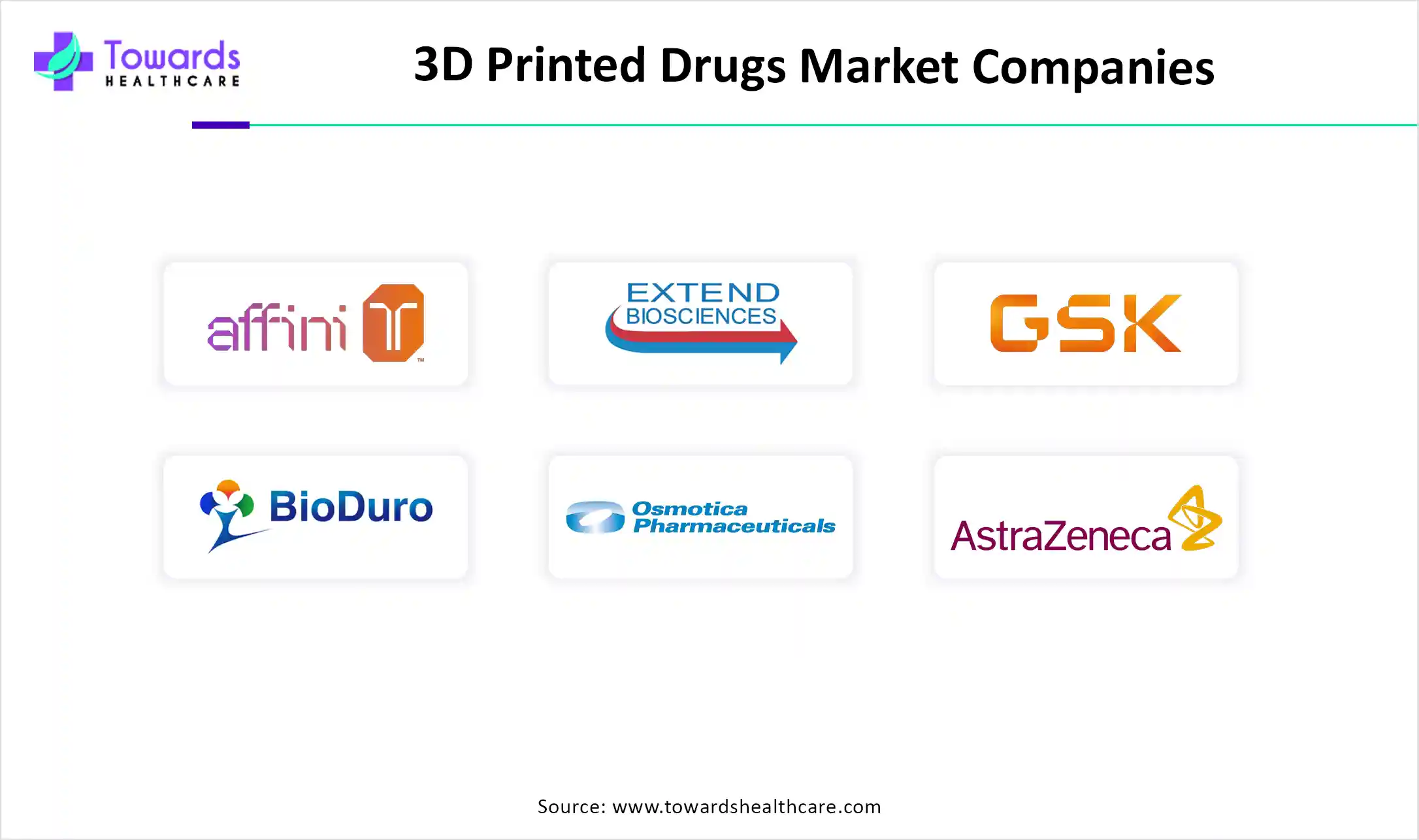
| Top Key Players | Aprecia, Affinity Therapeutics, Extend Biosciences, GlaxoSmithKline Plc, Merck, Bioduro, Osmotica Pharmaceuticals, Hewlett Packard Caribe, AstraZeneca, Cycle Pharmaceuticals, FabRx Ltd |
Which Technology Type Segment Dominated the 3D Printed Drugs Market?
By technology type, the zip dose segment dominated the market in 2025. It developed high-concentration drugs in a compact form that can be easily administered. It also manufactured various rapid disintegrating medications along with personalized medications. Its demand increased due to the use of these medications in pediatric and geriatric, which resulted in 3D printed drugs market growth.
By technology type, the inkjet printing segment is estimated to be the fastest growing at a notable CAGR during the forecast period. Inkjet printing provides precision in complex formulations and also develops multilayered drugs of different combinations. Furthermore, it also develops medications in different shapes with controlled release. This increases patients’ adherence to the treatment and enhances the market growth.
Why Did the Neurology Segment Dominate the 3D Printed Drugs Market?
By application type, the neurology segment dominated the market in 2025. Various personalized drugs were manufactured for different neurological disorders. Similarly controlled resealed drugs and targeted specific drugs were also used largely, which were developed by using 3D printing technology. This resulted in market growth.
By application type, the orthopedic segment is anticipated to grow significantly during the forecast period. The manufacturing, as well as the need for 3D printed complex drug formulations and personalized medication, are increasing. Furthermore, the demand for the use of biocompatible implants and fast-healing implants is also increasing. All the factors are promoting the market.
How the Hospitals & Clinics Segment Dominated the 3D Printed Drugs Market?
By end user, the hospitals & clinics segment dominated the global market in 2025. Different types of 3D-printed drugs are made available in hospitals & clinics to the patients. This helped in improving patient compliance with the treatment. Furthermore, the medications were made available quickly and at affordable prices. Thus, this amplified the market growth.
By end user, the research laboratories segment is predicted to grow significantly during the forecast period. The use of personalized medications has increased the interest in developing more such drugs for different diseases. Thus, the innovations in research laboratories are increasing. At the same time, the development of prototypes accelerates the drug development process. All these factors contribute to market growth.
North America dominated the 3D-printed drugs market share by 38% in 2024. North America has well-established healthcare facilities, which are well-equipped with advanced technologies of 3D printing. Due to this rapid production of prototypes, their testing and manufacturing of personalized drugs were achieved rapidly and effectively, which promoted the market growth.
The U.S. 3D Printed Drugs Market Trends
The U.S. has a large number of pharmaceutical companies, due to which the investments in 3D printing technology have increased. At the same time, research institutes are also focusing on developing new drug combinations using 3D technology. All these factors contribute to market growth.
The high prevalence of chronic diseases requires personalised and precise medicines that increase demand for 3D-printed drugs. Several 3D-printed drugs have been approved by the United States Food and Drug Administration.
The Canada 3D Printed Drugs Market Trends
The use of 3D printing has shown various applications in healthcare systems, due to which the government is continuously investing in the adoption of 3D printing technologies. Furthermore, the demand for personalized medicines has increased the demand for 3D-printed medicines in the market.
Asia Pacific is estimated to host the fastest-growing 3D printed drugs market during the forecast period. The number of industries in Asia Pacific is increasing along with technological advancements. The pharmaceutical and biotechnology industries are using 3D printing technology in various processes. This, in turn, has increased the demand for 3d printed drugs in the market.
The China 3D Printed Drugs Market Trends
China is collaborating with various national and international companies for the production of 3D-printed drugs. This contributes to the increased rates of production and distribution of 3D-printed drugs in the market. The government has also shown its support for the production of personalized drugs, which helps to drive the market.
The rapid growth in the healthcare sector increases demand for high-quality & cost-effective medical solutions, which increases demand for 3D printed drugs. The growing partnerships between international pharmaceutical companies and Chinese companies provide access to best practices in drug production & development, fueling demand for 3D printed drugs.
The India 3D Printed Drugs Market Trends
Due to the large population, the healthcare system is focusing on the development of affordable medication by using 3D printing technology. Thus, cost-effective personalized drugs are being manufactured for various diseases, which are made available to the population. All these factors boost the 3D-printed drugs market.
The strong government support helps in the innovation of 3D-printed drugs. For instance, the government initiative National Biopharma Mission encourages innovation in the healthcare sector.
Europe is expected to be significantly growing in the 3D-printed drugs market during the forecast period. Various research and development sectors, industries, and universities are investing their time in developing new formulations by using 3D printing technologies. This is due to the increased diseases, which have increased the demand for new drug combinations along with personalized medication, which in turn is driving the market.
The Germany 3D Printed Drugs Market Trends
Research institutes and industries are currently employing the use of 3D printing technology in various applications. Various new formulations are being formulated and tested as per the public demands. At the same time, the government is providing investments and funding for the same. This altogether is enhancing the market growth.
The well-established biotech sector fuels collaboration between regulatory bodies, industry, and academia, helping in the development of bioprinting technologies, which increases the adoption of 3D printed drugs.
The UK 3D Printed Drugs Market Trends
Most of the research and development sectors are currently focusing on the development of personalized drugs for various diseases. At the same time, various institutes are collaborating for the same. The use of personalized drugs, along with other combination drugs, has increased the adherence rate of patients to the treatment. All these factors are contributing to the market growth.
The Middle East & Africa are considered to be a significantly growing area, owing to the growing awareness about the benefits of 3D printing technology in the pharmaceutical sector. The increasing population and the rising prevalence of chronic disorders potentiate the need for medicines and new drug delivery systems. Favorable government support, rising R&D investments, and the growing adoption of advanced technologies favor market growth. The increasing demand for personalized medicines also propels the market.
UAE Market Trends
In April 2025, researchers from Al Ain leveraged state-of-the-art tools, such as a cryogenic freezer and a 3D bioprinter, to conduct stem cell research for the treatment of Alzheimer’s and Parkinson’s disease. The local startups also raise funding to adopt 3D printing technologies. In July 2025, BioSapien raised $1.8 million to support the development of its MediChip, a 3D printed biodegradable mesh to deliver cancer drugs at the target site.
South Africa Advances 3D-Printed Drug Innovation
South Africa’s 3D-printed drugs market is significantly growing due to increasing pharmaceutical research, rising interest in personalized medicine, and expanding adoption of advanced drug-delivery technologies. Growing academic and biotechnology research into 3D printing is supporting development of customized dosage forms and controlled drug-release systems. Increasing healthcare innovation, local research capabilities, and demand for patient-specific therapies are creating further opportunities for 3D-printed pharmaceuticals.
R&D
The latest research focuses on the development of effective and safe delivery of personalized treatment regimens.
Key Players: Triastek, Merck Group, and Aprecia Pharmaceuticals.
Clinical Trials & Regulatory Approval
Clinical trials demonstrate the efficacy and acceptability of personalized 3D printed medicines.
Key Players: MB Therapeutics, FABRX, and Materialise.
Patient Support & Services
Patient support refers to providing personalized medicines with tailored dosage and combined medications, as well as guiding patients about drug delivery.
By Technology
By Application
By End-use
By Region



Principal Consultant
Payal Rabde is a Healthcare Market Research Analyst at Towards Healthcare Research & Consulting with 4+ years of experience in pharmaceuticals, biotechnology, medical devices, and life sciences.
Learn more about Payal Rabde

Reviewed By
Aditi Shivarkar is a seasoned professional with over 14 years of experience in healthcare market research. As a content reviewer, Aditi ensures the quality and accuracy of all market insights and data presented by the research team.
Learn more about Aditi Shivarkar