Pipeline Programs

CGT Companies Tracked

Manufacturing Facilities


The global behavioural mental health tools market size was estimated at USD 3.36 billion in 2025 and is predicted to increase from USD 3.85 billion in 2026 to approximately USD 13.28 billion by 2035, expanding at a CAGR of 14.74% from 2026 to 2035.
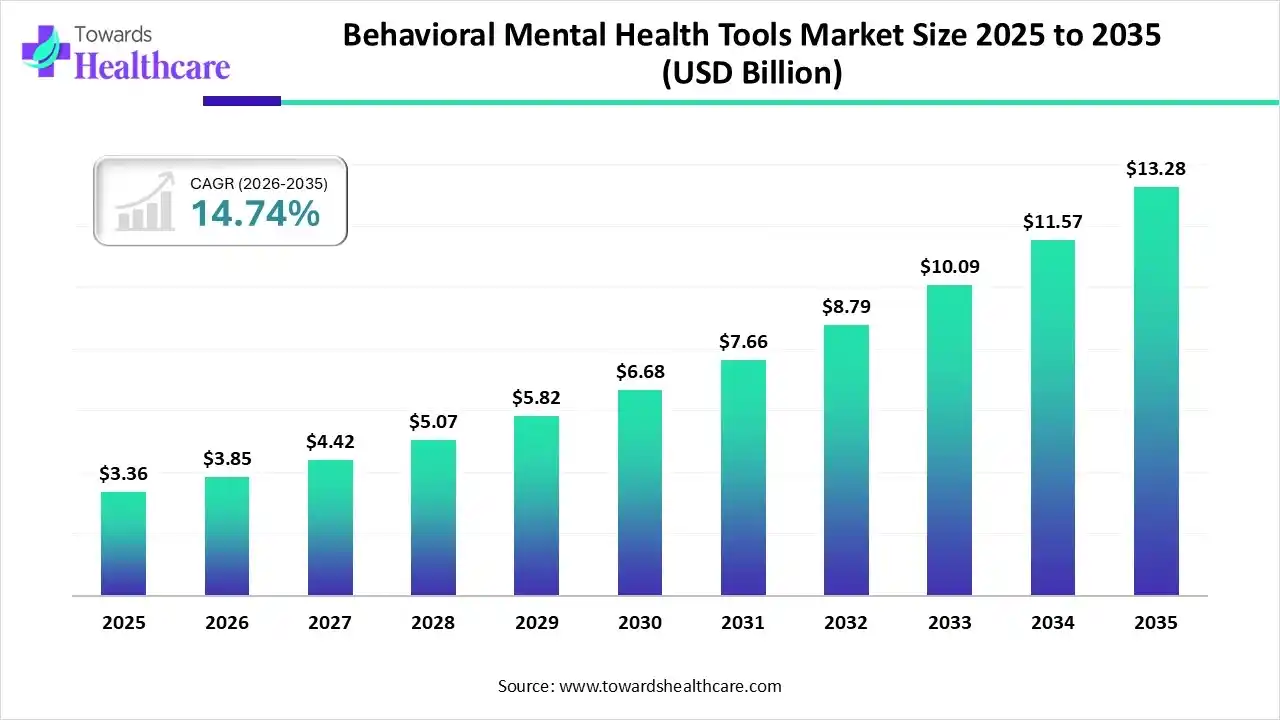
The behavioural mental health tools market is growing as these tools are significant for enhancing diagnosis, allowing early intervention, targeted treatment, and tracking development. These tools indicate their patients' mental and behavioural health.
| Key Elements | Scope |
| Market Size in 2026 | USD 3.85 Billion |
| Projected Market Size in 2035 | USD 13.28 Billion |
| CAGR (2026 - 2035) | 14.74% |
| Leading Region | North America |
| Market Segmentation | By Component, By Delivery Model, By Functionality, By End User, By Region |
| Top Key Players | Universal Health Services, Inc., Magellan Health, Inc., Beacon Health Options, LLC, Teladoc Health, Inc., Acadia Healthcare Company, Inc., LifeStance Health Group, Inc., Hims & Hers Health, Inc. |
The behavioural mental health tools market encompasses a wide range of services, therapies, medications, and support programs intended to manage, diagnose, and treat mental and behavioural health conditions like anxiety, depression, bipolar disorder, trauma-associated disorders, and substance abuse. It involves clinical treatments, counselling, digital therapies, and pharmacotherapy delivered in outpatient, inpatient, home-driven, and telehealth settings. Growth is driven by the increasing prevalence of mental disorders, rising awareness, technological acceptance, and expansion of care access worldwide.
The integration of AI-driven technology into the behavioural mental health tools market is AI-based for mental health drive computerized cognitive-behavioural therapy (CBT) programs, which focus on changing thinking patterns to recognize distortions, using challenge-solving to cope with problematic situations, and changing behavioural patterns, like facing fears instead of avoiding them, breaking the cycle of negativity, and building resilience. By providing real-time feedback and progress tracking for patients, AI-assisted technology in mental healthcare tailors interventions based on patients' requirements.
Which Component Led the Behavioural Mental Health Tools Market in 2024?
In 2025, the software segment held the dominant market as it enables physicians to monitor patient advancement at various stages of treatment and adjust strategies to improve results. Behavioural and mental health software enables practitioners to evaluate both short-term and long-term results with tools such as worldwide assessments, clinical notes, and patient interaction records.
Support Services
Whereas the support services segment is the fastest-growing in the market, as it improves the efficient advancement, availability, and management of abilities in an organization, including functions such as finance, human resources, and information systems. It provides informational and psychosocial support, lowers social isolation, and attaches patients and caregivers to others with similar health challenges.
Why did the Ownership Model Segment Dominate the Market in 2024?
The ownership model segment is dominant in the behavioural mental health tools market in 2025, as it drives a feeling of ownership and control over living spaces, leading to better mental well-being, increased self-esteem, and reduced stress levels. Ownership is related to positive results for the organization, including growing motivation, stewardship, and loyalty.
Subscription Model
Whereas the subscription model segment is the fastest growing in the market, as a subscription-based behavioral health model reduces the challenges of insurance billing. This model provides a simpler, patient-focused approach. The subscription model creates financial predictability, enabling practices to manage cash flow more efficiently.
Why is the Clinical Functionality Segment Dominant in the Market?
In 2025, the clinical functionality segment held the dominant behavioural mental health tools market share as it improved care quality, streamlining healthcare workflows, confirming data security and compliance, and enhancing patient results. These tools are custom-made exactly to the nuances of mental health care, rather than general healthcare practices.
Administrative Functionality
Whereas the administrative functionality segment is the fastest growing in the market, as administrative functionality in the behavioural mental health tools offers important benefits that modernize practice operations, ensure compliance, and eventually allow clinicians to dedicate more time to patient-driven care.
Why is the Hospitals Segment Dominant in the Market?
In 2025, the hospitals segment held the dominant share of the behavioural mental health tools market as this type of tool combines with mental healthcare in the general health solutions, making treatment more accessible and efficient, and eventually enhancing overall health results and lowering expenses. It also enables the early identification of mental health issues and challenging factors before they intensify into crises.
Community Clinics
Whereas the community clinics segment is the fastest growing in the market, as behavioral mental health tools have massive potential to be simply integrated into people's lives and significantly impact public health. These tools extend the reach and increase the influence of mental health interventions. It supports growing access to health care in regions with limited mental health resources and offers efficient treatment for mental health situations.
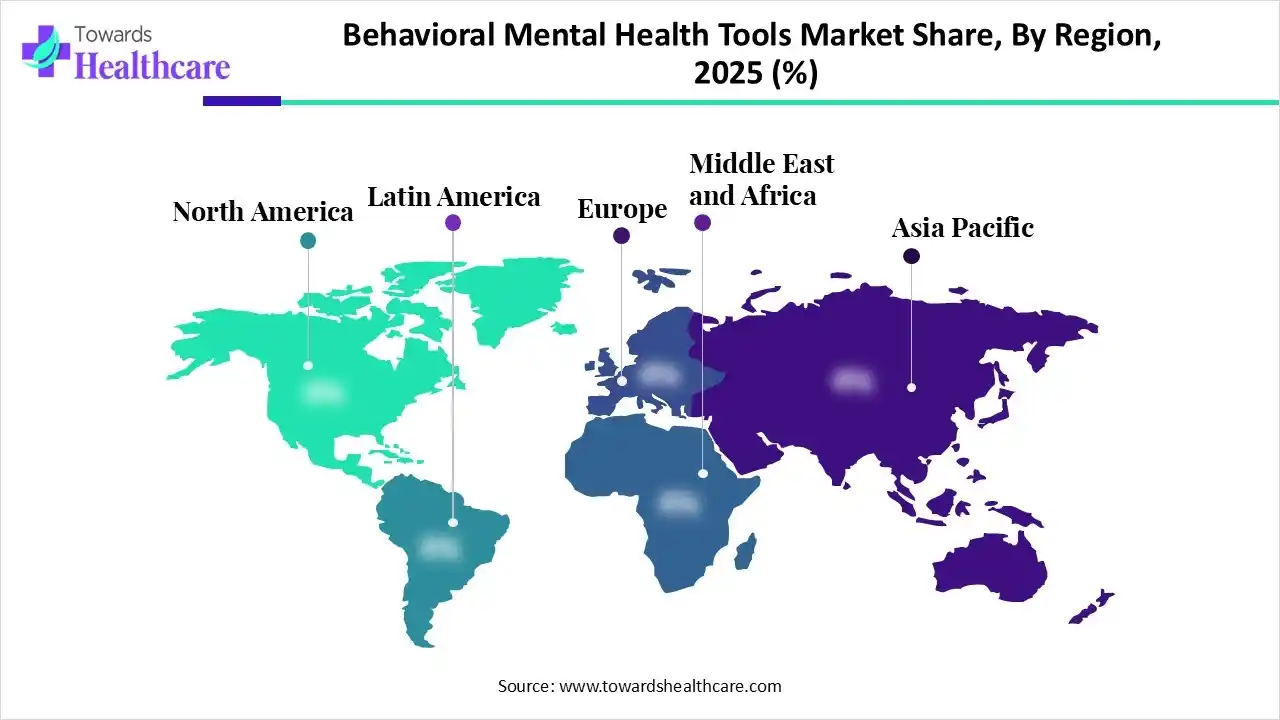
In 2025, North America led the behavioural mental health tools market, as the medical care system has spent significant resources in health research and pharmaceutical development, which has led to developed discoveries and enhanced treatments in a variety of fields. This region is well-positioned to be a leader in the evolving sector of targeted medicine. Employing novel guidelines to increase accessibility to medical care insurance and solutions.
U.S. Market Trends
The United States leads the world in healthcare R&D spending, with industry leaders consistently assigning significant resources to novelties. The United States has maintained its leadership in first-in-class therapies and breakthrough technologies, driven by advanced regulatory pathways, noteworthy multinational corporation spending, an advanced research and development (R&D) workforce, and incessant technological innovations.
Asia Pacific is set to experience rapid growth in the behavioural mental health tools market, as Governments, health establishments, and cross-border working groups are present, formalizing standards for data governance, cybersecurity, interoperability, and healthcare validation, creating the guardrails that define how digital health scales responsibly. Smartphone and internet penetration are soaring, governments in the region are backing telemedicine with policy and infrastructure, and demand for remote care is intensifying, particularly in rural areas and among aging people.
India Market Trends
India accounts for 18% of the worldwide population. WHO approximates that the challenges of mental health problems in India are 2443 disability-adjusted life years (DALYs) per 10000 population. India has evolved as one of the most vibrant startup ecosystems worldwide and is currently ranked as the world’s third-largest startup hub. India is a hub for around 450 mental health start-ups and accounts for 6% of such start-ups worldwide. India is currently home to 157,066 registered startups, and reports suggest a record number of advanced startups launched nationwide in the present times.
Europe is experiencing substantial growth in its behavioural mental health tools market, as the WHO European Framework for Action on Mental Health (EFAMH) provides a coherent basis for intensiï¬ed efforts to promote, mainstream, and safeguard mental health, which drives the growth of the market. There are various EU-driven campaigns and national initiatives to destigmatize mental illness and increase well-being. The EU4Health program and Horizon Europe offer significant funding for mental health promotion and AI-based innovations.
The UK has an advanced research situation, with partnering between universities, medical care providers, and the private sector growing innovation. With increasing demand for mental health help, there is a significant requirement for accessible and scalable services. The UK government made mental health a priority, launching inclusive strategies like the NHS Long Term Plan and the Mental Health Goals program. Revolutionize UK is spending over £3.6 million in business-led projects developing therapeutic extended reality (XR) services to offer mental healthcare solutions.
| Company | Headquarters | Latest Update |
| Universal Health Services, Inc. | United States | In June 2025, Hippocratic AI, the worldwide leader in safety-focused generative AI agents for healthcare, and Universal Health Services announced that GenAI agents that support clinicians by making discharge follow-up outreach to patients by phone have been deployed. |
| Magellan Health, Inc. | Texas | Magellan Healthcare's Behavioral Healthcare Management Solution combines 50 years of clinical excellence with today's leading-edge technologies. |
| Beacon Health Options, LLC | United States | Beacon Behavioral partnered accelerates mission to expand mental health access nationwide with the addition of five new partners |
| Teladoc Health, Inc. | United States | Teladoc Health provides inclusive care containing talk therapy, diagnosis, and medication support. |
| Acadia Healthcare Company, Inc | United States | Acadia Healthcare's behavioral health treatment facilities specialize in supporting children, adolescents, adults, and seniors who are suffering from mental health issues. |
| LifeStance Health Group, Inc. | United States | LifeStance has partnered with Calm Health to connect Calm users with complex mental health needs to LifeStance clinicians for direct clinical care. |
| Hims & Hers Health, Inc. | United States | In July 2025, Hims & Hers Health, Inc. is actively leveraging artificial intelligence (AI) to revolutionize the delivery of healthcare, with the goal of making it more targeted, accessible, and scalable. |
By Component
By Delivery Model
By Functionality
By End User
By Region




Principal Consultant
Deepa Pandey is a focused and detail-oriented market research professional with growing expertise in the healthcare sector, delivering high-quality insights across therapeutic areas, diagnostics, biotechnology and healthcare services.
Learn more about Deepa Pandey

Reviewed By
Aditi Shivarkar is a seasoned professional with over 14 years of experience in healthcare market research. As a content reviewer, Aditi ensures the quality and accuracy of all market insights and data presented by the research team.
Learn more about Aditi Shivarkar