Pipeline Programs

CGT Companies Tracked

Manufacturing Facilities


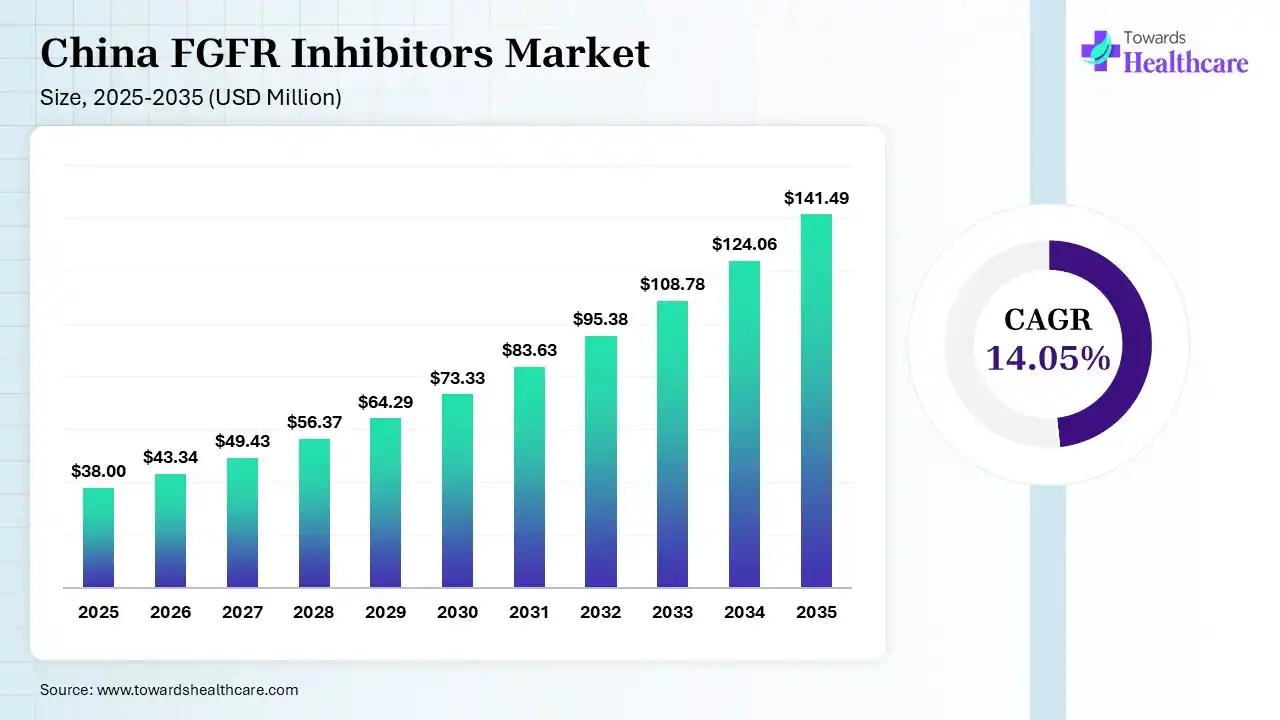
The China FGFR inhibitors market is estimated at USD 43.34 million in 2026, and is projected to reach USD 141.49 million by 2035, expanding at a CAGR of 14.05% from 2026 to 2035, driven by rising demand for biomarker-targeted cancer therapies, wider molecular testing, and the development of treatments for FGFR-altered cancers.
FGFR inhibitors target the fibroblast growth factor receptor pathway, which can contribute to tumour growth and progression when specific genetic alterations are present. These medicines offer targeted treatment options for selected patients with cancers such as intrahepatic cholangiocarcinoma and urothelial carcinoma. Market demand depends on the number of patients with actionable FGFR alterations, the availability of approved treatments, testing rates, treatment-line eligibility, and access to oncology care.
China’s market includes approved therapies and locally developed candidates at different stages of clinical and regulatory development. Commercial adoption depends on the strength of clinical evidence, product-specific indications, physician awareness, molecular diagnostic capacity, reimbursement, and treatment affordability.
A Chinese molecular epidemiology study identified FGFR2 fusions or rearrangements in 44 of 717 intrahepatic cholangiocarcinoma samples (6.14%). In a separate Chinese Phase II study, pemigatinib achieved an objective response rate of 50% among 30 efficacy-evaluable patients and a disease-control rate of 100% at the initial analysis. These figures provide clinical context but do not represent the national prevalence of eligible patients or the commercial market size.
The China FGFR inhibitors market is segmented by FGFR target or genetic alteration, including FGFR2 fusions and rearrangements, susceptible FGFR3 alterations, and other FGFR alterations under investigation. It is also segmented by cancer indication, including intrahepatic cholangiocarcinoma (iCCA), urothelial carcinoma, and other solid tumours; by inhibitor profile, including selective FGFR inhibitors, multi-target inhibitors with FGFR activity, and resistance-focused candidates; and by market status, including approved therapies, products under regulatory review, and clinical-stage candidates. Additional segmentation covers treatment setting, molecular testing pathway, sales and access channel, and geographic region within China.
FGFR2-altered intrahepatic cholangiocarcinoma remains an important treatment segment because molecular testing identifies patients who may be eligible for targeted therapy. A Chinese molecular profiling study identified FGFR2 fusions or rearrangements in 44 of 717 iCCA samples (6.14%). This finding applies to the study population and should not be interpreted as the national prevalence of eligible patients. FGFR3-altered urothelial carcinoma represents another relevant segment, subject to the specific biomarker requirements and approved indications of each product.
Commercial value depends on eligible patients, treatment access, and product-specific evidence. Wider molecular testing can help identify patients with actionable alterations, but testing alone does not guarantee treatment uptake. Product approvals, treatment-line eligibility, clinical outcomes, reimbursement, affordability, and access to specialist oncology services also determine revenue. Resistance-focused therapies may create an additional opportunity for patients who progress after earlier FGFR inhibitor treatment, although investigational candidates should remain separate from marketed products in current market estimates.
The primary demand driver is the availability of treatments for cancers with actionable FGFR alterations. Targeted therapy creates a treatment option for a subset of patients whose disease has progressed after earlier treatment, but the addressable pool is narrow relative to the overall cancer burden. The commercial effect of each approval therefore depends on diagnostic coverage, identification of eligible patients, physician familiarity, treatment-line requirements and patient access.
A second driver is the development of inhibitors intended to address resistance or provide alternative activity in FGFR-driven disease. These products can broaden the treatment pathway for patients who progress on an earlier FGFR inhibitor. However, resistance-directed use is a separate segment and should not be merged with first FGFR inhibitor use without accounting for prior treatment.
Key constraints include low biomarker prevalence in some tumour populations, incomplete testing, heterogeneous fusion partners, acquired resistance, adverse-event monitoring, affordability and the need for specialist interpretation. Competition may also increase as additional targeted therapies or combination regimens become available.
FGFR inhibitor pricing should be assessed by product, indication, dose schedule, treatment duration and reimbursement status. List price alone does not establish the realized cost to the patient or payer. Discounts, hospital purchasing arrangements, insurance coverage, patient assistance, dose interruptions and treatment discontinuation can affect net revenue. Publicly accessible sources do not provide a consistent, comparable China net-price dataset for all relevant products.
Supply is determined by approved product availability, manufacturing and release arrangements, distribution coverage, hospital access and the ability to maintain consistent supply. Public disclosures do not provide a reliable, comparable measure of China-specific manufacturing capacity or utilization for the full FGFR inhibitor category. Capacity should not be inferred from a company’s overall manufacturing footprint.
The report evaluates product availability, marketing authorization holders, local distribution, supply continuity, manufacturing disclosures where available, and the potential impact of additional approvals. Demand is modelled from eligible and tested patients rather than from the total population with cancer.
The value chain extends from drug discovery and clinical development through regulatory submission, manufacturing, quality release, dispensing and post-treatment monitoring. Molecular diagnostics are commercially important because a patient generally needs a qualifying alteration documented before receiving a biomarker-directed therapy. Testing method, sample quality, turnaround time and interpretation can influence the conversion of diagnosed cancer cases into eligible treated patients.
The supply chain includes active pharmaceutical ingredient production, finished-dose manufacturing, quality assurance, regulatory release, distribution to hospitals and pharmacies, and pharmacovigilance. The report separates publicly disclosed corporate capabilities from product-specific China supply evidence.
FGFR inhibitors differ in target selectivity, kinase activity, clinical evidence, toxicity profile and potential activity against resistance-associated disease. The clinical benchmark should compare objective response rate, duration of response, progression-free survival, overall survival where mature, grade 3 or higher adverse events, discontinuation and study population. Cross-trial comparisons require caution because patient selection, prior therapy, follow-up and assessment methods differ.
The Chinese pemigatinib Phase II study provides an early local evidence base: 31 patients enrolled, 30 were efficacy-evaluable, and the initial analysis reported ORR of 50.0%, disease-control rate of 100% and median PFS of 6.3 months. In the fanregratinib registration study, the reported ORR was 42.5%, disease-control rate 83.9%, median duration of response 6.9 months, median PFS 6.9 months and median OS 16.6 months. These results belong to separate studies and should not be treated as a head-to-head comparison.
China’s National Medical Products Administration (NMPA) approval and the exact product label determine which patients can receive a medicine for an approved indication. Conditional approval may require confirmatory evidence. Regulatory milestones should be dated and updated as new decisions occur. Approval in another country does not establish approval or reimbursement in mainland China.
Market access analysis should track inclusion in national or provincial reimbursement arrangements, hospital formulary access, patient-assistance programmes and the gap between regulatory approval and routine availability. Reimbursement status and current net prices should be confirmed product by product rather than inferred from the company’s wider portfolio.
The primary users are specialist oncology teams treating advanced biliary tract cancers and urothelial carcinoma. Adoption depends on identifying eligible patients, interpreting molecular results, sequencing therapy after prior treatment and managing class-related toxicities. Diagnostic laboratories and pathology networks influence the speed and completeness of patient identification, while hospital access and affordability influence whether an eligible patient starts and continues therapy.
Competition is best assessed at product and indication level, not by total company revenue. The approved market includes products with different targets and treatment roles, while clinical-stage candidates create potential future competition. Company inclusion below indicates relevant product ownership, development, licensing or market participation; it does not imply that every company currently sells an FGFR inhibitor in China.
| Company | Headquarters | Relevant asset / role | China-market relevance |
| HUTCHMED | China / Hong Kong | Fanregratinib (ATLED) | China conditional approval for FGFR2-altered iCCA; late-stage domestic programme |
| TransThera Sciences | China | Tinengotinib (Yochanra) | China-approved resistance-focused cholangiocarcinoma treatment; product-specific label applies |
| Incyte | United States | Pemigatinib; global originator | FGFR inhibitor originator; China commercialization/rights should be checked by product |
| Innovent Biologics | China | Pemigatinib (IBI375) development/commercial context | Relevant to Chinese clinical development and commercialization arrangements |
| Janssen / Johnson & Johnson | United States | Erdafitinib | China-approved FGFR3-altered urothelial carcinoma treatment |
| Taiho Pharmaceutical | Japan | Futibatinib | Global FGFR2 inhibitor developer; China commercial status must be assessed separately |
| Abbisko Therapeutics | China | FGFR-targeted oncology research | Include only for verifiable FGFR-related assets and active development |
| Asieris Pharmaceuticals | China | Uro-oncology portfolio | Adjacent uro-oncology participant; not assumed to have an approved FGFR inhibitor |
| BeiGene / BeOne Medicines | China / global | Oncology commercial infrastructure | Adjacent oncology competitor; not counted as direct FGFR inhibitor supplier without a relevant product |
| Hengrui Pharmaceuticals | China | Oncology pipeline and domestic commercialization | Potential competitive participant; FGFR-specific assets require product-level verification |
| Hansoh Pharmaceutical | China | Targeted oncology development | Potential pipeline participant only where a current FGFR asset is verified |
| Qilu Pharmaceutical | China | Oncology and generic medicines | Potential local market participant; direct FGFR product status must be confirmed |
| Zai Lab | China | Oncology commercialization and licensing | Adjacent commercial infrastructure; no direct share assigned without a relevant product |
| Bristol Myers Squibb | United States | Oncology portfolio | Therapeutic adjacency; not counted as a direct FGFR inhibitor seller |
| Foundation Medicine / other molecular diagnostic providers | United States / international | Genomic profiling | Diagnostic ecosystem participant; not a drug competitor |
Public corporate disclosures generally do not isolate China FGFR inhibitor sales from broader oncology revenue. As a result, a market-share ranking requires product-level China sales, net realized prices, eligible treatment volumes and a consistent market definition. Global product sales and company-wide revenue must not be presented as China market revenue.
Benchmarking compares target profile, indication breadth, clinical evidence maturity, response and durability measures, safety, resistance coverage, and commercial readiness. A product with strong trial data may not capture a large share if its eligible population is small, its label is narrow or affordability and testing constrain use.
Relevant strategic developments include domestic clinical programmes, licensing and commercialization arrangements, regulatory submissions, confirmatory trials and partnerships that support molecular testing or access. Only transactions with verifiable FGFR relevance should be included. Deal values and strategic impact should be stated only where disclosed.
Potential growth opportunities include broader access to molecular testing, faster referral from diagnosis to targeted treatment, evidence generation in Chinese patient populations, management of acquired resistance, and improved affordability. Future indication expansion may create additional opportunity, but investigational use must remain separate from approved commercial demand. The report quantifies each opportunity only when patient, price and treatment assumptions can be supported.
Competitive rivalry is concentrated among a limited number of targeted products and specialist developers. Entry barriers include drug development cost, clinical evidence, NMPA review, molecular testing, and access to oncology prescribers. Buyer power is influenced by reimbursement and hospital access, while substitutes include chemotherapy, immunotherapy, other targeted agents and clinical trials, depending on tumour type and treatment line.
From 2026 to 2035, the market outlook will be influenced by uptake of recently approved therapies, launch execution, confirmatory evidence, potential label expansions, resistance-focused treatment and the development of additional FGFR-targeted assets. The base case should model only approved indications and verified treatment pathways. An upside case may include higher testing penetration and broader access; a downside case may reflect affordability constraints, narrow eligibility, adverse-event discontinuation or slower uptake.
By FGFR Target / Alteration
By Cancer Indication
By Inhibitor Profile
By Treatment Line / Setting
By Market Status
By Testing Pathway
By Sales / Access Channel
By Geography


Principal Consultant
Payal Rabde is a Healthcare Market Research Analyst at Towards Healthcare Research & Consulting with 4+ years of experience in pharmaceuticals, biotechnology, medical devices, and life sciences.
Learn more about Payal Rabde

Reviewed By
Aditi Shivarkar is a seasoned professional with over 14 years of experience in healthcare market research. As a content reviewer, Aditi ensures the quality and accuracy of all market insights and data presented by the research team.
Learn more about Aditi Shivarkar