

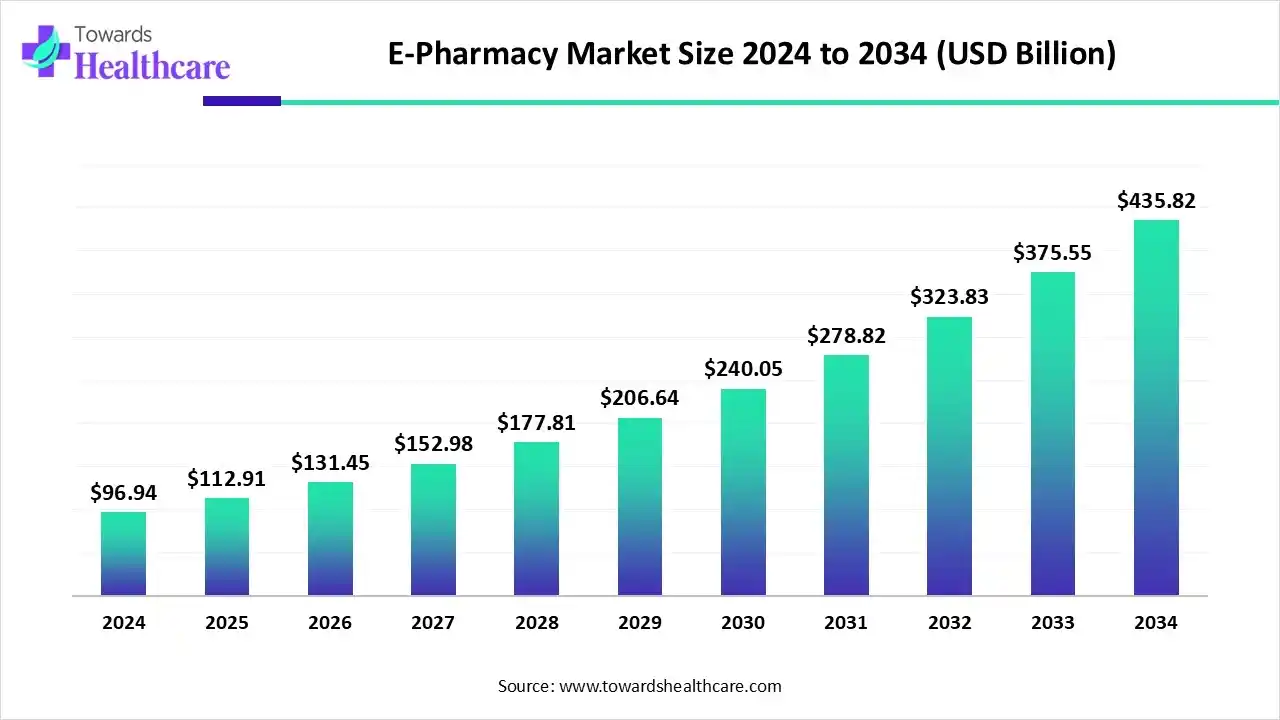
The global E-pharmacy market size is projected to grow to US$ 131.43 billion in 2026, and is expected to reach around US$ 517.16 billion by 2035. The market is projected to expand at a CAGR of 16.44% between 2026 and 2035.
The E-pharmacy market is growing because of the increasing internet penetration, smartphone usage, and rising demand for contactless and convenient medical care services. Strong presence of e-players such as 1mg, Netmeds, and Amazon pharmacy. Growing advancements in technology and telemedicine integration, and supportive government policies are driving the growth of the market.
Increasing access to the internet and smartphones means the E-pharmacy market is rising, with consumer preference for online consumption and a growing focus on convenience. Growing adoption of digital technologies and e-commerce in the medical care sector. E-pharmacy, or mail-order pharmacy, is a pharmacy that operates over the Internet and sends orders to customers. Continue to grow post-pandemic, significantly owing to growing adoption by consumers due to the affordability, convenience, and accessibility offered by these platforms. The growing geriatric population is expected to fuel the growth of the market.
E-pharmacy is an online platform that enables consumers to purchase prescription medicine, over-the-counter (OTC), drugs, healthcare products, and wellness items through digital channels, while offering services such as e-prescription management, pharmacist consultations, and home delivery. The market is expanding due to increasing adoption of digital healthcare services, rising internet and smartphone penetration, and growing consumer preference for convenient medicine ordering. A key trend is the integration of telemedicine with e-pharmacy platforms to provide seamless virtual consultations and digital prescriptions. Technological advancements in artificial intelligence, e-prescriptions, cloud-based pharmacy management, digital payment systems, and real-time inventory tracking are improving operational efficiency and customer experience. Future opportunities lie in personalized medicine management, subscription-based pharmacy services, drone-enabled medicine delivery, cross-border digital pharmacies, and AI-driven medication adherence solutions supported by expanding digital health ecosystems.
AI has a major contribution to the growth of the e-pharmacy market by automating prescription processing, personalizing patient engagement, and optimizing supply chain logistics. AI systems automatically read, scan, and categorize incoming digital or copied prescriptions by urgency. Machine learning models also help to cross-check medication details against patient history to eliminate manual transcription and reduce dispensing errors. AI-powered chatbots and virtual assistants provide 24/7 customer support, answer medication queries, and also offer personalized health advice, which acts as a boon for patients who are unable to visit a doctor’s clinic or a hospital physically.
Increasing government initiative related to e-pharmacy in the healthcare sector, which drives the growth of the market.
For Instance,
Increasing adoption of digital technology in healthcare services contributes to the growth of the market.
For Instance,
The e-pharmacy market is influenced by a combination of internal capabilities and external healthcare trends. Internally, AI-powered recommendation systems, secure digital payment platforms, efficient logistics networks, cloud-based pharmacy management, and user-friendly mobile applications enhance operational efficiency and customer experience. However, cybersecurity risks, counterfeit medicine concerns, and complex inventory management remain key challenges. Externally, the market is driven by increasing internet and smartphone penetration, rising adoption of telemedicine and e-prescriptions, growing prevalence of chronic diseases, and changing consumer preferences for convenient home delivery of medicines. Regulatory developments, digital health initiatives, reimbursement policies, competition from traditional pharmacies, and evolving data privacy requirements continue to shape market growth and long-term adoption.
| E-pharmacy | Investment |
| Truemeds | In March 2025, the Indian online pharmacy Truemeds closed a Series C funding round worth $44 million. |
| MyDawa | The Kenyan online medical care platform MyDawa secured $20 million in Series B funding in May 2025. |
| Apollo 24/7 | Raised $300 million (₹2,475 Cr) from Advent International private equity in 2024, at a valuation of $1.75 billion (₹14,478 Cr). |
| Table | Scope |
| Market Size in 2026 | USD 131.43 Billion |
| Projected Market Size in 2035 | USD 517.16 Billion |
| CAGR (2025 - 2034) | 16.44% |
| Leading Region | North America |
| Historical Data | 2020 - 2023 |
| Base Year | 2025 |
| Forecast Period | 2026 - 2035 |
| Measurable Values | USD Millions/Units/Volume |
| Market Segmentation | By Drug Type, By Region |
| Top Key Players | CVS Health, Optum Rx, Inc., Rowlands Pharmacy, DocMorris (Zur Rose Group AG), Cigna Corporation (Express Scripts Holdings), Amazon.com Inc., Axelia Solutions (Pharmeasy), Apex Healthcare Berhad (Apex Pharmacy), Apollo Pharmacy, Netmeds |

| Segments | Shares % |
| Prescription Drug | 70% |
| OTC Drug | 30% |
Explanation
Why the Prescription Drug Segment Dominated the Market?
In the drug type, the prescription drug segment led the E-pharmacy market by 70%, as online prescriptions often provide good pricing, discounts, and generic substitutes, leading to significant expense savings for patients. This type of platform enables consumer to browse and buy medications inconspicuously from the comfort of their own home, without the requirement for face-to-face communications. Realising e-prescriptions enhance productivity, reduce medication challenges, and improve convenience.
On the other hand, the OTC drug segment is projected to experience the fastest CAGR in the E-pharmacy market by 30% from 2026 to 2035, as it is evident that the greater use of OTC drugs enhances access, convenience, service, health results, and patient satisfaction. By offering a suitable opportunity for accessing drugs, online pharmacies contribute to enhancing healthcare results and lowering inequalities in access to crucial treatments. By working in a digital space, these stages often have lower overhead expenses as compared to brick-and-mortar pharmacies.
North America was dominant in the market in 2025, due to growing high internet and smartphone penetration. For instance, around 77% of its population uses a smartphone, so it has a massive consumer base that is happy with digital platforms and online spending. Healthcare providers transformed patient care with AI-driven automation, and huge digital infrastructure forms the backbone of any thriving health-tech hub in North America, which drives the growth of the market.
For Instance,
U.S. E-Pharmacy Market Trends
In September 2025, Novartis announced the launch of a direct-to-patient (DTP) platform in the US, which offers cash-paying patients prescribed Cosentyx the option to purchase it at a 55% discount off the list price. Cosentyx, Novartis’ top-selling product in the US, is a biologic that is FDA-approved for the treatment of multiple immune-mediated inflammatory diseases, including psoriasis, hidradenitis suppurativa, and psoriatic arthritis.
Canada E-Pharmacy Market Trends
In March 2025, Phoenix, Canada’s foremost online health clinic for men, today announced it has signed a CAD 50 million Series A financing round. The round is led by Valspring Capital, with transformed investment from Y Combinator, and support from CIBC Innovation Banking. Phoenix is becoming a dominant force in digital healthcare, addressing long-standing gaps in access to treatment.
Asia Pacific is the fastest-growing region in the E-pharmacy market in the forecast period, due to the large and growing consumer base, the presence of huge populations, increasing disposable incomes, and a burgeoning middle class. Major e-pharmacy companies in this region started tie-ups with medical insurers to offer medicines to the consumer at lower prices, in turn saving the expenses for insurers. Consumers in the Asia-Pacific are progressively comfortable with e-commerce, and this preference for digital shopping spreads to healthcare, which drives the growth of the market.
For Instance,
China E-Pharmacy Market Trends
In July 2025, Chinese tech giant Alibaba Group is seeking to raise around HK$12 billion ($1.53 billion) through exchangeable bonds to boost investments in its cloud infrastructure and global commerce operations. Investors later exchange these bonds, which link to Alibaba Health Technology, opens a new tab, for shares in Alibaba Health, and the bonds will not pay interest for a longer time.
India E-Pharmacy Market Trends
In September 2025, Quick medicine delivery startup Plazza raised USD 1.4 million in a seed funding round led by All in Capital, with participation from Better Capital, Tracxn founder Abhishek Goyal, Bounce co-founder Vivekananda Hallekere, the Singhania family office, and the promoters of JK Tyre. Plazza operates on an omnichannel platform combining app-based ordering with physical outlets.
Europe is expected to grow significantly in the E-pharmacy market during the forecast period, as it has a vigorous and digitizing healthcare system and favorable government reforms, which increase the demand for e-pharmacy services in this region. As the growing load of chronic disease and medical care spending places growing pressure on health systems, a digital health revolution is needed to ensure the sustainability of European healthcare, which drives the growth of the market.
Germany E-Pharmacy Market Trends
In July 2025, Redcare Pharmacy’s CardLink solution for e-Rx redemption was extended by Gematik, enabling a smooth transition to the next-generation technology. Redcare’s CardLink solution has been available in the Shop Apotheke app since May 2024, allowing patients in Germany to redeem their prescriptions digitally.
Europe is expected to grow significantly in the e-pharmacy market during the forecast period, due to growing digitalization. The growing smartphone and internet penetration are also increasing the adoption of e-pharmacy platforms. The growing geriatric population and government initiatives are also increasing their use. Moreover, increasing health awareness is also increasing their demand, which is enhancing the market growth.
UK E-Pharmacy Market Trends
The UK consists of an advanced healthcare sector, which is adopting new digital tools, promoting the use of e-pharmacies. At the same time, the growing chronic diseases and e-commerce integration are also increasing their use, where the growing health awareness is also increasing their demand to enhance patient convenience. The home deliveries and presence of discounts are also increasing their use.
South America is expected to grow significantly in the e-pharmacy market during the forecast period, due to the use of smartphones, which are increasing the use of various online platforms, driving the adoption of e-pharmacy platforms. The growing shift towards home care is also increasing its demand, where the growing number of chronic diseases are also increasing their use. Moreover, growing healthcare infrastructure is also promoting the market growth.
Brazil E-Pharmacy Market Trends
The growing smartphone and internet penetration across Brazil is also increasing e-pharmacy adoption rates. The expanding healthcare sector and e-commerce infrastructure are also increasing the use of these e-pharmacies. At the same time, the growing chronic diseases and health awareness are also increasing their use for the purchase of OTC drugs and for the long-term management of these diseases.
Mexico Market Trends
Mexico is known to act as a major catalyst in the growth of the e-pharmacy market for the regional and national e-pharmacy and digital health sectors. The growth is also fueled by rapid digital adoption, mobile-first consumer behavior, and supportive regulatory shifts. It is also known for launching a national platform for digital prescriptions to streamline patient record management, improve prescription legibility, and normalize app-based consultations and medicine delivery. Access to the internet by a major population of Mexico, allowing them to get benefits of online healthcare and pharmacy consumers accessing services via smartphones, also helps to fuel the market’s growth. Telecom upgrades in Tier II and Tier III cities are also shrinking the urban-rural digital divide.
Argentina Market Trends
Argentina has a major role in the market’s growth, further fueling the growth of the digital and e-pharmacy ecosystem through strong manufacturing capabilities, rising digital adoption, and a massive local health market. Argentina is also known as the 4th largest pharmaceutical market in Latin America, providing a deep domestic supply chain of both multinational giants (such as Bayer, Roche, and Abbott) and prominent local manufacturers (such as Roemmers, Bagó, and Elea) that feed digital distribution channels. The e-pharmacy and online retail segment in Argentina is also expanding rapidly, outpacing traditional brick-and-mortar acceleration, further fueling the market’s growth.
Middle East and Africa have a major contribution to the market’s growth with the help of factors such as technology adoption, infrastructure, and high disposable incomes. Various other factors such as rapid smartphone usage, strong government digital health initiatives, home healthcare popularity, and high-tech pharmacy automation accelerating online medication delivery also fuel the market’s growth. Growing internet access and widespread smartphone adoption have also shifted consumer preference towards convenience and over-the-counter digital orders.
South Africa Market Trends
South Africa has a major strategic and economic anchor for the e-pharmacy and broader digital healthcare market in Africa. It also acts as an industrial and logistical hub, housing 23 WHO-compliant manufacturing sites that supply regional and global pharmaceutical chains. The South African Health Products Regulatory Authority (SAHPRA) enforces strict guidelines for prescription validation, storage, and distribution, and its alignment with international bodies like the International Council for Harmonisation (ICH) builds consumer and institutional trust in digital channels, further propelling the market’s growth.
UAE Market Trends
The e-pharmacy and digital healthcare market in the United Arab Emirates (UAE) is expanding rapidly. The growth of the market is mainly driven by factors such as high digital infrastructure, supportive government policies, and shifting consumer habits. The overall UAE online/digital pharmacy and apps ecosystem is also scaling rapidly, further fueling the market’s growth.
R&D
Clinical Trials and Regulatory Approvals
Packaging and Serialization
Patient Support and Services
Strengths
The option for 24/7 ordering, home delivery, and a wider range of products is particularly helpful for older adults or those in remote locations.
The lower overhead costs of online pharmacies, compared to physical stores, allow for significant savings and competitive prices on medications and over-the-counter products.
Weaknesses
The lack of consistent and specific regulations in various areas creates operational difficulties and legal uncertainties.
There is a limited chance to interact with licensed pharmacists, which reduces the personalized support usually available in traditional pharmacies.
Opportunities
By expanding services to include teleconsultations, diagnostic services can be smoothly combined with medication delivery.
Using artificial intelligence can improve personalized medication reminders, health tracking, and inventory management.
Threats
There are stricter government rules or complete bans on the online sale of certain drugs.
The existence of fraudulent sellers threatens brand trust.
| Companies | Description |
| CVS Health | It is a dominant leader in the e-pharmacy market, ranked as the second-largest pharmacy chain in the United States. The platform supports ePrescriptions, allowing users to start the filling process by scanning a paper script through the app. |
| Optum Rx, Inc. | The portfolio includes online home delivery, a specialized digital pharmacy for chronic conditions, and a digitized formulary with biosimilar options. |
| Rowlands Pharmacy | The company portfolio offers prescription medicines, OTC remedies, and health/beauty products featuring major brands, specialized skincare, and exclusive deals. |
| DocMorris (Zur Rose Group AG) | It offers a broad range of prescription (Rx), over-the-counter (OTC), and consumer health products, including beauty, personal care, and nutritional supplements. |
| Cigna Corporation (Express Scripts Holdings) | The company offers the Express Scripts Pharmacy for home delivery, the ScriptVision digital tool suite, and specialized care management programs for chronic and complex conditions. |
| Amazon.com Inc. | It offers a full-service online pharmacy experience, including prescription medications, over-the-counter (OTC) drugs, and health devices. |
| Axelia Solutions (Pharmeasy) | PharmEasy, through Axelia's operations, holds a leading position in the Indian e-pharmacy market, characterized by high, frequent, and repeat customer usage. |
| Apex Healthcare Berhad (Apex Pharmacy) | The company is a Malaysian-based pharmaceutical group involved in the manufacturing, marketing, and distribution of generic pharmaceuticals, consumer healthcare products, and medical devices. |
| Apollo Pharmacy | The company is dominating India's e-pharmacy sector, offering 70,000+ products, including prescription drugs, OTC, and private labels. It is also integrating its digital services with its insurance business, Apollo 24|7 Insurance Services Limited. |
| Netmeds | In August 2020, Reliance Retail Ventures Limited (RRVL) bought a 60% shares in the company and 100% direct ownership of its subsidiaries, including Tresara Health, Netmeds Marketplace, and Dadha Pharma Distribution. |
By Drug Type
By Region



Principal Consultant
Payal Rabde is a Healthcare Market Research Analyst at Towards Healthcare Research & Consulting with 4+ years of experience in pharmaceuticals, biotechnology, medical devices, and life sciences.
Learn more about Payal Rabde

Reviewed By
Aditi Shivarkar is a seasoned professional with over 14 years of experience in healthcare market research. As a content reviewer, Aditi ensures the quality and accuracy of all market insights and data presented by the research team.
Learn more about Aditi Shivarkar