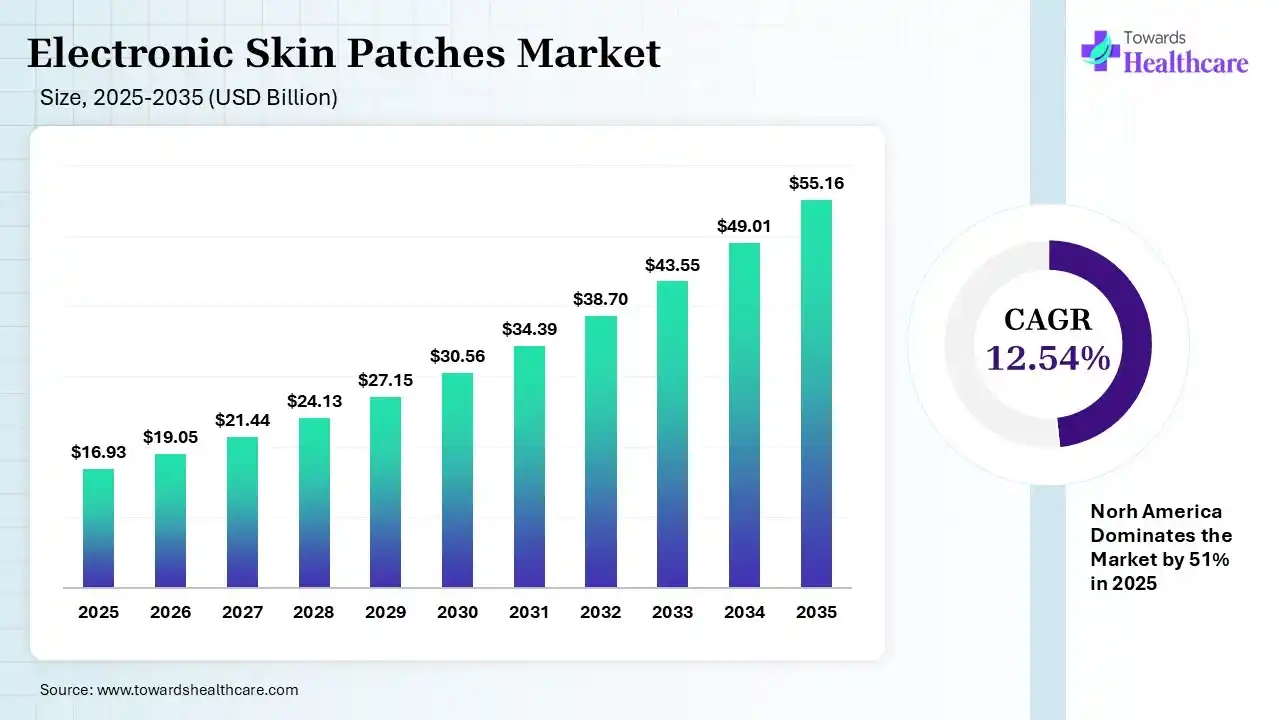
The global electronic skin patches market size was estimated at USD 16.93 billion in 2025 and is predicted to increase from USD 19.05 billion in 2026 to approximately USD 55.16 billion by 2035, expanding at a CAGR of 12.54% from 2026 to 2035.
A massive growth in chronic disease instances and surging demand for remote patient monitoring is fueling the advanced measures, like electronic skin patches. Eventually, numerous leading firms and scientists will embrace AI-powered approaches to integrate these patches to transmit data to cloud systems.
These are thin, flexible, & stretchable wearable devices that adhere directly to the skin & further assist in monitoring, recording, & transferring health data in real time. However, the global electronic skin patches market is driven by the growing demand for remote patient monitoring and chronic disease management, as well as the notable rise in the geriatric population. Also, several leading firms are pushing the development of versatile, biocompatible sensors.
Electronic skin patches are flexible, wearable devices embedded with sensors and electronic components that adhere to the skin to continuously monitor physiological parameters, deliver therapies, of transmit real-time health data. The Market is growing due to the increasing real-time health data/ The market is growing due to the increasing prevalence of chronic diseases, rising demand for remote patient monitoring, and, greater adoption of personalized healthcare solutions. Technological advancements in flexible electronics, biosensors, and energy-efficiency materials are enhancing devices’ accuracy, comfort, and performance. A major trend in the development of multifunctional patches capable of simultaneously monitoring multiple biomarkers and vital signs. Future opportunities lie in integrating electronic skin patches with digital health ecosystems, expanding non-invasive disease diagnostics, advancing smart drug delivery technologies, and supporting preventive healthcare through continuous, real-time monitoring and data-driven clinical decision-making.
The era is focused on exploring advanced patches using AI algorithms in the analysis of multiple signals simultaneously, like sweat composition & electrophysiological data, to offer tailored health insights. Alongside, ongoing breakthroughs are leveraging closed-loop feedback systems to track health indicators & automatically release drugs via microneedles in response to AI-assessed data. Upcoming solutions execute the integration of triboelectric nanogenerators to harvest energy and allow for autonomous operation.
Transforming Materials & Wearability
Research activities are emphasizing conformable, ultrathin, & stretchable sensors that blend perfectly with skin to boost comfort for long-term wear.
Expanding Applications Scope
The market is keeping its goal to broaden applications into sports performance, rehabilitation, & Human-Machine Interface (HMI) for robotics.
Featuring Wound Healing Monitoring
Researchers are putting efforts into implementing smart bandages to monitor pH, temperature, & bacterial infections in real-time, certainly unified with controlled drug delivery systems.
| Table | Scope |
| Market Size in 2026 | USD 19.05 Billion |
| Projected Market Size in 2035 | USD 55.16 Billion |
| CAGR (2026 - 2035) | 12.54% |
| Leading Region | North America by 37% |
| Key Applications | Continuous glucose monitoring (CGM), cardiac monitoring, temperature monitoring, hydration tracking, sleep monitoring, drug delivery, remote patient monitoring (RPM), sports performance monitoring, wound management |
| Primary End Users | Hospitals, clinics, home healthcare providers, patients, athletes, pharmaceutical companies, research institutions |
| Key Challenges | Sensor accuracy, battery limitations, reimbursement challenges, data privacy concerns, regulatory approvals, manufacturing complexity |
| Measurable Values | USD Millions/Units/Volume |
| Market Segmentation | By Type, By Connectivity, By Material Type, By Application , By End User, By Distribution Channel, By Region |
| Top Key Players | Abbott Laboratories, Dexcom, Inc., Medtronic plc, F. Hoffmann-La Roche Ltd, Koninklijke Philips N.V., VitalConnect, iRhythm Technologies, Inc., BioTelemetry, Inc., Sensium Healthcare, Isansys Lifecare |
The Monitoring & Diagnostic Segment Led the Market in 2025
| Segment | Share 2025 (%) |
| Monitoring & Diagnostic | 68% |
| Therapeutic | 32% |
Explanation
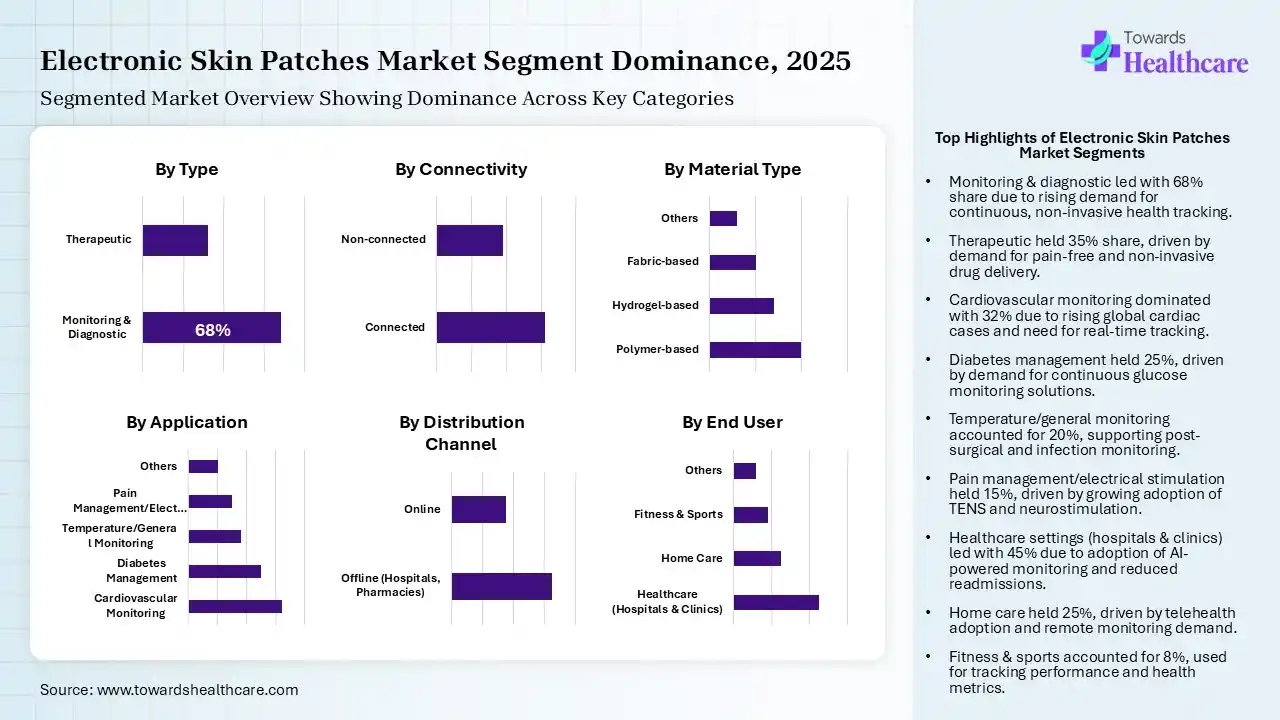
In 2025, the monitoring & diagnostic segment captured the largest share of nearly 68% of the electronic skin patches market. Globally surging cases of diabetes and cardiovascular diseases are driving the need for persistent, non-invasive surveillance. Also, the vast population is demanding patient monitoring outside traditional clinical settings for rigorous chronic disease management. A prominent progression includes advanced remote cardiac care, CGM, & targeted drug delivery.
Whereas the therapeutic segment held the second-largest share of nearly 35% in 2025 due to the rising demand for a non-invasive, pain-free alternative to traditional injections & oral therapeutics. Trends are fostering pairing of microneedles with electrical stimulation to boost the delivery of drugs for issues, including psoriasis, skin cancers, & infections.
The Cardiovascular Monitoring Segment Dominated the Market in 2025
| Segment | Share 2025 (%) |
| Cardiovascular Monitoring | 32% |
| Diabetes Management | 25% |
| Temperature/General Monitoring | 18% |
| Pain Management/Electrical Stimulation | 15% |
| Others | 10% |
Explanation
The cardiovascular monitoring segment held the largest share of nearly 32% share of the electronic skin patches market in 2025. The globe is experiencing a huge rise in cardiac issues prevalence & nearly 19.8 to 20.5 million CVD deaths per year, which fuels the need for constant, real-time monitoring devices. The latest approach comprises a GelMA-based (gelatin methacryloyl) E-skin patch, a highly porous, flexible, and breathable patch for temperature and electrocardiac (ECG) measures.
Moreover, the diabetes management segment captured the second-largest share of approximate 25% of the market in 2025. Around 537 million adults are living with diabetes in the world, where these patches facilitate a superior alternative to finger-pricking, with real-time glucose tracking & raising lifestyle convenience.
The temperature/general monitoring segment held nearly 20% share of the electronic skin patches market, due to the accelerating need for continuous tracking, vital for post-surgical care, fever management, & prior infection detection, mainly for pediatric & elderly care. Scientists have promoted self-powered patches by using thermoelectrics to power sensors from skin heat.
The pain management/electrical stimulation segment captured approximately 15% share in 2025. Specifically, patients & clinicians are moving to neurostimulation & Transcutaneous Electrical Nerve Stimulation (TENS) to manage chronic & acute pain. Leaders are encouraging soft bioelectronics, wireless integration, & multifunctional therapeutic delivery.
The Healthcare (Hospitals & Clinics) Segment Led the Market in 2025
| Segment | Share 2025 (%) |
| Healthcare (Hospitals & Clinics) | 45% |
| Home Care | 25% |
| Fitness & Sports | 18% |
| Others | 12% |
Explanation
In 2025, the healthcare (hospitals & clinics) segment held an approximate 45% share of the electronic skin patches market. Drivers are escalating shift towards value-based care, lowering hospital readmissions, & breakthroughs in wearable, AI-powered sensors for real-time data streaming. Patches are providing arrhythmia detection & unification with electronic health records (EHR) & cloud analytics, which bolsters clinical purpose.
However, the home care segment accounted for the second-largest share of nearly 25% in 2025. Expanding adoption of telehealth is demanding wearable patches to share data with healthcare professionals remotely, & declines hospital visits. Speeding awareness about preventive healthcare, fitness tracking, & hydration monitoring propels adoption among consumers for monitoring health while performing daily activities.
The fitness & sports segment captured approximately 8% share of the market. Primarily, athletes are widely using these patches for constant monitoring of metrics, like heart rate, metabolic rate, muscle activity, & oxygen levels. Advances are promoting thin-foil sensors & conductive composites, enabling patches for self-healing, with long-term durability & accurate monitoring.
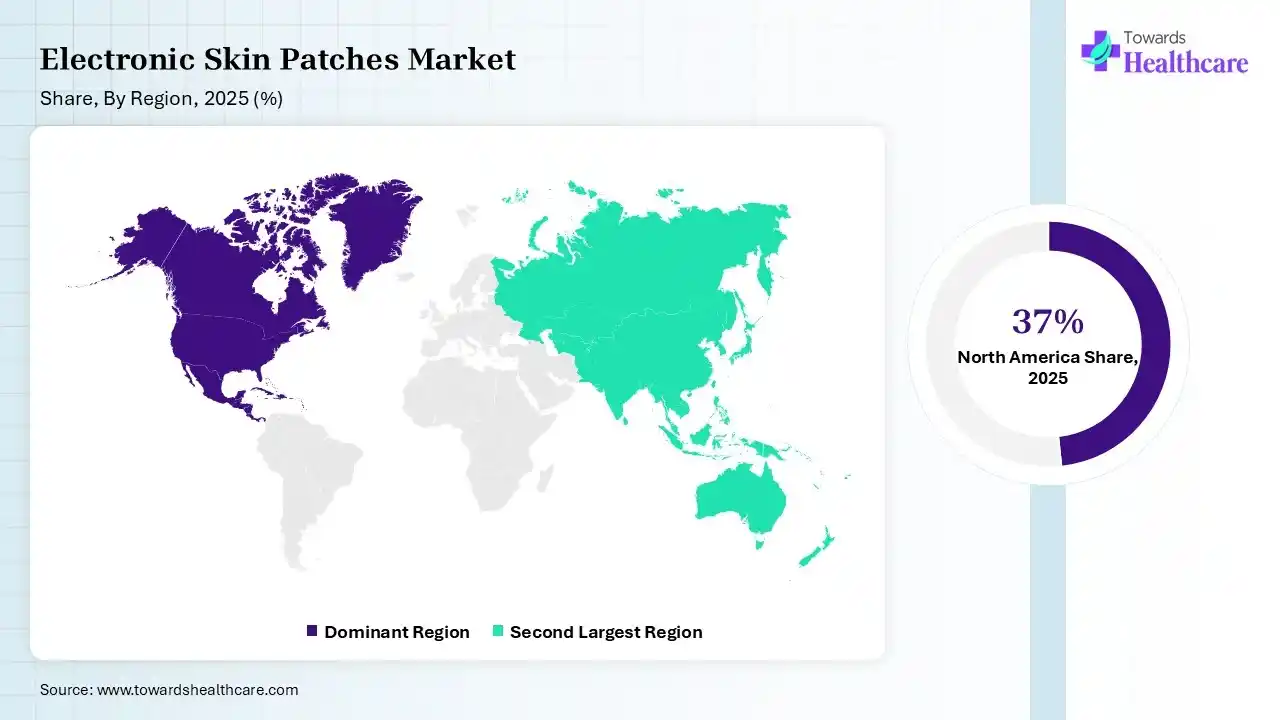
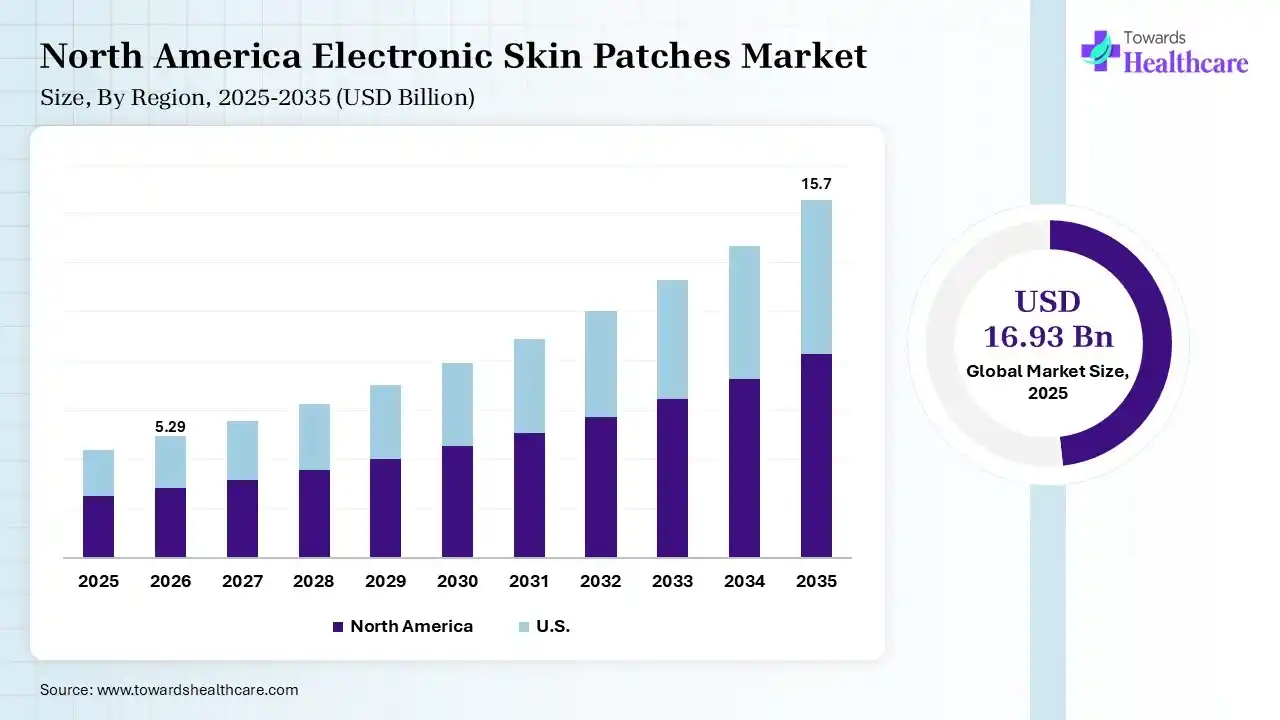
North America dominated the electronic skin patches market with nearly 37% share in 2025. The dominance is driven by the increasing demand for constant remote patient monitoring and advances in flexible sensor technology. Canadian researchers have demonstrated a transparent, ultra-stretchable sensor to record complex sensations of human skin.
For instance,
U.S. Market Trends
Whereas the U.S. market has showcased a wireless, battery-free patch by leveraging the electrical properties of the skin to identify potential cancers. Also, their efforts have pushed to deliver a neck-worn patch employing AI to monitor speech, breathing, & heart rates.
Canada’s Electronic Skin Patches Market Advances Through Digital Healthcare Innovation
Canada electronic skin patches market is growing significantly due to increasing adoption of wearable healthcare technologies, rising demand for remote patient monitoring, and expanding prevalence of chronic diseases. Strong investments in digital health innovation, advanced medical research, and AI-enabled biosensor development are accelerating product adoption. Government support for connected healthcare solutions and growing collaborations between providers and technology companies further drive market growth.
Asia Pacific is anticipated to witness rapid expansion at 12.5% CAGR in the electronic skin patches market, and it also held the second-largest revenue share of approximately 30% in 2025. As per studies, the projections of diabetes cases show that there will be around 175 million Chinese people & 125 million people will have diabetes by 2045. For this, countries are promoting government initiatives, like Healthy China 2030 & National Digital Health Mission in India.
China Market Trends
Chinese researchers are extensively employing bionic 3D architecture to measure pressure, friction & strain with raised accuracy, & a few prototypes are achieving 1-gram force detection. The country has been immensely fostering electronic skin for humanoid robots, which detects pressure, temperature, and damage, allowing reflex-like reactions to mitigate harm.
India's Electronic Skin Patches Market Accelerates with Expanding Digital Healthcare
India's electronic skin patches market is growing significantly due to the rising burden of chronic diseases, increasing adoption of wearable medical devices, and rapid expansion of digital healthcare services. Growing investments in healthcare technology, improving access to remote patient monitoring, and rising awareness of preventive healthcare are driving demand. Advancements in biosensor technologies and supportive government initiatives for digital health further fuel market growth.
| Ecosystem Segment | Key Participants | Role in Market |
| Technology Providers | Philips, GE HealthCare, Medtronic, Abbott, Dexcom | Develop sensing technologies, wireless connectivity, flexible electronics, and data integration capabilities |
| Product Manufacturers | Abbott, Dexcom, Medtronic, VitalConnect, BioIntelliSense | Design and commercialize wearable electronic patches for monitoring and diagnostics |
| Service Providers | Biofourmis, Current Health, Teladoc Health | Remote monitoring services, patient management platforms, healthcare analytics |
| Platform Providers | Philips, GE HealthCare, Biofourmis, Current Health | Cloud-based monitoring and clinical decision support platforms |
| CROs/CDMOs | IQVIA, ICON plc, Parexel, Syneos Health | Clinical validation, regulatory studies, device trials, commercialization support |
| Software Vendors | Biofourmis, Validic, Current Health, Philips | Data management, AI analytics, interoperability solutions |
| Research Institutions | Northwestern University, University of California San Diego, MIT, Stanford University | Flexible electronics research, biosensor innovation, next-generation e-skin development |
| End-User Industries | Healthcare, Sports & Fitness, Military, Pharmaceutical, Elderly Care | Deployment and utilization of electronic skin patch technologies |
R&D
Manufacturing Process
Patient Support & Services
| Tier 1 | Tier 2 | Tie 3 | |
| Typical Market Influence | 68% | 22% | 10% |
| Tier 1 | ||||
| Company Name | Headquarters | Country | Why Relevant to This Market | Key Products/Services |
| Abbott Laboratories | Abbott Park, Illinois | USA | Global leader in wearable biosensors and digital health monitoring | FreeStyle Libre CGM wearable sensors |
| Dexcom | San Diego, California | USA | Pioneer in wearable skin-adhered glucose monitoring systems | Dexcom G7 CGM platform |
| Medtronic | Galway | Ireland | Extensive wearable monitoring and diabetes management portfolio | Guardian CGM systems, wearable sensors |
| Tier 2 | ||||
| Company Name | Headquarters | Country | Why Relevant to This Market | Key Products/Services |
| VitalConnect | San Jose, California | USA | Leading cardiac and vital sign monitoring patch developer | VitalPatch platform |
| BioIntelliSense | Golden, Colorado | USA | Commercial wearable biosensor platform provider | BioSticker, BioButton |
| iRhythm Technologies | San Francisco, California | USA | Market leader in wearable cardiac patch monitoring | Zio Patch |
| Tier 3 | ||||
| Company Name | Headquarters | Country | Why Relevant to This Market | Key Products/Services |
| Epicore Biosystems | Cambridge, Massachusetts | USA | Advanced sweat-monitoring skin patch innovator | Connected hydration monitoring patches |
| GraphWear Technologies | San Francisco, California | USA | Developing graphene-based wearable skin sensors | Graphene biosensing patches |
| MC10 | Lexington, Massachusetts | USA | Pioneer in stretchable bioelectronic skin technology | BioStamp wearable sensors |
In July 2026, “For the 85% of lupus patients whose disease includes skin manifestations, often associated with substantial physical and psychosocial burden, the lack of targeted treatment makes the disease hard to control,” said David Weinreich, MD, MBA, Global Head of R&D and Chief Medical Officer for the Healthcare business of Merck.
Strengths
Weaknesses
Opportunities
Threats
By Type
By Connectivity
By Material Type
By Application
By End User
By Distribution Channel
By Region







Principal Consultant
Shivani Zoting is a dedicated research analyst specializing in the healthcare industry. With a strong academic foundation, a B.Sc. in Biotechnology and an MBA in Pharmabiotechnology, she brings a unique blend of scientific understanding and strategy.
Learn more about Shivani Zoting
Reviewed By
Aditi Shivarkar is a seasoned professional with over 14 years of experience in healthcare market research. As a content reviewer, Aditi ensures the quality and accuracy of all market insights and data presented by the research team.
Learn more about Aditi Shivarkar