The global hygienic and aseptic valves for pharmaceuticals and biotechnology market size was estimated at USD 1.24 billion in 2025 and is predicted to increase from USD 1.33 billion in 2026 to approximately USD 2.57 billion by 2035, expanding at a CAGR of 7.54% from 2026 to 2035.
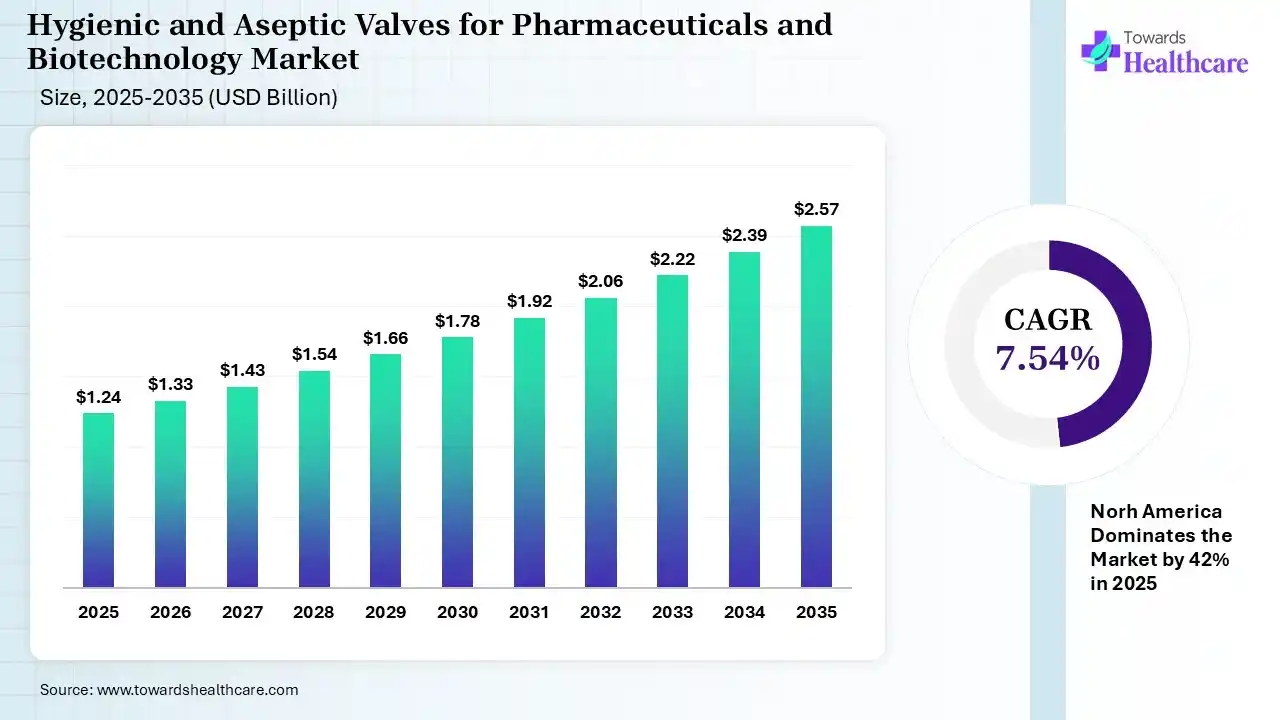
The market is expanding steadily, driven by strict sterility requirements, increasing biologics production, and growing adoption of automated processing systems, with rising demand for contamination-free and efficient fluid handling solutions.
AI is transforming hygienic and aseptic valves by enabling predictive maintenance, real-time monitoring, and automated process control, reducing contamination risks and downtime. Machine learning optimizes fluid handling, ensures regulatory compliance, and enhances operational efficiency. Additionally, AI-driven analytics improve quality assurance and support smart manufacturing in pharmaceutical and biotechnology production environments.
| Table | Scope |
| Market Size in 2026 | USD 1.33 Billion |
| Projected Market Size in 2035 | USD 2.57 Billion |
| CAGR (2026 - 2035) | 7.54% |
| Leading Region | North America by 42% |
| Historical Data | 2020 - 2023 |
| Base Year | 2025 |
| Forecast Period | 2026 - 2035 |
| Measurable Values | USD Millions/Units/Volume |
| Market Segmentation | By Valve Type, By Material, By End-Use Industry/Application, By Region |
| Top Key Players | Emerson Electric Co., Crane Co., ITT Inc., GEA Group AG, Alfa Laval AB, Bürkert Fluid Control Systems, SPX FLOW, Inc. |
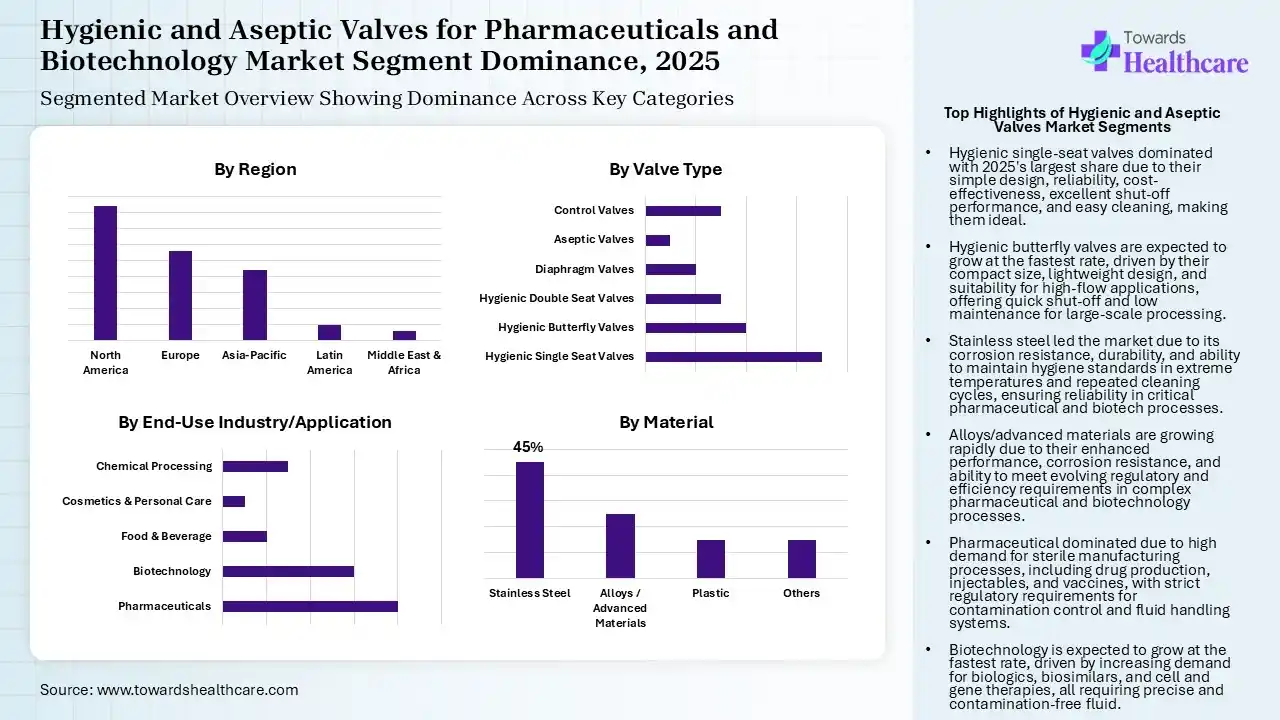
Why Did the Hygienic Single-Seat Valves Segment Dominate in the Market in 2025?
| Segment | Share 2025 (%) |
| Hygienic Single Seat Valves | 35% |
| Hygienic Butterfly Valves | 20% |
| Hygienic Double Seat Valves | 15% |
| Diaphragm Valves | 10% |
| Aseptic Valves | 5% |
| Control Valves | 15% |
Explanation
The hygienic single-seat valves segment dominated the hygienic and aseptic valves for pharmaceuticals and biotechnology market by 35% in 2025 due to their simple designs, high reliability, and cost-effectiveness in standard sterile processes. They provide excellent shut-off performance and easy cleaning, making them ideal for contamination-sensitive applications. Widely used across pharmaceutical and biotech operations, their low maintenance needs for compliance with hygiene standards further strengthened their dominant adoption.
Hygienic Butterfly Valves
The hygienic butterfly valves segment is projected to grow at the fastest CAGR due to their compact size, lightweight design, and cost-effectiveness in large-scale processing. They enable quick shut-off, easy installation, and reduced maintenance requirements. Their suitability for handling high-flow applications and increasing preference for space-efficient equipment in modern pharmaceutical and biotechnology facilities are key factors driving their rapid adoption.
What Made the Stainless-Steel Segment Dominant in the Market in 2025?
| Segment | Share 2025 (%) |
| Stainless Steel | 45% |
| Alloys / Advanced Materials | 25% |
| Plastic | 15% |
| Others | 15% |
Explanation
The stainless-steel segment dominated the hygienic and aseptic valves for pharmaceuticals and biotechnology market by 45% in 2025 due to its excellent resistance to corrosion, high durability, and ability to maintain strict hygiene standards. It performs well under extreme temperatures and repeated cleaning cycles, such as clean-in-place (CIP) and sterile-in-place (SIP). Its non-reactive and smooth surface minimizes contamination risks, making it highly suitable for critical pharmaceutical and biotechnology processes, thus ensuring strong and widespread adoption.
Alloys/Advanced Materials
The alloys/advanced materials segment is expected to grow at the fastest CAGR due to increasing demand for enhanced performance, durability, and resistance to extreme processing conditions. These materials offer improved corrosion resistance, longer service life, and better compatibility with aggressive chemicals. Their ability to evolve to meet evolving regulatory and efficiency requirements in complex pharmaceutical and biotechnology processes is driving their rapid adoption.
How Does the Pharmaceuticals Segment Dominate the Market in 2025?
| Segment | Share 2025 (%) |
| Pharmaceuticals | 40% |
| Biotechnology | 30% |
| Food & Beverage | 10% |
| Cosmetics & Personal Care | 5% |
| Chemical Processing | 15% |
Explanation
The pharmaceutical segment dominated the hygienic and aseptic valves for pharmaceuticals and biotechnology market by 40% in 2025 due to high demand for sterile manufacturing in drug production, including tablets, injectables, and vaccines. Strict regulatory requirements for contamination control and product safety increased reliance on hygienic and aseptic valves. Additionally, large-scale production volumes, continuous process operations, and the need for reliable fluid handling systems further strengthened the segment's leading position in the market.
Biotechnology
The biotechnology segment is expected to grow at the fastest CAGR due to rising demand for biologics, biosimilars, and cell and gene therapies. These processes require highly sterile and precise fluid handling systems, increasing reliance on advanced hygienic and aseptic valves. Additionally, expanding R&D activities, the growth of biomanufacturing facilities, and the need for flexible, contamination-free processing environments are accelerating adoption in this environment.
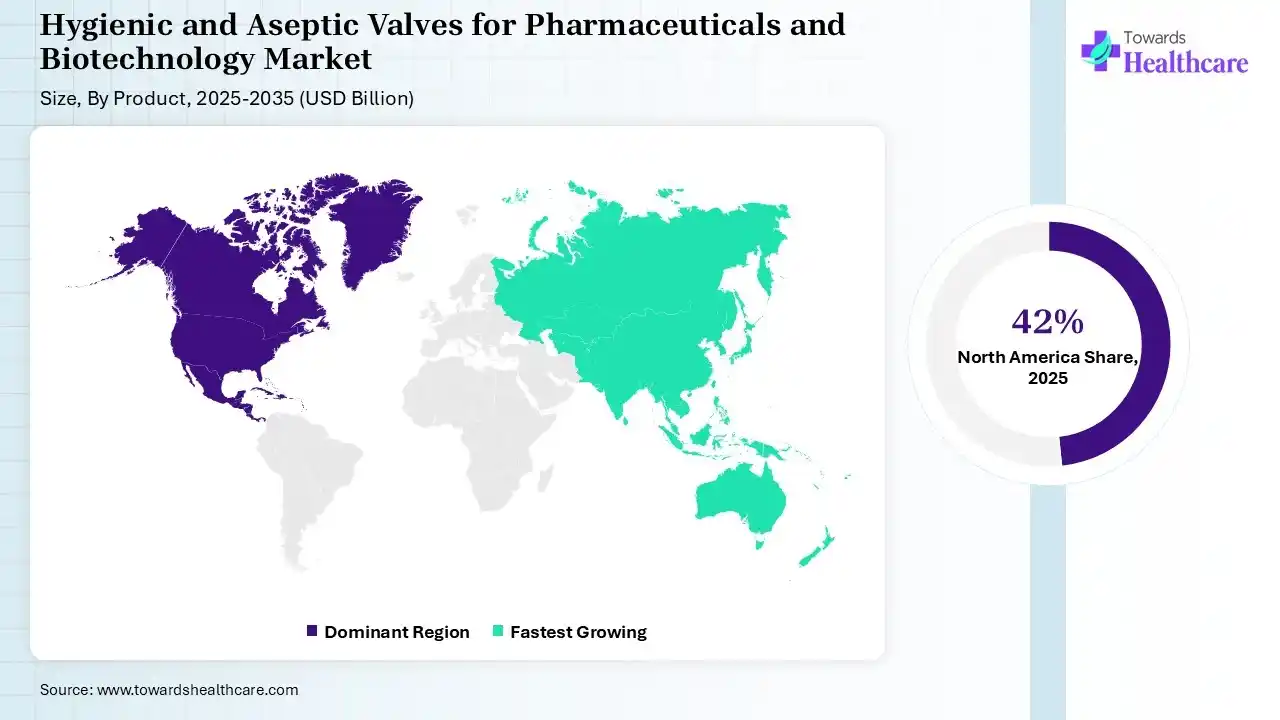
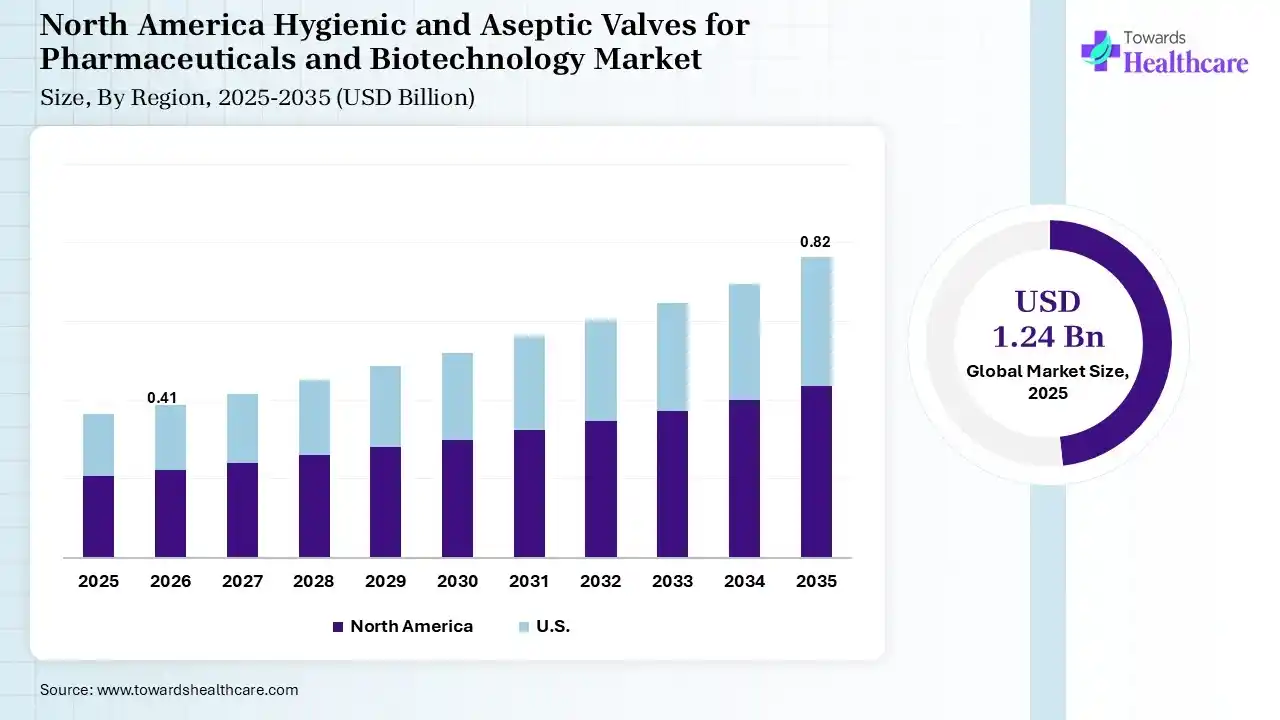
North America dominated the hygienic and aseptic valves for pharmaceuticals and biotechnology market by 42% due to its well-established pharmaceutical and biotechnology industries, supported by strong regulatory frameworks and high-quality standards. The region benefits from advanced manufacturing infrastructure, early adoption of innovative technologies, and significant investments in biologics and drug development. Additionally, the presence of major industry players and increased demand for sterile processing solutions further strengthened its leading market position in 2025.
U.S. Market Trends
The U.S. dominated the hygienic and aseptic valves for pharmaceuticals and biotechnology market due to its advanced pharmaceutical and biotechnology infrastructure, strong focus on innovation, and high investments in biologics, especially drugs. Strict regulatory requirements for product safety and quality further drive demand for hygienic systems. Additionally, the presence of major manufacturers, well-established supply chains, and the continuity of biomanufacturing facilities strengthened its leading position in 2025.
Asia Pacific is expected to grow at the fastest CAGR in the hygienic and aseptic valves for pharmaceuticals and biotechnology market, due to rapid expansion of pharmaceutical and biotechnology manufacturing, increasing investments in healthcare infrastructure, and rising demand for generic drugs and biologics. Favorable government initiatives, cost-effective production capabilities, and growing outsourcing activities are further boosting the adoption of hygienic and aseptic valves across emerging economies in the region.
India Market Trends
India is expected to grow at the fastest CAGR in the hygienic and aseptic valves for pharmaceuticals and biotechnology market, due to the rapid expansion of its pharmaceutical and biotechnology sectors, supported by strong generic drug production and increasing biologics manufacturing. Government initiatives, cost-effective production, and rising foreign investments are boosting infrastructure development. Additionally, growing focus on quality standards and export-oriented manufacturing is driving higher adoption of hygienic and aseptic valves across the country.
| Metric | %/Value |
| Global Vaccine Supply | 70% of the WHO vaccine supply is sourced from India |
| Global Pharma Volume Share | 20% of the global medicine supply |
| Generic Supply | Largest supplier of generic drugs, accounting for 20% of global supply |
| Global Ranking | 3rd largest globally by volume, 11th by value |
| Manufacturing Infrastructure | Highest number of U.S. FDA-approved plants outside the U.S. |
Europe is anticipated to grow at a notable rate in the hygienic and aseptic valves for pharmaceuticals and biotechnology market, due to its strong pharmaceutical manufacturing base and increasing focus on high-quality biologics production. Strict regulatory standards and emphasis on product safety are driving the adoption of advanced hygienic systems. Additionally, ongoing investments in research, modernization of facilities, and rising demand for innovative therapies are supporting the steady growth of hygienic and aseptic valves across the region.
UK Market Trends
The UK is expected to grow at a significant rate due to increasing investments in biotechnology, a strong focus on biologics and vaccine development, and supportive regulatory frameworks. The expansion of research activities and biomanufacturing facilities is driving demand for sterile processing equipment. Additionally, growing collaborations between industry and academia and rising adoption of advanced manufacturing technologies are boosting the use of hygienic and aseptic valves in the country.
| Companies | Headquarters | Offerings |
| Emerson Electric Co | St. Louis, USA | Provides sterile diaphragm and control valves with automation support for precise fluid handling in bioprocessing |
| Crane Co. | Stamford, USA | Offers hygienic diaphragm and lined valves designed for safe and contamination-free pharmaceutical operations |
| ITT Inc. | White Plains, USA | Develops sanitary valve solutions focused on reliable fluid control in critical pharma and biotech processes. |
| GEA Group AG | Düsseldorf, Germany | Supplies aseptic valve systems, including mixproof and single-seat valves for high-purity production lines |
| Alfa Laval AB | Lund, Sweden | Delivers hygienic valves such as butterfly and tank valves suited for clean and sterile applications |
| Bürkert Fluid Control Systems | Ingelfingen, Germany | Provides compact, hygienic valves and automated flow control solutions for sterile environments. |
| SPX FLOW, Inc. | Charlotte, USA | Offers a wide range of aseptic and hygienic valves, including mixproof systems for biopharma manufacturing |
Strengths
Weaknesses
Opportunities
Threats
By Valve Type
By Material
By End-Use Industry/Application
By Region







Principal Consultant
Shivani Zoting is a dedicated research analyst specializing in the healthcare industry. With a strong academic foundation, a B.Sc. in Biotechnology and an MBA in Pharmabiotechnology, she brings a unique blend of scientific understanding and strategy.
Learn more about Shivani Zoting
Reviewed By
Aditi Shivarkar is a seasoned professional with over 14 years of experience in healthcare market research. As a content reviewer, Aditi ensures the quality and accuracy of all market insights and data presented by the research team.
Learn more about Aditi Shivarkar