


The global small molecule drug discovery outsourcing market size was estimated at USD 8.9 billion in 2025 and is predicted to increase from USD 9.67 billion in 2026 to approximately USD 20.5 billion by 2035, expanding at a CAGR of 8.7% from 2026 to 2035. The overall growth is fueled by the cost-effectiveness of outsourcing, the involvement of skilled expertise, & the wider use of advanced technologies. Eventual developments will pose increased applications of AI, machine learning, & computer aided drug design solutions in the ongoing innovations.
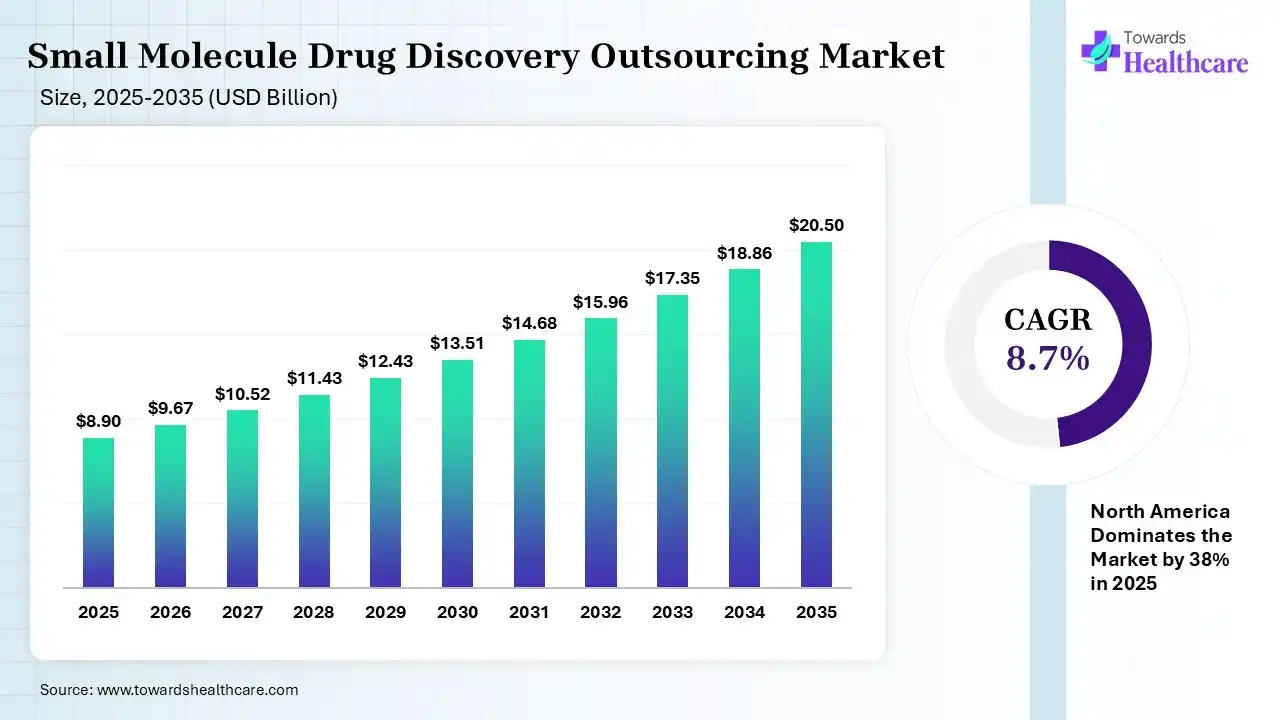
The small molecule drug discovery outsourcing market covers the practice of pharmaceutical & biotech companies contracting external Contract Research Organizations (CROs), which supports managing stages of the development of low-molecular-weight drug candidates. The global market expansion is fueled by the surging R&D expenditures & focus on improving cost management, with increasing need for specialised expertise in medicinal chemistry, ADME/PK studies, and IND-enabling activities that facilitate CROs.
Small molecule drug discovery outsourcing refers to the practices of pharmaceutical and biotechnology companies partnership with contract research organizations (CROs) to perform drug discovery activities such as target identification, hit discovery, lead optimization, medicinal chemistry, biological screening, and preclinical evaluation.
The small molecular drug discovery outsourcing market is expanding rapidly as pharmaceutical companies seek faster development timelines, access to specialized scientific expertise, and flexible research capabilities. Technological advancements in artificial intelligence, high-throughput screening, computational chemistry, automation, and cloud-based research platforms are improving discovery efficiency and reducing development risks. Emerging trends include AI-guided molecular design, integrated end-to-end outsourcing models, and data -driven drug development. Future opportunities lie in precision therapeutics, rare disease research, and the growing use of predictive analytics for candidate selection. Increasing R&D investments, expanding biotech pipelines, and rising demand for cost-efficient innovation continue to drive sustained market growth.
Primarily, outsourcing is notably shifting from simple virtual screening to end-to-end drug discovery, where CROs are offering integration of generative AI, deep learning, and simulation tools. This further leads to accelerated lead optimization, minimal spending, & optimized target identification. Moreover, the exploration of TechBio alliances & broader emphasis on the estimation of ADMET profiles results in reduced reliance on prior, human, brute-force screening.
Progression of Complex Modalities
The globe is gradually escalating demand for outsourcing expertise in complex areas, particularly targeted protein degraders (PROTACs), small molecule drug-drug conjugates (SMDCs), & oral medications for oncology & neurology.
Executing Integration of Early-Stage Development
A lucrative trend includes surging demand for one-stop-shop services from early discovery through preclinical formulation & IND-enabling studies.
Transformation in HTS
Researchers will foster the use of automation & robotics-intensive services for rapid screening of large chemical libraries to determine hits.
| Table | Scope |
| Market Size in 2026 | USD 9.67 Billion |
| Projected Market Size in 2035 | USD 20.5 Billion |
| CAGR (2026 - 2035) | 8.7% |
| Leading Region | North America by 38% |
| Key Applications | Oncology, CNS Disorders, Infectious Diseases, Cardiovascular Diseases, Metabolic Disorders, Immunology, Rare Diseases |
| Primary End Users | Pharmaceutical Companies, Biotechnology Firms, Academic Research Institutions, Virtual Biotech Startups |
| Key Challenges | Intellectual property concerns, project attrition rates, regulatory complexity, talent shortages, pricing pressure among CROs |
| Measurable Values | USD Millions/Units/Volume |
| Market Segmentation | By Drug Discovery Phase, By Service Type, By Therapeutic Area, By End User, By Region |
| Top Key Players | WuXi AppTec, Charles River Laboratories, Evotec SE, Pharmaron, Eurofins Scientific, Labcorp Drug Development, Syngene International Ltd, Curia Global, Selvita, Viva Biotech |
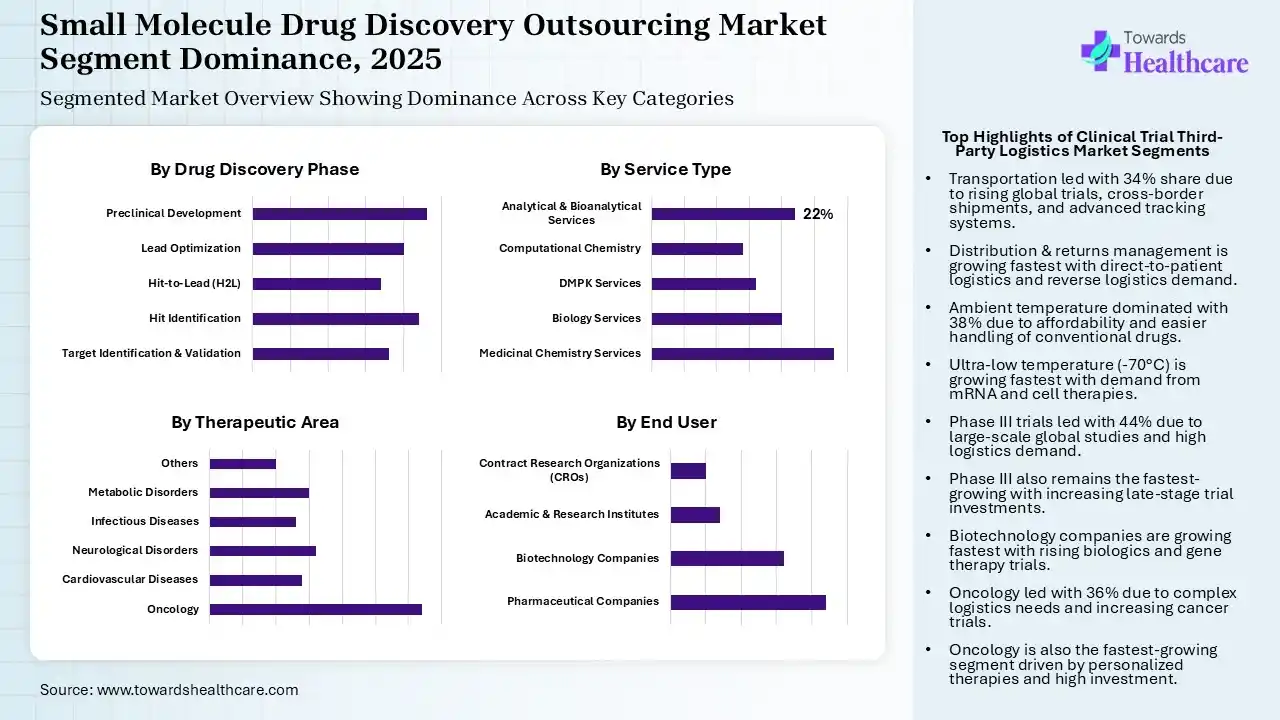
The Preclinical Development Segment Led the Market in 2025
| Segment | Share 2025 (%) |
| Target Identification & Validation | 18% |
| Hit Identification | 22% |
| Hit-to-Lead (H2L) | 17% |
| Lead Optimization | 20% |
| Preclinical Development | 23% |
The preclinical development segment dominated with 23% share in 2025, due to the strict regulatory guidelines from the FDA & EMA for safety data pushes to use experienced CROs to ensure data integrity & offer smoother IND applications. Outsourcing enables firms to access specialized GLP-compliant infrastructure without large capital investments, with the reinforcement of toxicology & ADME outsourcing.
In 2025, the hit identification segment held a 22% share of the small molecule drug discovery outsourcing market, due to a rigorous focus on identifying lead compounds against targets such as growth factors, leveraging high-throughput screening (HTS) & AI. Extensive breakthroughs include the adoption of biophysical techniques, including Surface Plasmon Resonance (SPR), Isothermal Titration Calorimetry (ITC), & NMR to find small, low-molecular-weight hits.
The lead optimization segment held 20% share in 2025 & is predicted to expand at 9.2% CAGR. Drivers are rising conversion of increased fixed spending into flexible variable expenditures to prevent risk at the rapid depletion lead optimization stage. CROs are increasingly using 3D organoid models, automated medicinal chemistry with robotics, & specialized degrader technology (PROTACs).
The hit-to-lead (H2L) segment held 17% share of the market. This is driven by a rise in the cost of internal R&D & the requirement for specialized expertise, specifically for complex therapeutic targets. CROs are emphasising rapid, unified Design-Make-Test-Analyze (DMTA) iterative cycles to lower the time from hit identification to optimize lead candidates.
The Medicinal Chemistry Services Segment Dominated the Market in 2025
| Segment | Share 2025 (%) |
| Medicinal Chemistry Services | 28% |
| Biology Services | 20% |
| DMPK Services | 16% |
| Computational Chemistry | 14% |
| Analytical & Bioanalytical Services | 22% |
The medicinal chemistry services segment led with 28% share of the small molecule drug discovery outsourcing market in 2025. Dominance is propelled by the surging demand for lead optimization, with skilled chemists in outsourcing hubs, which declines costs. Also, fostering continuous innovation in small molecule design, which spurs adoption of AI-enabled design, specialized expertise, & expedited synthesis.
The analytical & bioanalytical services segment held the second-largest share of 22% in 2025. It is difficult to maintain in-house labs, which need a huge initial investment in high-end instrumentation, including LC-MS/MS, UPLC, & NMR, while outsourcing gives cost-effectiveness for small to mid-sized biotech players for these services. The market is demanding accurate compound characterization for approvals.
The biology services segment captured 20% share of the small molecule drug discovery outsourcing market. This is fueled by the growing need for target validation & assays, with increasing specialized expertise for complex biological models, which demands outsourcing.
The DMPK services segment held 16% share in 2025, due to the significance of drug metabolism studies for safety profiling. CROs are pushing rapid turnaround, high-resolution bioanalysis, & combined chemistry-to-DMPK platforms.
The computational chemistry segment held 14% share in 2025 & is estimated to expand fastest at 10.2% CAGR. This has wider application in modeling chemical interactions in silico, estimating biological activity & physical properties before physical synthesis. Also, the firms are executing AI tools to predict protein structures, & then employ them in docking & molecular simulations to improve interactions.
The Oncology Segment Was Dominant in the Market in 2025
| Segment | Share 2025 (%) |
| Oncology | 32% |
| Cardiovascular Diseases | 14% |
| Neurological Disorders | 16% |
| Infectious Diseases | 13% |
| Metabolic Disorders | 15% |
| Others | 10% |
In 2025, the oncology segment led with 32% share & is predicted to witness rapid growth at the 9.4% CAGR. Surging cancer cases require faster progression of kinase inhibitors & specialized oncology models. To promote innovations in oncology therapies, firms are putting major investments in oncology pipelines, which encourages outsourcing services.
The neurological disorders segment captured 16% share of the small molecule drug discovery outsourcing market, due to the rising instances of Alzheimer’s & Parkinson’s disease, with a significant need for skilled professionals to develop complex CNS drugs. CROs are prominently focusing on the evolution of molecules with robust BB crossing abilities.
The metabolic disorders segment held 15% of the small molecule drug discovery outsourcing market. Key drivers are a growth in diabetes & obesity prevalence, with notable demand for long-term treatment. CROs are exploring metabolic-specific capabilities, like 3D cell models & high-throughput screening, to push the pipeline.
The cardiovascular diseases segment accounted for 14% share, due to the surging reliance on CRO for evolving new small-molecule inhibitors of MAP4K4 for cardioprotection following heart attacks. Efforts using integrated AI, machine learning, & 3D cell culture models to shorten timelines for determining lead compounds for heart failure & coronary diseases.
The infectious diseases segment captured 13% share in 2025. This is driven by the emergence of pathogens, which raises focus on drug discovery. Also, governments are funding R&D in anti-infective drugs, coupled with the growth in antibiotic resistance, which drives innovations.
The Pharmaceutical Companies Segment Led the Market in 2025
| Segment | Share 2025 (%) |
| Pharmaceutical Companies | 44% |
| Biotechnology Companies | 32% |
| Academic & Research Institutes | 14% |
| Contract Research Organizations (CROs) | 10% |
The pharmaceutical companies segment dominated with a 44% share of the small molecule drug discovery outsourcing market in 2025. Like, WuXi AppTec, Charles River, and Evotec are nurturing virtual, leaner pharmaceutical models that emphasise lead optimization & expedited, affordable preclinical development. Certainly, a significant number of drug candidate failures are spurring the need for outsourcing expertise among these companies.
However, the biotechnology companies segment captured 32% share in 2025 & is estimated to expand at 9.6% CAGR. These firms have a lack of in-house infrastructure, which bolsters reliance on external alliances. Escalating demand for targeted therapies & the use of advanced technologies are fostering outsourcing in biotech companies.
The academic & research institutes segment held 14% share, due to the emerging collaboration of universities with CROs for sophisticated facilities. Also, the inclusion of grant-funded projects is promoting outsourcing services in institutes.
The contract research organizations (CROs) segment accounted for 10%, as they expand their service portfolios internally. Globally surging demand for end-to-end solutions supports CROs' steady growth.
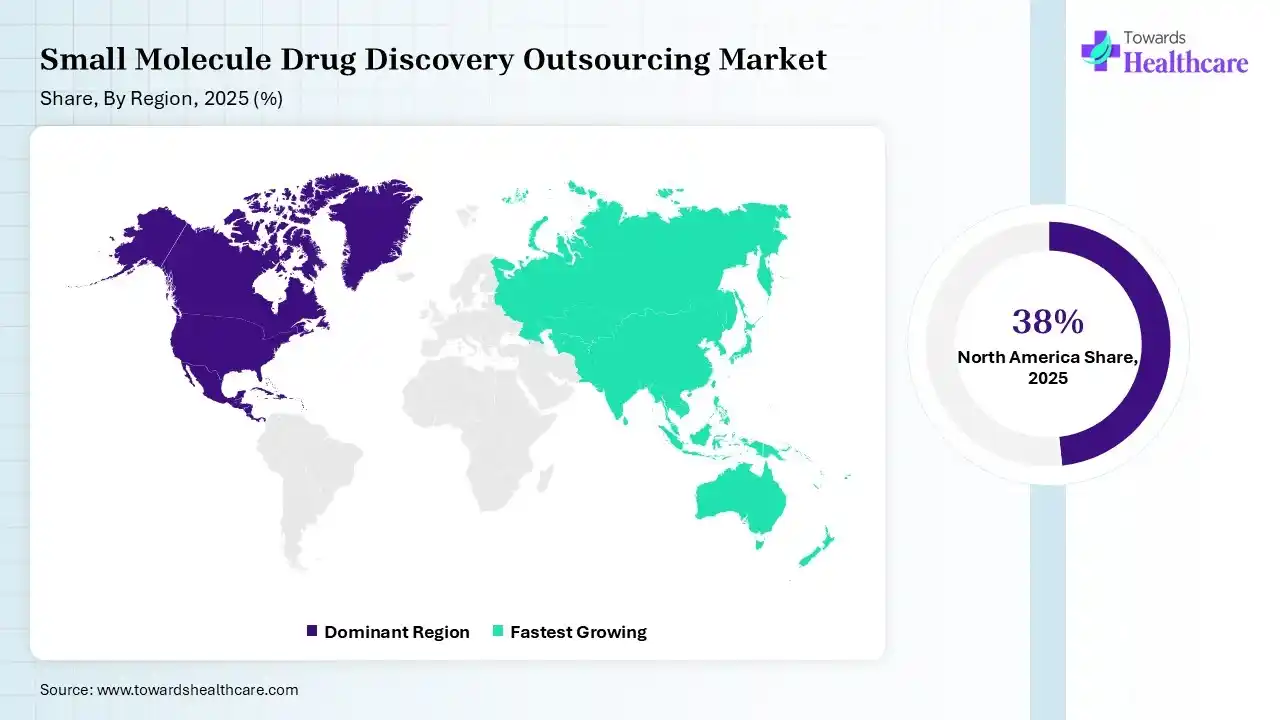
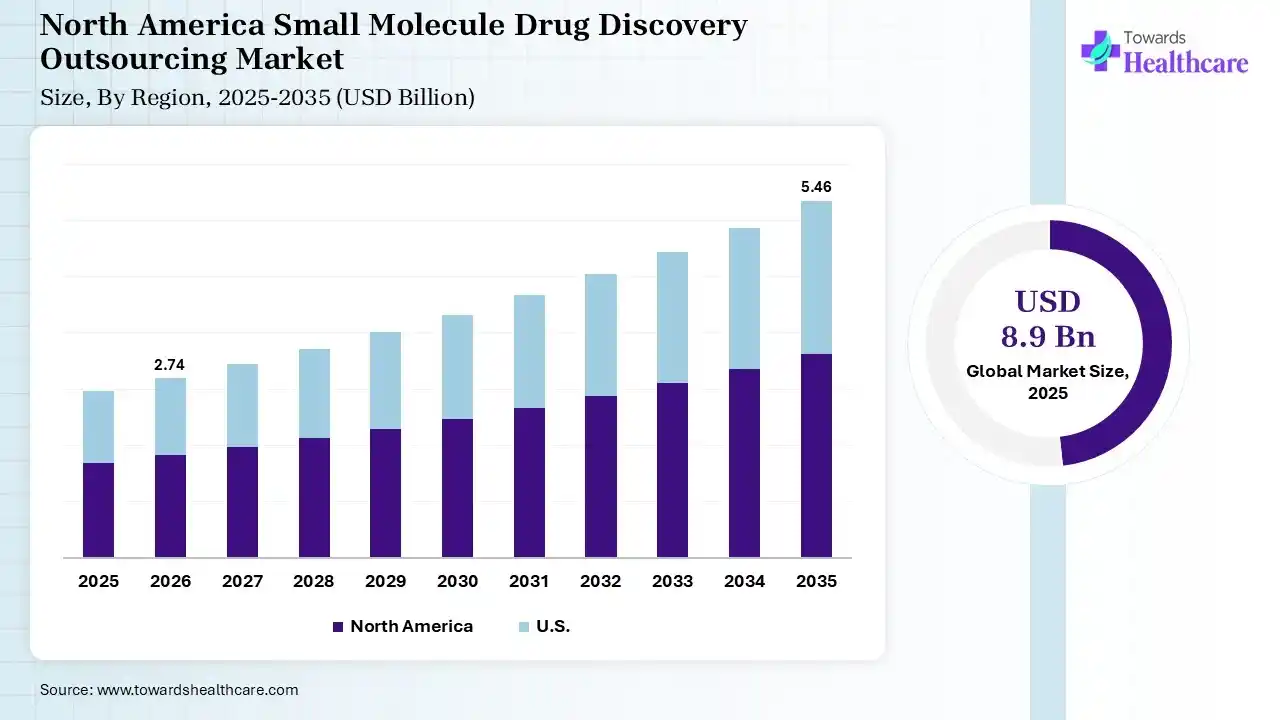
In 2025, North America registered dominance with 38% share of the small molecule drug discovery outsourcing market. This is propelled by the possession of a robust pharma hub, with immersive R&D investment, which finally surges innovation. Many Canadian CROs are widely leveraging AI-enabled platforms to automate data analysis & predictive modeling.
For instance,
U.S. Market Trends
The U.S. market has several giant pharma firms, which are promoting their substantial services, especially medicinal chemistry, hit-to-lead optimization, custom synthesis, & DMPK/toxicology screening by using advanced technologies, like AI, machine learning, & computer-aided drug design.
Canada Strengthens Small Molecule Drug Discovery Outsourcing Through Research Excellence
The Canada small molecule drug discovery outsourcing market is growing significantly due to its strong life science research ecosystem, increasing collaborations between biotechnology firms and contract research organizations (CROs), and expanding pharmaceutical innovation. Favorable government support for R&D, a highly skilled scientific workforce, and growing investments in precision medicine and early-stage drug discovery are attracting outsourcing partnerships and accelerating market growth.
Asia Pacific held 27% share in 2025 & is anticipated to grow at 10.5% CAGR in the small molecule drug discovery outsourcing market. This has been driven by the pool of affordable R&D services, with skilled professionals, raising the comprehensive research position of APAC. Chinese labs are fostering ADC development, with ADCs comprising over 50% of the value in recent licensing deals, which boosts crucial chemistry expertise.
India Market Trends
However, the Indian government is actively involved in the sector through encouragement, such as the Research Linked Incentive (RLI) scheme and funding for BIRAC to transform infrastructure, improve GMP compliance, & elevate global competitiveness.
China Accelerates Small Molecule Drug Discovery Outsourcing Through Expanding R&D Capacity
The China small molecule drug discovery outsourcing market is growing significantly due to its expanding pharmaceutical manufacturing capabilities, increasing investments in innovative drug research, and a large pool of skilled scientific talent. Rapid adoption of AI-driven drug discovery platforms, growing partnerships with global pharmaceutical companies and organizations (CROs) are strengthening outsourcing capabilities. Supportive government policies for biopharmaceutical innovation further fuel market growth.
| Ecosystem Segment | Key Participants | Role in Market |
| Technology Providers | Schrödinger, Certara, Exscientia | Computational chemistry, molecular modeling, AI-assisted drug discovery |
| Drug Discovery CROs | Charles River Laboratories, WuXi AppTec, Evotec | End-to-end discovery services |
| CDMOs | Lonza, Catalent, Recipharm | Development and manufacturing support |
| Platform Providers | Relay Therapeutics, BenevolentAI | AI and computational drug design platforms |
| Medicinal Chemistry Specialists | Symeres, Sai Life Sciences | Lead optimization and chemistry services |
| Biology Service Providers | Crown Bioscience, Pharmaron | In vitro and in vivo pharmacology |
| Research Institutions | Broad Institute, The Scripps Research Institute | Target identification and translational research |
| End-User Industries | Pharmaceutical, Biotechnology, Academic Research, Venture-backed Drug Discovery Startups | Outsource discovery programs to accelerate pipelines |
R&D
Clinical Trials & Regulatory Approvals
Formulation and Final Dosage Preparation
| Tier 1 | Tier 2 | Tier 3 | |
| Typical Market Influence | 58% | 28% | 14% |
| Tier 1 | ||||
| Company Name | Headquarters | Country | Why Relevant to This Market | Key Products/Services |
| WuXi AppTec | Shanghai | China | One of the largest global drug discovery outsourcing providers | Chemistry, biology, DMPK, preclinical discovery |
| Charles River Laboratories | Wilmington, Massachusetts | USA | Major integrated discovery CRO platform | Target discovery, medicinal chemistry, pharmacology |
| Evotec SE | Hamburg | Germany | Global leader in discovery partnerships | Hit identification, lead optimization, integrated discovery |
| Tier 2 | ||||
| Company Name | Headquarters | Country | Why Relevant to This Market | Key Products/Services |
| Sai Life Sciences | Hyderabad, Telangana | India | Leading discovery CRO serving global pharma and biotech firms | Medicinal chemistry, biology, integrated discovery |
| Syngene International | Bengaluru, Karnataka | India | Major discovery services partner for global innovators | Drug discovery, chemistry, biology |
| Jubilant Biosys | Bengaluru, Karnataka | India | Specialized discovery services provider | Integrated drug discovery solutions |
| Tier 3 | ||||
| Company Name | Headquarters | Country | Why Relevant to This Market | Key Products/Services |
| Aurigene Pharmaceutical Services | Bengaluru, Karnataka | India | Specialized discovery outsourcing platform | Small molecule discovery and optimization |
| Eurofins Discovery | St. Charles, Missouri | USA | Growing discovery services business | Screening, assay development, pharmacology |
| GVK BIO (Aragen Life Sciences) | Hyderabad, Telangana | India | Significant contract discovery operations | Integrated discovery services |
In July 2026, "Rentosertib was not discovered by starting from a conventional target and simply screening more compounds. It came from a biology-first, aging-informed AI workflow that connected TNIK to fibrotic and inflammatory disease mechanisms, and then used generative chemistry to create a drug candidate with the properties required for clinical development”, said Feng Ren, PhD, Co-CEO and Chief Scientific Officer of Insilico Medicine.
Strengths
Weaknesses
Opportunities
Threats
By Drug Discovery Phase
By Service Type
By Therapeutic Area
By End User
By Region






Principal Consultant
Rohan Patil is a seasoned market research professional with over 5+ years of focused experience in the healthcare sector, bringing deep domain expertise, strategic foresight, and analytical precision to every project he undertakes.
Learn more about Rohan Patil

Reviewed By
Aditi Shivarkar is a seasoned professional with over 14 years of experience in healthcare market research. As a content reviewer, Aditi ensures the quality and accuracy of all market insights and data presented by the research team.
Learn more about Aditi Shivarkar









