
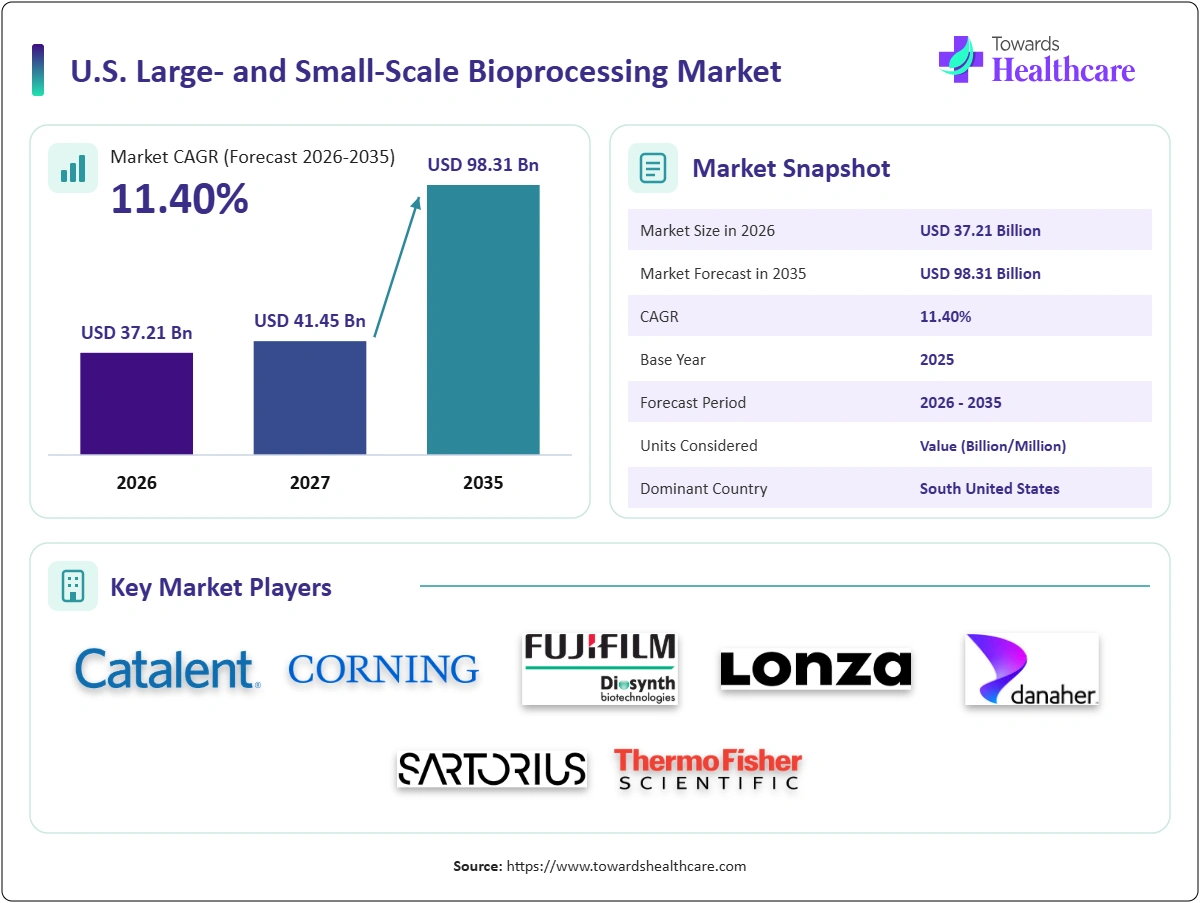
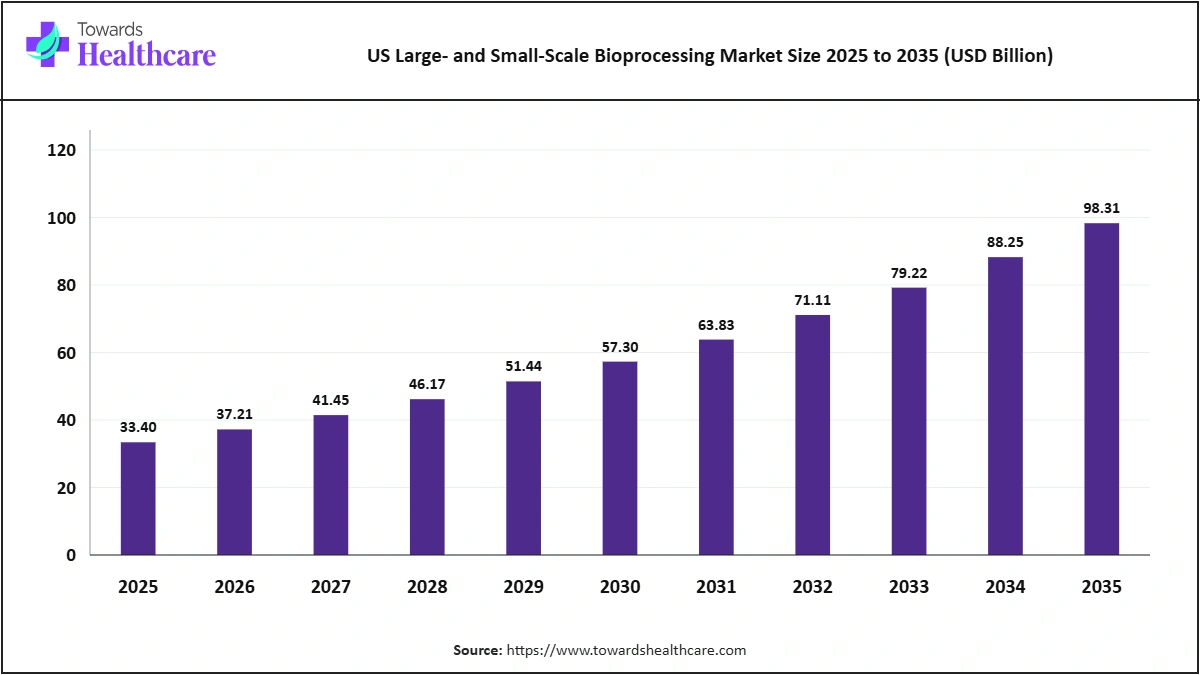
The U.S. large- and small-scale bioprocessing market is estimated to rise from USD 33.40 billion in 2025 to USD 98.31 billion in 2035 due to the increasing proportion of biologicals in new drug approvals and due to major investments in new U.S. manufacturing capacity by pharmaceutical firms that need lots of bioprocessing products. Domestic manufacturing investment, demand for GLP-1 drugs and antibodies, cell and gene therapy scale-up, adoption of single-use technology, and capacity expansion at CDMOs will drive growth strongly to raise the market size to USD 57.30 billion in 2030, while maintaining a CAGR of 11.40% during 2026 to 2035.
Analyst View: The forecast was constructed using the U.S. biologics and bio-based manufacturing volumes by size, process, and application type multiplied by the cost of equipment, supplies, and services per unit volume and capital costs for new facilities. Costs include expenses related to commercial and clinical biologics manufacturing, construction of new plants, CDMO operations, and biotechnology manufacturing volumes. The result was benchmarked against the revenues of top bioprocessing vendors and CDMOs in the U.S., as well as other published forecasts, putting the base year slightly above the highest comparable value. The growth rate is based on the size of manufacturing investments announced in the U.S., supporting a slightly higher rate than comparable estimates.
Driver: More biologics pipelines. Pharma companies make investments in their plants in the U.S. Demand for GLP-1 and antibodies increases. There is growth in cell and gene therapy products. Single-use technology fast-tracks facility construction.
Restraint: High capital costs. Lack of qualified workers. Timelines may be delayed. Drug pricing pressure impacts investment decisions. Single-use generates waste problems.
Opportunity: Onshoring generates additional demand. Continuous processing brings higher efficiency. Biosimilar volumes increase. Precision fermentation advances.
| Segments | 2025 Share | 2025 Value (USD Billion) | 2035 Value (USD Billion) | CAGR 2026–2035 |
| Industrial Scale | 58.60% | 19.57 | 55.45 | 10.98% |
| Small Scale | 41.40% | 13.83 | 42.86 | 11.98% |
Note: 2025 is the base year; 2035 values are forecasts.
Sources: Expert interviews, secondary sources, Towards Healthcare database, and Towards Healthcare analysts.
Industrial Scale: This segment contributed 58.60% (USD 19.57 billion) to the market size of the U.S. large- and small-scale bioprocessing market in 2025 and is expected to grow to USD 55.45 billion by 2035, at a CAGR of 10.98% between 2026 and 2035. This includes commercial manufacturing in large-scale stainless steel and single-use bioreactors/fermenters along with complete downstream purification trains. This is leading due to manufacturing of biologics such as monoclonal antibodies, insulin, GLP-1 drug and vaccines, and enzymes and biochemicals in large quantities.
Small Scale: This segment contributed 41.40% (USD 13.83 billion) to the market size of the U.S. large- and small-scale bioprocessing market in 2025 and is expected to grow to USD 42.86 billion by 2035, at a CAGR of 11.98% between 2026 and 2035. This includes process development, clinical manufacturing, and small-scale commercial manufacturing that includes cell and gene therapy products and personalized medicine. The growth rate is higher as the pipeline of novel modalities using small-scale manufacturing is growing fast.
| Segments | 2025 Share | 2025 Value (USD Billion) | 2035 Value (USD Billion) | CAGR 2026–2035 |
| Downstream Processing | 46.80% | 15.63 | 46.89 | 11.61% |
| Upstream Processing | 32.60% | 10.89 | 31.51 | 11.21% |
| Fermentation | 20.60% | 6.88 | 19.91 | 11.21% |
Note: 2025 is the base year; 2035 values are forecasts.
Sources: Expert interviews, secondary sources, Towards Healthcare database, and Towards Healthcare analysts.
Downstream Processing: This category represented 46.80% (USD 15.63 billion) of the total bioprocessing industry market share in the US in 2025, and it is anticipated that this value will increase to USD 46.89 billion by 2035, with an average annual growth rate of 11.61% during the period from 2026 to 2035. Downstream process includes harvest, clarification, chromatography, viral inactivation and removal, ultrafiltration, and formulation. This is the largest and the fastest-growing workflow due to increasing cell culture titres and the high cost of resins and filters.
Upstream Processing: This market segment comprised 32.60% (USD 10.89 billion) of the U.S. large- and small-scale bioprocessing market in 2025 and is expected to grow to USD 31.51 billion by 2035, registering a CAGR of 11.21% between 2026 and 2035. The upstream process involves the development of cell lines, media preparation, seed trains, and cell cultures in the bioreactor. It is driven by intensification and perfusion processes along with cell and gene therapy manufacturing.
Fermentation: This market segment comprised 20.60% (USD 6.88 billion) of the U.S. large- and small-scale bioprocessing market in 2025 and is expected to grow to USD 19.91 billion by 2035, registering a CAGR of 11.21% between 2026 and 2035. The process of fermentation involves the use of microorganism systems to manufacture proteins, enzymes, peptides, plasmids, and biochemicals.
| Segments | 2025 Share | 2025 Value (USD Billion) | 2035 Value (USD Billion) | CAGR 2026–2035 |
| Bioreactors/Fermenters | 29.00% | 9.69 | 27.29 | 10.91% |
| Cell Culture Products | 24.60% | 8.22 | 25.77 | 12.11% |
| Filtration Assemblies | 16.40% | 5.48 | 15.99 | 11.31% |
| Chromatography Resins & Columns | 15.80% | 5.28 | 15.41 | 11.31% |
| Bioreactor Accessories & Others | 14.20% | 4.74 | 13.85 | 11.31% |
Note: 2025 is the base year; 2035 values are forecasts.
Sources: Expert interviews, secondary sources, Towards Healthcare database, and Towards Healthcare analysts.
Bioreactors/Fermenters: It held a 29.00% (USD 9.69 billion) share of the U.S. large- and small-scale bioprocessing market in 2025, which is forecast to reach USD 27.29 billion by 2035, growing at a CAGR of 10.91% during 2026 - 2035. Bioreactors and fermenters, ranging from benchtop to production scales, are the largest product type due to the fact that every new biologics facility needs them, and single-use bioreactors have gained popularity for their flexibility.
Cell Culture Products: The segment contributed 24.60% (USD 8.22 billion) to the United States' bioprocessing market share in 2025 and is expected to grow up to USD 25.77 billion in 2035 at a CAGR of 12.11% during 2026 to 2035. The cell culture products consist of media, feeds, sera, and supplements. This product type is growing at the highest rate due to its continuous usage.
Filtration Assemblies: It constituted 16.40% (USD 5.48 billion) of the total U.S. large- and small-scale bioprocessing market in 2025 and is expected to reach USD 15.99 billion by 2035, with a CAGR of 11.31% from 2026 to 2035. Filtration assemblies are comprised of depth filtration, sterile filtration, tangential flow, and viral filters that are used during the process.
Chromatography Resins & Columns: It constituted 15.80% (USD 5.28 billion) of the total U.S. large- and small-scale bioprocessing market in 2025 and is expected to reach USD 15.41 billion by 2035, with a CAGR of 11.31% from 2026 to 2035. Chromatography resins and columns such as protein A resins are used to purify antibodies.
Bioreactor Accessories & Others: This section made up 14.20% (US$ 4.74 billion) of the bioprocessing market in the U.S. in 2025 and is estimated to hit US$ 13.85 billion by 2035, growing at a CAGR of 11.31% during 2026 to 2035. Accessories for bioreactors and others comprise sensors, controllers, bags, tubing, connectors, and process analytics.
| Segments | 2025 Share | 2025 Value (USD Billion) | 2035 Value (USD Billion) | CAGR 2026–2035 |
| Biopharmaceuticals | 63.60% | 21.24 | 63.33 | 11.54% |
| Specialty Industrial Chemicals | 22.80% | 7.62 | 21.91 | 11.14% |
| Environmental Aids & Others | 13.60% | 4.54 | 13.07 | 11.14% |
Note: 2025 is the base year; 2035 values are forecasts.
Sources: Expert interviews, secondary sources, Towards Healthcare database, and Towards Healthcare analysts.
Biopharmaceuticals: This segment represented 63.60% (USD 21.24 billion) of the U.S. large- and small-scale bioprocessing market in 2025 and is expected to grow to USD 63.33 billion by 2035, with a CAGR of 11.54% from 2026 to 2035. Biopharmaceuticals, comprising monoclonal antibodies, vaccines, recombinant proteins, peptides, and cell & gene therapies, are the largest and fastest-growing applications owing to a robust pipeline and expansion of U.S. manufacturing capabilities.
Specialty Industrial Chemicals: This segment represented 22.80% (USD 7.62 billion) of the U.S. large- and small-scale bioprocessing market in 2025 and is expected to grow to USD 21.91 billion by 2035, with a CAGR of 11.14% from 2026 to 2035. Specialty Industrial Chemicals comprise enzymes, bio-based chemicals/materials derived through fermentation processes for industrial applications.
Environmental Aids & Others: This segment represented 13.60% (USD 4.54 billion) of the U.S. large- and small-scale bioprocessing market in 2025 and is expected to grow to USD 13.07 billion by 2035, with a CAGR of 11.14% from 2026 to 2035. Environmental aids & others comprise bioremediation agents, biofuels, and food/feed ingredients.
| Segments | 2025 Share | 2025 Value (USD Billion) | 2035 Value (USD Billion) | CAGR 2026–2035 |
| Multi-Use | 54.20% | 18.10 | 49.10 | 10.49% |
| Single-Use | 45.80% | 15.30 | 49.21 | 12.39% |
Note: 2025 is the base year; 2035 values are forecasts.
Sources: Expert interviews, secondary sources, Towards Healthcare database, and Towards Healthcare analysts.
Multi-Use: It represented 54.20% (USD 18.10 billion) of the U.S. large- and small-scale bioprocessing market in 2025 and is expected to grow to USD 49.10 billion by 2035 at a CAGR of 10.49% from 2026 to 2035. This type of system uses stainless steel that can be cleaned and reused. It is dominant since large commercial operations still depend on stainless steel systems.
Single-Use: It represented 45.80% (USD 15.30 billion) of the U.S. large- and small-scale bioprocessing market in 2025 and is expected to grow to USD 49.21 billion by 2035 at a CAGR of 12.39% from 2026 to 2035. The single-use system utilizes disposable assemblies, bags, and bioreactors. This system is growing at a much higher rate due to lower cleaning and validation requirements, as well as quicker facility construction.
| Segments | 2025 Share | 2025 Value (USD Billion) | 2035 Value (USD Billion) | CAGR 2026–2035 |
| In-House | 61.40% | 20.51 | 56.33 | 10.63% |
| Outsourced | 38.60% | 12.89 | 41.98 | 12.53% |
Note: 2025 is the base year; 2035 values are forecasts.
Sources: Expert interviews, secondary sources, Towards Healthcare database, and Towards Healthcare analysts.
In-House: This segment held a 61.40% (USD 20.51 billion) share of the U.S. large- and small-scale bioprocessing market in 2025 and is expected to reach USD 56.33 billion by 2035, recording a CAGR of 10.63% from 2026 to 2035. In-house manufacturing involves the manufacturing of drugs by the drug manufacturers within their own facilities. It is dominant because major pharmaceutical companies have been establishing new plants in the United States to ensure supply.
Outsourced: This segment held 38.60% (USD 12.89 billion) of the U.S. large- and small-scale bioprocessing market in 2025 and is expected to reach USD 41.98 billion by 2035, registering a CAGR of 12.53% from 2026 to 2035. Outsourced manufacturing is done with the help of CDMOs like Lonza, Catalent, Fujifilm Diosynth, and Thermo Fisher's Patheon. The reason why outsourced manufacturing is growing at a fast pace is that biotech companies do not have their own plants.
Analyst View: Values for segments were determined by correlating production volumes and expenditure against scales, processes, products, applications, uses, and modes of use. The industrial scale, downstream process, bioreactor, biopharmaceutical, multi-use, and in-house production dominate the segment. However, we believe that the small scale, cell culture product, single-use system, and outsourced production will be gaining ground.
| Region | 2025 Share | 2025 Value (USD Billion) | 2035 Value (USD Billion) | CAGR 2026–2035 |
| Northeast | 34.20% | 11.42 | 32.16 | 10.91% |
| South | 27.80% | 9.29 | 29.11 | 12.11% |
| West | 24.60% | 8.22 | 23.98 | 11.31% |
| Midwest | 13.40% | 4.48 | 13.06 | 11.31% |
Note: 2025 is the base year; 2035 values are forecasts.
Sources: Expert interviews, secondary sources, Towards Healthcare database, and Towards Healthcare analysts.
Northeast: This region held a 34.20% (USD 11.42 billion) share of the U.S. large- and small-scale bioprocessing market in 2025 and is expected to reach USD 32.16 billion by 2035 at a CAGR of 10.91% during the forecast period from 2026 to 2035. The region hosts the Boston-Cambridge biotech cluster, the pharmaceutical corridor of New Jersey, and the cell and gene therapy hub of Pennsylvania, and houses several biologics production facilities and process development labs.
South: This region held a 27.80% (USD 9.29 billion) share of the U.S. large- and small-scale bioprocessing market in 2025 and is expected to reach USD 29.11 billion by 2035 at a CAGR of 12.11% during the forecast period from 2026 to 2035. The region comprises North Carolina's Research Triangle, which is one of the biggest biomanufacturing clusters in the country, and also features Texas, Georgia, and some other states that attract large plants. The South is the fastest-growing region since most of the recently announced manufacturing projects for U.S. biologics and GLP-1 drugs are here.
West: In 2025, this region accounted for 24.60% (USD 8.22 billion) of the U.S. large- and small-scale bioprocessing market and is expected to grow up to USD 23.98 billion by 2035 at a CAGR of 11.31% from 2026 to 2035. The West region comprises biotechnology clusters in California, the San Francisco Bay Area, and San Diego, and biopharmaceutical manufacturing in Washington, Colorado, and Utah, where media and single-use products are manufactured by suppliers like Thermo Fisher and Cytiva.
Midwest: In 2025, this region accounted for 13.40% (USD 4.48 billion) of the U.S. large- and small-scale bioprocessing market and is expected to grow up to USD 13.06 billion by 2035 at a CAGR of 11.31% from 2026 to 2035. This region is made up of Indiana, Illinois, Ohio, and Michigan, which have manufacturing and investments in the pharma industry, with a resin manufacturing site by Cytiva in Michigan.
Analyst View: The regional shares have been calculated using the capacities of biologics production, investment, and R&D in each region. Northeast holds the lead because of high biopharma cluster densities. South receives the highest growth premium owing to new investments in manufacturing capacity.
| Rank | Company Name | Market-Specific Revenue (USD Billion) | 2025 Share | Key Products / Business | Headquarters |
| 1 | Thermo Fisher Scientific | 4.60 | 13.77% | Single-use, media, bioreactors and Patheon CDMO | United States |
| 2 | Danaher (Cytiva and Pall) | 4.20 | 12.57% | Bioreactors, resins, filters and single-use | United States |
| 3 | Merck KGaA (MilliporeSigma) | 3.20 | 9.58% | Filtration, media, Mobius single-use | Germany |
| 4 | Sartorius | 1.60 | 4.79% | Bioreactors, filters and media | Germany |
| 5 | Lonza | 1.50 | 4.49% | Biologics CDMO services | Switzerland |
| 6 | Avantor | 1.20 | 3.59% | Bioprocessing materials and single-use | United States |
| 7 | Catalent | 1.00 | 2.99% | Biologics and gene therapy CDMO | United States |
| 8 | Fujifilm Diosynth Biotechnologies | 0.60 | 1.80% | Biologics CDMO services | United States |
| 9 | Corning | 0.50 | 1.50% | Cell culture vessels and media | United States |
| 10 | Repligen | 0.36 | 1.08% | Filtration, chromatography and ATF | United States |
Note: Company revenues and shares are 2025 estimates.
Sources: Company press releases, expert interviews, secondary sources, Towards Healthcare database and Towards Healthcare analysts.
The leader of the U.S. large- and small-scale bioprocessing industry was Thermo Fisher Scientific, which captured an estimated share of 13.77% (USD 4.60 billion) of the revenue generated in 2025, while Danaher (Cytiva and Pall) occupied the second position with 12.57% (USD 4.20 billion), and third was Merck KGaA (MilliporeSigma) with 9.58% (USD 3.20 billion). Thermo Fisher Scientific has the leadership in the market due to single-use systems, cell culture media, bioreactors, and Patheon CDMO solutions. Danaher's Cytiva and Pall deliver bioreactors, chromatography resins, filters, and single-use solutions, while Merck KGaA's MilliporeSigma delivers filtration, media, and Mobius single-use solutions.
Estimated share of the top 10 companies was 56.17% (USD 18.76 billion), and the other 43.83% (USD 14.64 billion) was captured by the specialized equipment manufacturers, media and resin providers, smaller CDMOs, and distributors. The U.S. large- and small-scale bioprocessing market has only a few number of big players as suppliers & CDMOs and competition revolves around product quality, supply stability, presence in the U.S., single-use capabilities, integrations, regulatory assistance, and cost. The suppliers are building their capacities in the U.S. to satisfy onshoring requirements.
The U.S. large- and small-scale bioprocessing ecosystem links raw material and component suppliers with equipment and consumable makers, CDMOs, engineering firms, and biopharmaceutical and industrial producers.
| Ecosystem Stage | Role in the Market | Key Companies |
| Raw Materials | Supply polymers, chemicals, and media components | Chemical and polymer suppliers |
| Equipment & Consumables | Supply bioreactors, media, resins, filters, and single-use equipment | Thermo Fisher, Cytiva, MilliporeSigma, Sartorius, Repligen |
| CDMOs | Provide outsourced manufacturing | Lonza, Catalent, Fujifilm Diosynth, Patheon |
| Engineering & Construction | Design and build facilities | Engineering and construction firms |
| End Users | Produce biologics and biochemicals | Pharma companies, biotech firms, industrial biotech companies |
Sources: Company press releases, expert interviews, secondary sources, Towards Healthcare database and Towards Healthcare analysts.
Key players in the U.S. large- and small-scale bioprocessing market have been positioned under the Towards Healthcare Companies Quadrant based on their market strength, which includes revenue size, market share, and geographic presence, as well as innovation and growth strategy, which includes product portfolio, research and development, and alliances. Positioning has been done considering each company’s projected 2025 U.S. bioprocessing revenue and technology and alliances.
Sources: Company press releases, expert interviews, secondary sources, Towards Healthcare database and Towards Healthcare analysts.
Leaders: Thermo Fisher Scientific, Danaher (Cytiva and Pall), Merck KGaA (MilliporeSigma), Sartorius, Lonza and Catalent combine large U.S. revenue with broad portfolios, U.S. manufacturing and strong innovation.
Challengers: Avantor has large U.S. operations but less product innovation.
Innovators: Fujifilm Diosynth Biotechnologies and Repligen bring specialised filtration, chromatography, and CDMO capabilities.
Niche Players: Corning serves narrower product segments.
By Scale
By Workflow
By Product
By Application
By Use Type
By Mode
By Region
The U.S. large- and small-scale bioprocessing market has been defined as bioreactors and fermenters, cell culture products, filtration, chromatography, single-use and other bioprocessing equipment, consumables, and outsourced production for industrial and small-scale bioprocessing in the United States. The 2025 base year was developed bottom-up from the volume of biologics and bio-based products produced in the U.S., by scale, workflow, product, application, use type and mode, and spending per unit of production, and verified top-down by comparing to the revenues for U.S. bioprocessing of leading suppliers and CDMOs. Segment, regional and company values have been distributed across scales, workflows, products, applications, use types and modes, and regional production capacity. Critical values have been validated against company disclosure, regulatory, industry, and third-party estimates of published data, and inconsistent inputs have been excluded. All segment, regional, and company values have been converted to the 2025 base year, and the forecast period 2026 – 2035, using a constant CAGR from the 2025 base, has been recalculated and validated.
Analyst View: The U.S. market for large- and small-scale bioprocessing equipment is currently experiencing an uptrend in investments due to the growth in the biologics sector and onshoring of drug production. Our forecast model depends on the volume of production, investment in facilities, and utilization of consumables. Therefore, the forecast model follows the growth in production of biologics, investment in facilities, and outsourcing. Growth will be driven by construction of US plants and single-use systems.