Pipeline Programs

CGT Companies Tracked

Manufacturing Facilities


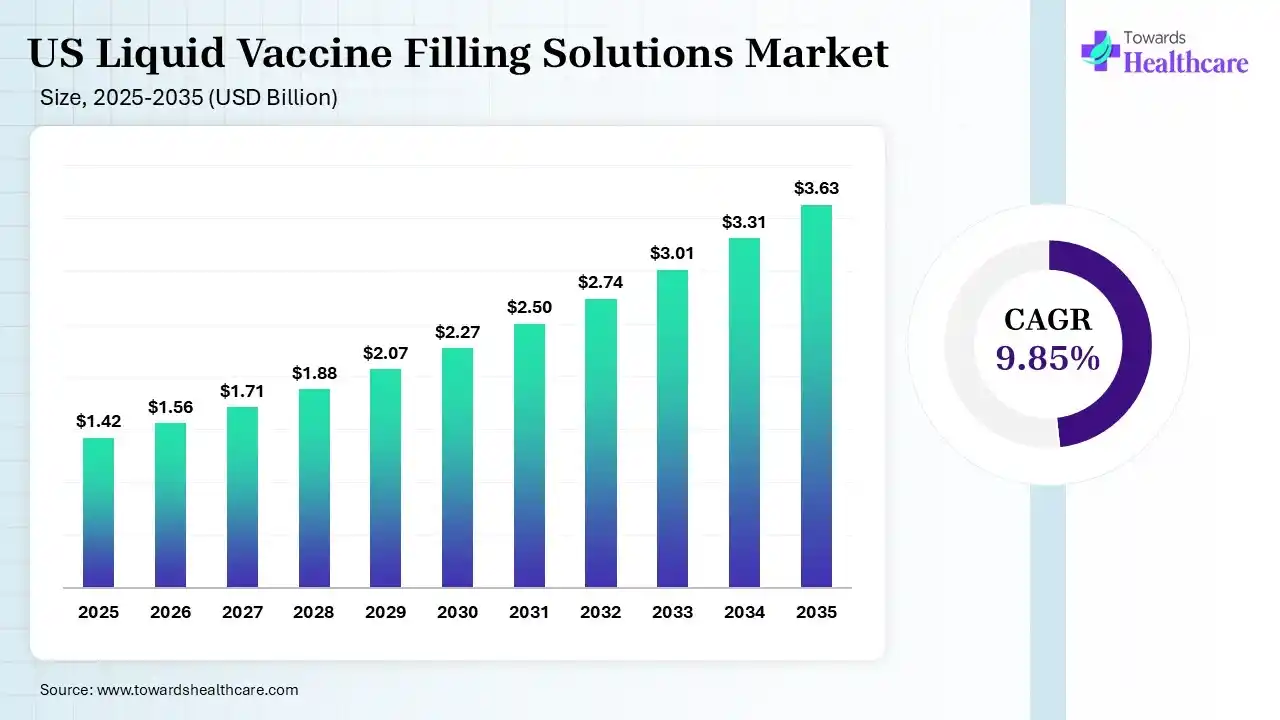
The U.S. liquid vaccine filling solutions market size was estimated at USD 1.42 billion in 2025 and is predicted to increase from USD 1.56 billion in 2026 to approximately USD 3.63 billion by 2035, expanding at a CAGR of 9.85% from 2026 to 2035. The U.S. liquid vaccine filling solutions market is growing as increasing demand for biologics, pre-filled syringes, and improved pandemic preparedness. There is a growing demand for automated, high-precision filling services in various industries.
Liquid fillers are advantageous in the healthcare, cosmetic, and beverage sectors. Filling tools shore up healthcare businesses ahead of growth and expansion, and actively save money in the long term. These technologies lower contamination challenges and streamline technology, leading to higher purity and safety. Liquid filling machines significantly improve the effectiveness of vaccine manufacturing by automating significant steps, lowering manual labor, and increasing the precision and speed of the filling technology. Liquid filling machines play a significant role in vaccine manufacturing, streamlining technology and improving efficiency at different stages.
The U.S. liquid vaccine filling solutions market is expanding due to increasing vaccine production, rising demand for biologics, and continuous investments in pharmaceutical manufacturing. The country has a well-established network of vaccine developers, contract manufacturing organizations, and advanced sterile filling facilities that support both commercial production and clinical research. Growing adoption of automated aseptic filling systems is improving production efficiency, product quality, and regulatory compliance. Demand for flexible filling solutions is also increasing as manufacturers produce multiple vaccine types in different packaging formats, including vials and prefilled syringes. Government support for pandemic preparedness, expanding immunization programs, and investments in domestic biopharmaceutical manufacturing continue to encourage innovation, strengthen supply chains, and create new opportunities for technology providers and contract manufacturing companies.
AI-based technology has the potential to process and analyse large volumes of multivariate data, therefore increasing manufacturing. It is transforming pharmaceutical production, from automating sterile fill-finish to ensuring regulatory compliance. AI can predict equipment failures and provide maintenance insights more quickly and accurately than older methods. By analyzing sensor data embedded in machinery, AI systems can detect unusual patterns and predict potential failures before they happen. Additionally, AI tools support process monitoring at various stages of bioprocessing, including upstream processes like cell culture for production.
| Table | Scope |
| Market Size in 2026 | USD 1.56 Billion |
| Projected Market Size in 2035 | USD 3.63 Billion |
| CAGR (2026 - 2035) | 9.85% |
| Historical Data | 2020 - 2023 |
| Key Applications | Human vaccines, veterinary vaccines, biologics, injectable pharmaceuticals, pandemic vaccine manufacturing |
| Primary End Users | Pharmaceutical companies, biopharmaceutical companies, CDMOs, research institutes, clinical laboratories |
| Key Challenges | High equipment investment costs, regulatory compliance requirements, complex sterile manufacturing processes, validation challenges |
| Market Segmentation | By Product Type, By Container Type, By Technology, By End User, By Capacity, By Application |
| Top Key Players | Stevanato Group, Lonza Group, Catalent, Inc., Vetter Pharma |

| Segment | Share 2025 (%) |
| Automated Filling Systems | 62% |
| Semi-Automated Filling Systems | 25% |
| Manual Filling Systems | 13% |
The Automated Filling Systems Segment Led the U.S. Liquid Vaccine Filling Solutions Market in 2025
The automated filling systems segment contributed the largest market share of 62% in 2025, as automatic liquid fillers provide both consistency and reliability, which is typically achievable by doing a fill by hand. The automatic bottle filler is centrally controlled by an easy-to-use, touch-screen operator interface. Automatic filling machines are configured to handle a wide range of products and container sizes and shapes, and even run more than one product in various cases.
The semi-automated filling systems segment held a significant share of 25% in the market, and is expected to grow at the fastest 8.70% CAGR during the forecast period, as it reduces human error in the filling process. Offers adaptability for different container specifications. Semi-automatic filling machines are extremely beneficial for small and medium manufacturers. They need a reduced investment, offer precise and hygienic dosing, and are easy to operate with lower training.
The manual filling systems segment held a significant share of 13% of the market, as manual bottle filling machinery uses a piston in a cylinder to force liquid into the container. These are usually pneumatically powered pump mechanisms, set to fill containers with the needed volume of liquid, fed from a floor-standing container or a machine-mounted hopper.

| Segment | Share 2025 (%) |
| Vials | 48% |
| Syringes | 34% |
| Ampoules | 10% |
| Cartridges | 8% |
Vials Segment Led the U.S. Liquid Vaccine Filling Solutions Market in 2025
The vials segment contributed the largest market share of 48% in 2025. A vial liquid filling machine is specialized pharmacological equipment used to fill sterile liquid medicines into glass or plastic vials with the highest precision. These systems work in a controlled aseptic environment, protecting product integrity and the safety of the patient. Vials used for liquids or lyophilized medicines.
The syringes segment held a significant share of 34% of the market, and is expected to grow at the fastest 11.2% CAGR during the forecast period, as syringes are reducing wastage of drugs, increasing product life span. Prefilled syringes are recognized as an effective, reliable, and convenient process for drug administration. Syringes lower manufacturing expenses because of decreased wastage of active pharmaceutical ingredient (API).
The ampoules segment held a significant share of 10% of the U.S. liquid vaccine filling solutions market in 2025, as ampoules serve a significant role in the medical care sector by confirming that medications are delivered as safely and effectively as possible. It precisely measures and fills sterile injectable powder into glass. With lower product wastage, negligible maintenance, and high reliability, this technology proves to be affordable in the long term.
The cartridges segment held a significant share of 8% of the market, as cartridges are filled aseptically and directly connected to the fluid path, deprived of any requirement for the consumer to transfer the liquid, which eliminates the challenges of exposing the drug to contaminants during administration. Cartridges are more effective than vials, as they remove the requirement for overfilling.
| Segment | Share 2025 (%) |
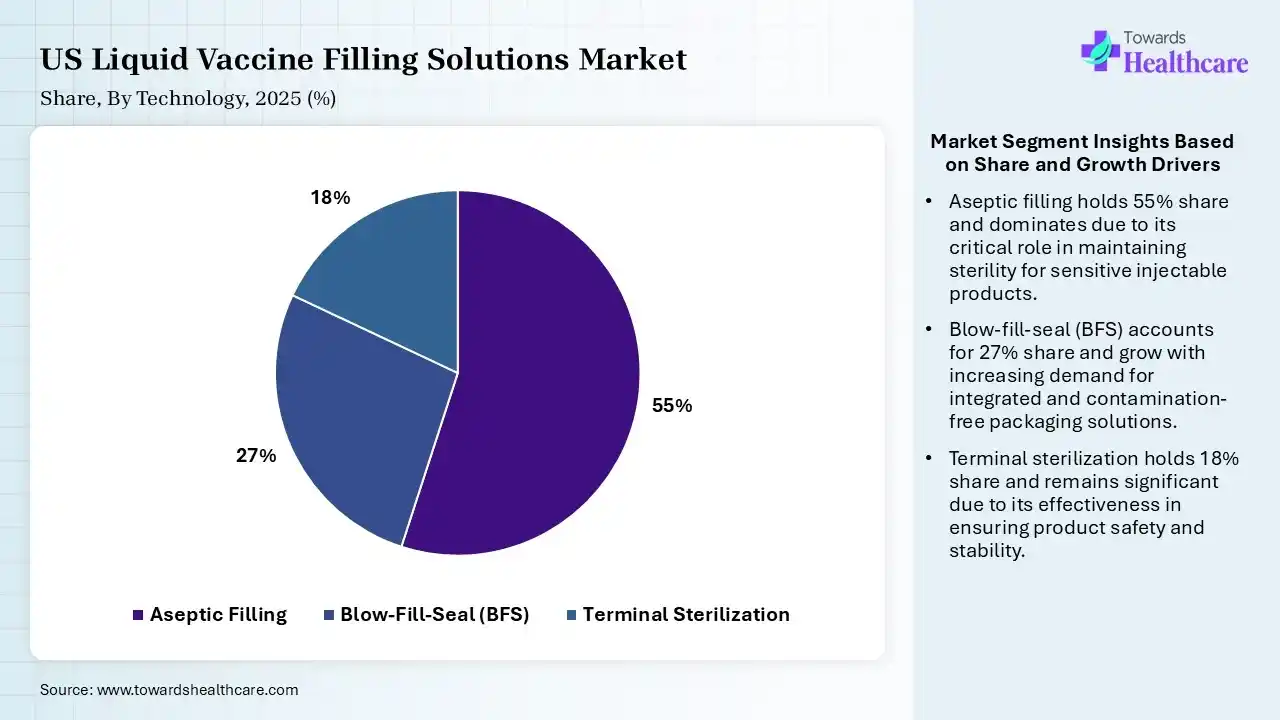
| Aseptic Filling | 55% |
| Blow-Fill-Seal (BFS) | 27% |
| Terminal Sterilization | 18% |
Aseptic Filling Segment Led the U.S. Liquid Vaccine Filling Solutions Market in 2025
The aseptic filling segment contributed the largest market share of 55%, as aseptic filling, the product and packaging are brought together under sterile conditions to avoid any contamination. Aseptic filling offers advanced product quality, reducing thermal impact on the beverage, and superior bottle design flexibility.
The blow-fill-seal (BFS) segment held a significant share of 27% in the market, and is expected to grow at the fastest 11.6% CAGR during the forecast period, as this technology is used to fill and finish sterile liquid healthcare products, involving ophthalmic, nebulizer, nasal, and parental vaccines. The BFS advanced aseptic technology lowers the requirement for human intervention through the filling process as compared to conventional aseptic filling.
The terminal sterilization segment held a significant share of 18% in the market, as terminal sterilization provides time savings and cost advantages to healthcare organizations. Since terminal sterilization takes place after the formulation and filling steps, these initial production processes occur in a less rigidly structured setting.
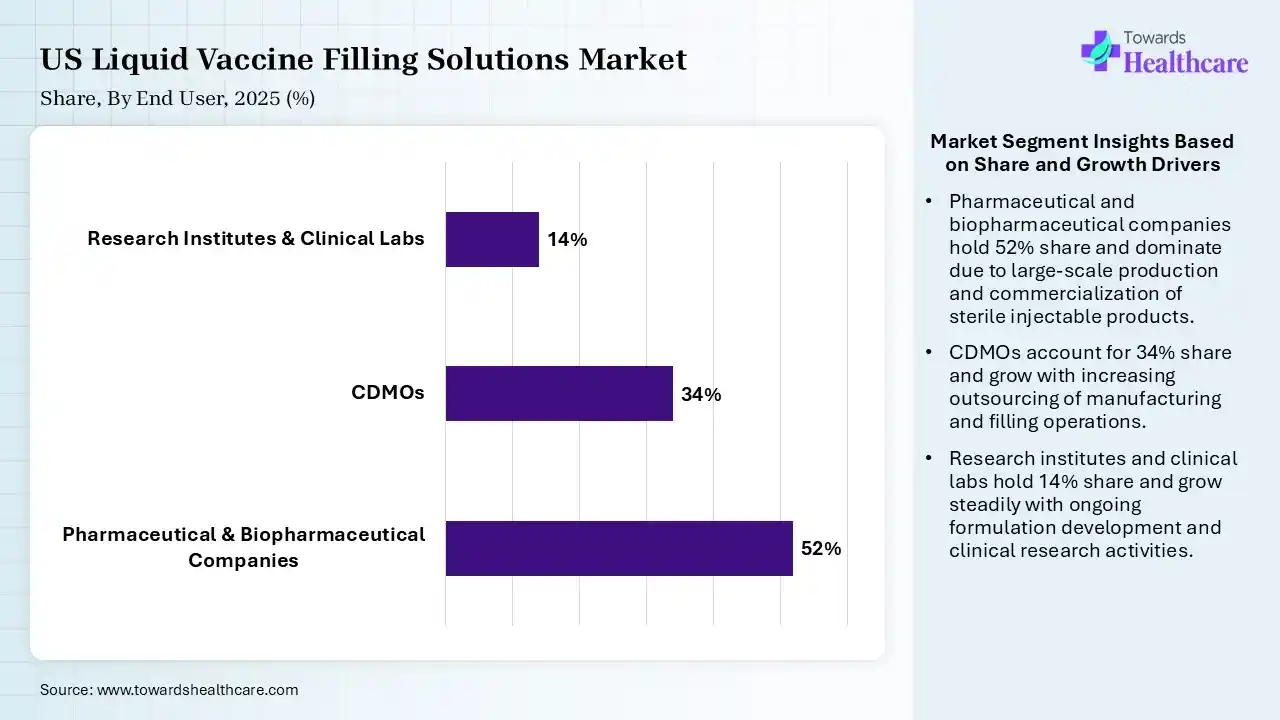
| Segment | Share 2025 (%) |
| Pharmaceutical & Biopharmaceutical Companies | 52% |
| CDMOs | 34% |
| Research Institutes & Clinical Labs | 14% |
The Pharmaceutical & Biopharmaceutical Companies segment led the U.S. Liquid Vaccine Filling Solutions Market in 2025
The pharmaceutical & biopharmaceutical companies segment contributed the largest market share of 52%, as the vaccine filling system plays a significant role in ensuring the safety, quality, and effectiveness of healthcare production. The precise and controlled filling technology ensures minimal product wastage and spillage, efficiently conserving precious resources and lowering material losses.
The CDMOs segment held a significant share of 34% in the market, and is expected to grow at the fastest 11.8% CAGR during the forecast period, as sterile fill-finish technology for injectable medicinal products, helping clinical to commercial productions in vials, cartridges, and prefilled syringes. CDMOs provide significant benefits, including superior scheduling flexibility and adaptable process trains, which are often tougher to instrument in larger organizations.
The research institutes & clinical labs segment held a significant share of 14% in the market, as liquid vaccine filling provides important benefits to research institutes and clinical labs, mainly by offering a rapid, more flexible, and affordable technique for handling small-batch manufacturing, clinical trials, and rapid development requirements as compared to lyophilization.
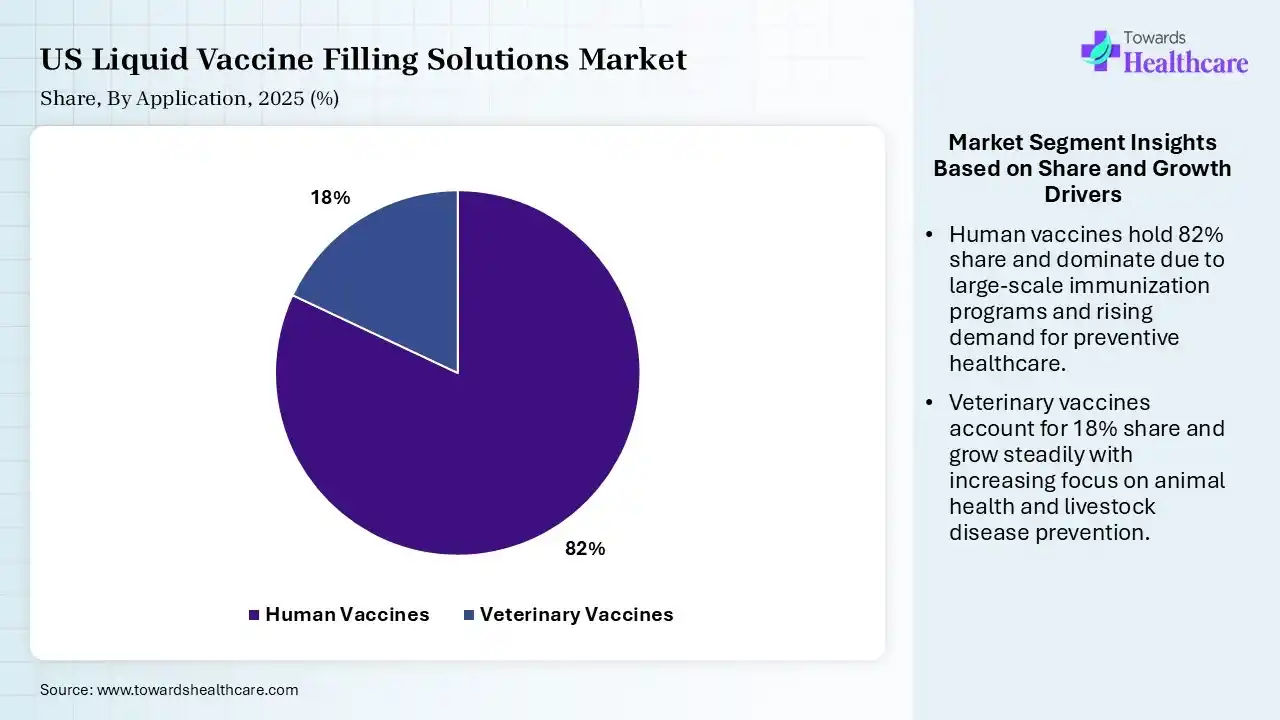
| Segment | Share 2025 (%) |
| Human Vaccines | 82% |
| Veterinary Vaccines | 18% |
The Human Vaccines segment led the U.S. Liquid Vaccine Filling Solutions Market in 2025
The human vaccines segment contributed the largest market share of 82% in 2025, and is expected to be the fastest-growing segment with a CAGR of 10.20% during 2026-2034, as advanced filling technologies, like isolators and restricted access barrier systems (RABS), reduce human intervention, radically lowering the challenges of microbial contamination in the end product. Human vaccines offer lower risk, advanced reliability, and better logistical tracking. This vaccination is one of the most effective public health interventions in lowering disease spread, preventing difficulties, and even deaths.
The veterinary vaccines segment held a significant share of 18% in the market, as these vaccines are a cost-effective use in preventing animal diseases; they are usually safe, effective, and are related with rare severe adverse effects. Veterinary vaccines have various benefits in that they are developed and licensed much more rapidly and at a lower cost than human vaccines.
| Category | Market Participants | Role in Ecosystem |
| Technology Providers | Syntegon, IMA Group, GEA, Romaco | Develop advanced filling, sterilization, automation, and process technologies for vaccine manufacturing |
| Product Manufacturers | Stevanato Group, Bausch+Ströbel, Groninger, Optima | Manufacture vial filling lines, syringe filling systems, isolators, and sterile fill-finish equipment |
| Service Providers | Catalent, Lonza, Vetter Pharma, Recipharm | Provide contract fill-finish, sterile manufacturing, and commercialization services |
| Platform Providers | Single-use technology providers, automation solution companies | Enable flexible vaccine manufacturing and scalable production |
| CROs/CDMOs | Catalent, Lonza, Vetter, Thermo Fisher Scientific | Support clinical-to-commercial vaccine production and outsourced manufacturing |
| Software Vendors | Siemens, Rockwell Automation, Emerson | Provide manufacturing execution systems, process monitoring, automation controls |
| Research Institutions | NIH-supported research centers, academic vaccine research facilities | Conduct vaccine development and manufacturing research |
| End-User Industries | Pharmaceutical & biotechnology companies, vaccine manufacturers | Utilize liquid filling solutions for commercial and clinical vaccine production |
R&D:
Manufacturing Processes:
Patient Services:
| Tier 1 | Tier 2 | Tier 3 | |
| Typical Market Influence | 62% | 28% | 10% |
| Tier 1 | ||||
| Company Name | Headquarters | Country | Why Relevant to This Market | Key Products/Services |
| Stevanato Group | Piombino Dese, Veneto, Italy | Italy | Global leader in pharmaceutical containment and drug delivery systems with strong vaccine fill-finish presence | EZ-fill vial solutions, inspection systems, syringe systems, integrated fill-finish technologies |
| Syntegon Technology | Waiblingen, Baden-Württemberg, Germany | Germany | Major pharmaceutical equipment provider with strong sterile filling expertise | Liquid pharmaceutical filling lines, aseptic processing systems, vaccine filling equipment |
| IMA Group | Bologna, Emilia-Romagna, Italy | Italy | Global supplier of pharmaceutical processing and packaging systems | Aseptic filling machines, vial filling systems, pharmaceutical automation |
| Tier 2 | ||||
| Company Name | Headquarters | Country | Why Relevant to This Market | Key Products/Services |
| Vetter Pharma | Ravensburg, Baden-Württemberg, Germany | Germany | Specialized CDMO focused on injectable drug manufacturing and sterile filling | Vial filling, syringe filling, cartridge filling, aseptic manufacturing |
| Bausch+Ströbel | Ilshofen, Baden-Württemberg, Germany | Germany | Established pharmaceutical machinery manufacturer specializing in sterile filling | Filling and closing machines, inspection systems, packaging solutions |
| Groninger & Co. GmbH | Crailsheim, Baden-Württemberg, Germany | Germany | Provides pharmaceutical filling and closing equipment for sterile products | Vial filling systems, syringe filling equipment, isolator-based solutions |
| Tier 3 | ||||
| Company Name | Headquarters | Country | Why Relevant to This Market | Key Products/Services |
| Dara Pharma | Granollers, Barcelona, Spain | Spain | Specialized manufacturer of pharmaceutical filling and packaging equipment | Aseptic filling machines, vial and syringe systems |
| Cozzoli Machine Company | Somerset, New Jersey, USA | United States | Provides liquid filling equipment for pharmaceutical applications | Liquid fillers, vial fillers, injectable filling systems |
| Romaco Group | Karlsruhe, Baden-Württemberg, Germany | Germany | Pharmaceutical equipment provider with filling and packaging technologies | Liquid filling, processing equipment, packaging systems |
Strengths
Weakness
Opportunities
Threat
In April 2026, "We are very excited to partner with Apotex on their Made in the U.S. strategy for injectables," said Lee Karras, Chief Executive Officer of Halo Pharmaceuticals. "We will still have ample capacity available for other customers who require vial, syringe, and cartridge sterile filling CDMO services."
By Product Type
By Container Type
By Technology
By End User
By Capacity
By Application








Principal Consultant
Rohan Patil is a seasoned market research professional with over 5+ years of focused experience in the healthcare sector, bringing deep domain expertise, strategic foresight, and analytical precision to every project he undertakes.
Learn more about Rohan Patil

Reviewed By
Aditi Shivarkar is a seasoned professional with over 14 years of experience in healthcare market research. As a content reviewer, Aditi ensures the quality and accuracy of all market insights and data presented by the research team.
Learn more about Aditi Shivarkar