


Symcel announced the initiation of customer evaluation research for the caloTrace Sterility Testing System, a next-generation platform for rapid microbial testing of cell and gene therapies, biologics, biopharmaceuticals, and other sterile medical care products.
The program allows pharmaceutical and advanced therapy developers to assess the platform on their products and in-process samples, confirming robust performance while optimizing workflows, information management, and technology incorporation to meet their particular needs.
The manual caloTrace, including the significant validation package, is specific for launch in November 2026. Deliveries of the automated sample handling upgrade are expected to begin in the first half of 2027.
Release times are significant for life-saving therapies, and sterility testing is presently a key bottleneck, delaying patient access and growing manufacturing expenses. The caloTrace Sterility testing technology is based on highly sensitive isothermal microcalorimetry and is intended to tackle this challenge. It integrates rapid results, continuous monitoring, and growth-based detection, reducing the challenges of false-positive results from non-viable cells. The platform characterizes 30 independently loaded random-access channels per temperature and supports direct, non-destructive testing in 13 mL vials, allowing larger and more representative sample volumes to be analyzed.
"Slow-growing organisms have traditionally been one of the greatest challenges in rapid sterility testing," says Dr. Wilhelm Paulander, Chief Clinical Development Officer at Symcel. "The integration of high-sensitivity heat identification and continuous real-time monitoring allows many microorganisms to be identified within just a few hours. The capability to identify organisms like C. acnes in as little as 48 hours demonstrates the strength to achieve time-to-negative sterility testing in 2-3 days.
The caloTrace Sterility System is being developed to support implementation in GMP-regulated environments, including a primary validation package to support method-specific validation. Using prefilled sterile calVials containing compendial FTM and TSB media, the platform supports dual-temperature testing at 20-25 °C and 30-37 °C in alignment with compendial sterility testing solutions.
The technology is being advanced with a target limit of identification of one colony-forming unit (CFU), consistent with expectations for substitute microbiological processes outlined in USP. The calView software is available with a 21 CFR Part 11 compliance package, and IQ/OQ/PQ documentation support technology qualification.
Testing and developing the technology in collaboration with leading biopharmaceutical and well-developed therapy developers supports ensuring that the platform aligns with consumer requirements, validation expectations, and the supplies of regulated production environments.
"The start of these customer evaluations marks an important milestone for the caloTrace Sterility Testing System," says Dr. Jesper Ericsson, CEO of Symcel. "We have already run the first customer samples with excellent results. Working directly with industry leaders allows us to demonstrate the value of the technology in real manufacturing environments while gaining valuable insights that help shape future development."
The caloTrace sterility testing system is being developed in both physical and automated configurations. The automated workflow integrates automatic vial identification, loading, and monitoring with full sample traceability via specific vial IDs, batch numbers, and data matrix codes. The core technology stays the same, so biological authentication is performed on the manual version ahead of predominantly upgrading to the automated sample handling module. Complemented by the benchtop calScreener sterility technology, the caloTrace platform offers a scalable path from method development to routine quality control testing.
The caloTrace platform is being advanced to support a broad range of healthcare applications. Its capability to directly analyze challenging sample matrices makes it specifically well suited for biologics, cell cultures, and other interesting products where matrix interference challenges the performance of conventional processes. As part of a grant awarded by the Coalition for Epidemic Preparedness Innovations (CEPI), Symcel is developing vaccine test processes aimed at allowing sterility testing in under three days.
According to Towards Healthcare, the rapid sterility testing for cell and gene therapies market is projected to experience significant growth, with estimates suggesting the market size will increase from USD 573.71 million in 2026 to approximately USD 2164.91million by 2035, representing a compound annual growth rate (CAGR) of 15.9% from 2026 to 2035, driven by rapid sterility testing for cell and gene therapies confirms rapid, reliable contamination identification, hastening product release and enhancing patient results.
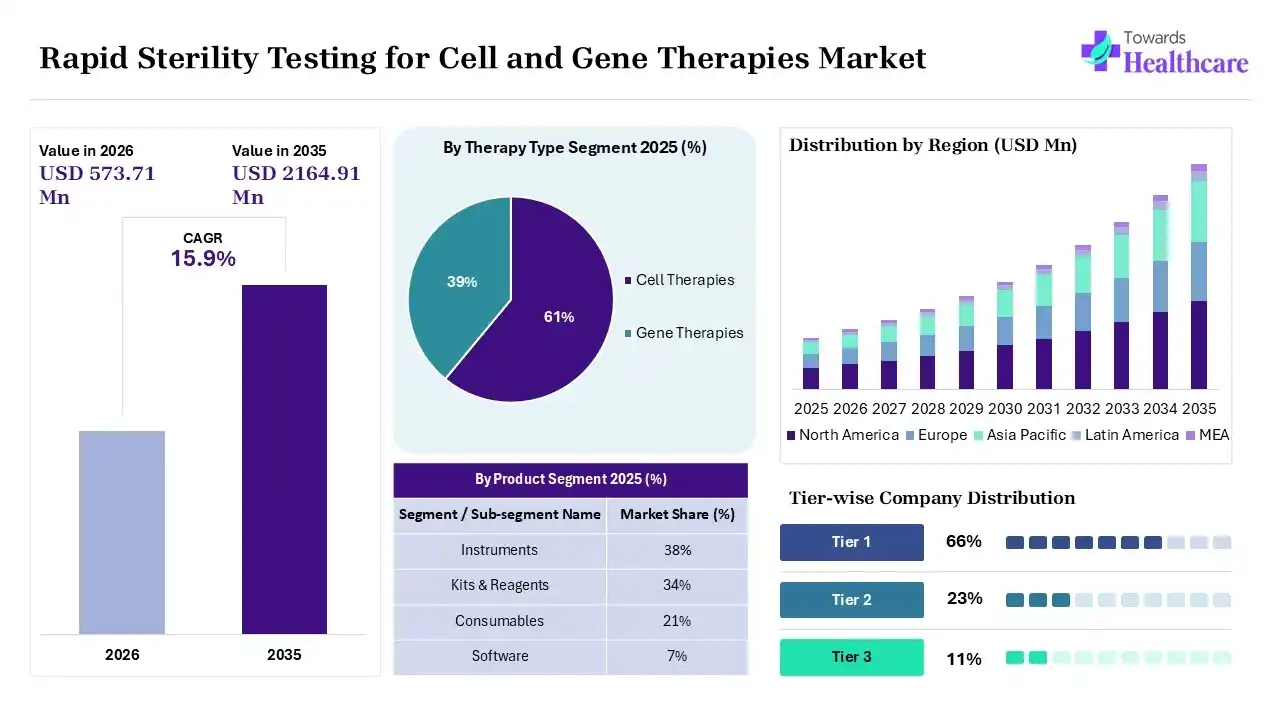
Sterility testing for cell and gene therapies is significant for verifying product safety, complying with regulations, and protecting immunocompromised patients via applications such as raw material screening, in-process contamination monitoring, and short-shelf-life product release. Broad range of biological medicinal products including vaccines, blood products, biotechnology products, and cell and tissue products.
Symcel is leading a new era in metabolic measurements for microbial testing, biological research, and diagnostics. The organization's biocalorimetry platforms offer new strategies for detecting and analyzing biological activity using isothermal microcalorimetry, with uses ranging from sterility testing of advanced therapies and microbial identification in foods and consumer goods to biofilm, microbiome, and cell research. Founded by leading authorities in microcalorimetry, Symcel is headquartered at the Karolinska Institute in Stockholm, Sweden.
A recent report by Towards Healthcare highlights that the rapid sterility testing for cell and gene therapies market is growing, as sterility testing of the ATMP is a significant component in confirming the safety of the cellular product before patient infusion, particularly because terminal purification is not possible for live therapeutics. Sterility testing is a core part of healthcare production, confirming that products remain free from harmful microorganisms.
Moreover, it is a time- and resource-intensive process that requires being carried out under aseptic conditions by specialized staff following detailed protocols. Significant development in biopharmaceutical sterility testing is the acceptance of rapid microbiological methods (RMM). These advanced technologies have transformed the testing technology, predominantly lowering testing times, enhancing accuracy, and lowering the requirement for human intervention.


