
The biologic imaging reagents market is projected to grow from USD 27.60 billion in 2025 to USD 64.74 billion by 2035 because CT, MRI, ultrasound and PET examinations keep rising with ageing populations and cancer care, and researchers rely on optical and molecular probes to study cells, tissues and disease. Targeted PET radiotracers, theragnostic, lower-dose contrast agents and advanced optical probes increase value per procedure and per study, lifting the market to USD 42.27 billion by 2030 and sustaining a CAGR of 8.90% from 2026 to 2035.
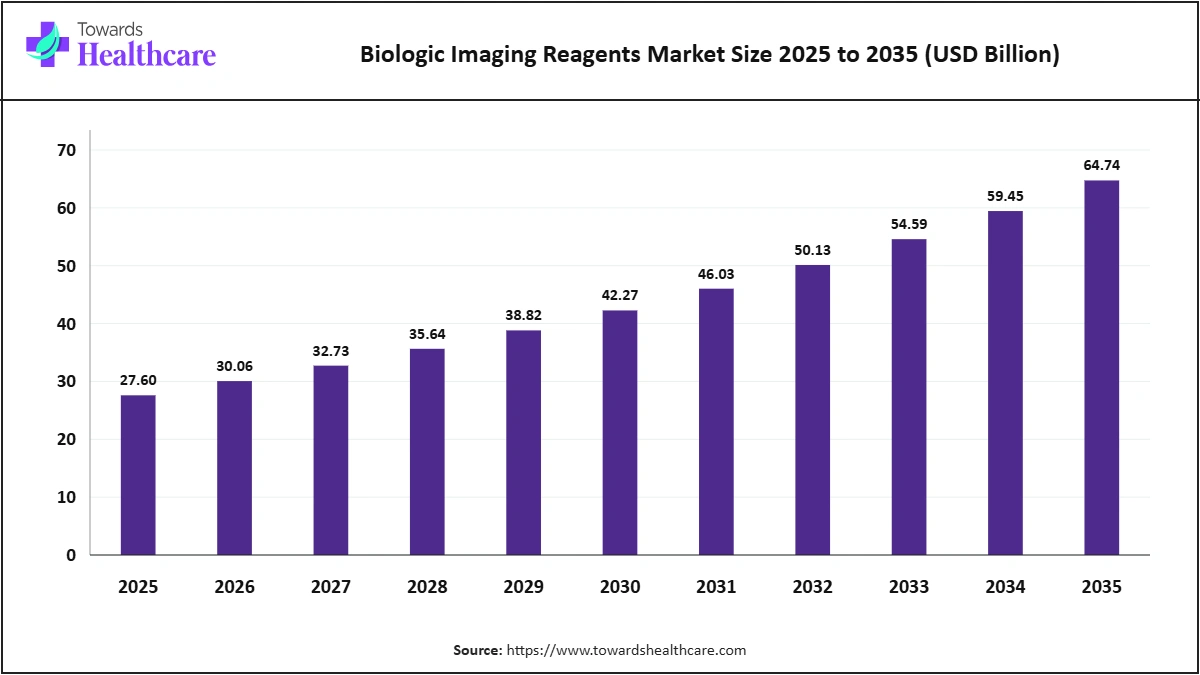
Analyst View: We developed the market estimate using imaging procedure volumes by modality and region, multiplied by reagent utilization and average prices per procedure, along with research reagent consumption across laboratories and life science companies, segmented by product, modality, application and end use. Volume estimates reflect the installed imaging base, equipment utilization, cancer diagnostic pathways, and research activity. The overall market estimate was cross validated against imaging agent revenues reported by leading pharmaceutical diagnostics, radiopharmaceutical and research reagent companies, as well as published industry estimates. This cross-validation indicates that our 2025 base-year estimate is slightly higher than the upper end of comparable published market estimates. The projected growth rate reflects strong expansion in nuclear imaging, alongside steady demand for contrast agents and research reagents, moderated by pricing pressure on generic contrast agents and constraints in isotope supply.
Driver: Ageing populations and rising chronic disease prevalence are increasing imaging volumes, driving demand for contrast agents, radiopharmaceuticals and optical imaging reagents. Growing reliance on CT, MRI and PET in cancer diagnosis, the adoption of targeted PET tracers and theragnostic, increasing amyloid imaging for Alzheimer's disease assessment, and extensive use of optical probes in life science research are further supporting market growth.
Restraint: Pricing pressure from generic contrast agents reduces average selling prices and limits revenue growth. Medical isotope supply disruptions, concerns regarding gadolinium retention, reimbursement limitations, and lengthy regulatory approval processes are restricting the adoption of advanced imaging agents. Additionally, the short half-lives of certain radionuclides increase production and distribution complexity, raising logistics costs and limiting radiotracer availability.
Opportunity: Growing adoption of theragnostic approaches is creating demand for companion diagnostic radiotracers, opening new revenue opportunities for manufacturers. Expanding imaging infrastructure in emerging markets is increasing procedure volumes and reagent consumption, while AI-enabled imaging protocols offer opportunities to optimize contrast agent dosages. Rising adoption of fluorescence-guided surgery and the development of new PET imaging targets in cardiology and neurology are further expanding the application scope and commercial potential of imaging reagents.
| Segments | 2025 Share | 2025 Value (USD Billion) | 2035 Value (USD Billion) | CAGR 2026–2035 |
| Contrast Reagents | 46.20% | 12.75 | 27.60 | 8.03% |
| Radiopharmaceuticals | 30.40% | 8.39 | 22.63 | 10.43% |
| Optical Reagents | 23.40% | 6.46 | 14.51 | 8.43% |
Note: 2025 is the base year; 2035 values are forecasts.
Sources: Expert interviews, secondary sources, Towards Healthcare database and Towards Healthcare analysts.
Contrast Reagents: This segment accounted for 46.20% (USD 12.75 billion) of the biologic imaging reagents market in 2025 and is projected to reach USD 27.60 billion by 2035, expanding at a CAGR of 8.03% from 2026 to 2035. Contrast reagents include iodinated agents for X-ray and CT, gadolinium-based agents for MRI, and microbubble agents for ultrasound. They are used in a very large number of procedures, including CT scans for trauma, cancer staging, and cardiovascular disease, and contrast-enhanced MRI for neurology, oncology, and musculoskeletal imaging. GE HealthCare, Bayer, Bracco, and Guerbet are the main suppliers. Growth comes from rising imaging volumes, especially in Asia, and from newer macrocyclic and lower-dose gadolinium agents, while generic competition limits price growth.
Radiopharmaceuticals: This segment accounted for 30.40% (USD 8.39 billion) of the biologic imaging reagents market in 2025 and is projected to reach USD 22.63 billion by 2035, expanding at a CAGR of 10.43% from 2026 to 2035. Radiopharmaceuticals include diagnostic radiotracers for PET and SPECT, such as fluorodeoxyglucose, PSMA-targeted agents for prostate cancer, amyloid and tau agents for Alzheimer's disease, and technetium-99m agents for cardiac and bone imaging. This is the fastest-growing product because targeted PET agents command premium prices; new Alzheimer's therapies need amyloid imaging, and theragnostic treatments require companion diagnostic imaging. Large acquisitions, such as GE HealthCare's purchase of Nihon Medi-Physics and Lantheus' purchase of Life Molecular Imaging, show strong strategic interest.
Optical Reagents: This segment accounted for 23.40% (USD 6.46 billion) of the biologic imaging reagents market in 2025 and is projected to reach USD 14.51 billion by 2035, expanding at a CAGR of 8.43% from 2026 to 2035. Optical reagents include fluorescent dyes and probes, fluorescent proteins, antibodies conjugated to fluorophores, bioluminescent substrates, quantum dots, and near-infrared probes. They are used mainly in research for microscopy, flow cytometry, high-content screening, and in vivo animal imaging, and in fluorescence-guided surgery. Thermo Fisher, Revvity and specialist suppliers lead this category, which grows with life science research and drug discovery.
| Segments | 2025 Share | 2025 Value (USD Billion) | 2035 Value (USD Billion) | CAGR 2026–2035 |
| X-ray & CT | 30.60% | 8.45 | 18.24 | 8.00% |
| Nuclear (PET & SPECT) | 28.80% | 7.95 | 21.39 | 10.40% |
| MRI | 18.40% | 5.08 | 11.38 | 8.40% |
| Optical | 16.20% | 4.47 | 10.02 | 8.40% |
| Ultrasound | 6.00% | 1.66 | 3.71 | 8.40% |
Note: 2025 is the base year; 2035 values are forecasts.
Sources: Expert interviews, secondary sources, Towards Healthcare database and Towards Healthcare analysts.
X-ray & CT: This segment comprised 30.60% (USD 8.45 billion) of the biologic imaging reagents market in 2025 and is projected to reach USD 18.24 billion by 2035, expanding at a CAGR of 8.00% from 2026 to 2035. X-ray and CT are the largest modalities by reagent value because CT is the most widely used cross-sectional imaging method, with large volumes of contrast-enhanced scans in emergency, oncology, and cardiac care. Expansion of CT capacity in China, India, and other emerging markets supports volume growth.
Nuclear (PET & SPECT): This segment captured 28.80% (USD 7.95 billion) of the biologic imaging reagents market in 2025 and is projected to reach USD 21.39 billion by 2035, expanding at a CAGR of 10.40% from 2026 to 2035. Nuclear imaging uses radiotracers to show metabolic and molecular activity. It is the fastest-growing modality because PET is expanding in oncology, cardiology, and neurology; new targeted tracers are being approved, and theragnostic require diagnostic imaging before and during treatment. SPECT remains important for cardiac perfusion and bone scans.
| Segments | 2025 Share | 2025 Value (USD Billion) | 2035 Value (USD Billion) | CAGR 2026–2035 |
| In Vivo | 68.20% | 18.82 | 44.15 | 8.90% |
| In Vitro | 31.80% | 8.78 | 20.59 | 8.90% |
Note: 2025 is the base year; 2035 values are forecasts.
Sources: Expert interviews, secondary sources, Towards Healthcare database and Towards Healthcare analysts.
In Vivo: This segment held 68.20% (USD 18.82 billion) of the biologic imaging reagents market share in 2025 and is projected to reach USD 44.15 billion by 2035, expanding at a CAGR of 8.90% from 2026 to 2035. In vivo applications include clinical diagnostic imaging in patients and preclinical imaging in animal models. They account for most revenue because of the scale of clinical CT, MRI, PET, and ultrasound procedures and the premium prices of targeted radiotracers.
In Vitro: This segment secured 31.80% (USD 8.78 billion) of the biologic imaging reagents market share in 2025 and is projected to reach USD 20.59 billion by 2035, expanding at a CAGR of 8.90% from 2026 to 2035. In vitro applications include fluorescence microscopy, flow cytometry, cell imaging, and high-content screening in research and drug discovery, as well as some diagnostic assays. Demand follows life science research funding and pharmaceutical R&D activity.
| Segments | 2025 Share | 2025 Value (USD Billion) | 2035 Value (USD Billion) | CAGR 2026–2035 |
| Hospitals & Diagnostic Imaging Centers | 61.40% | 16.95 | 38.35 | 8.51% |
| Life Science & Pharmaceutical Companies | 18.20% | 5.02 | 13.16 | 10.11% |
| Research & Academic Institutes | 12.60% | 3.48 | 8.17 | 8.91% |
| Diagnostic Laboratories | 7.80% | 2.15 | 5.06 | 8.91% |
Note: 2025 is the base year; 2035 values are forecasts.
Sources: Expert interviews, secondary sources, Towards Healthcare database and Towards Healthcare analysts.
Hospitals & Diagnostic Imaging Centers: This segment captured 61.40% (USD 16.95 billion) of the biologic imaging reagents market revenue in 2025 and is projected to reach USD 38.35 billion by 2035, expanding at a CAGR of 8.51% from 2026 to 2035. Hospitals and diagnostic imaging centers are the largest end users because they perform most clinical imaging procedures and purchase contrast agents and radiopharmaceuticals daily. Outpatient imaging centers are growing as procedures shift out of hospitals.
Life Science & Pharmaceutical Companies: This segment represented 18.20% (USD 5.02 billion) of the biologic imaging reagents market in 2025 and is projected to reach USD 13.16 billion by 2035, expanding at a CAGR of 10.11% from 2026 to 2035. Life science and pharmaceutical companies use optical reagents and imaging agents in drug discovery, preclinical studies, and clinical trials, where imaging biomarkers measure treatment response. This is the fastest-growing end use as imaging becomes more important in drug development, especially for radiopharmaceutical and oncology programmes.
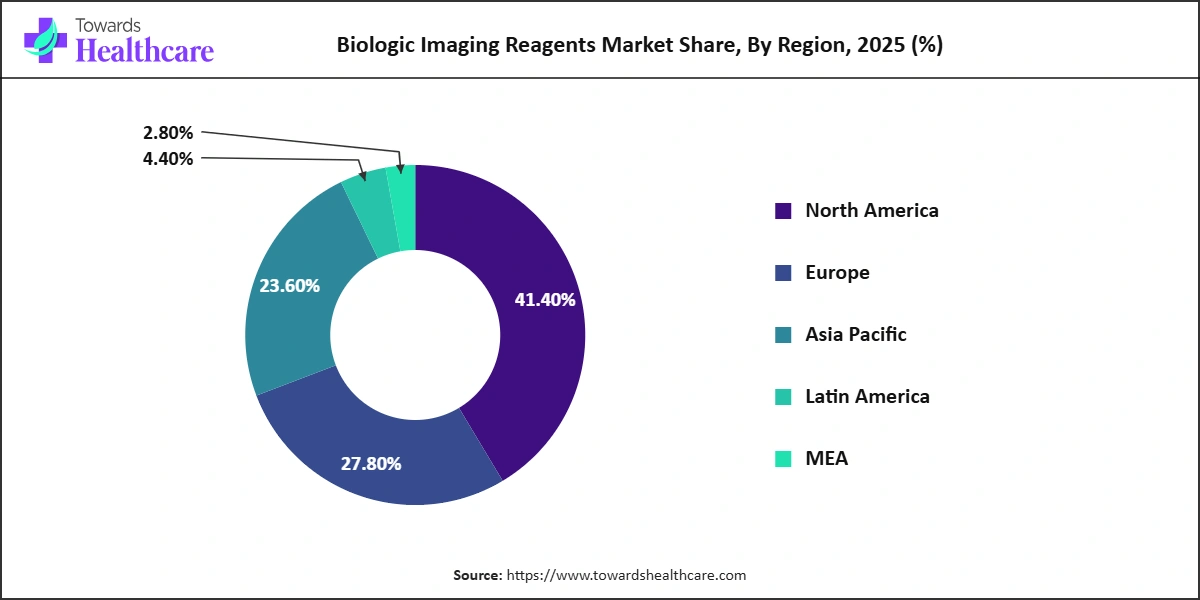
| Region | 2025 Share | 2025 Value (USD Billion) | 2035 Value (USD Billion) | CAGR 2026–2035 |
| North America | 41.40% | 11.43 | 25.16 | 8.21% |
| Europe | 27.80% | 7.67 | 17.52 | 8.61% |
| Asia Pacific | 23.60% | 6.51 | 17.53 | 10.41% |
| Latin America | 4.40% | 1.21 | 2.77 | 8.61% |
| Middle East & Africa | 2.80% | 0.77 | 1.76 | 8.61% |
Note: 2025 is the base year; 2035 values are forecasts.
Sources: Expert interviews, secondary sources, Towards Healthcare database and Towards Healthcare analysts.
North America: This region registered 41.40% (USD 11.43 billion) of the biologic imaging reagents market in 2025 and is projected to reach USD 25.16 billion by 2035, expanding at a CAGR of 8.21% from 2026 to 2035. The United States has very high per-capita imaging volumes, broad reimbursement for CT, MRI, and PET, and fast uptake of new radiotracers such as PSMA PET agents for prostate cancer and amyloid PET agents linked to new Alzheimer's therapies. It is also the largest market for research reagents, supported by NIH funding and a large biopharmaceutical industry. Lantheus, Cardinal Health, Thermo Fisher Scientific and Telix's US operations are major participants.
Europe: This region secured 27.80% (USD 7.67 billion) of the biologic imaging reagents market in 2025 and is projected to reach USD 17.52 billion by 2035, expanding at a CAGR of 8.61% from 2026 to 2035. Europe is a large market for contrast agents, with Bayer, Bracco and Guerbet headquartered in the region, and a growing market for radiopharmaceuticals supported by theragnostic centers in Germany, France and the Netherlands. EU rules on gadolinium agents have shifted use toward macrocyclic products. Research reagent demand is strong in Germany, the UK and Switzerland.
Asia Pacific: This region contributed 23.60% (USD 6.51 billion) of the biologic imaging reagents market share in 2025 and is projected to reach USD 17.53 billion by 2035, expanding at a CAGR of 10.41% from 2026 to 2035. Asia Pacific is the fastest-growing region. China and India are adding CT, MRI, and PET scanners rapidly, increasing contrast and radiotracer use, and Japan has a mature nuclear medicine sector strengthened by GE HealthCare's acquisition of Nihon Medi-Physics in 2025. Research spending in China, Japan, South Korea, and Singapore supports optical reagent demand.
Latin America: This region comprised 4.40% (USD 1.21 billion) of the biologic imaging reagents market in 2025 and is projected to reach USD 2.77 billion by 2035, expanding at a CAGR of 8.61% from 2026 to 2035. Latin America is supported by expanding imaging capacity in Brazil, Mexico, Argentina, and Colombia, with private hospitals investing in CT and MRI. PET capacity is growing slowly, limited by cyclotron and isotope availability.
Middle East & Africa: This region represented 2.80% (USD 0.77 billion) of the biologic imaging reagents market share in 2025 and is projected to reach USD 1.76 billion by 2035, expanding at a CAGR of 8.61% from 2026 to 2035. The Middle East and Africa are supported by hospital investment in Saudi Arabia, the UAE and Qatar, including new PET and cyclotron facilities, while access in much of Africa remains limited.
Analyst View: Regional shares were built from imaging volumes, reagent use, and prices in each region. North America leads because of imaging intensity and research spending. We assign Asia Pacific the highest growth premium because imaging capacity and research are expanding fastest there.
| Rank | Company Name | Market-Specific Revenue (USD Billion) | 2025 Share | Key Products / Business | Headquarters |
| 1 | GE HealthCare | 2.60 | 9.42% | Contrast media and radiopharmaceuticals | United States |
| 2 | Bayer | 2.10 | 7.61% | Radiology contrast agents | Germany |
| 3 | Bracco | 1.90 | 6.88% | Contrast agents and nuclear medicine | Italy |
| 4 | Lantheus | 1.50 | 5.43% | Pylarify, Definity and PET agents | United States |
| 5 | Cardinal Health | 1.30 | 4.71% | Nuclear pharmacy radiopharmaceuticals | United States |
| 6 | Thermo Fisher Scientific | 1.20 | 4.35% | Fluorescent probes and imaging reagents | United States |
| 7 | Guerbet | 0.90 | 3.26% | Contrast agents | France |
| 8 | Siemens Healthineers | 0.60 | 2.17% | PETNET radiopharmaceuticals | Germany |
| 9 | Telix Pharmaceuticals | 0.52 | 1.88% | Illuccix and Gozellix PSMA PET agents | Australia |
| 10 | Revvity | 0.25 | 0.91% | In vivo imaging reagents | United States |
Note: Company revenues and shares are 2025 estimates.
Sources: Company press releases, expert interviews, secondary sources, Towards Healthcare database and Towards Healthcare analysts.
GE HealthCare led the biologic imaging reagents market with an estimated 9.42% (USD 2.60 billion) of 2025 revenue, followed by Bayer at 7.61% (USD 2.10 billion) and Bracco at 6.88% (USD 1.90 billion). GE HealthCare leads through its Pharmaceutical Diagnostics business, which supplies iodinated and gadolinium contrast media and radiopharmaceuticals and was expanded by the acquisition of Nihon Medi-Physics. Bayer is a leading supplier of CT and MRI contrast agents, and Bracco offers contrast agents across CT, MRI, and ultrasound plus nuclear medicine products. Lantheus, Cardinal Health, Thermo Fisher Scientific, Guerbet, Siemens Healthineers, Telix Pharmaceuticals and Revvity compete through PSMA and other PET agents, nuclear pharmacy distribution, fluorescent probes, contrast agents, radiotracer manufacturing and in vivo imaging reagents. The top 10 companies accounted for an estimated 46.63% (USD 12.87 billion) of 2025 revenue, while the remaining 53.37% (USD 14.73 billion) was shared among radiopharmaceutical producers, research reagent suppliers and regional contrast agent makers. The biologic imaging reagents market is moderately concentrated, and competition targets clinical evidence and approvals, safety profiles, supply reliability of isotopes and contrast agents, pricing, distribution networks, and research reagent performance. Radiopharmaceutical capabilities are a key strategic focus, driving acquisitions.
The biologic imaging reagents ecosystem links isotope and chemical suppliers with reagent and radiopharmaceutical manufacturers, radiopharmacies and distributors, imaging equipment makers and clinical and research users.
| Ecosystem Stage | Role in the Market | Key Companies |
| Isotopes & Raw Materials | Supply medical isotopes, iodine, gadolinium and dyes | Isotope producers, cyclotron operators, chemical suppliers |
| Reagent Manufacturers | Produce contrast agents, radiotracers and optical probes | GE HealthCare, Bayer, Bracco, Lantheus, Guerbet, Thermo Fisher |
| Radiopharmacies & Distribution | Prepare and deliver short-lived radiotracers | Cardinal Health, Siemens PETNET, regional radiopharmacies |
| Imaging Equipment | Provide scanners that use reagents | GE HealthCare, Siemens Healthineers, Philips, microscope makers |
| End Users | Perform imaging and research | Hospitals, imaging centers, pharma companies, research institutes |
Sources: Company press releases, expert interviews, secondary sources, Towards Healthcare database and Towards Healthcareh analysts.
The Towards Healthcare Companies Quadrant positions key participants in the biologic imaging reagents market by market strength, reflecting revenue scale, market share and geographic reach, and by innovation and growth strategy, reflecting product portfolio breadth, R&D intensity, and partnerships. Positions reflect each company's estimated 2025 imaging reagent revenue and our assessment of its pipeline, product approvals, and partnerships.
Sources: Company press releases, expert interviews, secondary sources, Towards Healthcare database and Towards Healthcare analysts.
Leaders: GE HealthCare, Bayer, Bracco, Lantheus and Thermo Fisher Scientific combine large imaging reagent revenue with broad contrast and radiopharmaceutical portfolios, new approvals and global reach.
Challengers: Cardinal Health has strong distribution or contrast positions but less pipeline innovation.
Innovators: Siemens Healthineers, Telix Pharmaceuticals and Revvity bring PET tracer manufacturing, targeted radiopharmaceuticals and optical imaging reagents.
Niche Players: Guerbet serves specific contrast agent segments.
By Product
By Modality
By Application
By End Use
By Region
The biologic imaging reagents market was defined as contrast agents, diagnostic radiopharmaceuticals, and optical imaging reagents for clinical and research imaging, worldwide. The 2025 base year was built bottom-up from imaging procedure volumes by modality and region, reagent use and prices, and research reagent consumption, and checked top-down against the imaging agent revenue of leading pharmaceutical diagnostics, radiopharmaceutical, and research reagent companies. Segment, regional, and company values were allocated from products, modalities, applications, end uses, and regional demand. Key estimates were verified by cross-checking company disclosures, regulatory and industry data, and published third-party estimates, and inputs that could not be reconciled were excluded. All segment, regional and company figures were reconciled to the same 2025 base year, and the 2026–2035 forecast, which applies a constant CAGR from the 2025 base, was recalculated and validated.
Analyst View: The biologic imaging reagents market grows with imaging volumes and research activity, with nuclear imaging as the main growth engine. Our estimate links demand to procedures, reagent use, and prices, so the forecast follows imaging capacity, new tracer approvals, and research spending. The main upside comes from targeted PET agents and theranostics, while the main risks are contrasting price pressure and isotope supply.