Pipeline Programs

CGT Companies Tracked

Manufacturing Facilities


The global ESR1-targeted breast cancer therapy market is expected to reach US$ 0.71 billion in 2026 and approximately US$ 4.17 billion by 2035, growing at a CAGR of 21.8% during the 2026-2035 forecast period. The market is emerging as a distinct treatment segment, driven by the growing availability of targeted therapies for patients with estrogen receptor-positive breast cancer harboring ESR1 mutations. Market estimation must focus on the clinically eligible patient population and the commercial potential of relevant therapies.
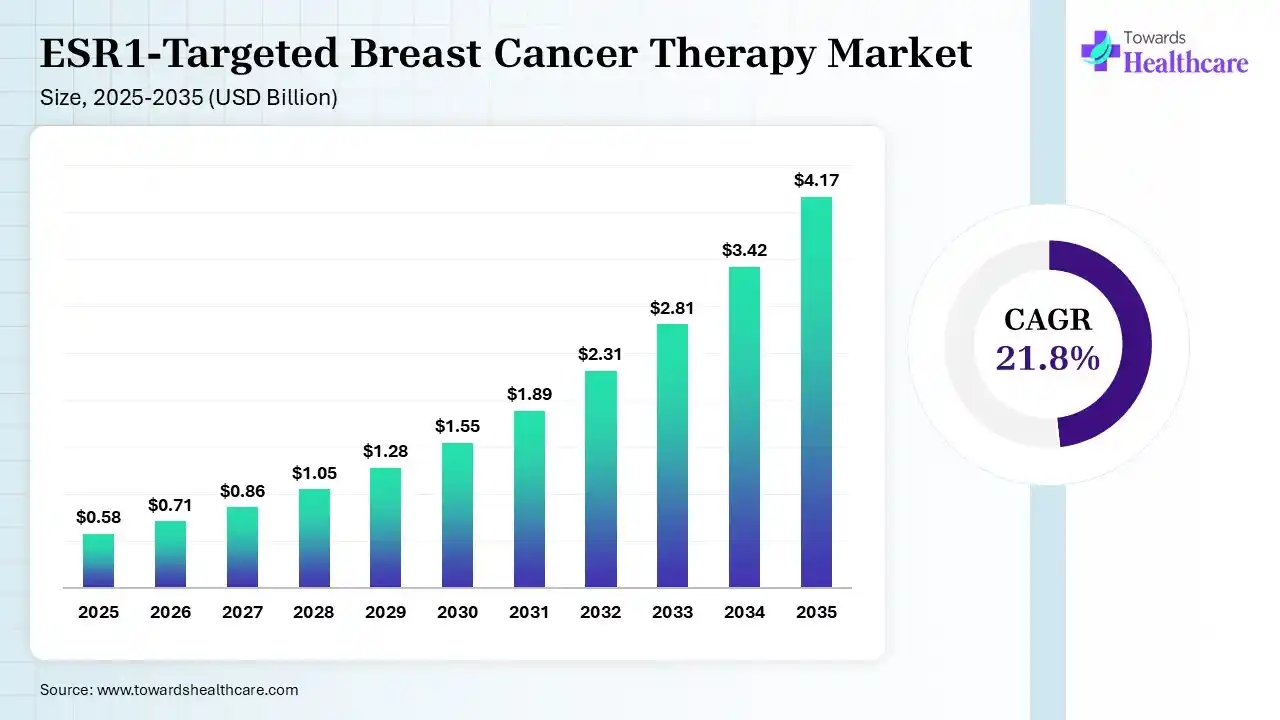
The U.S. approval of an oral selective estrogen receptor degrader (SERD) in January 2023 established an important commercial milestone, while subsequent approvals in 2025 and 2026 expanded the treatment landscape to include additional therapeutic approaches, such as estrogen receptor antagonism and protein degradation.
The ESR1-targeted breast cancer therapeutic market represents a new segment of precision oncology targeting ESR1 mutations driving acquired resistance to endocrine therapy for estrogen receptor-positive (ER+), HER2-negative metastatic breast cancer. Factors influencing the evolution of the market include the development of oral selective estrogen receptor degraders (SERDs), a new generation of estrogen receptor antagonists, combinations, and mutation-specific selection of treatment.
The key factor is that the ESR1-targeted market does not represent the whole market of ER+ breast cancer drugs. Its market is defined by patients carrying clinically significant ESR1 mutations in tumors that progress on endocrine therapy. As such, factors such as patient testing, prevalence of mutations, treatment lines and length of treatment, and regulatory and reimbursement status drive commercial value more directly than incidence of breast cancer.
Worldwide, the burden of breast cancer exceeds 2 million new patients each year, and ER-positive breast cancer accounts for an estimated 65%-75% of all breast cancers. Mutations in the ESR1 gene are rare in untreated primary tumors, but are relatively common after exposure to aromatase inhibitors in endocrine-resistant metastatic settings; estimates commonly lie within the 20%-40% range in this patient population, dependent on treatment history and choice of assay and cohort.
This context defines a market in which both molecular diagnostic testing and therapy development are mutually dependent economically. The most promising areas will be those in which mutation testing is standard practice, oral targeted therapies provide benefit, and treatment guidelines advocate early treatment for eligible patients.
The research approach delineates the mature market for ESR1-mutated therapies from the broader set of investigational drugs and also from the much broader endocrine-sensitive breast cancer market. This distinction is crucial in order to avoid an overstatement of addressable revenues and mixing of overall breast cancer drug revenues with commercial potential in ESR1-mutated breast cancer.
Approximately 2.3 million new cases of breast cancer were estimated in the world in 2022, with ER-positive breast cancers accounting for 65-75% of the cases in many populations. However, mutations in the ESR1 gene are more common among advanced breast cancer following aromatase inhibitor treatment than in untreated ER-positive primary tumors. In patients suffering from advanced breast cancer after endocrine therapy, ESR1 mutation prevalence usually varies from 20% to 40%, depending on the patient history, tumor characteristics, biopsy method, and sensitivity of the test. These numbers suggest that the market for targeted ESR1 therapies constitutes a small fraction of the total population with breast cancer.
From our analysis, it becomes clear that mutation prevalence is not enough to assess market potential. The addressable population should be calculated through all the steps of the process: ER-positive/HER2-negative disease, advanced/metastatic disease, previous endocrine therapy, disease progression, presence of an ESR1 mutation, treatment label eligibility, and treatment. We believe that the difference between the number of eligible patients and the number of those treated can be significant because of the differences in diagnosis availability, sensitivity of tests, treatment eligibility, and patient affordability.
As we see it, the most commercially relevant implication relates to the difference between the target pool of patients and actual treated patients. Even markets with similar mutation prevalence levels would produce varying commercial results due to differences in molecular testing penetration, reimbursement, treatment retention, and prescribing. In our opinion, the patient conversion rate at each step of the funnel would be a much more valuable data point in the forecasting exercise than simply using mutation prevalence and applying it to the incidence of breast cancer.
The report in its entirety analyzes the patient funnel in terms of geography, stage of disease, prior endocrine therapy, ESR1 mutation status, diagnostic modality used, and treatment eligibility. Liquid biopsy and tissue testing pathways are considered, patient leakage along the funnel is explained, and scenarios related to possible changes in testing and treatment penetration are modeled until 2035.
Furthermore, the underlying intelligence can be offered in the form of a detailed dataset for patient epidemiology and sizing, recording patient volumes on an annual basis by geography, staging of disease, ER/HER2 status, prior exposure to treatment, proportion of ESR1 mutation, mode of test used, test penetration, patient eligibility for treatment, and treatment initiation. Users will be able to filter out and benchmark patients across regions and forecast periods and analyze conversion ratios at each stage of the funnel, along with alternative tests and adoption scenarios.
The most important product segmentation according to the market would be based on mechanism of action as opposed to traditional pharmaceutical formulations. The oral selective estrogen receptor degrader drugs intend to block estrogen receptor signaling and degradation. Newer antagonists and protein degraders provide other means of pharmacological intervention.
First-generation products set the standard with respect to oral therapies for ESR1 mutation-positive conditions. Later products gave rise to additional options, while combination regimens presented a distinct option.
The report segments revenue across:
A critical analytical distinction is that investigational drugs, broader ER-positive treatments, and approved ESR1-directed products do not constitute interchangeable revenue pools.
The key growth factor will be endocrine resistance through acquisition. Mutations in the ESR1 gene can make the estrogen receptors functional even without estrogen, thus creating the biological basis for drugs that aim at the mutant receptor.
But innovations do not necessarily mean quick market uptake. It needs to show its advantages over appropriate comparators, tolerability that will allow continuing on the regimen, and the value over the current incremental costs for established endocrine agents.
The commercial dynamics are determined by five forces: acceptance of molecular diagnostics, the efficacy of new drugs' mechanisms, sequencing with CDK4/6 inhibitors, payers' willingness to reimburse mutation-based treatment, and rivalry from other targeted therapies.
An additional barrier is the distinction between statistically significant progression-free survival and the proven advantage in overall survival. The decision on treatment may also depend on adverse effects, previous treatments, tumor burden, and patients' preference.
Therapies based on ESR1 are mainly chronic oral cancer therapies; therefore, the cost per month of therapy, therapy length, and net cost per patient would be the key commercial considerations. Public U.S. list prices offer only a partial insight into the actual revenues since discounts, contracts, payer assistance, and distribution impact net sales.
The pricing analysis is built on the following parameters: monthly list price, net price estimate, persistence, discontinuation rate, dose intensity, and number of months for which the treatment is covered. The pricing framework differentiates between drug cost and diagnostic test cost, as well as the cost of combined therapy.
The pricing power will depend on clinical differentiation, labeling, convenience, tolerance, and availability of alternatives. Combined therapy could increase the value per patient while simultaneously increasing costs of treatment and payer pressure.
The supply side of the ESR1 medicines will be driven more by the creation of demand. The former includes all processes ranging from discovery, medicinal chemistry, drug development, regulatory approval of the medicine and companion diagnostic tests, manufacturing, release of medicines, specialized distribution, and even reimbursement.
Constraints related to the supply side of the pharmaceutical good will be dependent on the cost of active pharmaceutical ingredients, formulation and release of medicines. Constraints related to the commercialization process will be based on delays in launch, limited diagnosis, lack of reimbursement and lack of physician training instead of global shortages of the good.
Constraints related to the trade of the good are secondary to market access, since trade is constrained by registration, importation, pricing and distribution instead of volume.
In addition to offering a new option for diagnosing ESR1 mutations using blood samples, ctDNA testing is contributing to the growing number of diagnostic tools available for identifying such mutations. Nevertheless, its potential commercial value is dependent on factors including sensitivity of the test, mutation detection, cost-effectiveness, speed, and the ability to detect changes that are actionable prior to treatment. On the other hand, protein degradation technology is opening up a new avenue for therapy development, going beyond traditional SERD compounds and estrogen receptor inhibitors. Such developments include finding ways to degrade the estrogen receptor protein itself within the cell.
Our analysis shows that the technology development for the market will be reliant on the connection between mutation detection and treatment decision. Even though the liquid biopsy provides a less invasive route for testing, availability of the test in itself does not assure treatment adoption. It is determined by the performance of the assay, reimbursement coverage, and eligibility criteria for therapy. In the same manner, we think that the targeted protein degraders will be able to provide competitive differentiation for the market, but only when the clinical value and safety of these molecules are proven.
Our opinion is that the main strategic opportunity in this case would be the integration of advances in diagnostics into therapeutics. Drug companies will have to understand the need for companion diagnostics at the early stages of drug development, whereas diagnostic companies will have to prove that their tests provide proper patient identification and allow for making decisions in time. Patents and exclusivity would also affect investment, licensing, and commercial viability of technologies being developed. The report analyzes these aspects through the comparison of diagnostic options, treatment methods, regulatory milestones, clinical data, and patents.
The structured database included in the package would be used to track investigational and marketed products by method of action, development stage, clinical status, regulatory milestone, need for companion diagnostic, mutation coverage, and patent/exclusivity status. The records can be filtered and benchmarked by product, company, geography, and year.
The market environment has evolved from being a first mover market to a multi-mechanisms therapy. Until October 2026, there will be three distinct monotherapy approaches for treating advanced breast cancer with an ESR1 mutation in addition to an approved combination therapy using an oral estrogen receptor antagonist and a CDK4/6 inhibitor.
The pivotal data indicates the importance for clinical differentiation. The median PFS in the EMERALD trial was 3.8 months for elacestrant compared with 1.9 months for standard endocrine therapy for the ESR1-mutation subgroup, with a hazard ratio of 0.55. In the VERITAC-2 study, the median PFS was 5.0 months for vepdegestrant compared with 2.1 months for fulvestrant in the ESR1-mutation positive group. This is specific to trial data; there is no head-to-head data between the two drugs.
The competitive landscape includes four groups:
Thus, market dominance is not only reliant on efficacy in trials, but on label range, dosing convenience, tolerability, physician experience, net cost, diagnostics compatibility and international rights to commercialize.
| Company | Headquarters | Market position | Core strength | Major segment |
| Eli Lilly and Company | US | Approved therapy | Oral antagonist and combinations | Targeted endocrine therapy |
| Menarini Group | Italy | Commercial participant | Oncology commercialization | Oral SERD |
| Rigel Pharmaceuticals | US | Commercial entrant | Oncology commercialization | Vepdegestrant |
| Arvinas | US | Technology innovator | Targeted protein degradation | Oral ER degrader |
| Pfizer | US | Development and licensing participant | Global oncology capabilities | ER degradation |
| AstraZeneca | UK | Pipeline competitor | Endocrine combination development | Oral SERD |
| Roche | Switzerland | Pipeline competitor | Precision oncology | Oral SERD |
| Olema Oncology | US | Specialist developer | Next-generation SERD research | Palazestrant |
| Sermonix Pharmaceuticals | US | Specialist developer | Oral estrogen receptor modulation | Lasofoxifene |
| G1 Therapeutics | US | Historical development participant | Endocrine drug development | Rintodestrant |
| Eisai | Japan | Research participant | Oncology R&D | ER-targeted research |
| InventisBio | China | Regional pipeline participant | Small-molecule oncology | ER-targeted research |
| Accutar Biotechnology | US | Emerging innovator | AI-enabled drug discovery | Targeted therapeutics |
| Guardant Health | US | Diagnostic enabler | Blood-based genomic testing | Companion diagnostics |
| Foundation Medicine | US | Diagnostic enabler | Tumor genomic profiling | Mutation testing |
| Tempus AI | US | Diagnostic enabler | Molecular testing and clinical data | Precision oncology |
| Thermo Fisher Scientific | US | Technology supplier | Molecular diagnostic platforms | Genomic analysis |
| QIAGEN | Germany | Technology supplier | Molecular diagnostics | Sample preparation and testing |
Pharmaceutical companies cannot be ranked in the ESR1-targeted breast cancer therapy market based on their total oncology revenue or the number of therapies in their development pipelines. Only revenue generated by marketed ESR1-targeted treatments represents current commercial performance. Pipeline assets indicate future competitive potential but do not contribute to current drug sales.
The competitive analysis therefore evaluates companies based on three measures: ESR1-specific drug revenue, share of treated patients, and risk-adjusted pipeline value. These measures distinguish established commercial performance from treatment adoption and future market potential.
| Benchmark | Leading evidence or capability | Strategic interpretation |
| First-mover commercial experience | Elacestrant received US approval in 2023 | Establishes prescribing familiarity and market access experience |
| Oral antagonist platform | Imlunestrant received US approval in 2025 | Expands choice and supports combination development |
| Protein degradation | Vepdegestrant received US approval in 2026 | Introduces a differentiated mechanism |
| Combination potential | Imlunestrant plus abemaciclib received US approval in September 2026 | Creates potential for increased treatment value and cost |
| Diagnostic integration | Approved companion diagnostic pathways | Connects mutation detection to treatment eligibility |
This market includes traditional SERDs, advanced estrogen receptor blockers, protein degraders, and novel hormone-based therapies. The product-level assessment involves factors such as mutation coverage, binding to receptors, dosage, side effects, efficacy measures, and combinability.
The key technical challenge is whether the novel approach provides a clinical distinction as compared to whether it works differently in the degradation of the receptor. Success depends on providing a tangible benefit, a manageable side effect profile, and positioning for treatment.
The North American region represents the most mature commercial market for approved ESR1-targeted treatment. Europe represents a key growth opportunity contingent upon authorization in the region, pricing, and reimbursement. Asia-Pacific presents a heavy disease burden together with mixed availability of molecular diagnostics and novel treatments.
The relevant customer segments include oncologists, cancer centers, hospitals, specialty pharmacies, laboratories, payers, and healthcare providers. Prescribing decisions depend on treatment guidelines, availability of assays, turnaround time, and affordability.
One of the key deals in 2026 is the transfer of global rights for commercialization of vepdegestrant from Arvinas and Pfizer to Rigel Pharmaceuticals. The deal consisted of a US$70 million upfront fee, US$15 million contingent on transition services, and a potential for $320 million in future milestones. This deal illustrates how early stage innovations can be capitalized on through the use of specialized commercial capabilities, as opposed to having the originator establish a global commercial function.
The strategic focus is anticipated to be on licensing, co-development, regional commercial partnerships, diagnostic partnerships, and acquisition of differentiating endocrine assets. The commercial value of the deal will be a function of the clinical maturity, cost to develop, patent life, market access and adjusted eligible patient population.
Detailed company profiles are provided for the companies within the top universe, and incorporate both corporate finances as well as specific market data. ESR1 revenues are reported separately from total corporate revenues. Where ESR1 revenues are not available, they are shown to be unobtainable rather than estimated based on total oncology revenues.
The profiles include analysis of:
Development-stage companies are valued according to their pipeline development, probability-adjusted commercial potential, and financing needs rather than revenues.
The market supports several distinct competitive archetypes.
The assessment will examine the growth potential, data quality, IP, geographic presence, funding, and partnering flexibility of each participant. The criteria are strategic evaluations and not a proprietary ranking system.
The opportunities that are the most actionable are those where the patient population can be identified, but access to treatment and/or clinical differentiation is incomplete.
The report estimates each opportunity through eligible patients, diagnostics gaps, treatment conversion rates, and revenue per patient. Each opportunity is scored in terms of commercial viability, clinical rationale, implementation complexity, and competitive dynamics.
| Force | Assessment | Market-specific rationale |
| Supplier power | Medium | Specialized development, manufacturing, and diagnostic capabilities create dependencies, although several suppliers exist. |
| Buyer power | High | Payers can impose reimbursement restrictions, utilization controls, and price negotiations. |
| Threat of new entrants | Medium | Drug discovery, clinical trials, regulatory approval, and intellectual property create substantial barriers. |
| Threat of substitutes | High | Other endocrine therapies, targeted combinations and chemotherapy compete for treatment decisions. |
| Competitive rivalry | High and increasing | Multiple approved mechanisms and investigational agents compete for a defined patient population. |
The strategic implication is that innovation must translate into demonstrable clinical value and accessible treatment economics. Differentiation without reimbursement or sufficient patient reach may not generate attractive commercial returns.
The report assesses these forces by geography and translates them into implications for launch timing, pricing, clinical investment and market entry.
| Opportunity area | Attractiveness | Principal consideration |
| Approved mutation-directed therapies | Attractive | Demonstrated clinical activity and established regulatory pathways |
| Next-generation receptor degraders | Attractive, higher risk | Differentiation must justify development and launch investment |
| Combination treatments | Attractive, evidence-dependent | Potential efficacy gains versus higher cost and toxicity |
| Companion diagnostics | Attractive | Testing penetration and reimbursement determine utilization |
| Undifferentiated pipeline assets | Challenging | Crowded competition and uncertain clinical differentiation |
| Underserved geographic markets | Moderate to attractive | Access, pricing and diagnostic infrastructure vary substantially |
The investment case is strongest for assets with credible clinical differentiation, clear treatment positioning, defensible intellectual property and realistic access strategies. Commercial forecasts should be discounted for competing therapies, development failure, pricing pressure and limited treatment duration.
It is depending on three inter-related factors: the rate at which eligible patients are tested; any improvements in outcomes brought about by new treatments; and how well the manufacturers are able to translate their clinical value into reimbursed prescriptions.
The base case reflects an ongoing uptake of approved medicines, steady expansion of molecular testing and the adoption of combination therapies where appropriate. The upside case reflects improved clinical outcomes, wider reach, more efficient treatment sequencing, and expansion into other reimbursed markets. The downside case reflects incremental improvement, limited reimbursement, competing advances in treatments, and slower rates of testing.
By Drug Class/Mechanism of Action
By ESR1 Mutation Status
By Treatment Line
By Treatment Regimen
By Distribution Channel
By Diagnostic Approach
By Patient Population and Disease Characteristics
By Region


Principal Consultant
Payal Rabde is a Healthcare Market Research Analyst at Towards Healthcare Research & Consulting with 4+ years of experience in pharmaceuticals, biotechnology, medical devices, and life sciences.
Learn more about Payal Rabde

Reviewed By
Aditi Shivarkar is a seasoned professional with over 14 years of experience in healthcare market research. As a content reviewer, Aditi ensures the quality and accuracy of all market insights and data presented by the research team.
Learn more about Aditi Shivarkar