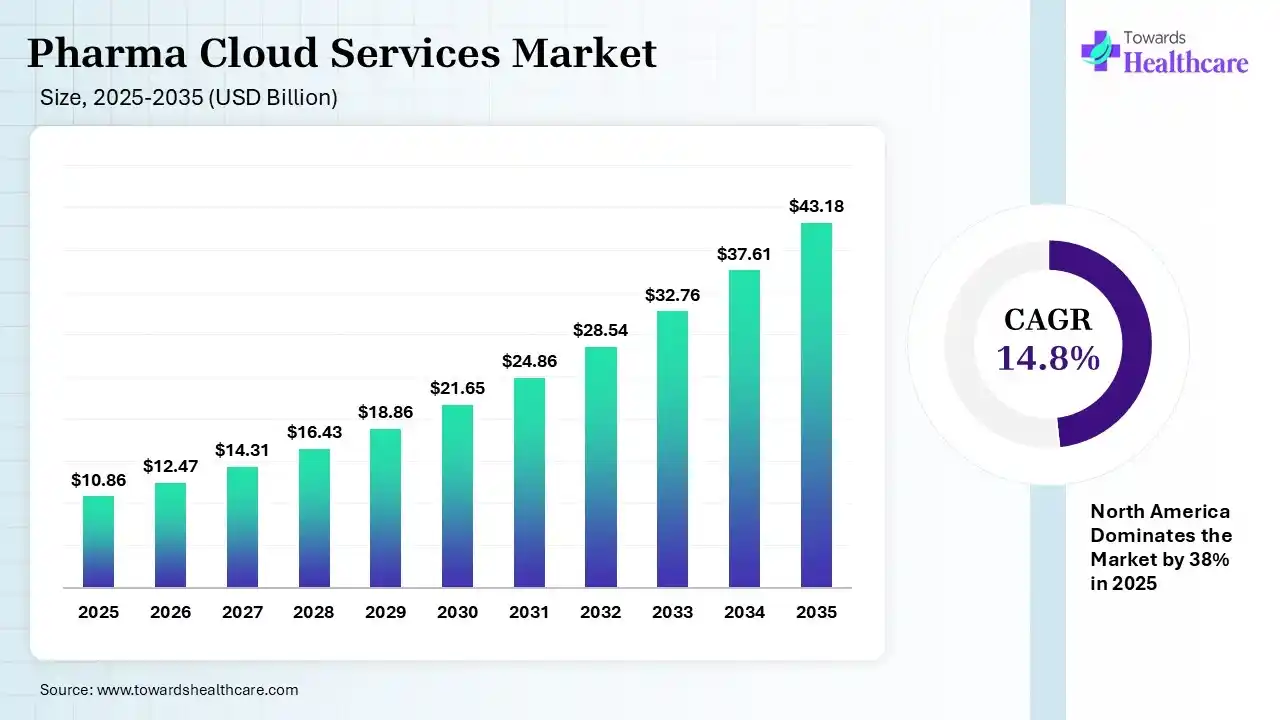
The global pharma cloud services market size was estimated at USD 10.86 billion in 2025 and is predicted to increase from USD 12.47 billion in 2026 to approximately USD 43.18 billion by 2035, expanding at a CAGR of 14.8% from 2026 to 2035. The pharma cloud services market is growing as cloud technologies have transformed the way life sciences brands strategize research and development, commercialization, supply chain, production, and clinical trials.
Cloud-based systems collect data at every stage of the drug journey, combating the grey market and ensuring product authenticity. Cloud services incorporated into healthcare make it simple for life sciences organizations to collaborate worldwide. With cloud platforms, professionals share thoughts, seek second opinions, and fill knowledge gaps rapidly, accelerating breakthroughs in medical care. Cloud-driven collaboration tools support stakeholders in keeping communication open at each product lifecycle stage, from discovery to manufacturing. Cloud-based technology applications also let medical care providers (HCPs) cooperate with patients, track their adverse effects, and prompt patients to seek care when required.
The pharma cloud services market is expanding as pharmaceutical companies accelerate digital transformation across research, manufacturing, clinical trials, and commercial operations. Growing demand for secure data management, real-time collaboration, and regulatory compliance is driving cloud adoption. Companies are investing in artificial intelligence, analytics, and cloud-based platforms to improve operational efficiency and speed decision-making. Opportunities are increasing through personalized medicine, decentralized clinical trials, and connected healthcare ecosystems that require scalable digital infrastructure. Service providers are enhancing cybersecurity, interoperability, and data integration capabilities to support complex pharmaceutical workflows. The competitive landscape includes global cloud technology providers, healthcare software companies, and specialized life sciences platforms competing through innovation, strategic partnerships, customized solutions, and expanded service portfolios that address evolving industry requirements.
Pharmaceutical cloud technology combined with AI and modernization facilitates designing, deploying, and managing resources on the cloud, leading to better collaboration. Cloud-based AI enables pharmaceutical companies to streamline operations, boost efficiency, and tailor treatments, thereby transforming patient care. AI-powered cloud solutions are revolutionizing pharma by speeding up drug discovery, enhancing collaboration, reducing costs, and supporting future innovations. When combined with cloud computing, AI accelerates the identification of drug candidates, trimming the timeline from molecule to medicine.
Decentralized Clinical Trials:
Decentralized clinical trial stages progress access, effectiveness, and quality for sites and patients alike by transporting richer and more precise data, supporting compliance, and facilitating the participant load.
Hybrid and Multi-Cloud Dominance:
A hybrid-cloud strategy allows the organization to maintain control over significant data while benefiting from the agility and affordability of public cloud solutions. A hybrid multicloud architecture provides businesses with high-performance storage, a low-latency network, security, and zero downtime.
| Table | Scope |
| Market Size in 2026 | USD 12.47 Billion |
| Projected Market Size in 2035 | USD 43.18 Billion |
| CAGR (2026 - 2035) | 14.8% |
| Leading Region | North America by 38% |
| Historical Data | 2020 - 2023 |
| Base Year | 2025 |
| Forecast Period | 2026 - 2035 |
| Measurable Values | USD Millions/Units/Volume |
| Market Segmentation | By Service Type, By Deployment Model, By Application, By End User, By Region |
| Top Key Players | Amazon Web Services, Microsoft Azure, Accenture, IBM, Wipro |
| Segment | Share 2025 (%) |
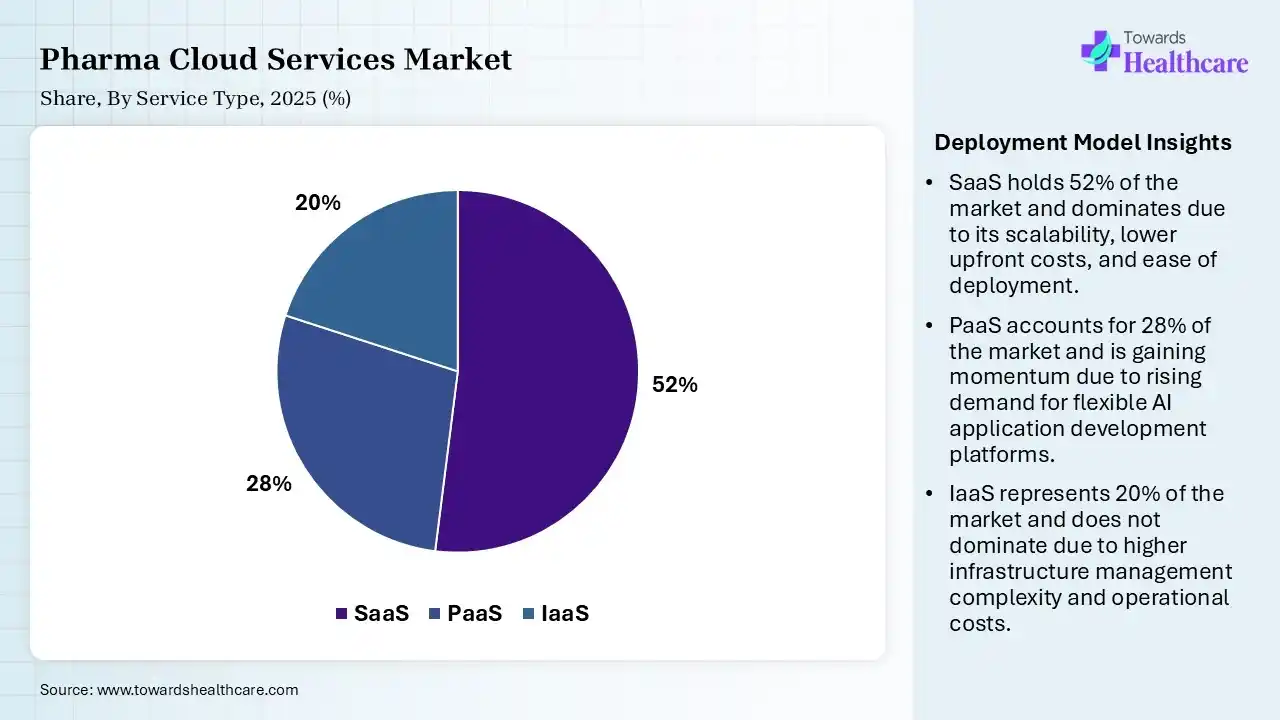
| SaaS | 52% |
| PaaS | 28% |
| IaaS | 20% |
The SaaS (Software as a Service) Segment Led the Pharma Cloud Services Market in 2025
The SaaS (software as a service) segment contributed the largest market share of 52% in 2025, and is expected to grow at the fastest CAGR during the forecast period, as using SaaS service providers offers the advantage of better scalability. To enhance agility and scalability, life sciences companies are embracing Software as a Service (SaaS) as part of their IT strategy. SaaS platforms address common problems in clinical trials, like patient recruitment and retention, information handling, and regulatory compliance.
The PaaS (platform as a service) segment held a significant share of 28% in the market, expected to grow at the fastest CAGR during the forecast period, as platform as a service (PaaS) in cloud computing offers a pre-configured, cloud-driven environment that speeds up application advancement by removing the need to manage underlying servers, storage, or operating technology. Key benefits include faster time-to-market, noteworthy expense reductions, enhanced scalability, simplified development cycles, and improved security.
The IaaS (infrastructure as a service) segment held a significant share of 20% of the market, as healthcare organizations use IaaS to store sensitive patient data while complying with regulations such as HIPAA. Hospitals and telemedicine platforms store electronic health records in secure cloud environments, evading the complexity of maintaining on-premises servers. Infrastructure as a Service (IaaS) provides businesses with virtualized computing resources delivered by cloud facility providers.
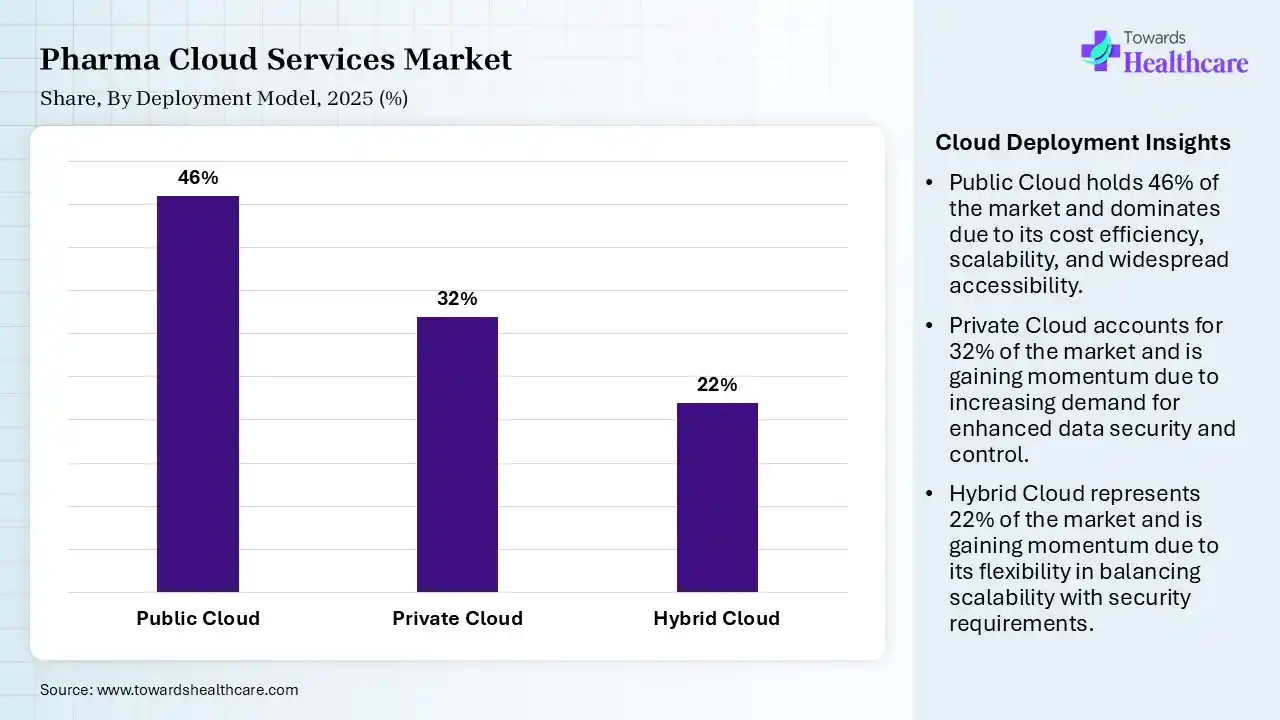
| Segment | Share 2025 (%) |
| Public Cloud | 46% |
| Private Cloud | 32% |
| Hybrid Cloud | 22% |
Public Cloud Segment Led the Pharma Cloud Services Market in 2025
The public cloud segment contributed the largest market share of 46%, and is expected to grow at the fastest CAGR during the forecast period. Public cloud realizes the significant concept of sharing solutions with the general public. Public clouds are usually implemented via data centers. Public cloud delivers high-performance computing (HPC) for challenging simulations, genomics, and artificial intelligence (AI), demonstrating.
The private cloud segment held a significant share of 32% of the market, as private cloud allows pharma manufacturers to access significant performance metrics, inventory levels, manufacturing timelines, and more, all in real-time. A private cloud provides organizations greater control and visibility by storing data and workloads behind isolated firewalls.
The hybrid cloud segment held a significant share of 22% of the market, as hybrid cloud architecture allows pharma organizations to balance public cloud scalability with private infrastructure control, quickening drug development while maintaining government compliance. Hybrid cloud architecture allows pharmaceutical organizations to navigate the complex landscape of drug discovery, advancement, production, and commercialization.
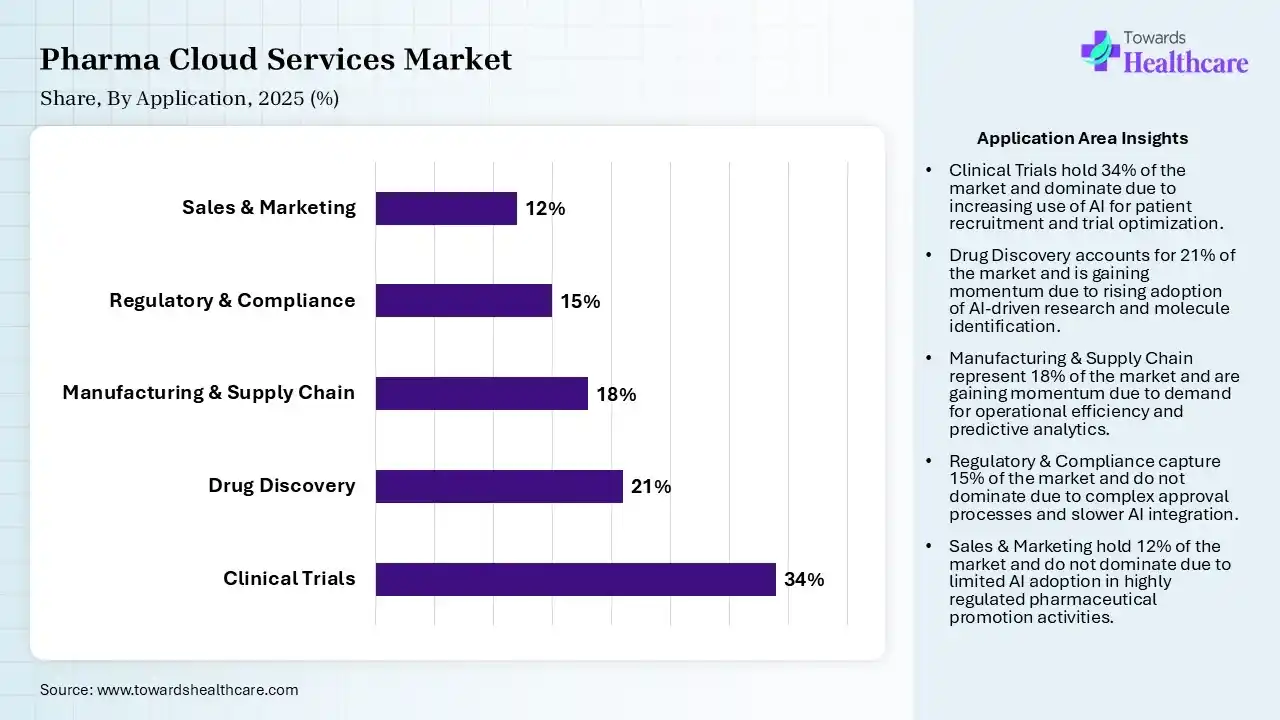
| Segment | Share 2025 (%) |
| Clinical Trials | 34% |
| Drug Discovery | 21% |
| Manufacturing & Supply Chain | 18% |
| Regulatory & Compliance | 15% |
| Sales & Marketing | 12% |
Clinical Trials Segment Led the Pharma Cloud Services Market in 2025
The clinical trials segment contributed the largest market share of 34%, as cloud computing is revolutionising clinical trials by centralising data management, lowering trial expenses, and shortening timelines. Cloud computing has initiated a transformative modification in clinical research by driving decentralized trials and increasing patient involvement.
The drug discovery segment held a significant share of 21% in the market, and is expected to be the fastest-growing during the forecast period, as the capability to effortlessly allocate required resources, cloud computing supports, to ensure that the drug discovery process remains uninterrupted and efficient. Cloud provides a high level of security measures to protect sensitive data.
The manufacturing & supply chain segment held a significant share of 18% in the market, as cloud computing in production provides multiple advantages, like process streamlining, improved scalability, and cost reduction. Cloud computing is used in production for supply chain management, enterprise resource planning, product lifecycle management, and quality management.
The regulatory & compliance segment held a significant share of 15% in the market, as cloud compliance ensures that data storage, processing, and access in the cloud environments meet government requirements and internal governance standards. By regularly monitoring and auditing cloud environments, governments promptly identify and address any compliance gaps or security vulnerabilities.
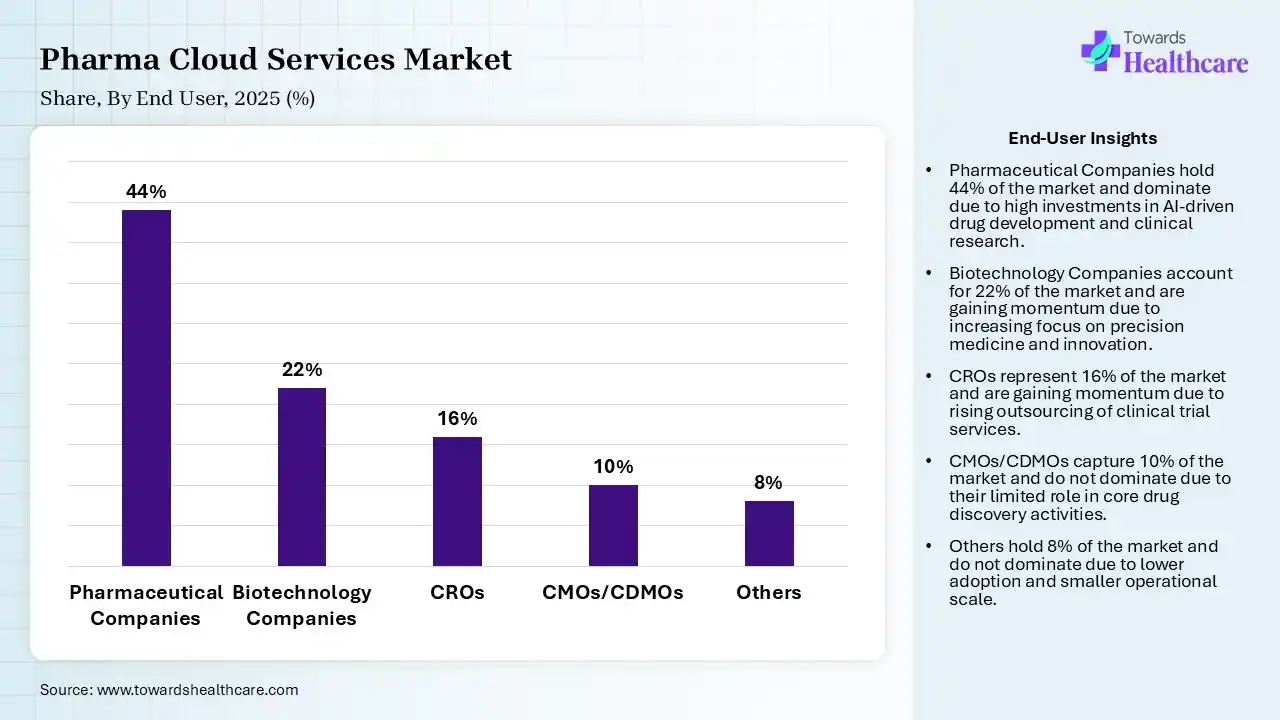
| Segment | Share 2025 (%) |
| Pharmaceutical Companies | 44% |
| Biotechnology Companies | 22% |
| CROs | 16% |
| CMOs/CDMOs | 10% |
| Others | 8% |
The pharmaceutical companies segment led the Pharma Cloud Services Market in 2025
The pharmaceutical companies segment contributed the largest market share of 44%, as pharmaceutical organizations are shifting to pharma cloud computing to enhance data safety, lower costs, and speed up research. Cloud computing allows the pharma community to revolutionize rapidly, manage changes effortlessly, and deliver novel medications.
The biotechnology companies segment held a significant share of 22% in the market, and is estimated to witness the fastest growth during the forecast period, as cloud storage on virtual servers allows continual holdup activity and lightning-rapid disaster recovery so that the lab experiences minimal downtime. Progressive cloud infrastructures are seen with managed IT solutions.
The CROs segment held a significant share of 16% in the market, as cloud computing offers advanced flexibility, effectiveness, and strategic value as compared to traditional on-premises healthcare infrastructure. Cloud computing offers enhanced collaboration in business entities, present inside and outside the organization. Cloud services provide businesses with different opportunities to optimize operations and reduce expenses.
The CMOs/CDMOs segment held a significant share of 10% in the market, as CMOs and CDMOs enhance operations and reduce expenses by shifting to the cloud. CDMOs offer the advantages of end-to-end support, appropriate for companies across development stages. CDMOs can simulate manufacturing processes, identify potential issues, and optimize them without the need for physical trials, leading to faster and more efficient drug development.
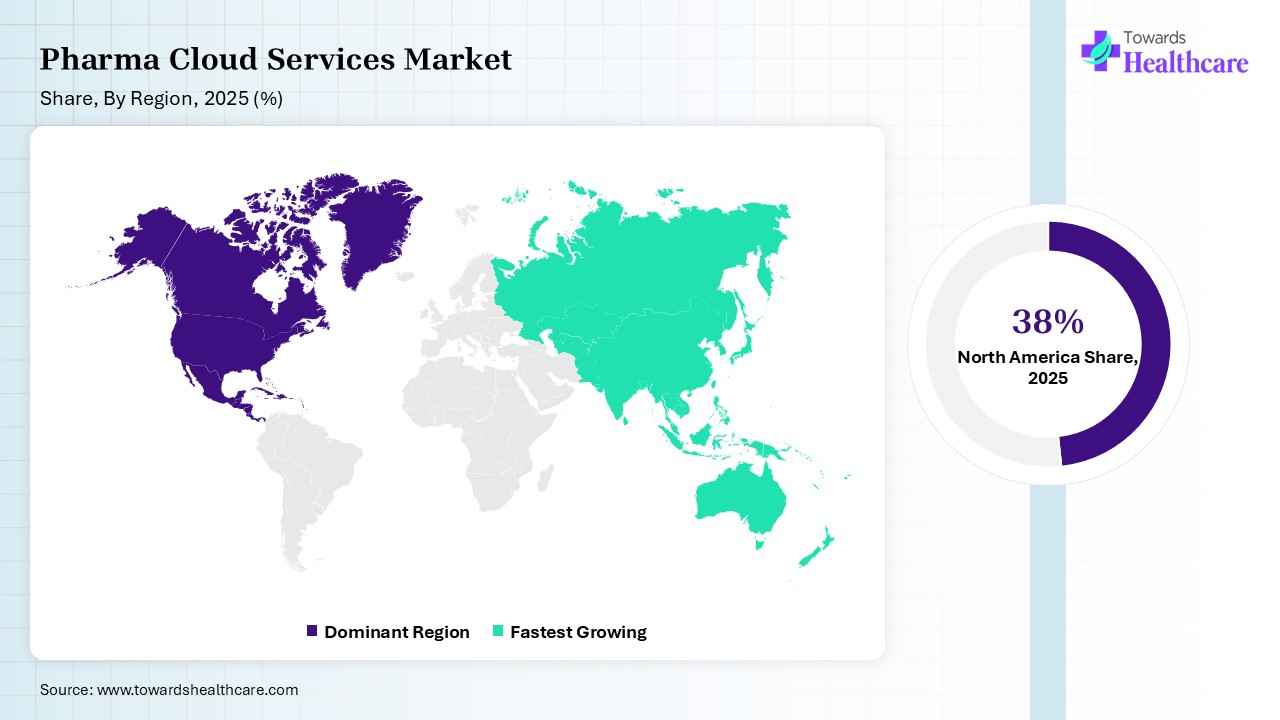
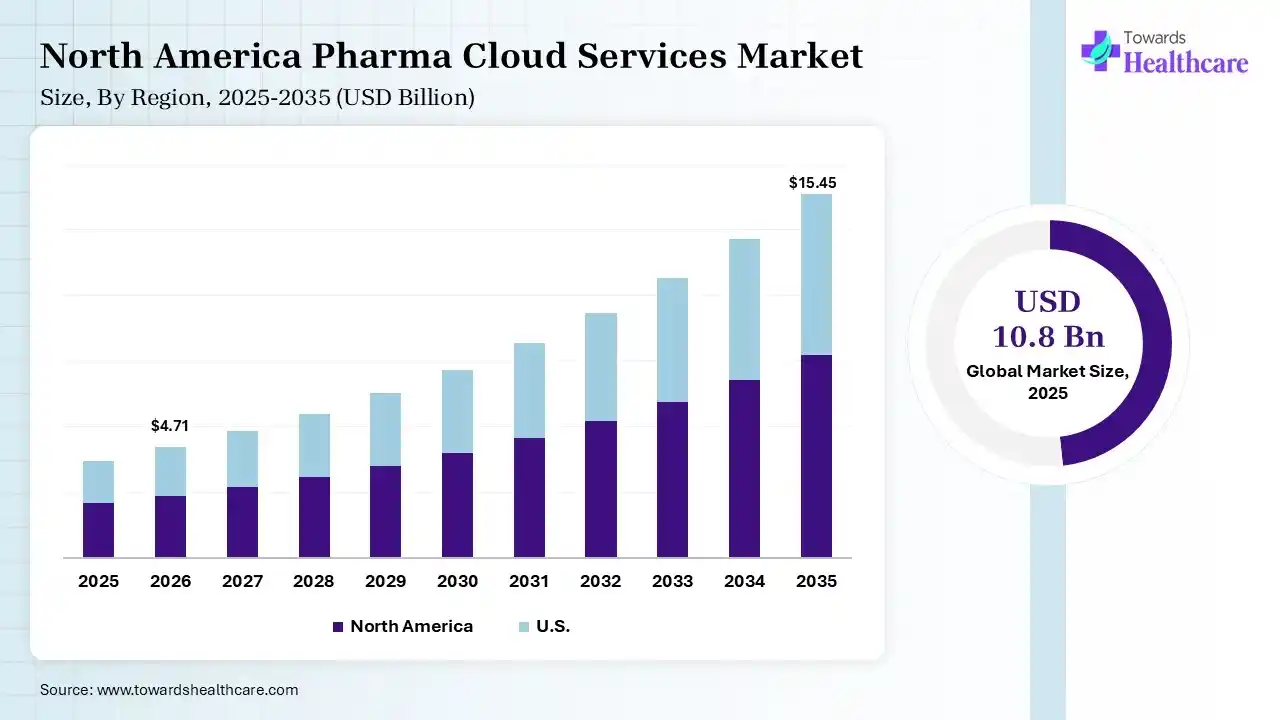
In 2025, North America dominated the pharma cloud services market with a share of 38% in 2025, due to this region's pharmaceutical organizations being early adopters of technology, using cloud platforms for AI-based analytics, genomic research, and managing large-scale information. The presence of a robust regulatory environment, involving HIPAA compliance and FDA support for digital technology, encourages the adoption of secure and reliable cloud organizations, which contribute to the growth of the market.
For Instance,
U.S. Market Trends
The U.S. is a hub for leading cloud infrastructure providers such as AWS, Microsoft Azure, and Google Cloud, providing advanced, secure, and compliant services necessary for handling large healthcare datasets. Stringent regulatory requirements from the FDA and compliance regulations, like the Drug Supply Chain Security Act (DSCSA). U.S. pharmaceutical organizations significantly invest in R&D and have been primary adopters of cloud technologies for clinical trials, drug discovery, and production.
Canada Market Trends
Canada is expanding its pharma cloud services market through growing investments in digital healthcare and life sciences research. Pharmaceutical companies are adopting cloud platforms to improve data management, regulatory compliance, and collaboration across research activities. Government support for digital innovation encourages wider technology adoption. Cloud service providers are strengthening cybersecurity and analytics capabilities. Canada continues attracting partnerships that help pharmaceutical organizations modernize operations and improve research efficiency through secure cloud solutions.
Asia Pacific held 23% share of the pharma cloud services market in 2025, and is expected to have the fastest CAGR during the forecast period, as rising digitalisation has reformed competitive dynamics in the economy, creating a novel healthcare sector and renovating existing ones. Growing AI-based integration into the Ayushman Bharat Digital Mission is expected to create a comprehensive health data infrastructure, connecting Digital Health IDs with electronic medical records (EMRs), which contributes to the growth of the market.
India Market Trends
India's data potential demands strong IP protection and clear regulations to attract early-stage research and foster true revolution. An Indian organization is exploring AI-based drug discovery, potentially increasing India's role in novel products. Cloud validation reduces the expenses related to a physical server, including server maintenance and software evaluation.
China Market Trends
China is experiencing rapid growth in the pharma cloud services market as pharmaceutical companies accelerate digital transformation and expand research activities. Rising investments in biotechnology and healthcare technology are increasing demand for secure cloud platforms. Domestic technology firms are introducing advanced cloud solutions with artificial intelligence and data analytics capabilities. Government support for digital healthcare and innovation encourages adoption. China remains an important market for cloud-based pharmaceutical services.
R&D:
Manufacturing Processes:
Patient Services:
| Company | Headquarters | Latest Update |
| Amazon Web Services | United States | In April 2026, Amazon Web Services launched Amazon Bio Discovery, an AI tool to accelerate drug discovery. Scientists now generate and evaluate potential drug molecules without coding. |
| Microsoft Azure | United States | Microsoft Azure has emerged as a significant cloud platform for pharma, offering scalable infrastructure, well-developed analytics, and advanced compliance features. |
| Accenture | Ireland | In October 2025, Accenture announced an expansion of its partnership with Amazon Web Services (AWS) to deliver a transformative digital solution to public sector, defense, and national security organizations. |
| IBM | United States | IBM introduces new AI Integration Services to support enterprises in building and scaling AI agents. |
| Wipro | India | Wipro leverages healthcare and life sciences technology, including AI and automation, to drive novelty, improve patient care, and ensure compliance. |
Strengths
Weaknesses
Opportunities
Threat
In June 2026, Justin Marcucci, President, Apexon, said, “While enterprises have largely begun to solve for AI strategy, the overwhelming gap that remains is scaled AI delivery: getting from a compelling use case to a system that runs in production, integrates with live data, adapts to the realities of the business, and compounds in value over time. In Healthcare and Life Sciences, that gap has real consequences for drug discovery timelines, clinical operations, and patient outcomes. This strategic collaboration agreement with AWS gives us the infrastructure depth and the service ecosystem to close that gap for our clients, at a scale that changes what is possible for them.”
By Service Type
By Deployment Model
By Application
By End User
By Region









Principal Consultant
Rohan Patil is a seasoned market research professional with over 5+ years of focused experience in the healthcare sector, bringing deep domain expertise, strategic foresight, and analytical precision to every project he undertakes.
Learn more about Rohan Patil

Reviewed By
Aditi Shivarkar is a seasoned professional with over 14 years of experience in healthcare market research. As a content reviewer, Aditi ensures the quality and accuracy of all market insights and data presented by the research team.
Learn more about Aditi Shivarkar