

Pipeline Programs

CGT Companies Tracked

Manufacturing Facilities


The global pharmaceutical ERP market size was estimated at USD 2.96 billion in 2025 and is predicted to increase from USD 3.33 billion in 2026 to approximately USD 9.66 billion by 2035, expanding at a CAGR of 12.56% from 2026 to 2035.
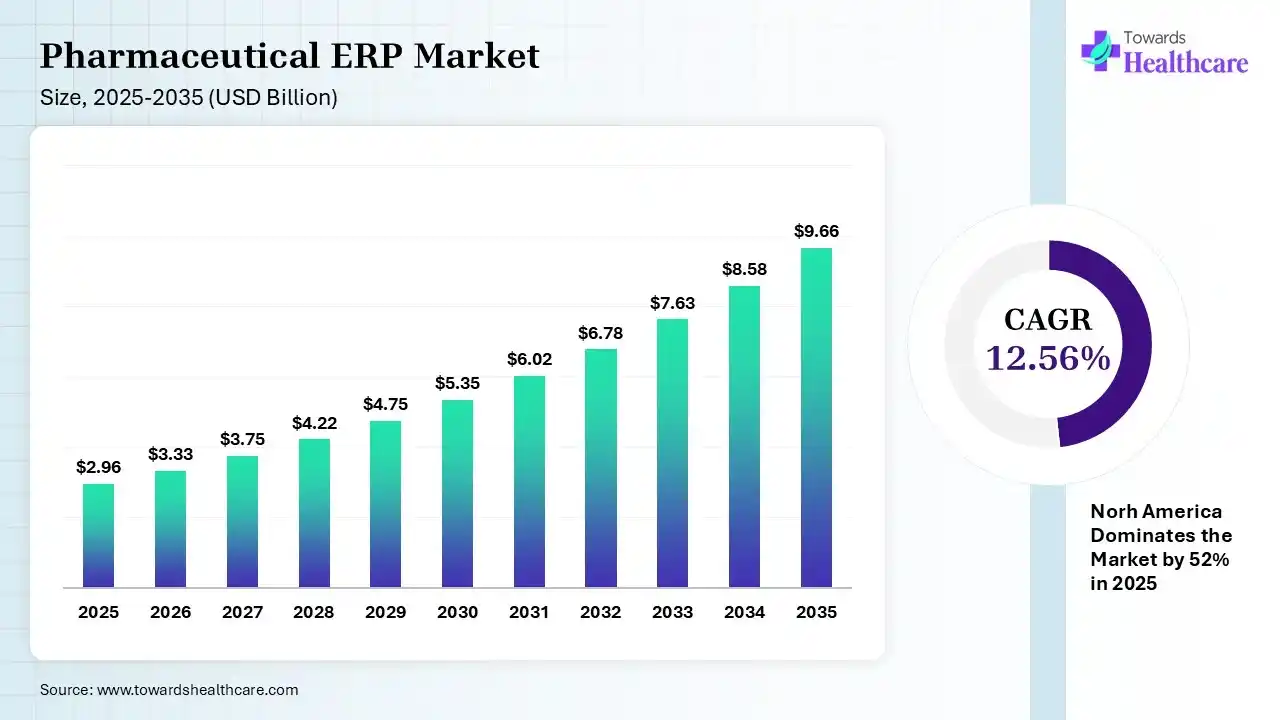
The pharmaceutical ERP market is growing due to pharma ERP systems providing real-time visibility into inventory levels, letting organization to maintain optimal stock levels and lower carrying expenses.
The pharmaceutical ERP market is growing, as applications of ERP for the pharmaceutical industry enable organizations to gain visibility in the supply chain. From the source of raw materials to the end product delivery, managers track and monitor every step. ERP systems are indispensable for healthcare organizations due to their capability to address the unique limitations of the industry. ERP services for the healthcare sector provide many advantages, including streamlined processes, improved control and compliance, enhanced supply chain management, a reduction in physical errors through automation, and support for modified medicine initiatives. ERP systems help to tackle pharmaceutical supply chain tasks by automating and streamlining inventory management, improving logistics coordination, and offering real-time tracking data.
AI-based ERP reinforces pharma compliance, improves batch traceability, and saves audit-ready data with real-time insights and automatic challenge controls. AI-based ERP software aimed at the pharma manufacturing is renovating price control, improving effectiveness, and ensuring regulatory compliance. An AI-based pharmaceutical organization identifies anomalies in production and quality data, predicts inventory scarcities or expiry challenges, and highlights potential compliance gaps early. By automating repetitive validations and checks, AI-based technology lowers manual effort while allowing faster, smarter, data-based decision-making in the departments. AI-driven ERP services are intended specifically for the pharmaceutical sector.
| Table | Scope |
| Market Size in 2026 | USD 3.33 Billion |
| Projected Market Size in 2035 | USD 9.66 Billion |
| CAGR (2026 - 2035) | 12.56% |
| Leading Region | North America by 52% |
| Key Applications | Manufacturing Management, Batch Tracking, Quality Control, GMP Compliance, Serialization & Traceability, Supply Chain Management, Financial Management, Inventory Optimization, Regulatory Reporting |
| Primary End Users | Pharmaceutical Manufacturers, Biotech Companies, CDMOs, CROs, Medical Device Manufacturers, Vaccine Producers, Life Sciences Organizations |
| Key Challenges | High implementation cost, complex validation requirements, legacy system migration, cybersecurity concerns, integration complexity |
| Measurable Values | USD Millions/Units/Volume |
| Market Segmentation | By Deployment Mode, By Function/Module, By Enterprise Size, By End Use, By Region |
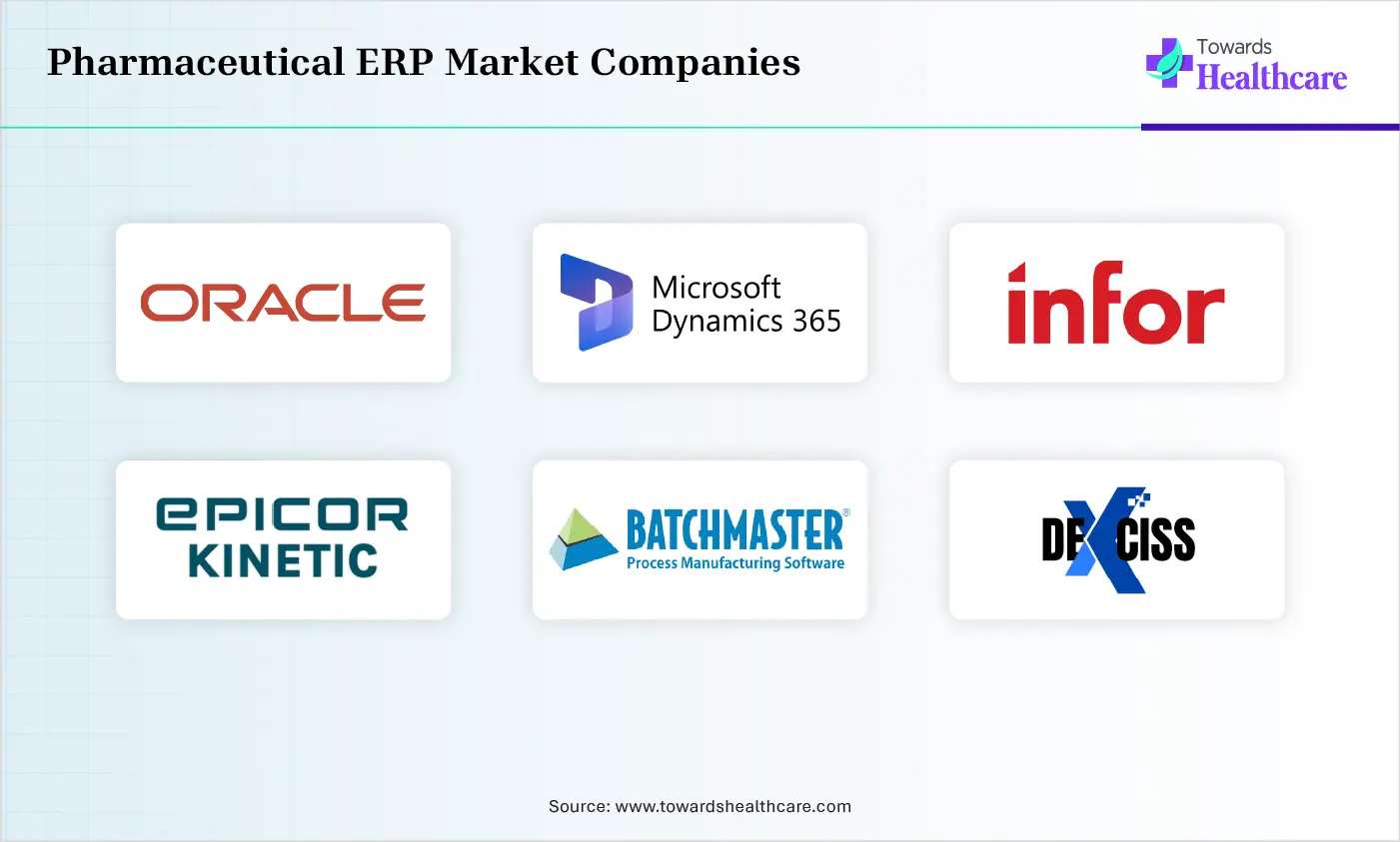
| Top Key Players | Oracle, Microsoft Dynamics 365, Infor CloudSuite Industrial, Epicor Kinetic, BatchMaster ERP, Dexciss ERP |
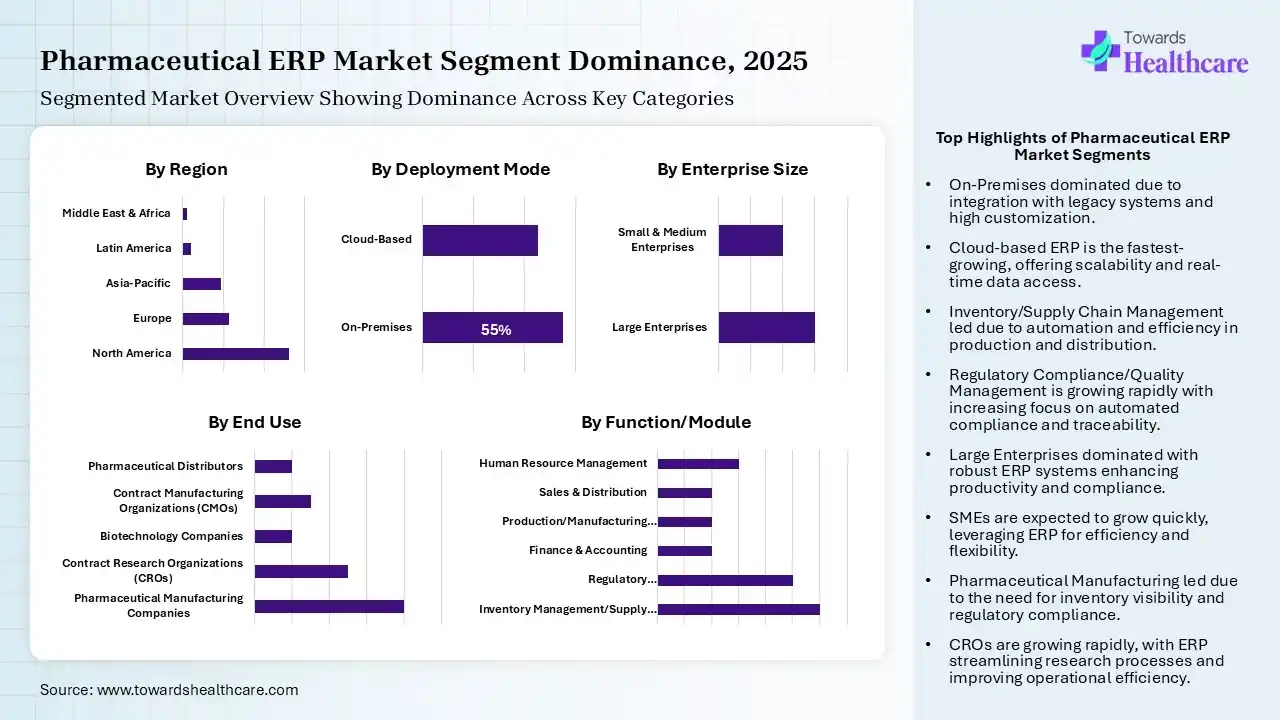
Which Deployment Segment Led the Pharmaceutical ERP Market in 2025?
| Segment | Share 2025 (%) |
| On-Premises | 55% |
| Cloud-Based | 45% |
Explanation
On-Premises
The on-premises segment was the dominant segment in the market by 55% in 2025, as an on-premises ERP system is usually installed and run on servers located in the organization's physical data center. It is simple to integrate with present, complex, and sometimes decades-old legacy hardware and software previously running on the local network. On-premise services traditionally provide the most extensive capability to customize the core code. On-premise ERP systems offer greater independence and flexibility. Businesses choose from a diversity of vendors and negotiate terms based on their specific requirements.
Cloud-Based
Whereas the cloud-based segment is estimated to be the fastest-growing in the market during the forecast period, as cloud-based ERP improves efficiency and encourages innovation. By leveraging advanced analytics, AI, and machine learning, organizations drive research, enhance compliance, and improve product quality. This technological edge is significant for staying competitive in a quickly emerging industry. Cloud-based ERP services offer flexibility and scalability. These systems offer real-time data access, streamline operations, and adapt to sector moves seamlessly.
Which Function/Module Segment Led the Pharmaceutical ERP Market in 2025?
| Segment | Share 2025 (%) |
| Inventory Management/Supply Chain Management | 30% |
| Regulatory Compliance/Quality Management | 25% |
| Finance & Accounting | 10% |
| Production/Manufacturing Management | 10% |
| Sales & Distribution | 10% |
| Human Resource Management | 15% |
Explanation
The inventory management/supply chain management segment dominated the market by 30% in 2025, as pharma inventory software is intended to automate and streamline the inventory management processes and lower the stress of pharma producers, ultimately propelling them towards business growth. A pharma inventory software enables manufacturers to have a number of verified suppliers. Inventory management in the pharmaceutical sector focuses on inventory control, manufacturing planning, and distribution planning.
Regulatory Compliance/Quality Management
Whereas the regulatory compliance/quality management segment is anticipated to be the fastest-growing in the pharmaceutical ERP market during 2026-2035, as pharmaceutical ERP confirms adherence to quality, safety, and effectiveness standards (FDA, EMA, GxP) via automated documentation, batch traceability, and electronic signatures. A quality management system (QMS) is a set of strategies, procedures, and responsibilities that organize and direct an organization’s activities based on its quality goals. QMS supports ensuring that the organization meets consumer and regulatory requirements, enhances effectiveness and efficiency, and strives for continuous improvement
Why the Large Enterprises Segment Led the Pharmaceutical ERP Market in 2025?
| Segment | Share 2025 (%) |
| Large Enterprises | 60% |
| Small & Medium Enterprises | 40% |
Explanation
The large enterprises segment held the largest share of the market by 60% in 2025, as ERP systems offer real-time visibility in the inventory levels, enabling organizations to maintain optimal stock levels and lower carrying expenses. Pharmaceutical ERP software enhances productivity, compliance, and growth. Pharma ERP system modernizes inventory management, confirms regulatory compliance, improves quality control, and enhances supply chain visibility. ERP software in the pharmaceutical industry includes streamlining processes and reducing operational expenses while increasing efficiency.
Small & Medium Enterprises
Whereas the small & medium enterprises segment is anticipated to be the fastest-growing in the upcoming years, because pharma ERP systems offer real-time visibility in the inventory levels, enabling companies to maintain optimal stock levels and decrease carrying expenses. A pharmaceutical ERP system is a technical catalyst, boosting an organization to meet dynamic healthcare challenges and patient expectations. ERP services support pharma companies in improving efficiency, ensuring compliance, and maintaining product quality.
Why the Pharmaceutical Manufacturing Companies Segment Led the Pharmaceutical ERP Market in 2025?
| Segment | Share 2025 (%) |
| Pharmaceutical Manufacturing Companies | 40% |
| Contract Research Organizations (CROs) | 25% |
| Biotechnology Companies | 10% |
| Contract Manufacturing Organizations (CMOs) | 15% |
| Pharmaceutical Distributors | 10% |
Explanation
The pharmaceutical manufacturing companies segment led the market by 40% in 2025, as pharma ERP systems offer real-time visibility in the inventory levels, enabling companies to maintain ideal stock levels and lower carrying expenses. Pharmaceutical ERP software progresses productivity, compliance, and growth. A pharmaceutical ERP allows for enhanced traceability, optimized inventory management, and protected data security. Pharma ERP system streamlines inventory management, confirms regulatory compliance, improves quality control, and advances supply chain visibility.
Contract Research Organizations (CROs)
Whereas the contract research organizations (CROs) segment is the fastest-growing in the market, including ERP, enables CROs to complete or upon project stages delivered, which supports timely, accurate billing, allowing consumers to monitor progress so they align their budgets with allocated invoices. CROs operate on a unique business model, which is based on the complexity and volume of research and evidence required. CRO management advantages in the same way as any other software consumer, streamlining resources and personnel, monitoring timescales against schedules, and quickly identifying where a change of plan is required.
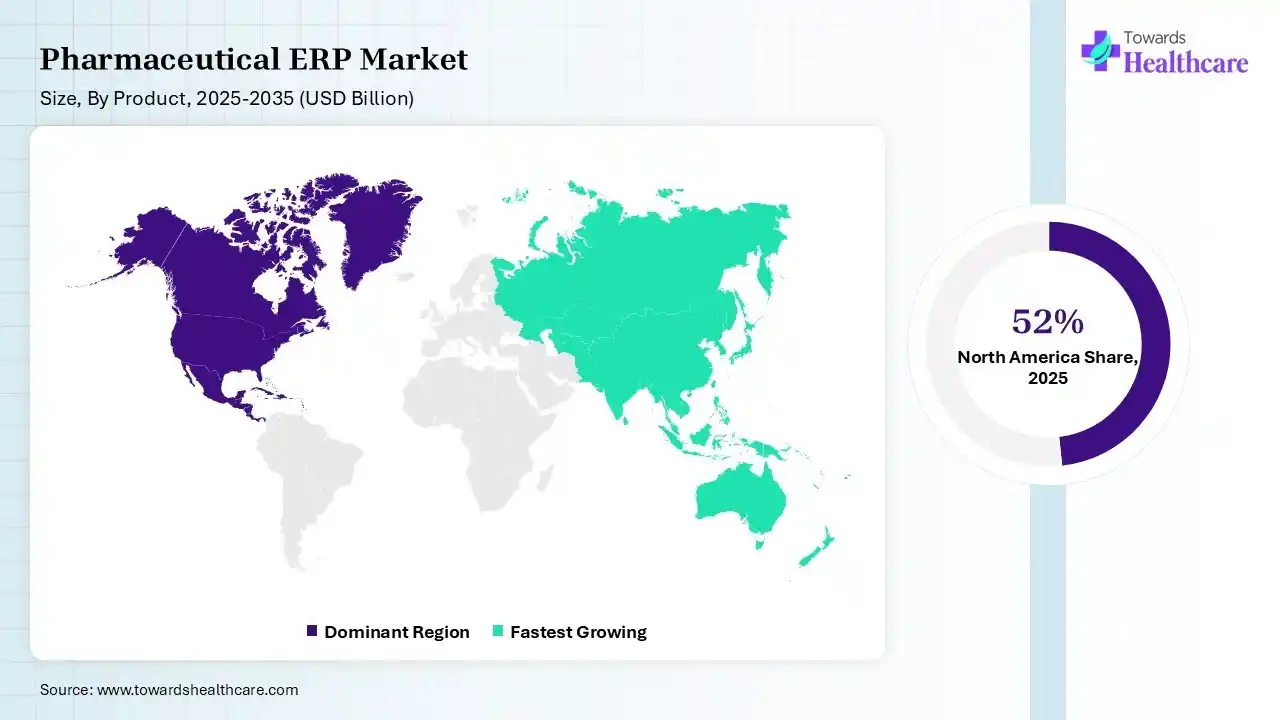
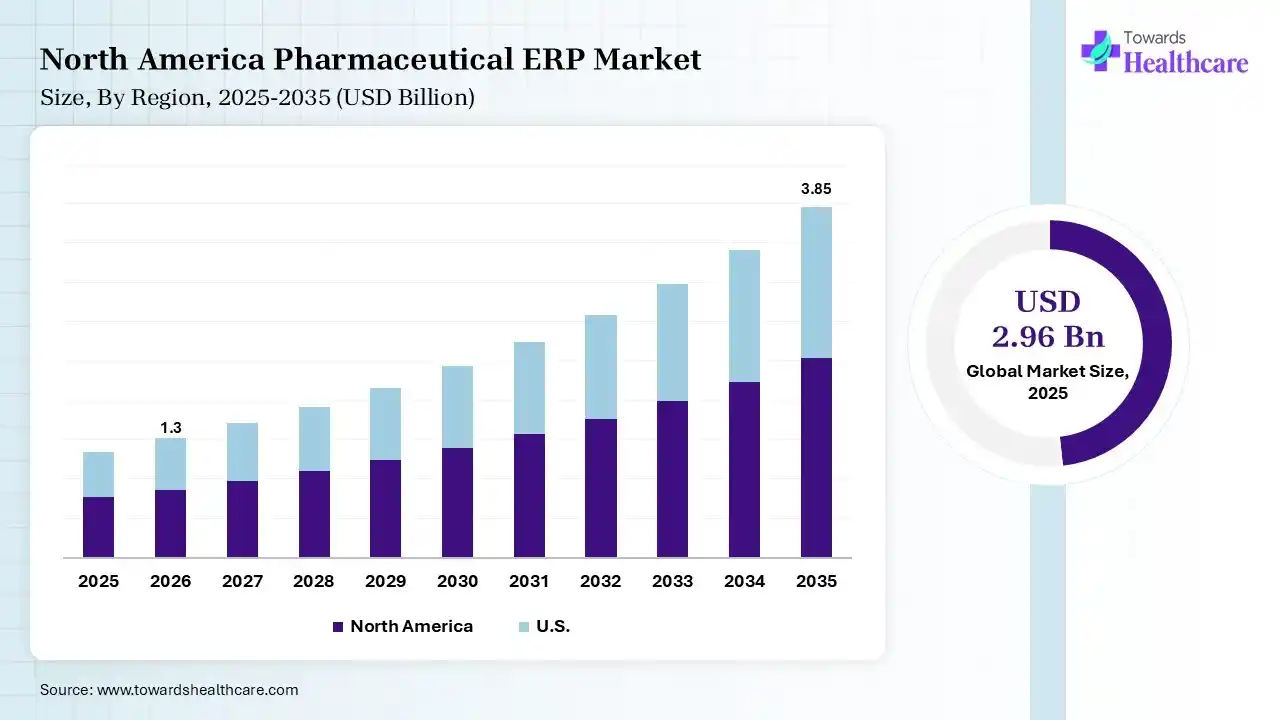
In 2025, North America dominated the pharmaceutical ERP market by 52% because this region is home to biotechnology and advanced pharmaceutical research. The presence of main pharmaceutical organizations requires advanced, scalable ERP services from top-tier vendors to manage R&D, clinical trials, and manufacturing. Pharmaceutical organizations are ever-changing to pharma cloud computing to enhance data safety, lower costs, and accelerate research. Cloud ERP services provide a lower total expense of ownership by limiting the requirement for huge initial capital expenditure on hardware, which drives the growth of the market.
U.S. Market Trends
In the U.S., regulatory compliance plays a significant role in ensuring the safety and efficacy of pharmaceutical products, healthcare tools, and food and beverages. Major sector 4.0 technologies support the creation of a sustainable environment in production and other industries. The presence of large pharmaceutical organizations is evolving their innovation strategies, shifting from closed R&D models towards open and collaborative ecosystems.
Asia Pacific is expected to see rapid growth in the pharmaceutical ERP market, as these biopharmaceutical organizations are accountable for nearly twice as much R&D spending. This is emerging as a worldwide production hub, showing opportunities for logistics companies. With rapid diffusion and adoption of advanced technologies, countries are realizing the wide range of opportunities to redefine their economies. Medical care organizations turned to the cloud to rapidly adapt to the pandemic’s disruption, increasing innovation in telemedicine, digital health, healthcare research, and clinical care, which contributes to the growth of the market.
India Market Trends
India has the largest number of pharmaceutical production facilities. The Indian healthcare sector is one of the largest in the ecosphere, contributing significantly to global generic medicine manufacturing. ERP software plays a significant role in integrating different business processes like manufacturing, supply chain management, inventory control, and compliance tracking.
| Ecosystem Segment | Key Participants | Role in Market |
| Technology Providers | SAP, Oracle, Microsoft, Infor | Core ERP technology infrastructure and cloud platforms |
| Product Manufacturers | SAP, Oracle, QAD, Epicor, Aptean | Develop pharmaceutical ERP products and modules |
| Service Providers | Accenture, Deloitte, Capgemini, Infosys | ERP consulting, implementation, validation, support |
| Platform Providers | SAP S/4HANA, Oracle Fusion Cloud ERP, Microsoft Dynamics 365 | Enterprise platforms for pharmaceutical operations |
| CROs/CDMOs | Lonza, Catalent, WuXi AppTec | Major ERP end-users for manufacturing and supply chain management |
| Software Vendors | SAP, Oracle, Microsoft, Infor, QAD, Epicor, Aptean, SYSPRO | Provide ERP software and industry-specific solutions |
| Research Institutions | ISPE, PDA | Support standards, compliance frameworks, and best practices |
| End-User Industries | Pharmaceuticals, Biotechnology, Vaccines, Medical Devices, Diagnostics | Deploy ERP systems to optimize operations |
R&D
Manufacturing Processes
Patient Services
| Tier 1 | Tier 2 | Tier 3 | |
| Typical Market Influence | 68% | 22% | 10% |
| Tier 1 | ||||
| Company Name | Headquarters | Country | Why Relevant to This Market | Key Products/Services |
| SAP SE | Walldorf, Baden-Württemberg | Germany | Largest ERP vendor globally with dedicated Life Sciences solutions | SAP S/4HANA for Life Sciences, SAP ATTP |
| Oracle Corporation | Austin, Texas | United States | Strong pharmaceutical cloud ERP and supply chain solutions | Oracle Fusion Cloud ERP, Oracle NetSuite |
| Microsoft Corporation | Redmond, Washington | United States | Rapidly growing pharmaceutical ERP deployments | Microsoft Dynamics 365 |
| Tier 2 | ||||
| Company Name | Headquarters | Country | Why Relevant to This Market | Key Products/Services |
| Epicor Software Corporation | Austin, Texas | United States | Strong manufacturing ERP capabilities for pharma firms | Epicor Kinetic |
| Aptean | Alpharetta, Georgia | United States | Process manufacturing ERP tailored for regulated industries | Aptean Process Manufacturing ERP |
| SYSPRO | Johannesburg, Gauteng | South Africa | Widely adopted by SME pharmaceutical manufacturers | SYSPRO ERP |
| Tier 3 | ||||
| Company Name | Headquarters | Country | Why Relevant to This Market | Key Products/Services |
| BatchMaster Software | Laguna Hills, California | United States | Dedicated process manufacturing and pharmaceutical ERP | BatchMaster ERP |
| Acumatica | Bellevue, Washington | United States | Fast-growing cloud ERP vendor in life sciences SMEs | Acumatica Cloud ERP |
| Rootstock Software | San Ramon, California | United States | Cloud-native manufacturing ERP for regulated industries | Rootstock ERP |
Strengths
Weaknesses
Opportunities
Threats
By Deployment Mode
By Function/Module
By Enterprise Size
By End Use
By Region







Principal Consultant
Shivani Zoting is a dedicated research analyst specializing in the healthcare industry. With a strong academic foundation, a B.Sc. in Biotechnology and an MBA in Pharmabiotechnology, she brings a unique blend of scientific understanding and strategy.
Learn more about Shivani Zoting
Reviewed By
Aditi Shivarkar is a seasoned professional with over 14 years of experience in healthcare market research. As a content reviewer, Aditi ensures the quality and accuracy of all market insights and data presented by the research team.
Learn more about Aditi Shivarkar









