
Towards Healthcare

Biotechnology Separation Systems Market Executive Forecast on AI-Driven Bioprocessing Growth

Biotechnology Separation Systems Market (By Technology/Method: Chromatography, Centrifugation, Membrane Filtration, Electrophoresis, Flow Cytometry, Magnetic Separation, Microfluidics / Lab-on-chip, Precipitation, Extraction; By Product Type / System: Instruments / Systems, Consumables, Software & Automation Systems; By Scale of Operation: Laboratory / R&D Scale, Pilot Scale, Commercial / Production Scale; By Application: Biopharmaceutical Production, Clinical Diagnostics, Research & Academic Use, Food & Beverage Processing, Environmental / Industrial Testing; By Region: North America, Europe, Asia Pacific, Latin America, Middle East and Africa) Global Analysis, Size, Trends, Leading Companies, Regional Outlook and Forecast 2026 to 2035.

Last Updated : 25 March 2026 Category: Biotechnology Insight Code: 6776 Format: PDF / PPT / Excel
Revenue, 2025
USD 14.06 Billion
Forecast, 2035
USD 46.89 Billion
CAGR, 2026-2035
12.8%
Report Coverage
Global

The global biotechnology separation systems market size was estimated at USD 14.06 billion in 2025 and is predicted to increase from USD 15.86 billion in 2026 to approximately USD 46.89 billion by 2035, expanding at a CAGR of 12.8% from 2026 to 2035.
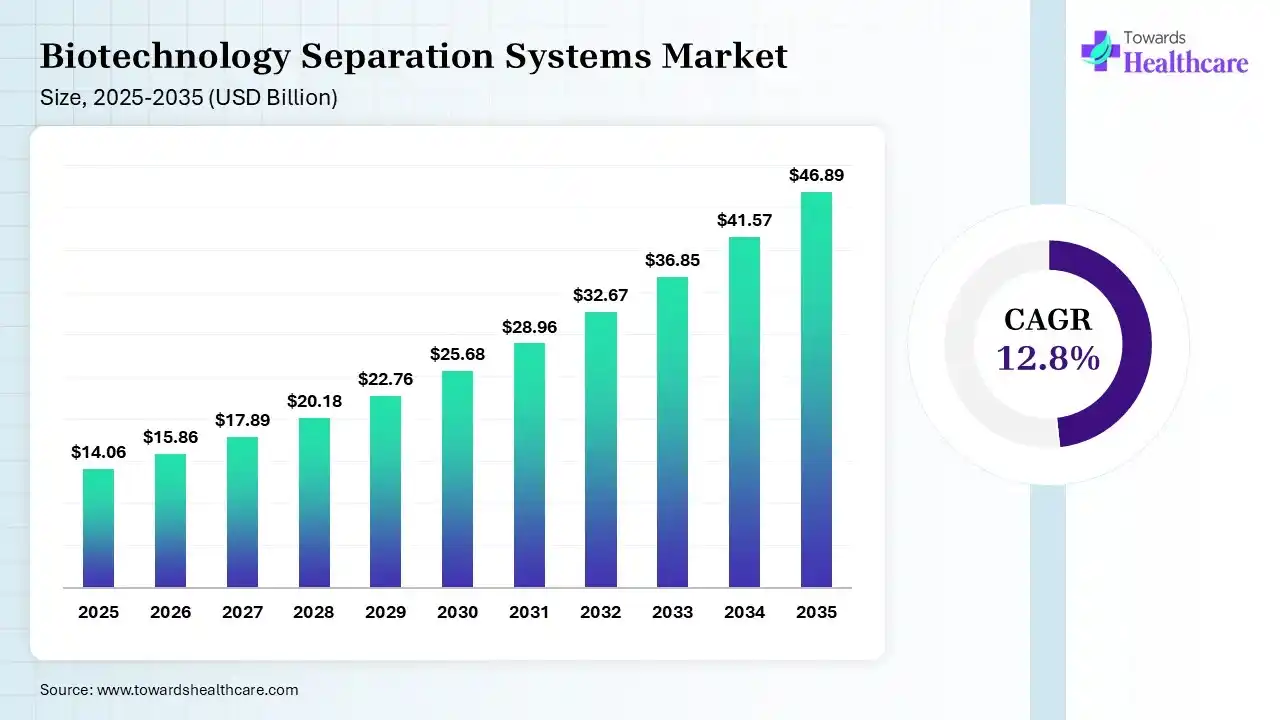
Biotechnology Separation Systems Market Size is USD 15.86 Billion in 2026.

The market is expanding, driven by rising demand for biologics, vaccines, and advanced therapies. Increasing research activities and the need for efficient purification technologies are encouraging innovation and wider adoption across the pharmaceutical and biotech industries.

Key Takeaways

  • The biotechnology separation systems market will likely exceed USD 15.86 billion by 2026.
  • Valuation is projected to hit USD 46.89 billion by 2035.
  • Estimated to grow at a CAGR of 12.8% starting from 2026 to 2035.
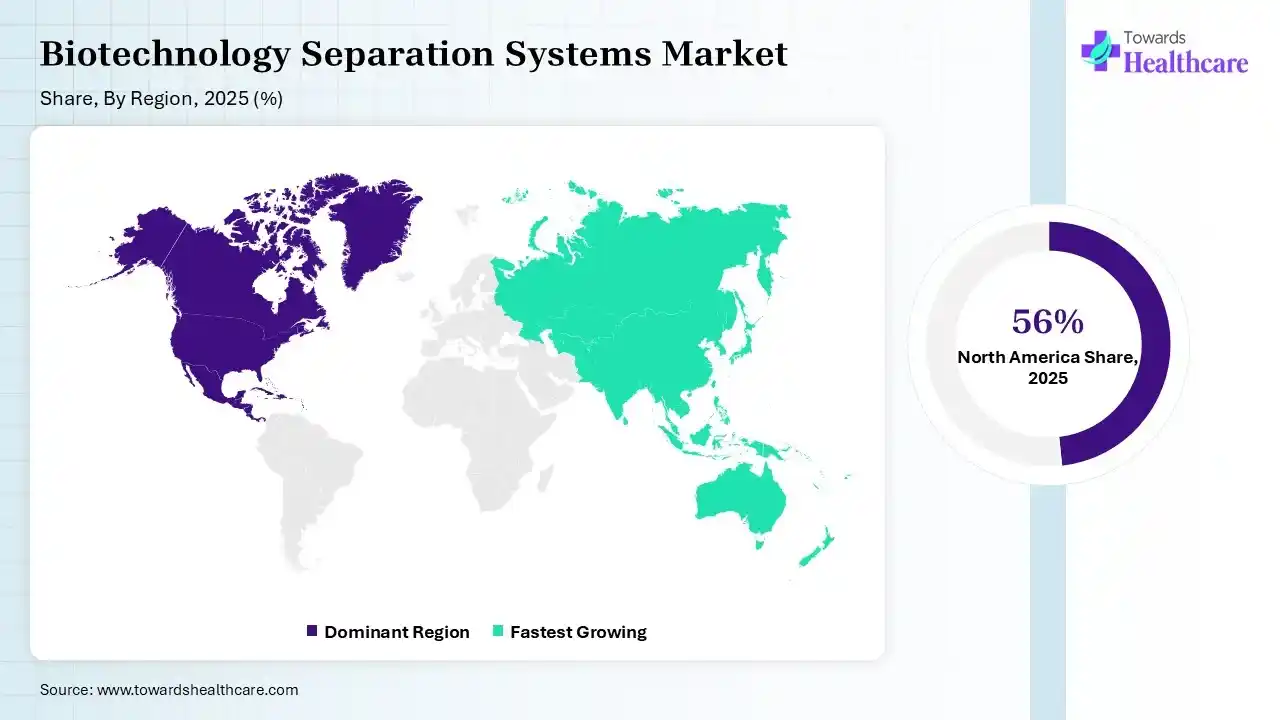
  • North America dominated the biotechnology separation systems market in 2025.
  • Asia Pacific is expected to grow at the fastest CAGR in the market during the forecast period.
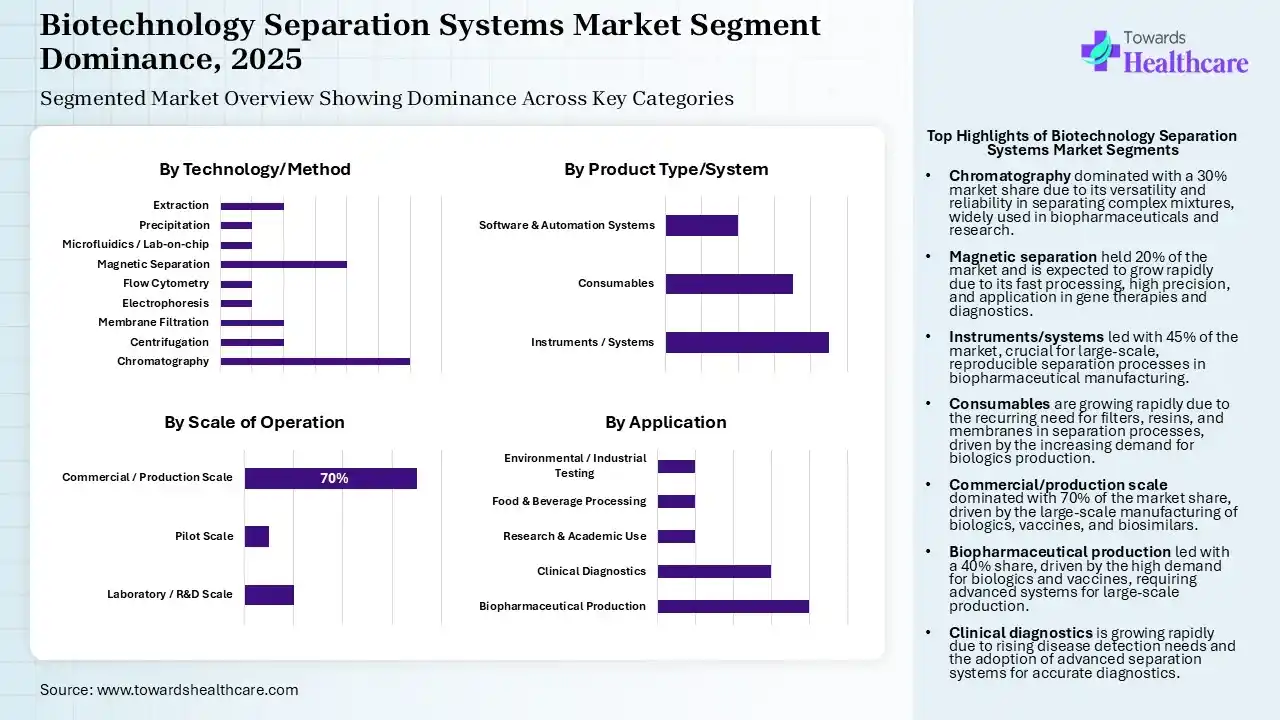
  • By technology/method, the chromatography segment held a dominant position in the market by 30% in 2025.
  • By technology/method, the magnetic segment is expected to grow at the fastest CAGR in the market during the forecast period.
  • By product type/system, the instruments/systems segment dominated the market by 45% in 2025.
  • By product type/system, the consumables segment is expected to grow at the fastest CAGR in the market during the forecast period.
  • By scale of operation, the commercial/production scale segment led the market by 20% in 2025.
  • By scale of operation, the laboratory/R&D scale segment is expected to grow at the fastest CAGR in the biotechnology separation systems market during the forecast period.
  • By application, the biopharmaceutical production segment held the major market share by 40% in 2025.
  • By application, the clinical diagnostic segment is expected to grow at the fastest CAGR in the market during the forecast period.

From Discovery to Purity: The Engine Behind Biotech Breakthroughs

Biotechnology separation systems are technologically used to isolate, purify, and extract specific biological components such as proteins, cells, or DNA from complex mixtures during biopharmaceutical production and research processes. The biotechnology separation systems market is growing due to increasing demand for biologics, vaccines, and advancements in filtration and chromatography technologies, which are accelerating adoption. Additionally, growing investments in biotechnology and stricter regulatory standards are pushing companies to adopt efficient, scalable separation solutions across production and research workflows.

How Can AI Affect the Biotechnology Separation Systems Market?

Artificial intelligence is transforming the market by optimizing purification processes, improving accuracy, and reducing time and cost. AI-driven analytics enable better process control, predictive maintenance, and real-time monitoring. It also supports faster drug development by enhancing data analysis and decision-making, leading to more efficient and scalable separation techniques across biopharmaceutical manufacturing and research.

Trend and Future Outlook of Biotechnology Separation Systems Market

  • Adoption of Intelligent & Automated Systems: Separation technologies are becoming more automated with the integration of smart monitoring tools. This shift improves precision, reduces manual intervention, and enhances process consistency, helping manufacturers achieve better productivity and reliable outcomes in bioprocessing.
  • Growing Preference for Flexible Processing Solutions: There is increasing use of modular, continuous, and single-use systems that allow faster setup and easier scaling. These solutions reduce contamination risks and operational complexity, making them ideal for dynamic production environments like biologics and vaccine manufacturing.
  • Emphasis on Efficiency and Sustainable Design: Future developments focus on minimizing waste, energy use, and resource consumption. Companies are investing in advanced materials and improved system designs to deliver high-performance separation while meeting environmental goals and strict quality requirements.

Quick Facts Table

Table Scope
Market Size in 2026 USD 15.86 Billion
Projected Market Size in 2035 USD 46.89 Billion
CAGR (2026 - 2035) 12.8%
Leading Region North America
Historical Data 2020 - 2023
Base Year 2025
Forecast Period 2026 - 2035
Measurable Values USD Millions/Units/Volume
Market Segmentation By Technology/Method, By Product Type / System, By Scale of Operation, By Application, By Region
Top Key Players Danaher, Thermo Fisher Scientific, BD, Merck KGaA, GE Healthcare, Agilent Technologies, Sysmex Corporation,Alfa Wassermann, Shimadzu Corporation

Segmental Insights

Biotechnology Separation Systems Market Segmentation

By Technology/Method Insights

Why Did the Chromatography Segment Dominate in the Biotechnology Separation Systems Market in 2025? 

Segment Share 2025 (%)
Chromatography 30%
Centrifugation 10%
Membrane Filtration 10%
Electrophoresis 5%
Flow Cytometry 5%
Magnetic Separation 20%
Microfluidics / Lab-on-chip 5%
Precipitation 5%
Extraction 10%

Explanation

  • Chromatography dominates with a 30% share due to its versatility and reliability in separating and analyzing complex mixtures, widely used in biopharmaceuticals and research.
  • Centrifugation holds a 10% share, commonly used for sample separation and cell fractionation, but does not dominate as other methods offer broader applications.
  • Membrane Filtration also holds a 10% share, gaining momentum for its efficiency in separating particles and purifying liquids, particularly in biotechnological and food industries.
  • Electrophoresis accounts for 5% of the market, used for separating biomolecules by size, but remains a specialized method in molecular biology research.
  • Flow Cytometry captures 5% of the market, gaining momentum in cell analysis and diagnostics, but is still a niche technique with lower overall adoption.
  • Magnetic Separation holds a 20% share, gaining momentum for its high efficiency in isolating biomolecules and cells, especially in biotechnological applications.
  • Microfluidics / Lab-on-chip represents 5% of the market, gaining momentum in personalized diagnostics and point-of-care testing due to its miniaturization and automation potential.
  • Precipitation captures 5% of the market, mainly used in protein purification, but does not dominate due to preference for more efficient methods in large-scale applications.
  • Extraction holds a 10% share, gaining momentum for its role in natural product recovery and pharmaceutical applications, though it faces competition from other methods.

The chromatography segment dominated the market by 30% in 2025 due to its high precision, reliability, and ability to purify complex biomolecules like proteins and antibiotics. Its scalability from research to commercial production, along with consistent product quality and regulatory acceptance, made it a preferred choice. Additionally, continuous improvements in resins and system efficiency strengthened its widespread adoption in biopharmaceutical manufacturing.

Magnetic

The magnetic segment is expected to grow at the fastest CAGR due to its fast processing, high precision, and ability to isolate specific biomolecules and cells with minimal loss. It simplifies workflows and reduces processing time, making it highly efficient for modern applications. Rising use in cell and gene therapies, diagnostics, and research, along with easy integration with automated systems, is further driving its strong adoption.

By Product Type/System Insights

What Made the Instruments/Systems Segment Dominant in the Market in 2025?

Segment Share 2025 (%)
Instruments / Systems 45%
Consumables 35%
Software & Automation Systems 20%

Explanation

  • The Instruments/Systems segment dominates with a 45% share due to its essential role in research, diagnostics, and manufacturing, offering the core technology required for a wide range of applications in the market.
  • Consumables hold a 35% share, driven by their ongoing use in daily operations, but they do not dominate as much due to the reliance on the more expensive and long-lasting instruments and systems.
  • Software & Automation Systems represent 20% of the market, gaining momentum for their role in improving efficiency and accuracy, but still make up a smaller portion compared to physical instruments and consumables.

The instruments/systems segment dominated the biotechnology separation systems market by 45% due to its critical role in ensuring precise, large-scale, and reproducible separation processes. These systems offer advanced control, automation, and higher throughput, making them essential for biopharmaceutical manufacturing. Their ability to handle complex purification tasks efficiently, along with continuous technological upgrades, has increased their adoption across research labs and commercial production facilities.

Consumables

The consumables segment is expected to grow at the fastest rate due to the recurring usage in separation processes, including filters, resins, and membranes that require frequent replacements. Increasing biopharmaceutical production and research activities drive continuous demand for these products. Additionally, the shift towards single-use technologies and contamination control is boosting adoption, as consumables offer convenience, cost efficiency, and operational flexibility in both research and large-scale manufacturing.

By Scale of Operation Insights

How did the Commercial/Production Scale Segment Dominate the Systems Market in 2025?

Segment Share 2025 (%)
Laboratory / R&D Scale 20%
Pilot Scale 10%
Commercial / Production Scale 70%

Explanation

  • The Commercial/Production Scale segment dominates with a 70% share due to its critical role in large-scale manufacturing and commercial production, where efficiency and volume are paramount in meeting market demands.
  • The Laboratory / R&D Scale holds a 20% share, important for early-stage research and development, but does not dominate as much due to the focus on scaling up operations for commercial production.
  • The Pilot Scale accounts for 10% of the market, serving as a transitional phase between R&D and commercial scale, but it does not dominate as its primary function is in small-scale trials and process development.

The commercial/production scale segment dominated the biotechnology separation systems market by 20% due to the large-scale manufacturing of biologics, vaccines, and biosimilars. These operations require high-capacity, efficient, and consistent separation systems to ensure product quality and regulatory compliance. Increasing global demand for biopharmaceuticals and the need for continuous production further drive reliance on advanced, scalable separation technologies in industrial settings.

Laboratory/R&D Scale

The laboratory/R&D scale segment is expected to grow the fastest due to rising investment in drug discovery, biologics development, and advanced research. Increasing focus on personalized medicine and early-stage testing is driving demand for flexible and small-scale separation systems. Additionally, continuous innovation in biotechnology and growing academic and research activities are accelerating the adoption of efficient separation technologies at the laboratory level.

By Application Insights

How Did the Biopharmaceutical Production Segment Dominate the Market in 2025?

Segment Share 2025 (%)
Biopharmaceutical Production 40%
Clinical Diagnostics 30%
Research & Academic Use 10%
Food & Beverage Processing 10%
Environmental / Industrial Testing 10%

Explanation

  • The Biopharmaceutical Production segment dominates with a 40% share due to the increasing demand for biologics and vaccines, requiring advanced systems and technologies for large-scale production.
  • The Clinical Diagnostics segment holds a 30% share, driven by the growing need for accurate and timely disease detection, but does not dominate as much as biopharmaceutical production, which is more expansive.
  • The Research & Academic Use segment accounts for 10% of the market, focusing on fundamental research but does not dominate due to its smaller scope compared to commercial applications.
  • The Food & Beverage Processing segment represents 10% of the market, seeing steady growth due to rising quality control demands, but does not dominate compared to biopharmaceutical and clinical applications.
  • The Environmental / Industrial Testing segment also holds 10%, driven by regulatory requirements and sustainability trends, though it remains a smaller share of the market.

The biopharmaceutical production segment dominated the biotechnology separation systems market by 40% in 2025 due to the high demand for biologics, vaccines, and biosimilars. Large-scale manufacturing requires efficient purification to ensure product safety and quality. Stringent regulatory requirements and the need for consistent high-purity outputs further increased reliance on advanced separation systems, making them essential in commercial biopharmaceutical production processes.

Clinical Diagnostic

The clinical diagnostic segment is expected to grow at the fastest rate due to increasing demand for early and accurate disease detection. The rising prevalence of chronic and infectious diseases is driving the need for advanced diagnostic tools. Separation systems play a key role in isolating biomarkers and samples efficiently. Additionally, growth in personalized medicine and expanding healthcare infrastructure is further accelerating the adoption of these technologies in clinical diagnostics.
Regional Insights

Biotech Boom: Why North America Leads the Separation Systems Market

North America dominated the biotechnology separation systems market by 56% in 2025 due to its advanced biopharmaceutical industry, strong R&D investments, and early adoption of cutting-edge technologies. The presence of major biotech companies, supportive regulatory frameworks, and high healthcare spending further accelerated demand. Additionally, increasing biologics production and continuous innovations in purification techniques reinforced the region’s leadership in this market.

U.S. Market Trends

The U.S. leads the biotechnology separation system market due to its strong biopharmaceutical ecosystem, high R&D investments, and rapid adoption of advanced purification technologies. The presence of major biotech firms, robust regulatory support from the U.S. Food and Drug Administration, and increasing biologics production drive demand. Additionally, continuous innovation and a skilled workforce further strengthen the country’s market dominance.

Asia Pacific Emerging as the Fastest-Growing Biotech Market

The Asia Pacific biotechnology separation systems market is expected to grow at the fastest CAGR due to increasing healthcare investments, expanding biopharmaceutical manufacturing, and rising demand for advanced therapies. Rapid industrialization, supportive government initiatives, and growing research activities in countries like China and India further boost market growth. Additionally, improving healthcare infrastructure and cost-effective production capabilities attracts global biotech companies to the region.

India Market Trends

India is expected to grow at the fastest CAGR in the biotechnology separation systems market due to increasing investments in biopharmaceutical manufacturing, expanding research infrastructure, and strong government support for biotechnology initiatives. The country's cost-effective production capabilities, rising demand for biologics, and growing presence of domestic and global biotech firms further accelerate market growth during the forecast period.

Europe’s Steady Surge in the Biotech Separation Systems Market

Europe is anticipated to grow at a notable rate in the biotechnology separation systems market due to strong government support for life science, increasing investments in research and innovation, and a well-established pharmaceutical industry. The region’s focus on advanced biologics, presence of leading biotech firms, and stringent quality regulation further drive demand for efficient separation technologies during the forecast period.

UK Market Trends

The United Kingdom is expected to grow at a significant CAGR in the biotechnology separation systems market due to strong investments in life science, increasing focus on biologics and biosimilars, and a well-established research ecosystem. Supportive government initiatives, collaborations between academia and industry, and the presence of leading biotech companies further accelerate demand for advanced separation technologies during the forecast period.

Supply Chain Analysis

Clinical Trials

  • Clinical trials in biotechnology separation systems mainly aim to assess the safety, effectiveness, and scalability of techniques such as chromatography, membrane filtration, and cell sorting. These studies ensure that separation processes meet quality standards for drug manufacturing and therapeutic use. They also help optimize purification efficiency and regulatory compliance.
  • Key players: Thermo Fisher Scientific, Merck KGaA, Danaher Corporation, and Sartorius AG.

Regulatory Approvals

  • Regulatory approvals for biotechnology separation systems are complex and strictly enforced to ensure the purity, safety, and effectiveness of biologics such as vaccines, proteins, and monoclonal antibodies. Techniques like chromatography, filtration, centrifugation, and flow cytometry must meet standards set by agencies like the U.S. Food and Drug Administration, European Medicines Agency, and World Health Organization.
  • Key players: GE HealthCare, Thermo Fisher Scientific, Merck KGaA, and Agilent Technologies.

Patient Support and Services

  • Patient support and service offerings in biotechnology separation systems focus on improving process efficiency, reducing operational costs, and maintaining regulatory compliance in biopharmaceutical manufacturing. These services include system installation, maintenance, user training, and audit support, especially for chromatography, filtration, and centrifugation technologies.
  • Key players: Thermo Fisher Scientific, Sartorius AG, Danaher Corporation, and Merck KGaA.

Top Vendors in the Biotechnology Separation Systems Market & Their Offerings

Biotechnology Separation Systems Market Companies are Danaher, Thermo Fisher Scientific, BD, Merck KGaA, GE Healthcare, Agilent Technologies, Sysmex Corporation

Companies Headquarters Offerings
Danaher Washington, U.S. Offers chromatography resins, filtration systems, and integrated bioprocessing platforms supporting large-scale biologics manufacturing and purification processes.
Thermo Fisher Scientific   Massachusetts, U.S. Provides advanced purification technologies, membrane filtration systems, and analytical instruments for efficient biotech separation and drug development workflows.
BD New Jersey, U.S. Specializes in flow cytometry, cell sorting, and sample preparation systems for cell-based separation and research applications.
Merck KGaA Darmstadt, Germany Delivers chromatography columns, filtration units, and single-use technologies for scalable and high-purity biopharmaceutical separation processes.
GE Healthcare  Chicago, U.S. Offers bioprocessing equipment, chromatography systems, and purification solutions widely used in biologics production and downstream processing.
Agilent Technologies California, U.S. Provides HPLC systems, chromatography columns, and sample preparation tools for precise separation and analytical testing in biotech applications.
Sysmex Corporation Kobe, Japan Offers advanced cell analysis, hematology systems, and separation technologies supporting clinical diagnostics and laboratory research. 
Alfa Wassermann  New Jersey, U.S. Focuses on centrifugation equipment and sample separation systems used in clinical, research, and biotechnology laboratories.
Shimadzu Corporation Kyoto, Japan provides LC/GC systems, chromatography solutions, and analytical instruments for high-precision separation and quality analysis in biotech industries.

SWOT Analysis

Strengths

  • Strong demand from expanding biologics and vaccine production.
  • High-precision technologies ensure purity and quality outcomes.
  • Continuous innovation improves efficiency and scalability.
  • Critical role in downstream bioprocessing and compliance.

Weaknesses

  • Expensive systems and operational costs.
  • Requires a skilled workforce for handling complex technologies.
  • Time-consuming validation and regulatory procedures.
  • Limited adoption in cost-sensitive regions.

Opportunities

  • Increasing focus on biosimilars and personalized therapies.
  • Rapid growth in emerging economies.
  • Advancements in automation and single-use technologies.
  • Expansion of contract manufacturing organizations.

Threats

  • Intense competition among established companies.
  • Frequent technological upgrades lead to obsolescence risks.
  • Pricing pressure affecting profit margins.
  • Strict regulatory changes impacting product approvals.

What are the Recent Developments in the Biotechnology Separation Systems Market?

  • In September 2025, Sysmex Corporation introduced next-generation cell analysis technologies to support clinical and research separation needs.
  • In June 2025, Agilent Technologies enhanced its liquid chromatography platforms with improved sensitivity for complex biologic sample analysis.

Segments Covered in the Report

By Technology/Method

  • Chromatography
    • HPLC 
    • Affinity Chromatography
    • Ion Exchange Chromatography
    • Size Exclusion Chromatography
  • Centrifugation
  • Membrane Filtration
  • Electrophoresis
  • Flow Cytometry
  • Magnetic Separation
  • Microfluidics / Lab-on-chip
  • Precipitation
  • Extraction

By Product Type / System

  • Instruments / Systems
  • Consumables 
    • Columns
    • Filters
    • Membranes
    • Reagents & Buffers
  • Software & Automation Systems

By Scale of Operation

  • Laboratory / R&D Scale
  • Pilot Scale
  • Commercial / Production Scale

By Application

  • Biopharmaceutical Production
  • Clinical Diagnostics
  • Research & Academic Use
  • Food & Beverage Processing
  • Environmental / Industrial Testing

By Region

  • North America
    • U.S.
    • Canada 
    • Mexico 
    • Rest of North America
  • Latin America
    • Brazil
    • Argentina
    • Rest of Latin America
  • Europe 
    • Western Europe 
      • Germany 
      • Italy
      • France
      • Netherlands
      • Spain
      • Portugal 
      • Belgium
      • Ireland
      • UK 
      • Iceland 
      • Switzerland
      • Poland
      • Rest of Western Europe
    • Eastern Europe 
      • Austria
      • Russia & Belarus 
      • Türkiye
      • Albania 
      • Rest of Eastern Europe 
  • Asia Pacific
    • China 
    • Taiwan
    • India 
    • Japan 
    • Australia and New Zealand
    • ASEAN Countries (Singapore, Malaysia)
    • South Korea 
    • Rest of APAC 
  • MEA 
    • GCC Countries
      • Saudi Arabia 
      • United Arab Emirates (UAE)
      • Qatar 
      • Kuwait 
      • Oman 
      • Bahrain 
    • South Africa
    • Egypt 
    • Rest of MEA

FAQ's

Finding : The biotechnology separation systems market currently in 2026 records USD 15.86 billion and is anticipated to grow to USD 46.89 billion by 2035, advancing at a CAGR of 12.8% from 2026 to 2035.

Finding : North America is currently leading the biotechnology separation systems market due to its advanced biopharmaceutical industry, strong R&D investments, and early adoption of cutting-edge technologies.

Finding : Ministry of Health and Family Welfare, Government of India, National Institutes of Health, FDA, WHO, PIB.

Tags

Meet the Team

Rohan Patil

Rohan Patil

Principal Consultant

Rohan Patil is a seasoned market research professional with over 5+ years of focused experience in the healthcare sector, bringing deep domain expertise, strategic foresight, and analytical precision to every project he undertakes.

Learn more about Rohan Patil


Aditi Shivarkar

Aditi Shivarkar

Reviewed By

Aditi Shivarkar is a seasoned professional with over 14 years of experience in healthcare market research. As a content reviewer, Aditi ensures the quality and accuracy of all market insights and data presented by the research team.

Learn more about Aditi Shivarkar

Related Reports

Biotechnology Separation Systems Market
Updated Date: 25 March 2026   |   Report Code: 6776
WhatsApp