


Lantern Pharma Launched ZetaOmics, an Autonomous, Intelligent “Computational Biologist” That Brings Expert-Grade Bioinformatics, Biostatistics and Reasoning to Each Type of Cancer
Lantern Pharma Inc., a research-based, AI-driven precision oncology industry, announced the launch of ZetaOmics, the computational-biology component of its multi-agentic AI co-scientist platform, with Zeta.ai. ZetaOmics launched an autonomous “Computational Biologist” persona, which performs actual, end-to-end bioinformatics and multi-omic analysis in various types of cancer, and is purpose-built for the rare and pediatric tumors, which have long been underserved by indicated computational resources and significant bioinformatics.
First launched as part of the withZeta.ai advanced roadmap, the Company revealed in May 2026 that ZetaOmics recently shifted from roadmap to reality. It is available initially via an early-access program for a select group of foremost academic and companies' bioinformatics teams and Lantern Pharma partners, whose real-world applications guide refinement ahead of wider profitable availability. This phased rollout is intended to validate the module the most against difficult research workflows while finding the reference relations that seed a larger subscriber and collaboration base.
The recent generation of AI scientist tools forces a choice between a skilled generalist who has read all but can run nothing, and legacy pipelines which perform fixed routines but cannot reason. ZetaOmics is constructed as a third choice, an agent that is both reasons and runs indented for the analysis, performing it autonomously on real biological data, defending its procedural choices, and returning publication-quality output to offer true real-time value to scientists.
Significantly evolving agentic bioinformatics technology wraps a language model around off-the-shelf technology, powering command-line execution. These strategies still build a confounded cohort, select the wrong statistical test, or relate datasets which were not comparable recurring a confident reply that only a skillful would recognize as incorrect. ZetaOmics takes the opposite strategy; it works on harmonized, pre-computed, multi-omic information layers with domain intelligence implanted directly in every one of its fourteen tools. Where conventional technology runs a faulty analysis and hands back flawed outputs, ZetaOmics is intended to recognize the flaw, failure to run it, and clarify how to fix the practical design.
Each analysis executes on Zeta.ai’s manufacturing runtime with unified verification and per-execution logging consumer asked what, which tools ran, and which data was accessed, manufacturing a queryable, exportable audit trail suited to controlled, compliance-sensitive studies.
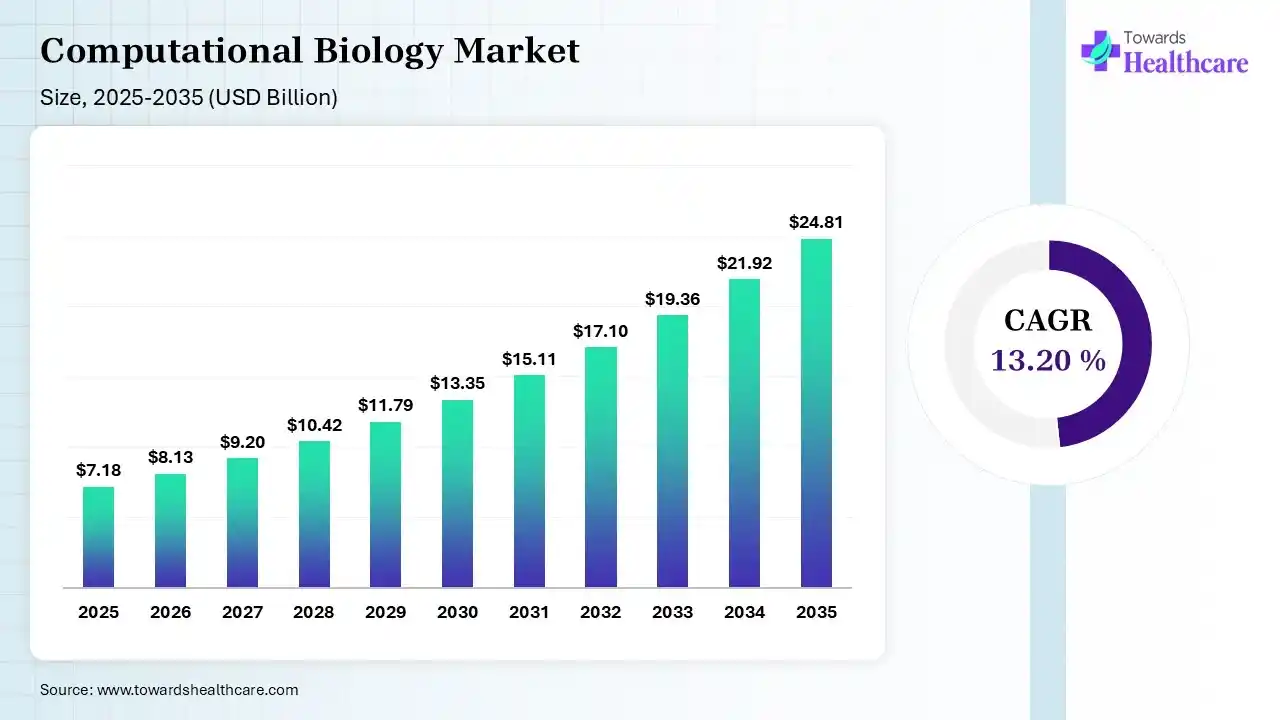
According to Towards Healthcare, the computational biology market is projected to experience significant growth, with estimates suggesting the market size will increase from USD 8.13 billion in 2026 to approximately USD 24.81 billion by 2035, representing a compound annual growth rate (CAGR) of 13.20% from 2026 to 2035, driven by there is increasing an emergency require for expertise in incorporation of pharmaceutical data with computational data such as machinery data, management data and remote sensing and imaging data to enhance significance agricultural results. The biological data of multiple types, like omics, laboratory testing, bioimaging, and both gathering and integration, would benefit from computational biologists.
“For decades, the deepest bottleneck in drug discovery hasn’t been data; it has been judgment. The rare instinct of a great bioinformatician or computational cancer biologist to know which test the data calls for, when two datasets should not be compared, and when a result is a true signal rather than statistical noise is scarce, costly, and often lost when that expert leaves. With ZetaOmics, we’ve worked to encode that judgment into an autonomous agent and make rigor the default so that any researcher, anywhere, can run analysis at a level that was once reserved for the best-resourced labs in the world.
We believe this is what the next decade of oncology R&D will be built on: co-scientists that don’t just retrieve knowledge, but generate it responsibly, reproducibly, and at a pace that finally matches the urgency facing patients. By opening ZetaOmics first to the world’s leading bioinformatics teams and our collaborators, we intend to prove its value where the science is hardest, and in doing so open entirely new markets, new partnerships and collaboration opportunities, and new subscription revenue for Lantern across every cancer, not only the rare ones. This is how we scale with Zeta.ai into a durable, non-dilutive growth engine for our shareholders while also advancing our own pipeline,” said Panna Sharma, President and Chief Executive Officer of Lantern Pharma and Founder of withZeta.ai.
About withZeta.ai™
Zeta.ai is an important company in rare cancer research, discovery, drug discovery, and clinical research design. Data work in oncology is migrating to AI co-scientists, autonomous systems that investigate, reason, and synthesize across the full breadth of scientific evidence. With Zeta.ai is a co-scientist purpose-built for the economics, biology, and emergency of rare cancer drug discovery, and reachable to any scientist, anywhere.
A recent report by Towards Healthcare highlights that the computational biology market is witnessing growth, as this type of biology has the capability to identify massive amounts of data. With the explosion of genetic sequencing and other omics technologies, biologists are now able to gather more data than ever before. Though this also means that there is a huge amount of data that needs to be analysed, and outdated experimental processes are not easily feasible. Computational biology offers the required tools and algorithms to analyze this data and extract expressive insights. Computational biology plays a significant role in drug development. By applying computer biology to simulate the interactions among drugs and biological targets, researchers rapidly identify latent drug applicants.


