

Pipeline Programs

CGT Companies Tracked

Manufacturing Facilities


The global animal drug compounding market size was estimated at USD 1.68 billion in 2025 and is predicted to increase from USD 1.82 billion in 2026 to approximately USD 3.73 billion by 2035, expanding at a CAGR of 8.32% from 2026 to 2035.
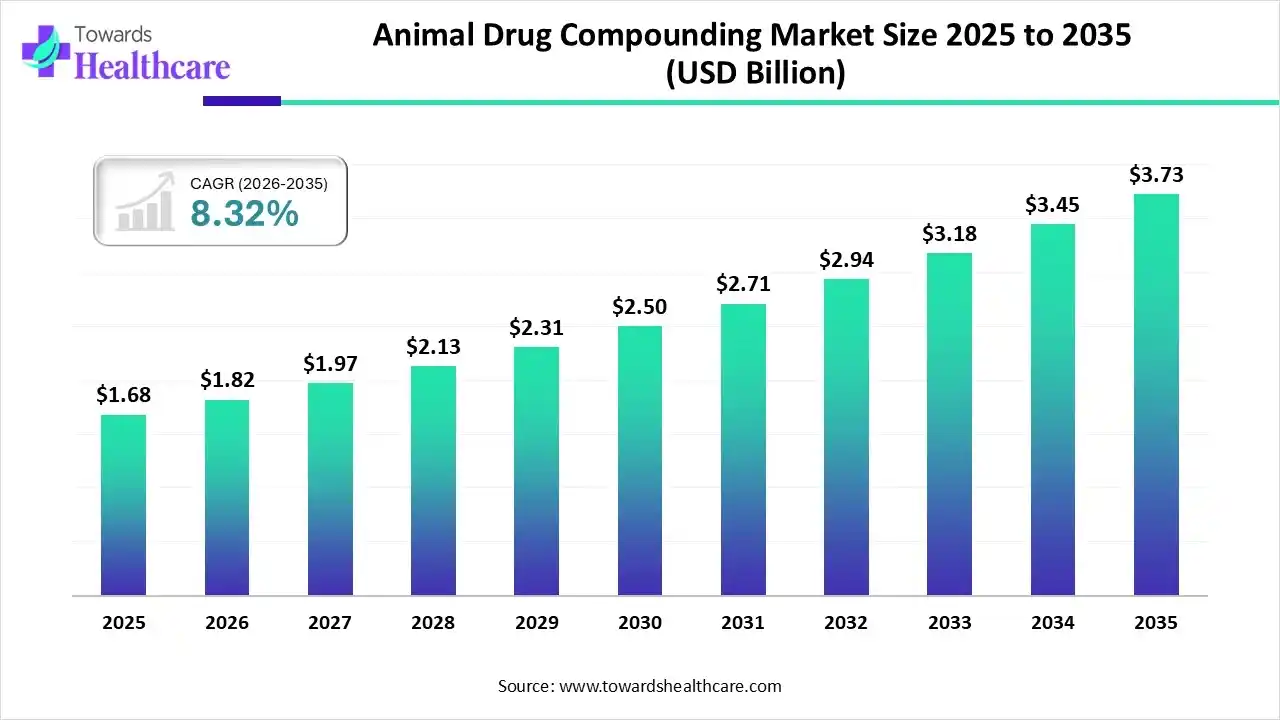
The current era is facing a huge rise in several infectious conditions among animals, which bolsters demand for innovative, customized medications. Also, regions are emphasizing revolutions in animal wellness through the adoption of advanced telemedicine and online pharmacy solutions.
The global animal drug compounding market refers to the adoption of tailored therapeutics for animals, which are developed by mixing, altering, or combining ingredients, and should meet extensive compliance guidelines. Moreover, the global market is fueled by a rise in the number of pets & raised pet humanization, which results in demand for human-like care. However, ongoing progression includes the expansion of Mixlab's physical footprint through novel lab acquisitions, providing rapid shipping and more reliable nationwide access to compounded drugs.
Advances in pharmaceutical compounding technologies will continue to improve the accuracy, stability, and safety of formulations. Many veterinary pharmacies are also offering flavored oral suspensions, transdermal gels, customized capsules, and alternative routes of administration that enhance adherence to medication regimens for animals. Additionally, there is a growing demand for personalized veterinary medicines as the use of telemedicine and digital prescription management systems continues to grow; this provides new opportunities for compounders. Lastly, there are increasing investments in veterinary healthcare infrastructure, continued innovation within drug delivery systems, and the availability of new specialty compounded therapies for pain management, skin disorders, endocrine diseases, and cancer, which will contribute to the ongoing growth of the animal drug compounding market in the future.
Revolutionary efforts in the market are exploring new projects, such as the Virtual Second Species project and other machine-learning-aided multi-scale modeling landscapes (MLMMF), which have designed virtual dog models to estimate toxicological endpoints and examine drug safety without live animals. Alongside, various AI models have been employed to develop personalized drug formulations for over 224 species, especially companion animals, horses, and exotics.
Strengthening Palatability
The market is emphasizing "feline-friendly" and "canine-friendly" alternatives, like flavored transdermal gels and chewable treats, which enhance owner compliance and lower animal stress.
Spurring Telemedicine Integration
Firms are executing advanced online veterinary pharmacies and telehealth platforms, which are further united with compounding labs to offer direct-to-home shipping of customized medications, mainly for remote or underserved areas.
Focus on Quality Control Protocols
Researchers will step towards the exploration of new, advanced quality control protocols and extensive documentation to ensure the safety, potency, and consistency of compounded products, which highlights issues raised by regulatory bodies, especially the FDA.
| Key Elements | Scope |
| Market Size in 2026 | USD 1.82 Billion |
| Projected Market Size in 2035 | USD 3.73 Billion |
| CAGR (2026 - 2035) | 8.32% |
| Leading Region | North America by 41% |
| Key Applications | Companion animal therapeutics, equine medicine, livestock treatment, exotic animal care, wildlife medicine, pain management, dermatology, cardiology, endocrinology, anti-infectives |
| Primary End Users | Veterinary clinics, veterinary hospitals, animal health pharmacies, livestock producers, zoos, wildlife rehabilitation centers, pet owners |
| Key Challenges | Regulatory scrutiny, quality control requirements, FDA compliance complexities, limited reimbursement, supply chain disruptions for APIs, variability in compounding standards |
| Measurable Values | USD Millions/Units/Volume |
| Market Segmentation | By Product, By Animal Type, By Route of Administration, By Dosage Form, By Region |
| Top Key Players | WEDGEWOOD PHARMACY, Vimian, Pharmaca, Akina Animal Health, Triangle Compounding |
| Segments | Shares % |
| CNS Agents | 30% |
| Anti-infective Agents | 25% |
| Anti-inflammatory Agents | 22% |
| Hormones & Substitutes | 13% |
| Other Products | 10% |
Which Product Dominated the Animal Drug Compounding Market in 2025?
In 2025, the CNS agents segment captured the biggest share of 30% of the market. Expanding awareness regarding neurological/behavioral conditions, such as anxiety, epilepsy, pain, and diversity of these agents, including anticonvulsants, anxiolytics, analgesics, sedatives, and antidepressants are propelling the segmental growth. The market is focusing on developing flavored oral oil suspensions, chewable tablets, and transdermal gels/patches for CNS agents, which makes easy administration for pet owners and reduces stress on animals.
Hormones & Substitutes
Whereas, the hormones & substitutes segment is anticipated to expand rapidly. These products are acquiring attention among veterinary practitioners for their distinguished potency and effectiveness in hormonal replacement therapy. Also, they have a vital role in treating endocrine disorders, like hyperthyroidism in cats & for reproductive management. The year had widened compounded altrenogest for estrus suppression and pregnancy support in horses, coupled with diverse vitamin-hormone supplements for livestock reproductive health.
| Segments | Shares % |
| Companion Animals | 68% |
| Livestock Animals | 32% |
How did the Companion Animal Segment Lead the Market in 2025?
The companion animal segment was dominant in the animal drug compounding market by 68% share in 2025 & will expand fastest. The raised adoption of compounding facilitates customized doses, flavors, such as fish for cats, beef for dogs, and forms, like gels, liquids for easier administration, with optimized compliance. The globe is putting efforts into the rising use of semi-solid extrusion (SSE) 3D printing to design chewable, precisely-dosed tablets for veterinary clinic preparation.
| Segments | Shares % |
| Oral | 48% |
| Injectable | 28% |
| Topical | 16% |
| Other Routes | 8% |
Why did the Oral Segment Dominate the Market in 2025?
In 2025, the oral segment held the largest revenue share of 48% of the market. More specifically, this route provides ease, non-invasiveness, and greater compliance for both pets and livestock. The latest solutions comprise oral transmucosal gels, which are an option for animals that resist swallowing drugs, with enhanced absorption for specific drugs, particularly compounded buprenorphine. Day by day, pharmacies are widely using automated mixing systems and cloud-based prescription platforms to accelerate the precision and accuracy of dosing in oral therapeutics.
Topical
In the future, the topical segment is predicted to witness the fastest expansion. Owners and practitioners are highly using creams, gels, and sprays to treat localized conditions, specifically infections, wounds, parasites, like fleas, ticks, mites, and dermatitis. However, transdermal gels/patches are broadly adopted as pain relievers or anti-anxiety meds. Nowadays, the market is implementing advanced nanotechnology, particularly nanogels and liposomes, to boost topical delivery by raising drug penetration, offering controlled release, and also enabling targeted action.
| Segments | Shares % |
| Suspensions | 42% |
| Solutions | 34% |
| Capsules | 24% |
How did the Suspensions Segment Lead the Market in 2025?
In 2025, the suspensions segment registered dominance in the animal drug compounding market by 42%. This dosage form is highly suitable for pediatric, geriatric, and exotic animals, as they offer accurate dosing and can mask unpleasant tastes, with crucially improved compliance in pets compared to solid forms. Researchers are working on long-acting injectable suspensions, often using oil-based vehicles or depot systems, which emphasize maintaining therapeutic levels over extended periods.
Solutions
The solutions segment is estimated to expand rapidly. They have prominent benefits over the other forms, such as quicker absorption, ease of administration, accurate dosing, and expanded stability. A recent development covers the launch of a patented injectable omeprazole solution for equine gastric ulcers developed by Epicur Pharma and Bova as an innovative administration route for horses. Recently, FDA-approved Otiserene, a single-dose, long-acting otic suspension that acts as a liquid for application but remains in the ear for sustained therapy.
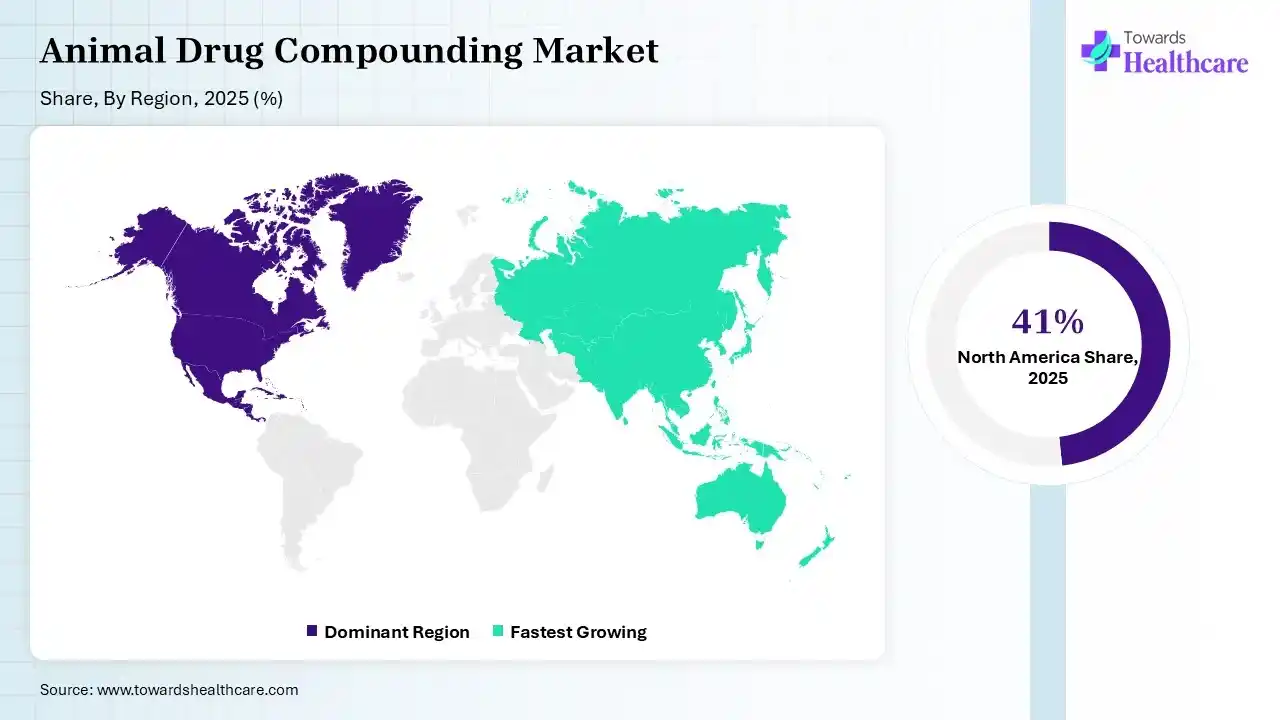
North America registered dominance in the animal drug compounding market by 41% share in 2025, due to the increasing pet ownership, wider emphasis on animal wellness, and robust veterinary infrastructure. As of late 2025, Health Canada is guiding on "Agile Licensing" regulations, which enable terms and conditions (T&Cs) for all drugs, comprising veterinary products, to highlight extensive evidence for debilitating concerns.
U.S. Market Trends
The U.S. dominated the market with a major share in 2025. This is led by the ongoing FDA upgradation to its "List of Bulk Drug Substances for Compounding Office Stock Drugs" under Guidance for Industry (GFI) #256, which allows application discretion for specific drugs required for urgent care.
Canada Market Trends
Canada has a growing animal drug compounding market, which is being aided by the increasing number of pets owned by people, an increased interest in buying customized vet medications, and a rise in how much money is being spent on animal healthcare. There are many vet clinics and specialty pharmacies that are turning to compounded formulations in order to improve the dosing accuracy, palatability, and compliance of treatment for both companion animals and livestock.
Mexico Market Trends
Mexico's animal drug compounding market also continues to see growth due to the expansion of veterinary services, increased production of livestock, and the trend of humanization of pets. The demand for customized drug medications continues to rise, as veterinarians are looking for customized medication solutions to meet the unique therapeutic needs of the variety of species they treat and the specific treatment requirements of the individual animal.
Asia Pacific is anticipated to show the fastest growth in the market, as the region is spurring specialized veterinary clinics and compounding pharmacies in countries, mainly in China and India. Alongside, the region is fostering AI-assisted dose-form personalization, which lowers formulation cycle times. Recently, My Compounding, a Brisbane-based pharmacy, broadened its operations nationwide to offer bespoke veterinary compounding, like transdermal gels and allergy-friendly formulas across substantial Australian cities to find hard-to-treat cases in domestic pets and livestock.
China Market Trends
In China, the animal drug compounding market is predicted to expand rapidly, as recently the Ministry of Agriculture and Rural Affairs (MARA) executed stringent veterinary drug registration guidelines that demand comprehensive, accurate data for novel products. This also further encompasses on-site inspections for non-compliant applications to ensure data authenticity and raised manufacturing standards.
India Market Trends
India represents an extremely high growth opportunity for animal drug compounding due to the size of its overall livestock population, the growth of the companion animal population, and increasing awareness of animal health. There is also a growing demand for species-specific formulations, flavoured medications, and custom dosage forms, which makes compounding more attractive to veterinarians and animal care professionals.
Japan Market Trends
Japan benefits from a high percentage of pet ownership; increased spending on companion animal health care; and increased demand for individualized veterinary treatment in its animal drug compounding market. As a result, veterinarians are continuing to utilise compounded medications as a way to manage dosing issues and improve compliance with treatment for ageing pets.
Europe is experiencing a notable growth in the market, as the region is shifting towards combating antimicrobial resistance (AMR) by enforcing new regulations and stricter restrictions on the preventative use of antimicrobials. Recently, all antiparasitics in Ireland need a veterinary prescription, moving them from over-the-counter status.
UK Market Trends
Recently, in the UK, a novel UK-wide licensing regime for human medicines was developed, but a two-tier system for veterinary medicinal products remains. Whereas the VMD facilitated rigorous guidance for the supply of veterinary medicines to Northern Ireland to ensure continued access.
Netherlands Market Trends
The Netherlands is showing steady growth in the compounding of animal drugs through a significant market for veterinary healthcare services and a commitment to animal welfare. With an increasing demand for customized medications for both pets and livestock, the compounding of drugs has increased the effectiveness of therapy and the ease of administering such therapies.
Argentina Market Trends
The Argentine animal drug compounding market is fueled by Argentina's growing number of livestock and pet owners looking for customized veterinary medicine. The growing need for custom veterinary prescriptions, especially for livestock, but also for specialized conditions, is creating a growing market for the use of compounded veterinary drugs to deliver therapeutic results and address unique health care needs.
| Ecosystem Segment | Key Participants | Role in Market |
| Technology Providers | Fagron, Medisca, PCCA | Supply pharmaceutical ingredients, formulation technologies, compounding systems, and quality solutions |
| Product Manufacturers | Wedgewood Pharmacy, Epicur Pharma, Bova Group | Develop and manufacture compounded veterinary medications |
| Service Providers | Covetrus, VetSource, Patterson Veterinary | Prescription fulfillment, veterinary pharmacy services, distribution |
| Platform Providers | Covetrus, Mixlab, VetSource | Digital prescription management, e-pharmacy, veterinary workflow integration |
| CROs/CDMOs | Epicur Pharma, Fagron, Bova Group | Outsourced sterile and non-sterile compounding manufacturing |
| Software Vendors | Covetrus, VetSource, Mixlab | Prescription processing, telepharmacy, practice management integration |
| Research Institutions | American Veterinary Medical Association, American Association of Veterinary Pharmacology and Therapeutics | Clinical guidance, veterinary pharmacology research, compounding standards |
| End-User Industries | Companion Animal Care, Livestock Production, Equine Medicine, Exotic Animal Care | Utilization of compounded medications |
R&D
Clinical trials & regulatory approvals
Distribution to hospitals & pharmacies
| Tier 1 | Tier 2 | Tier 3 | |
| Typical Market Influence | 62% | 26% | 12% |
| Tier 1 | ||||
| Company Name | Headquarters | Country | Why Relevant to This Market | Key Products/Services |
| Wedgewood Pharmacy | Swedesboro, New Jersey | United States | Largest dedicated animal-health compounding pharmacy in North America with extensive veterinary formulary and nationwide reach | Veterinary compounded medications, equine formulations, transdermal gels, flavored suspensions |
| Covetrus | Portland, Maine | United States | Leading veterinary pharmacy and prescription fulfillment platform with significant compounded medication offerings | Veterinary pharmacy services, compounded prescriptions, e-prescribing |
| Fagron NV | Rotterdam | Netherlands | Global leader in pharmaceutical compounding ingredients and veterinary formulations | Veterinary APIs, compounding formulations, sterile preparations |
| Tier 2 | ||||
| Company Name | Headquarters | Country | Why Relevant to This Market | Key Products/Services |
| Mixlab | New York, New York | United States | Fast-growing digital veterinary pharmacy platform offering customized compounded medications | Pet-specific compounded prescriptions, telepharmacy services |
| Veterinary Pharmaceutical Solutions (VPS) | St. Peter, Minnesota | United States | Specialized livestock compounding pharmacy with expanding manufacturing capacity | Livestock compounded pharmaceuticals, water-soluble antibiotics |
| Patterson Veterinary Pharmacy | Greeley, Colorado | United States | Major veterinary supply and pharmacy provider offering compounded medications | Veterinary prescription fulfillment and compounded therapies |
| Tier 3 | ||||
| Company Name | Headquarters | Country | Why Relevant to This Market | Key Products/Services |
| Akina Animal Health | West Palm Beach, Florida | United States | Animal-health-focused compounding organization with growing market presence | Veterinary compounded medications |
| Sierra Veterinary Compounding Pharmacy | Reno, Nevada | United States | Dedicated veterinary compounding provider serving specialty animal care markets | Customized veterinary medications |
| Central Compounding Center South | Memphis, Tennessee | United States | Regional compounding pharmacy with veterinary service offerings | Veterinary compounded formulations |
Strengths
Weaknesses
Opportunities
Threats
By Product
By Animal Type
By Route of Administration
By Dosage Form
By Region





Principal Consultant
Shivani Zoting is a dedicated research analyst specializing in the healthcare industry. With a strong academic foundation, a B.Sc. in Biotechnology and an MBA in Pharmabiotechnology, she brings a unique blend of scientific understanding and strategy.
Learn more about Shivani Zoting
Reviewed By
Aditi Shivarkar is a seasoned professional with over 14 years of experience in healthcare market research. As a content reviewer, Aditi ensures the quality and accuracy of all market insights and data presented by the research team.
Learn more about Aditi Shivarkar









