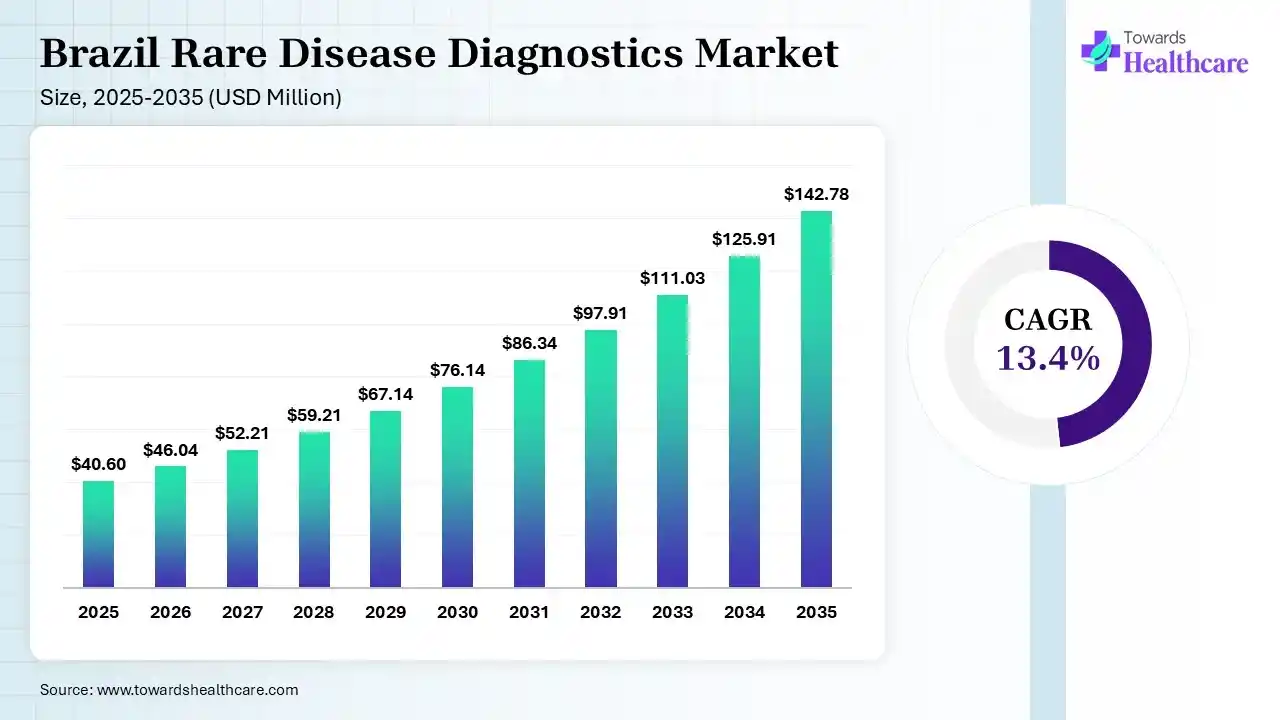
The Brazil rare disease diagnostics market was valued at USD 40.60 million in 2025 and is projected to reach USD 142.78 million by 2035, expanding at a CAGR of 13.4% from 2026 to 2035.The market is estimated at USD 46.04 million in 2026, representing the current-year market size.
Brazil's rare disease diagnostics market is an emerging segment of the country's genetic testing, molecular diagnostics, newborn screening, and specialized laboratory services market. Demand is driven by the large population affected by rare diseases, increasing recognition of genetic conditions, expansion of genomic medicine, and government efforts to strengthen diagnosis through the Unified Health System (SUS).
Brazil's rare-disease diagnostic market is moving from a predominantly specialist, fragmented testing model toward broader genomic diagnosis. The Ministry of Health estimates that approximately 13 million Brazilians live with a rare disease and around 70% of rare diseases have a genetic origin. In 2026, Brazil significantly strengthened the public diagnostic pathway by expanding access to whole-exome sequencing (WES) through SUS.
The diagnostic opportunity is particularly significant because historical access has been uneven. A national study of 12,530 patients found that more than 17% remained without a definitive diagnosis, while diagnosed patients had waited more than five years on average.
It is an emerging segment within the country’s broader genetic testing, molecular diagnostics, laboratory services, and newborn screening markets. A precise standalone market value is difficult to establish because rare disease diagnostics encompass a wide range of tests-including genetic sequencing, biochemical assays, cytogenetics, molecular testing, and newborn screening, and these services are delivered through both public and private healthcare systems. Nevertheless, Brazil represents a substantial addressable market because of its large population and significant number of people affected by rare diseases.
Brazil’s Ministry of Health estimates that approximately 13 million Brazilians live with rare diseases, while around 70% of rare diseases have a genetic origin. This creates a significant underlying need for genetic and genomic diagnostic services. The large patient population, combined with increasing awareness of rare diseases and improvements in diagnostic technology, provides a structural basis for market expansion.
The market is supported by both public healthcare through the Unified Health System (SUS) and private healthcare providers. SUS is particularly important because it provides healthcare access to a large share of Brazil’s population and has established specialized services for rare diseases. As of June 2026, Brazil had 61 authorized specialized rare-disease services across 15 states, indicating an expanding institutional infrastructure for diagnosis and treatment.
The principal commercial shift is not simply increasing test volumes; it is the migration toward higher-value genomic testing. WES and increasingly whole-genome sequencing can consolidate multiple diagnostic investigations into broader molecular assessments. The strongest opportunity is therefore concentrated around laboratories and healthcare systems capable of combining sequencing, bioinformatics, variant interpretation, genetic counseling, and specialist clinical correlation.
Growth is also being supported by the increasing use of next-generation sequencing (NGS), whole-exome sequencing (WES), whole-genome sequencing (WGS), targeted gene panels, PCR, MLPA, FISH, chromosomal microarray, and biochemical testing. These technologies can improve diagnostic accuracy and help identify genetic causes in patients who may previously have remained undiagnosed.
Newborn screening represents another important growth area. Brazil’s National Neonatal Screening Program provides screening for several inherited and metabolic disorders, creating a large population-level testing channel. Continued policy efforts to expand and strengthen newborn screening can increase the number of children diagnosed earlier in life.
However, market growth is constrained by several factors. Advanced genetic testing remains concentrated in specialized centres, creating geographic disparities in access. Brazil also faces shortages of genetic specialists, limited laboratory infrastructure in some regions, reimbursement constraints, and challenges associated with genomic-data interpretation.
Over the medium to long term, growth is expected to be driven by increased genomic testing, expanded newborn screening, government investment, greater physician awareness, and the development of specialized diagnostic networks. The market is likely to evolve from conventional testing toward integrated genomic diagnostics combining sequencing, bioinformatics, clinical interpretation, and genetic counselling.
Brazil’s rare disease diagnostics market can be segmented across several dimensions, including diagnostic technology, disease category, testing purpose, end user, and payer. This segmentation reflects the diversity of rare diseases and the different diagnostic approaches required to identify them.
By technology, the market includes next-generation sequencing (NGS), molecular testing, chromosomal microarray, biochemical/enzyme testing, cytogenetics, and other diagnostic methods. NGS-based technologies are becoming increasingly important because they allow multiple genes or the entire coding region of the genome to be examined simultaneously. Conventional biochemical and molecular tests remain relevant for diseases with established biomarkers or specific genetic mutations.
| Segment | 2025 Share | CAGR | Growth Driver |
| Next-Generation Sequencing - Dominating | 42% | 15.10% | WES/WGS and multigene panels improve diagnostic breadth |
| Molecular Testing | 24% | 11.80% | PCR, Sanger and MLPA remain important for known variants |
| Chromosomal Microarray | 12% | 10.70% | Structural and copy-number variant detection |
| Biochemical/Enzyme Testing | 10% | 9.20% | Continued relevance in metabolic and lysosomal disorders |
| Cytogenetics | 7% | 8.60% | Karyotyping and FISH remain disease-specific tools |
| Other Diagnostic Methods | 5% | 9.80% | Specialized laboratory and confirmatory testing |
Thus, the commercial opportunity is shifting toward integrated genomic testing platforms, particularly those that combine sequencing with automated variant prioritization, phenotype matching, interpretation, and clinical reporting.
By disease category, the market includes neurological disorders, metabolic & lysosomal disorders, congenital & developmental disorders, hematological rare diseases, neuromuscular disorders, and other rare diseases. The diagnostic pathway differs significantly between these categories. For example, metabolic disorders may require biochemical and enzyme assays alongside genetic testing, while suspected genetic syndromes may increasingly be investigated through targeted panels or exome sequencing.
| Disease Category | 2025 Share | CAGR | Growth Driver |
| Neurological Disorders - Dominating | 28% | 13.60% | High genetic heterogeneity and substantial undiagnosed populations |
| Metabolic & Lysosomal Disorders | 22% | 12.90% | Newborn screening and biochemical/genetic confirmation |
| Congenital & Developmental Disorders | 18% | 14.10% | Pediatric diagnosis and developmental-delay investigations |
| Hematological Rare Diseases | 12% | 12.40% | Hereditary blood disorders and molecular characterization |
| Neuromuscular Disorders | 10% | 14.60% | Increasing use of genetic confirmation |
| Other Rare Diseases | 10% | 11.80% | Expanding specialty testing |
This suggests that the commercial opportunity is moving toward high-complexity disease areas where early molecular confirmation changes clinical management. Neurology, developmental disorders, and neuromuscular disease are particularly relevant because conventional diagnosis can involve lengthy clinical investigation.
By end user, key segments include hospitals & reference clinics, reference diagnostic laboratories, academic & research institutions, and specialty rare-disease centers where rare genetic conditions may be investigated. Hospitals remain the primary gateway because suspected rare-disease patients generally enter the diagnostic pathway through specialist evaluation. Brazil currently has 61 habilitated rare-disease services across 15 states, including 37 Reference Services and 13 Specialized Care Services.
| End User | 2025 Share | CAGR | Growth Driver |
| Hospitals & Reference Clinics - Dominating | 43% | 12.40% | Specialist referral pathways and SUS rare-disease services |
| Reference Diagnostic Laboratories | 32% | 14.80% | Centralized sequencing and interpretation capabilities |
| Academic & Research Institutions | 15% | 15.30% | Genomic research, clinical trials and translational medicine |
| Specialty Rare-Disease Centers | 10% | 16.10% | Increasing concentration of complex diagnostic cases |
Therefore, the market is increasingly organized around hub-and-spoke diagnostics, where specialist hospitals identify patients while high-capacity laboratories perform complex sequencing and interpretation.
Another important segmentation is by payer. The public sector, primarily through SUS, represents a major component of the Brazilian market. Private health insurance companies, hospitals, patients paying directly, pharmaceutical companies, and research organizations represent additional demand channels.
Geographically, the market is unevenly distributed. Major metropolitan and healthcare centres have greater access to geneticists, advanced laboratories, sequencing platforms, and specialized rare-disease services. Other regions may depend on sample transportation to centralized laboratories.
| Region | 2025 Share | CAGR | Market Characteristics |
| Southeast - Dominating | 52% | 12.70% | Largest concentration of specialist hospitals, laboratories and genomic infrastructure |
| South | 18% | 14.20% | Strong academic and precision-medicine infrastructure |
| Northeast | 15% | 14.80% | Expanding public diagnostic access and specialist centers |
| Central-West | 9% | 13.90% | Growing tertiary-care and research capacity |
| North | 6% | 15.60% | Lower current penetration but significant access gap |
Hence, Brazil's diagnostic market remains structurally concentrated in the Southeast, but the largest unmet-access opportunities increasingly exist outside that region. The most commercially relevant strategy is therefore a combination of high-capacity sequencing hubs with decentralized sample collection and digital interpretation.
From a commercial perspective, NGS and other advanced genomic technologies represent important growth segments, while newborn screening offers a high-volume population-based opportunity. Genetic counselling and bioinformatics also represent increasingly important complementary services because sophisticated testing generates a need for expert interpretation.
Overall, Brazil’s market segmentation demonstrates that rare disease diagnostics is not a single testing category. It is a multi-layered ecosystem combining conventional laboratory diagnostics, molecular testing, genomics, screening, interpretation, and counselling, with different technologies and service models addressing different patient and healthcare-system requirements.
Demand for rare disease diagnostics in Brazil is driven by a combination of large patient need, genetic disease prevalence, increasing awareness, improved diagnostic technologies, government programs, and the clinical importance of early and accurate diagnosis. The Ministry of Health estimates that approximately 13 million Brazilians live with rare diseases, creating a substantial potential patient population for diagnostic services.
One of the strongest sources of demand comes from the genetic origin of many rare diseases. With approximately 70% of rare diseases estimated to have a genetic component, patients frequently require molecular, cytogenetic, biochemical, or genomic testing to establish a definitive diagnosis. The increasing availability of sequencing technologies is also encouraging physicians to investigate genetic causes in patients who previously may have received only symptomatic diagnoses.
Physicians and specialized healthcare centres are major demand generators. Pediatricians, neurologists, geneticists, hematologists, metabolic specialists, and other clinicians may request rare disease tests when patients present with unexplained symptoms, developmental disorders, recurrent complications, or unusual clinical patterns. As physician awareness increases, testing demand can expand beyond specialized genetic centres.
Newborn screening is another major source of diagnostic demand. Brazil’s National Neonatal Screening Program screens newborns for several inherited and metabolic disorders. Expansion of screening programs can increase early detection and create demand for both initial screening and subsequent confirmatory testing.
Demand also comes from patients and families seeking diagnostic certainty. A confirmed diagnosis can help families understand disease progression, inheritance patterns, recurrence risks, and potential treatment options. In some cases, molecular diagnosis can also help identify eligibility for targeted therapies or clinical trials.
Geographic variation is a major characteristic of the Brazilian market. Diagnostic capacity is more concentrated in major urban healthcare centres, where specialist physicians, universities, hospitals, and advanced laboratories are located. Patients in less-developed or remote regions may face longer diagnostic journeys and may need to send samples to centralized facilities.
The public healthcare system is an important source of demand because SUS provides access to healthcare services for a large proportion of the population. Specialized rare-disease centres and government-supported diagnostic programs therefore have a significant influence on overall testing volumes.
Private laboratories and health insurers create additional demand among patients who have access to private healthcare.
Future demand is likely to increase as genomic awareness, newborn screening, specialist capacity, and diagnostic infrastructure expand. Telemedicine and digital clinical networks may also allow physicians outside major cities to access genetic expertise and order advanced testing.
The key challenge will be converting potential demand into accessible diagnostic services. Expanding laboratory networks, specialist training, sample logistics, reimbursement, and genomic interpretation capacity will therefore be essential for meeting Brazil’s growing rare-disease diagnostic needs.
Brazil’s rare disease diagnostics market has a mixed competitive structure, combining public-sector laboratories, private diagnostic networks, hospital laboratories, specialized genetic-testing providers, academic institutions, and international diagnostic technology companies. Competition varies considerably by diagnostic technology, geographic coverage, clinical specialization, and access to advanced genomic platforms.
Large private laboratory networks have an important role because they offer broad geographic coverage, established sample-collection infrastructure, and access to molecular and genetic testing. Specialized laboratories and university-based centres are particularly relevant for complex rare diseases requiring advanced sequencing, biochemical analysis, or expert interpretation.
International diagnostic and genomics companies participate primarily through sequencing platforms, reagents, laboratory equipment, bioinformatics solutions, and specialized testing technologies. Their role is therefore often indirect, supplying the infrastructure used by Brazilian laboratories.
Competitive differentiation occurs across several factors. Test menu breadth is important because rare diseases require diverse diagnostic approaches. Laboratories offering targeted panels, exome sequencing, cytogenetic testing, biochemical assays, and confirmatory testing can address a broader range of clinical requirements.
Turnaround time is another competitive factor. Faster diagnosis can be particularly valuable for pediatric and metabolic conditions where delayed diagnosis may affect clinical outcomes.
Clinical interpretation is becoming increasingly important as genomic testing expands. Laboratories with strong bioinformatics, variant interpretation, genetic counselling, and clinical-genetics expertise can provide greater value than providers offering sequencing alone.
Geographic reach also differentiates providers. Large laboratory networks can collect samples from multiple regions and process them through centralized facilities. This model can improve utilization of expensive sequencing infrastructure while extending access beyond major cities.
Public-sector institutions compete differently because their primary objective is healthcare access. Specialized SUS centres and university hospitals provide advanced diagnostic capabilities while also supporting research and professional training.
Brazil’s rare disease diagnostics ecosystem includes government agencies, SUS, specialized healthcare centres, hospitals, diagnostic laboratories, universities, research institutions, technology companies, pharmaceutical companies, insurers, physicians, and patient organizations. Each participant contributes to different stages of the diagnostic and treatment pathway.
The Brazilian Ministry of Health is a central ecosystem participant because it establishes national healthcare policies, supports specialized services, and oversees programs related to rare diseases and newborn screening. The Unified Health System (SUS) provides an important platform for delivering diagnostic services to the population.
Specialized rare-disease centres provide clinical assessment, specialist consultations, diagnostic testing, genetic counselling, and referrals. These centres often act as important coordination points between patients, laboratories, and treatment providers.
Hospitals and university medical centres contribute specialist physicians, laboratories, research capabilities, and access to complex diagnostic procedures. Academic institutions are particularly important for rare and difficult-to-diagnose conditions because they combine clinical expertise with research capabilities.
Private diagnostic laboratories provide genetic, molecular, biochemical, and cytogenetic testing. Large laboratory networks can provide geographic reach through extensive sample-collection networks, while specialized laboratories may focus on advanced genomic or rare-disease testing.
Technology companies supply sequencing platforms, reagents, laboratory equipment, bioinformatics systems, and data-analysis tools. As NGS adoption increases, these companies become increasingly important to the diagnostic ecosystem.
Pharmaceutical and biotechnology companies are also relevant because rare-disease therapies increasingly depend on accurate molecular diagnosis. They may support diagnostic initiatives, patient identification programs, research collaborations, or companion diagnostic development.
Health insurers and healthcare payers influence access by determining which tests and services are reimbursed. Patient advocacy groups also play a role by raising disease awareness, supporting families, and advocating for improved diagnostic access.
Physicians including geneticists, pediatricians, neurologists, hematologists, and metabolic specialists are important demand generators because they identify patients who require diagnostic investigation.
Brazil’s rare disease diagnostics value chain begins with patient identification and clinical suspicion and extends through testing, laboratory analysis, interpretation, genetic counselling, and treatment referral. Because rare diseases can involve complex symptoms, the diagnostic process often requires several healthcare and laboratory participants.
The first stage is clinical identification. Patients may initially visit primary-care physicians, pediatricians, neurologists, hematologists, metabolic specialists, or other clinicians. A rare disease may be suspected when symptoms are unusual, persistent, hereditary, or unexplained by conventional diagnoses.
The second stage is specialist referral. Patients may be referred to geneticists, specialized rare-disease centres, university hospitals, or tertiary-care facilities. Specialists determine which diagnostic tests are appropriate based on clinical presentation and family history.
The third stage is sample collection and logistics. Blood, saliva, tissue, or other biological samples are collected and transported to laboratories. Because advanced testing infrastructure is concentrated geographically, efficient sample logistics are particularly important for patients outside major healthcare centres.
The fourth stage is laboratory testing. Depending on the suspected condition, testing can include biochemical and enzyme assays, PCR, FISH, MLPA, chromosomal microarray, targeted gene panels, whole-exome sequencing, or whole-genome sequencing.
The fifth stage involves bioinformatics and variant interpretation. Sequencing generates large volumes of genetic data that must be analyzed to identify potentially disease-causing variants. Clinical interpretation requires comparison with reference databases, scientific literature, family information, and the patient's phenotype.
The sixth stage is clinical confirmation and genetic counselling. Results are reviewed by specialists, and genetic counselling helps patients and families understand the diagnosis, inheritance pattern, implications for relatives, and potential reproductive considerations.
The final stage is treatment and long-term management. Where therapies exist, diagnosis can support treatment selection or eligibility. Even where no curative therapy exists, diagnosis can help guide monitoring, supportive care, and family planning.
Value is created at multiple points throughout the chain. Laboratories provide technical accuracy, while specialists provide clinical interpretation. Technology providers supply testing infrastructure, and hospitals coordinate diagnosis with treatment.
Brazil’s rare disease diagnostics market is being driven by several structural factors, particularly the country's large rare-disease population, growing awareness of genetic conditions, advances in genomic technology, government healthcare initiatives, and increasing demand for earlier diagnosis.
A major driver is the estimated 13 million Brazilians living with rare diseases. With a large proportion of rare diseases having a genetic basis, there is substantial underlying demand for molecular and genomic testing.
Technological progress is another important driver. NGS, whole-exome sequencing, whole-genome sequencing, targeted panels, and improved bioinformatics have expanded the ability to diagnose genetically complex conditions. Tests that previously required multiple sequential investigations can increasingly be evaluated using broader genomic approaches.
Government initiatives are also supporting demand. Brazil has established specialized rare-disease services within SUS and has programs for newborn screening. These initiatives create institutional demand for diagnostic infrastructure and services.
However, several barriers remain. One of the most significant is unequal geographic access. Advanced laboratories and genetic specialists are concentrated in major urban centres, making access more difficult for patients in remote and underserved regions.
A shortage of trained geneticists, genetic counsellors, bioinformaticians, and specialized laboratory professionals can also constrain market development.
Cost is another barrier. Advanced genomic tests can be expensive, particularly when sequencing is combined with expert interpretation. Reimbursement policies may not cover all available testing options consistently across public and private systems.
The complexity of genomic interpretation is also challenging. Identifying a genetic variant does not automatically establish that it causes disease. Laboratories need appropriate databases, clinical expertise, and bioinformatics capabilities.
Brazil’s rare disease diagnostics market operates within a regulatory framework involving the Ministry of Health, SUS, ANVISA, laboratory accreditation bodies, professional councils, and data-protection regulations. These institutions influence diagnostic quality, laboratory operations, genetic testing, reimbursement, and patient data management.
The Ministry of Health plays a central role in establishing policies for rare diseases and organizing specialized services within SUS. Brazil's National Policy for Comprehensive Attention to People with Rare Diseases provides a framework for diagnosis, treatment, genetic counselling, and coordinated healthcare.
SUS is particularly important because it determines the availability of publicly funded diagnostic procedures and services. Government-supported specialized centres provide a channel through which patients can access genetic and other diagnostic evaluations.
ANVISA is relevant to the regulation of health products, diagnostic technologies, medical devices, reagents, and related laboratory products. Diagnostic laboratories must also meet applicable quality and professional standards.
Laboratory accreditation and quality management are important because rare-disease diagnostics can involve highly sensitive and technically complex procedures. Providers need reliable processes for sample handling, testing, quality control, reporting, and data management.
Genetic data protection is another important consideration. Brazil's General Data Protection Law (LGPD) provides rules governing the processing of personal data, including sensitive health information. Genomic information requires particular attention because it can reveal information about both individuals and their biological relatives.
Newborn screening is another policy area. Brazil has a National Neonatal Screening Program that provides screening for specified conditions through the public health system. Government efforts to strengthen and expand the program can influence demand for screening technologies and confirmatory diagnostics.
The regulatory environment can create both opportunities and challenges. Clear government programs and standardized diagnostic pathways can support market development, while complex approval, reimbursement, and compliance requirements can increase operating costs and market-entry timelines.
Overall, regulatory policy is a major structural factor shaping Brazil's rare disease diagnostics market. Companies that establish strong compliance, quality assurance, data governance, and public-sector partnerships will be better positioned to operate within the evolving market.
Brazil’s rare disease diagnostics market is expected to evolve toward greater adoption of genomic testing, expanded newborn screening, and integrated clinical-genomic services. The transition will be influenced by advances in technology, government healthcare initiatives, specialist training, and increasing awareness of rare diseases.
NGS is likely to become increasingly important as laboratories adopt targeted panels, whole-exome sequencing, and whole-genome sequencing. These technologies can help clinicians investigate patients with complex or unexplained conditions more efficiently than sequential testing approaches.
Genomic interpretation and bioinformatics are expected to become equally important. Increasing test volumes will generate more genomic data, creating demand for sophisticated databases, variant interpretation tools, and trained professionals.
Newborn screening is another area with potential for continued development. Expansion of screening programs could lead to earlier identification of additional inherited and metabolic conditions and increase demand for confirmatory genetic and biochemical testing.
Geographic accessibility is likely to remain a major focus. Centralized reference laboratories combined with regional sample-collection networks could help extend advanced diagnostics beyond Brazil's largest healthcare centres.
The role of telemedicine and digital health is also likely to increase. Digital referral systems and remote genetic consultations can connect physicians and patients in underserved regions with specialists in major cities.
Government investment will remain important. The Ministry of Health has already taken steps to strengthen genomic-analysis capabilities within SUS, including national training initiatives related to rare-disease diagnosis.
The competitive environment may gradually shift toward integrated providers offering more than laboratory testing. Companies may increasingly combine sample collection, sequencing, bioinformatics, interpretation, genetic counselling, and clinical partnerships.
Private healthcare and pharmaceutical partnerships could also expand, particularly as more rare-disease therapies become available and molecular diagnosis becomes important for treatment selection.
However, market development will continue to face challenges related to specialist shortages, reimbursement, laboratory infrastructure, affordability, data governance, and unequal regional access.
By 2030, Brazil's rare disease diagnostics market is likely to be more genomics-driven and digitally connected, although conventional biochemical and molecular tests will remain important.
The long-term direction is therefore toward a more integrated model in which genomic testing is connected directly to clinical diagnosis, counselling, treatment selection, and long-term disease management.
Brazil’s rare disease diagnostics market offers strategic opportunities for companies operating across genomics, molecular diagnostics, laboratory services, bioinformatics, newborn screening, and precision medicine. However, success requires understanding the country's dual public-private healthcare structure and the uneven distribution of diagnostic infrastructure.
A key strategic priority is to develop integrated diagnostic capabilities. Combining sequencing, bioinformatics, variant interpretation, genetic counselling, and sample logistics can create greater value for physicians, hospitals, and patients.
Partnerships with SUS, hospitals, universities, specialized rare-disease centres, and private diagnostic networks should be considered important elements of market strategy. Public-sector partnerships can provide access to large patient populations, while private partnerships can support commercial scale and faster adoption.
Companies should also consider a centralized laboratory plus regional sample-collection model. This approach can allow expensive genomic infrastructure to be concentrated in high-utilization facilities while extending access to patients across different regions.
Specialization can provide another source of differentiation. Providers can develop expertise in areas such as metabolic disorders, neurological diseases, pediatric genetics, or hereditary hematological conditions.
Technology strategy should include NGS, WES/WGS, bioinformatics, AI-assisted variant interpretation, digital reporting, and tele-genetics, depending on the target segment. However, technology adoption needs to be accompanied by trained personnel and appropriate clinical validation.
Pricing and reimbursement are also strategically important. Providers should design offerings suitable for both public-sector and private healthcare, where applicable. Multiple revenue channels can reduce dependence on a single payer.
Geographic expansion should be approached carefully. Major metropolitan areas provide access to specialist physicians and infrastructure, while underserved regions represent longer-term opportunities through decentralized sample collection and digital specialist support.
Investors and market entrants should monitor testing volumes, turnaround time, laboratory utilization, reimbursement, workforce availability, and regulatory requirements.
The strategic direction of the market is toward a genomics-enabled, integrated diagnostic ecosystem. Companies that can combine advanced technology with clinical expertise, strong laboratory quality systems, public-private partnerships, and broad sample-access networks may be better positioned to participate in the market's development.
By Diagnostic Technology
By Disease Category
By Test Type
By Sample Type
By End User
By Payer
By Region


Principal Consultant
Payal Rabde is a Healthcare Market Research Analyst at Towards Healthcare Research & Consulting with 4+ years of experience in pharmaceuticals, biotechnology, medical devices, and life sciences.
Learn more about Payal Rabde

Reviewed By
Aditi Shivarkar is a seasoned professional with over 14 years of experience in healthcare market research. As a content reviewer, Aditi ensures the quality and accuracy of all market insights and data presented by the research team.
Learn more about Aditi Shivarkar