
Pipeline Programs

CGT Companies Tracked

Manufacturing Facilities


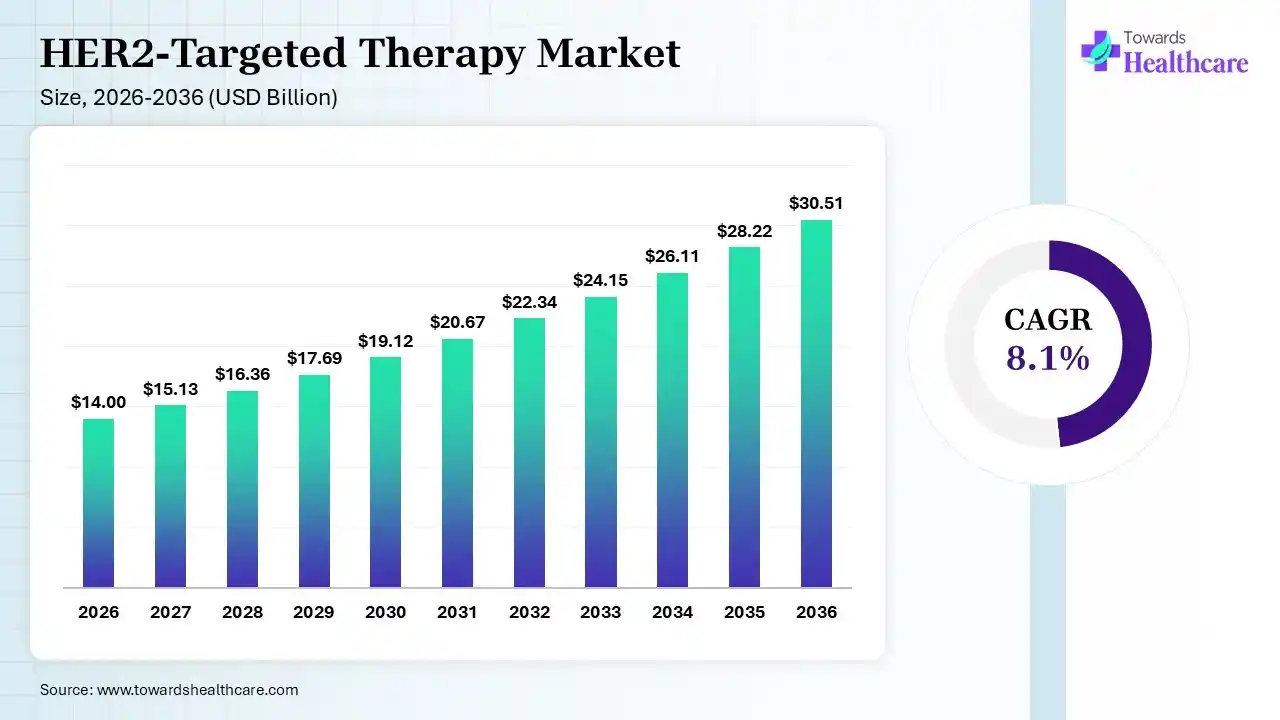
The HER2-targeted therapy market size is calculate at US$ 14 billion in 2026, grew to US$ 15.13 billion in 2027, and is projected to reach around US$ 30.51 billion by 2036, expanding at a CAGR of 8.1% between 2027 and 2036.
The commercial opportunity extends across established HER2-positive breast and gastric cancer treatments, newer antibody-drug conjugates, targeted small molecules and emerging therapies for additional tumor types. Revenue generation depends on treatment eligibility, therapy pricing, duration of treatment, patient access, and the adoption of newer regimens.
Antibody-drug conjugates represent an important area of innovation because they combine HER2 recognition with targeted delivery of cytotoxic payloads. Monoclonal antibodies and tyrosine kinase inhibitors remain established treatment approaches. Broader investigation of HER2-low, HER2-ultralow, and HER2-mutant disease expands the clinical scope of the market.
HER2-targeted therapies act on HER2 overexpression, gene amplification, or activating mutations associated with selected cancers. These treatments include monoclonal antibodies, antibody-drug conjugates, tyrosine kinase inhibitors, and bispecific antibodies.
Breast cancer represents a central treatment area because HER2 status directly informs treatment selection. Gastric and gastroesophageal junction cancers also represent established applications. HER2-mutant non-small cell lung cancer and selected HER2-positive solid tumors extend the market into additional oncology settings.
The market includes branded medicines, eligible biosimilar products, combination regimens and emerging HER2-directed therapies. Its commercial boundaries depend on approved indications, biomarker definitions and the role of each medicine within treatment pathways.
The distinction between HER2-positive, HER2-low, HER2-ultralow and HER2-mutant disease is commercially important. These classifications do not represent interchangeable treatment categories. Eligibility depends on the specific medicine, cancer type, testing method and applicable regulatory label.
| Segments | 2026 Share | 2026 Market Value (USD Million) |
| Monoclonal Antibodies | 32% | $4,480 |
| Antibody-Drug Conjugates | 38% | $5,320 |
| Tyrosine Kinase Inhibitors | 17% | $2,380 |
| Bispecific Antibodies | 6% | $840 |
| Other HER2-Targeted Therapies | 7% | $980 |
Antibody-drug conjugates are estimated to represent the largest therapy-type segment as they expand treatment options across HER2-positive and selected HER2-low cancers. Monoclonal antibodies remain an established category, while tyrosine kinase inhibitors, bispecific antibodies, and other approaches contribute to the evolving treatment landscape.
| Segments | 2026 Share | 2026 Market Value (USD Million) |
| HER2-Positive | 68% | $9,520 |
| HER2-Low | 20% | $2,800 |
| HER2-Ultralow | 7% | $980 |
| HER2-Mutant | 5% | $700 |
HER2-positive disease is estimated to account for the largest share, supported by established targeted treatments and combination regimens. HER2-low and HER2-ultralow categories are gaining importance as treatment eligibility expands for selected patients, while HER2-mutant tumors create additional opportunities in certain cancer types.
| Segments | 2026 Share | 2026 Market Value (USD Million) |
| Breast Cancer | 65% | $9,100 |
| Gastric and Gastroesophageal Junction Cancer | 15% | $2,100 |
| Non-Small Cell Lung Cancer | 8% | $1,120 |
| Colorectal Cancer | 5% | $700 |
| Other Solid Tumors | 7% | $980 |
Breast cancer is estimated to dominate the market because HER2-directed therapies have an established role across early-stage and metastatic disease. Gastric and gastroesophageal junction cancers remain important indications, while NSCLC and other solid tumors offer additional growth opportunities as more HER2-directed treatments are studied and adopted.
| Segments | 2026 Share | 2026 Market Value (USD Million) |
| Neoadjuvant Treatment | 14% | $1,960 |
| Adjuvant and Early-Stage Treatment | 23% | $3,220 |
| First-Line Metastatic Treatment | 25% | $3,500 |
| Later-Line Treatment | 27% | $3,780 |
| Maintenance Treatment | 11% | $1,540 |
Later-line and first-line metastatic treatment are estimated to represent substantial shares because HER2-targeted medicines are used across advanced-disease treatment pathways. Early-stage and neoadjuvant use also contribute meaningfully, while maintenance treatment supports ongoing disease management in selected settings.
| Segments | 2026 Share | 2026 Market Value (USD Million) |
| Monotherapy | 35% | $4,900 |
| Combination Therapy | 65% | $9,100 |
Combination therapy is estimated to lead the market, reflecting the role of HER2-directed medicines alongside chemotherapy and other targeted treatments in several cancer settings. Monotherapy remains important for eligible patients and indications where a single HER2-targeted agent is an established treatment option.
| Segments | 2026 Share | 2026 Market Value (USD Million) |
| Hospital Pharmacies | 52% | $7,280 |
| Specialty Pharmacies | 30% | $4,200 |
| Retail Pharmacies | 12% | $1,680 |
| Other Distribution Channels | 6% | $840 |
Hospital pharmacies are estimated to account for the largest share because many HER2-targeted treatments require specialist prescribing, infusion services, or hospital-based monitoring. Specialty pharmacies support access to selected oral and specialty oncology medicines, while retail and other authorized channels serve eligible patients under local distribution rules.
| Segments | 2026 Share | 2026 Market Value (USD Million) |
| North America | 43% | $6,020 |
| Europe | 27% | $3,780 |
| Asia Pacific | 21% | $2,940 |
| Latin America | 5% | $700 |
| Middle East and Africa | 4% | $560 |
North America is estimated to lead the HER2-targeted therapy market, supported by access to innovative oncology medicines, established cancer-care infrastructure, and broad use of biomarker testing. Europe also represents a substantial market, while Asia Pacific offers growth potential as access to targeted therapies and diagnostic capabilities develops.
The United States is estimated to account for most North American revenue because of its large oncology market and access to advanced targeted treatments. Canada and Mexico represent smaller shares, with market uptake influenced by reimbursement, diagnosis rates, and access to specialist cancer services.
Western Europe is estimated to account for the larger share of European revenue, reflecting established oncology infrastructure and access to newer medicines in major markets. Eastern European market development varies with national reimbursement policies, healthcare funding, and availability of HER2 testing.
Germany, the United Kingdom, and France are estimated to be key Western European markets because of their established oncology services and access to targeted treatments. Uptake in individual countries also depends on reimbursement decisions, clinical guidelines, and the availability of newer HER2-directed medicines.
Eastern European demand is shaped by differences in access to cancer diagnostics, public funding, and availability of newer oncology treatments. The rest-of-region category captures markets not listed separately.
China and Japan are estimated to be major contributors to regional market revenue, while India, South Korea, and Australia and New Zealand also support demand. Growth across Asia Pacific will depend on diagnostic access, medicine affordability, regulatory approvals, and the availability of advanced cancer care.
Brazil is estimated to be the largest separately identified market in Latin America. Across the region, adoption depends on public and private reimbursement, access to biomarker testing, and the affordability of newer targeted medicines.
The GCC and South Africa are estimated to represent meaningful markets within the region, while the remaining allocation covers other Middle Eastern and African countries. Growth is influenced by access to oncology specialists, HER2 testing, reimbursement, and healthcare-system capacity.
Saudi Arabia and the United Arab Emirates are estimated to account for the largest portions of the GCC allocation. The smaller markets contribute through specialized oncology services, although uptake can vary with population size, reimbursement policies, and access to innovative medicines.
Growth drivers: Established HER2-directed treatment pathways support demand in breast and gastric cancers. ADC innovation and broader biomarker-defined applications extend the clinical scope of HER2-targeted medicines. Earlier treatment settings and combination regimens also expand product use.
Restraints: Treatment resistance, adverse events, high medicine costs and reimbursement restrictions constrain adoption. Differences in HER2 testing methods and access to diagnostic services affect patient identification. Competition from other targeted medicines and established oncology treatments adds pressure on clinical differentiation.
Opportunities: Next-generation ADCs, bispecific antibodies, expanded treatment combinations, and mutation-specific therapies create opportunities for product development. Earlier-stage treatment and additional solid-tumor applications provide further commercial avenues. Improved biomarker testing supports patient selection and treatment planning.
Threats: Clinical trial failures, safety concerns, changing treatment guidelines, biosimilar competition, and pricing pressure affect market positioning. New therapies also require convincing clinical evidence against established treatments to gain broader adoption.
Pricing depends on therapy type, dosage, treatment duration, administration requirements, indication, and healthcare reimbursement arrangements. Monoclonal antibodies and ADCs involve complex biologic manufacturing, while oral TKIs follow different production and distribution models.
Treatment costs also vary across early-stage and metastatic settings. Some regimens involve multiple medicines, increasing the total cost of treatment. Hospital administration, monitoring, diagnostic testing, and management of adverse events contribute to overall care expenditure.
A single average selling price does not accurately represent the market. Pricing analysis covers individual medicines, treatment regimens, therapy duration, and regional reimbursement conditions separately. It also distinguishes branded products from biosimilars where relevant.
Demand comes primarily from oncology treatment pathways for HER2-positive breast cancer, gastric cancer, and selected HER2-mutant or HER2-expressing solid tumors. Diagnosis rates, biomarker testing, treatment guidelines and access to specialist care influence the number of eligible patients.
Supply comes from pharmaceutical manufacturers with capabilities in monoclonal antibodies, ADCs, small-molecule inhibitors, and related biologic production. ADC manufacturing involves antibody production, linker-payload development, conjugation, formulation, and quality testing. These processes create specialized manufacturing requirements.
Commercial supply assessment distinguishes finished-dose production from the availability of specialized biologic inputs and ADC components. Manufacturing capacity alone does not establish reliable market supply; quality consistency, regulatory compliance, distribution, and product availability across regions also affect commercial performance.
The value chain extends from target discovery and antibody engineering to preclinical research, clinical development, regulatory approval, manufacturing, distribution, and treatment delivery.
Upstream participants provide antibodies, cell lines, linker-payload components, active pharmaceutical ingredients, and diagnostic technologies. Midstream participants develop and manufacture therapeutic products. Downstream participants include distributors, hospitals, oncology centers, specialty pharmacies and healthcare providers.
Value capture depends on intellectual property, clinical differentiation, manufacturing efficiency, regulatory approvals, and market access. Companies with established oncology portfolios benefit from commercialization infrastructure and relationships with treatment centers. Developers with differentiated ADC platforms or mutation-specific medicines compete through product innovation and clinical evidence.
The technology landscape includes antibody engineering, ADC linker and payload development, small-molecule kinase inhibition, bispecific antibody design, and biomarker-guided treatment selection.
ADC innovation focuses on payload potency, linker stability, drug delivery, and tolerability. Improvements in antibody design and conjugation processes support efforts to achieve consistent manufacturing quality. TKIs provide an alternative approach by targeting intracellular signaling associated with HER2-driven disease.
Bispecific antibodies engage two molecular targets or pathways. Their development focuses on treatment activity, safety, and differentiation from established antibodies and ADCs. Combination regimens also represent an important development area, especially where complementary mechanisms improve disease control.
Technology benchmarking compares clinical efficacy, duration of response, safety, administration requirements and performance in defined patient populations. A novel mechanism alone does not establish clinical or commercial superiority.
HER2-targeted therapies follow indication-specific regulatory pathways. Approval requirements depend on clinical evidence, patient eligibility, cancer type, prior treatment and the benefit-risk profile of each medicine. Companion diagnostics support patient selection where required by the product label.
Regulatory expansion into additional treatment settings depends on evidence from clinical trials. Early-stage treatment, metastatic disease, and tumor-agnostic applications involve different patient populations and clinical endpoints. Developers also face requirements for safety monitoring, manufacturing quality and post-marketing surveillance.
Biosimilars introduce additional considerations for established antibody products. Their commercial impact depends on regulatory approval, clinical acceptance, pricing, reimbursement and supply availability.
Breast cancer remains a major application for HER2-targeted therapy. Treatment selection depends on HER2 status, disease stage, previous treatment, and the medicine's approved indication. Established antibodies, ADCs, and TKIs serve different roles within treatment pathways.
Gastric and gastroesophageal junction cancers represent additional established applications. HER2-mutant non-small cell lung cancer contributes a distinct opportunity based on mutation testing and targeted treatment eligibility. Other solid tumors expand the market through selected biomarker-defined indications.
Customer and purchasing considerations vary across healthcare systems. Hospitals and oncology centers assess clinical benefit, safety, administration requirements, treatment cost, and reimbursement. Specialty pharmacies and distributors contribute to medicine availability where outpatient dispensing is part of the treatment pathway.
The competitive landscape includes pharmaceutical companies with established HER2-directed medicines, ADC developers, and biotechnology companies advancing next-generation treatments. Competitive positioning depends on approved indications, clinical evidence, product safety, intellectual property, manufacturing capacity and commercial reach.
Established companies benefit from oncology portfolios, clinical development infrastructure and relationships with healthcare providers. Specialist developers compete through ADC technologies, bispecific antibodies, novel payloads and therapies targeting specific HER2 mutations or expression profiles.
Competition increasingly centers on differentiation within defined patient populations. Products with strong clinical evidence, manageable safety profiles and clear treatment positioning hold advantages in an increasingly broad treatment landscape.
| Company | Headquarters | Market Position | Core Strength |
| Roche | Switzerland | Established HER2 therapy developer | Trastuzumab and pertuzumab-based treatments |
| AstraZeneca | United Kingdom | Major oncology developer | HER2-directed ADC development and commercialization |
| Daiichi Sankyo | Japan | ADC specialist | Trastuzumab deruxtecan and ADC technology |
| Pfizer | United States | Established oncology company | Tucatinib and broad oncology commercialization |
| Gilead Sciences | United States | Oncology medicine developer | ADC expertise and solid-tumor portfolio |
| Zymeworks | Canada | Biotherapeutics developer | Zanidatamab and bispecific antibody technology |
| Jazz Pharmaceuticals | Ireland | Oncology-focused company | Zanidatamab commercialization and development |
| Bayer | Germany | Oncology and targeted medicine developer | Targeted oncology research |
| Merck & Co. | United States | Oncology company | Combination treatment development and cancer immunotherapy |
| Bristol Myers Squibb | United States | Oncology company | Broad oncology portfolio and combination research |
| AbbVie | United States | Biopharmaceutical company | Antibody engineering and oncology development |
| Amgen | United States | Biopharmaceutical company | Biologic engineering and targeted oncology capabilities |
| DualityBio | China | ADC developer | Antibody-drug conjugate pipeline |
| MacroGenics | United States | Antibody-based oncology developer | Antibody engineering and immune-oncology research |
North America represents an important market because of its established oncology infrastructure, access to advanced diagnostics, and active clinical development environment. Regulatory decisions, reimbursement arrangements, and specialist treatment capacity influence adoption.
Europe remains important for oncology treatment and pharmaceutical development. Market access depends on regulatory authorization, national reimbursement decisions, pricing negotiations, and healthcare-system requirements.
Asia Pacific presents opportunities through its large cancer patient population, expanding oncology infrastructure and pharmaceutical manufacturing capabilities. Access varies by country according to diagnostic availability, medicine pricing, reimbursement and local regulatory approval.
Latin America and the Middle East and Africa present further opportunities for expanded access. Market development depends on healthcare funding, specialist availability, medicine distribution, and access to HER2 testing.
Manufacturing assessment covers antibody production, small-molecule synthesis, linker-payload production, ADC conjugation, formulation, quality testing and finished-product distribution.
For monoclonal antibodies, relevant measures include production consistency, batch quality, manufacturing efficiency and cold-chain requirements. For ADCs, assessment also covers conjugation consistency, payload handling, product stability and specialized manufacturing infrastructure.
Commercial supply depends on validated manufacturing processes, regulatory compliance, and reliable distribution. Company-level capacity figures require verification against publicly disclosed manufacturing information.
Healthcare providers evaluate HER2-targeted therapies based on clinical efficacy, safety, treatment duration, administration requirements, patient eligibility, and total treatment cost. Hospitals and oncology centers also assess treatment guidelines, reimbursement coverage, and the availability of diagnostic testing.
Distribution channels include hospital pharmacies, specialty pharmacies, wholesalers and other authorized medicine-distribution networks. Channel structures differ by product, country and treatment setting.
Customer benchmarking covers hospital access, specialist engagement, medical education, distribution reach, reimbursement support and treatment continuity. Companies with established oncology infrastructure benefit from broader commercial reach, while emerging developers depend on partnerships and focused commercialization strategies.
Strategic developments in the HER2-targeted therapy market include ADC pipeline expansion, antibody engineering, combination trials, licensing agreements and geographic commercialization partnerships.
The competitive review covers product approvals, clinical trial milestones, collaborations, licensing, acquisitions, and portfolio expansion. Transactions involving HER2-targeted medicines and technologies hold direct relevance. Broader oncology deals require a clear connection to the market's products or competitive positioning.
The analysis distinguishes approved products from clinical-stage assets and separates commercial developments from early research programs. This distinction supports a clearer assessment of the competitive landscape and future revenue opportunities.
| Force | Assessment | Market-Specific Rationale |
| Supplier Power | Medium | Specialized biologic inputs and ADC components create supply dependencies. |
| Buyer Power | Medium to High | Healthcare systems and payers evaluate clinical benefit, pricing and treatment alternatives. |
| Threat of New Entrants | Medium | Clinical development costs, regulatory requirements and manufacturing complexity create entry barriers. |
| Threat of Substitutes | High | Chemotherapy, immunotherapy, other targeted medicines and alternative oncology regimens address overlapping treatment needs. |
| Competitive Rivalry | High | Established products and emerging ADCs compete on efficacy, safety, treatment duration and access. |
By Therapy Type
By HER2 Status
By Cancer Type
By Treatment Setting
By Treatment Approach
By Distribution Channel
By Region


Principal Consultant
Payal Rabde is a Healthcare Market Research Analyst at Towards Healthcare Research & Consulting with 4+ years of experience in pharmaceuticals, biotechnology, medical devices, and life sciences.
Learn more about Payal Rabde

Reviewed By
Aditi Shivarkar is a seasoned professional with over 14 years of experience in healthcare market research. As a content reviewer, Aditi ensures the quality and accuracy of all market insights and data presented by the research team.
Learn more about Aditi Shivarkar